I have a tradition of writing a blog post about the "back story" of most of the books I write. With the release of The Lafayette Circle, it is time to do it again.
A Friend in Need
About a year ago, a Xavier High School classmate, Peter Reilly, reached out to me with a suggestion that I get involved in celebrating the upcoming 200th Anniversary of the Marquis de Lafayette's celebrated 1824 tour of America. Truth be told, I had never read about or heard of the event, so I was caught off guard. Peter, a CPA and contributor to Forbes.com and Think Outside The Tax Box, is also chair of the Massachusetts committee for the Bicentennial of Lafayette's Farewell Tour 2024-2025. I wondered how to respond.

Maybe I could repost items about the upcoming celebration
on my social media platforms. Or write a book about life in America in 1824?
I knew quite a bit about Marie-Joseph-Paul-Yves-Roch-Gilbert du Motier, the Marquis de Lafayette, from my study of the American and French Revolutions, but little of the events after the fall of Napoleon in 1815. Most of what I remembered from
that era came from Peter Neary's American History class when I attended Xavier
High School in New York City—Jacksonian Democracy and all that.

Background
When in doubt, do some research. I started by rereading two legacy books on Lafayette from my library and immersing myself in a recently released biography. I also took the opportunity to join The Friends of Lafayette, and when I did, I got behind their paywall and found a trove of information about Lafayette's trip and the dynamics behind it. A review quickly led me to conclude that this was more than a feel-good junket—although it certainly was that, too.

A World in Upheaval
Although the Congress of Vienna, convened after Napoleon Bonaparte's abdication in 1814, set up a framework for a much-needed fifty years of peace among the European powers, the world itself was shaking from the movement of the tectonic plates of liberty. The Spanish colonies in America looked to North America and, to some extent, to revolutionary France as examples. Liberation movements, some long-simmering, began to erupt into rebellion and wars of liberation.

Names like Simon Bolivar and Bernardo O'Higgins would become figures equal to George Washington throughout most of the continent to our south. In Spain itself, the newly formed Asturian battalion, one of ten organized to sail to America to suppress the wars of liberation, revolted, led by its commander, Rafael del Riego y Flórez.

Other regiments joined. The soldiers demanded a return to the 1812 Constitution. In March 1820, they surrounded the royal palace, and the king capitulated. A junta ruled Spain for several years until the autocrats of Europe pushed Royalist France to invade, restoring the king to his rightful place as an absolute monarch. Now, General de Riego was put on trial and hanged for treason.
Entry into Geopolitics
The long-isolationist United States grew concerned about the possibility of some European powers stepping into the void left by Spanish authority in the New World. Britain felt the same, especially fearing Russia's incursions from the North and threats to its holdings in South America and the West Indies. A suggestion for a joint declaration of the status quo ante in the New World resonated somewhat with President Monroe but not with the Secretary of State, John Quincy Adams. After all, two wars had been fought against Britain, one quite recently. America would render its own statement. Adams was the prime drafter of what became, many years later, known as The Monroe Doctrine.
A Birthday Celebration—and More
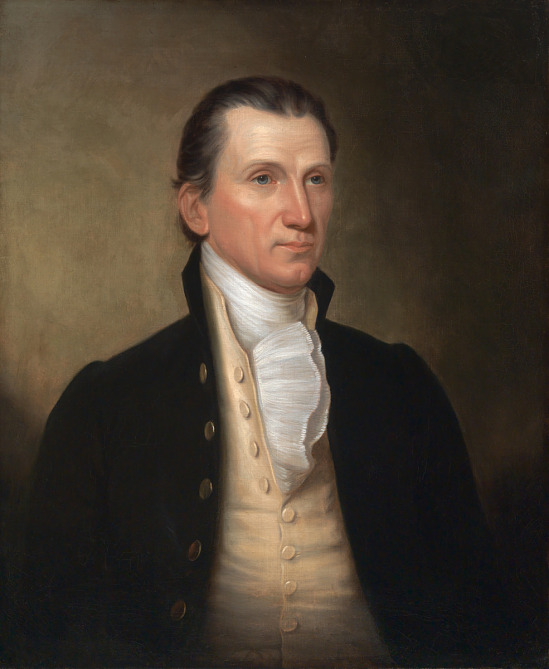
Monroe's administration was nearing its close as the nation approached its 50th anniversary. He would be out of office by April 1825, yet he wanted to do something celebratory before his departure. Inviting the last surviving Continental Army general to return to his adopted land seemed a fitting way to begin the celebration on his watch, to underscore the young republic's arrival on the world stage, and to rebuild patriotic fervor. Lafayette was beloved in America and a world-renowned figure for his leading role in two revolutionary movements.th Anniversary. He would be lawfully out of office by April 1825, yet he wanted to do something celebratory before his departure. Inviting the last surviving Continental Army general to return to his adopted land seemed a great way to begin the party on his watch, underscore the young republic's arrival on the world stage, and rebuild patriotic fervor. Lafayette was beloved in America and was a world-renowned figure for his lead role in two revolutionary movements.

The Plot Thickens
As I learned all this, I realized the tour was more than a feel-good event; it was a tool for both internal and external politics. This was pretty slick. Others thought so, too. Among them were the members of the Holy Alliance, a reactionary (and not so holy) pact among the Empire of Austria, the Kingdom of Prussia, and the Empire of Russia, aimed at curbing the spread of democracy and buttressing autocracy.
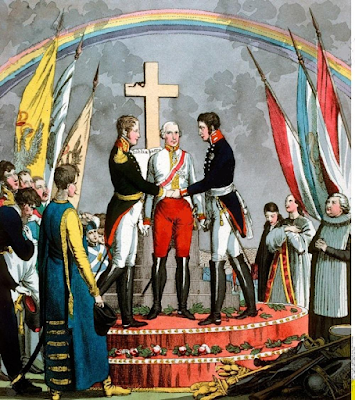
Of course, I built on this by creating the fictional subcommittee of the Holy Alliance, which I named the Aulic Council. The historical Aulic Council was an executive-judicial council for the Holy Roman Empire, active from the Late Middle Ages until Napoleon dissolved the Holy Roman Empire in 1806. I spin it into a Spectre-like organization run by villainous barons who answer to Austen Powers's Mr. Evil.

Protecting the Man
How does a country with no Secret Service or FBI and a small military scattered across coastal forts and western outposts protect a dignitary during a highly publicized series of events? That's the central theme of the tale. An eclectic mix of characters, both inside and outside government, come together with minimal help from federal and state governments. Catholic monks, diplomats, US naval officers, US Marines, the New York militia, and others all play a role in protecting the general. They call themselves The Lafayette Circle.

Boris and Natascha x Three
Three assassin teams, each consisting of one male and one female, are dispatched to seek out Lafayette and kill him. This is another eclectic cast of characters, intentionally evil yet, like the famed "nogoodnik" Boris Badanoff and his sultry sidekick Natasha in the Rocky and Bullwinkle Show, not entirely unlikeable. Their struggle to "acquire" their target as they roam early 19th-century America adds to the suspense.

Who's Your President?
The fact that one of the most controversial presidential contests in America's history took place in the middle of all this provided a subplot I could not resist. The events prove that the more things change, the more they stay the same, with backroom deals, fights for votes, and a "rigged election" that was also, curiously, legitimate. The events that deprived Andrew Jackson of the White House in the 1824 election are more obscure to most Americans than Julius Caesar's assassination, which at least was celebrated in a play by the Bard himself.

Yet the election took place during Lafayette's visit, and he was known to all the principals involved when the election was thrown to the House of Representatives for just the second time in America's history. Deals were struck, and John Quincy Adams went to the White House. The man with the most electoral votes went home to his estate, The Hermitage, outside Nashville. Lafayette would go out of his way to meet the war hero Jackson while Jackson was home, licking his wounds.

Companions
Lafayette's journey was captured by his personal secretary, Auguste Levasseur, who penned an account titled Lafayette en Amérique, en 1824 et 1825 ou Journal d'un voyage aux États-Unis. His son, Georges Washington Lafayette, also accompanied the general. Both appear in fictionalized scenes meant to move the plot along while revealing different sides of the great man. Likewise, Fanny Wright, a socialist activist (and Lafayette's purported mistress) from Scotland, who was some thirty years younger than Lafayette, accompanies him for part of the trip.

Glimpses
The novel includes several flashback sections—scenes meant to place Lafayette back in his youth, fighting in the American Revolution, leading the French Revolution, and dealing with the consequences of both. These are intended to give a bit of historical perspective to those uninformed about his role in those earlier significant events that shaped the Western world.

The Ordeal
I also attempted to offer a look at America and the world in 1824. Travel was by wind, steam, and horse. It was slow and steady, always an ordeal with hundreds of stops across a vast continent. Meetings with folks from all walks of life. Reminiscing with old comrades. Shaking thousands and thousands of hands around the clock. Lafayette's prodigious schedule of events and speeches was like a MAGA tour of the day and bound to take a toll on a man approaching seventy. Yet he did it with aplomb and graciousness. One has to ask why, and the answer is simple. Indeed, he loved America and what it stood for. But even more than that, he loved its people.


