The Militia General: Philemon Dickinson
The role of the militia during the fight for independence was uneven. For various reasons, militias were often unreliable and poorly equipped. But mostly, they lacked strong leadership. However, Philemon Dickinson stood out as a leader any Continental soldier would be proud to follow. Like the militia, Dickinson embodies understated service and quiet achievement. Unlike many militia units, Dickinson was consistently dependable. Like the militias he led, Dickinson always kept one eye on the home front.
 |
| Philemon Dickinson |
The Making of a Citizen
Philemon Dickinson was born at Crosiadore in Talbot County, Maryland, on April 5, 1739. As the son of a local judge, he was also the younger brother of fellow patriot and signer John Dickinson. After graduating from the College of Pennsylvania (now the University of Pennsylvania) in 1759, the younger Dickinson briefly worked as a clerk at his brother John’s law office. However, he soon left the profession and began managing their father’s estates. In 1767, he married Mary Cadwalader, a member of one of the area's most prominent families. The couple moved to a farm just outside Trenton, New Jersey.
 |
| Dickinson attended the College of Pennsylvania |
A Call to Arms
With a family involved in revolutionary politics, it was natural that Philemon would eventually take part alongside his older brother John. In 1775, he was offered a colonelcy in the Hunterdon County militia, and he quickly accepted. By October of the next year, he had been promoted to brigadier general and also served in the state’s provincial congress. During the Continental Army’s retreat across the Jerseys in 1776, Dickinson proved to be a valuable asset to the beleaguered George Washington. His performance under fire at Trenton in December 1776 was especially noteworthy. There, the tough militia general ordered his own house to be shelled during the heat of battle after learning it was an enemy command post.
 |
| The American attack on Trenton |
Kicking Off the Forage War
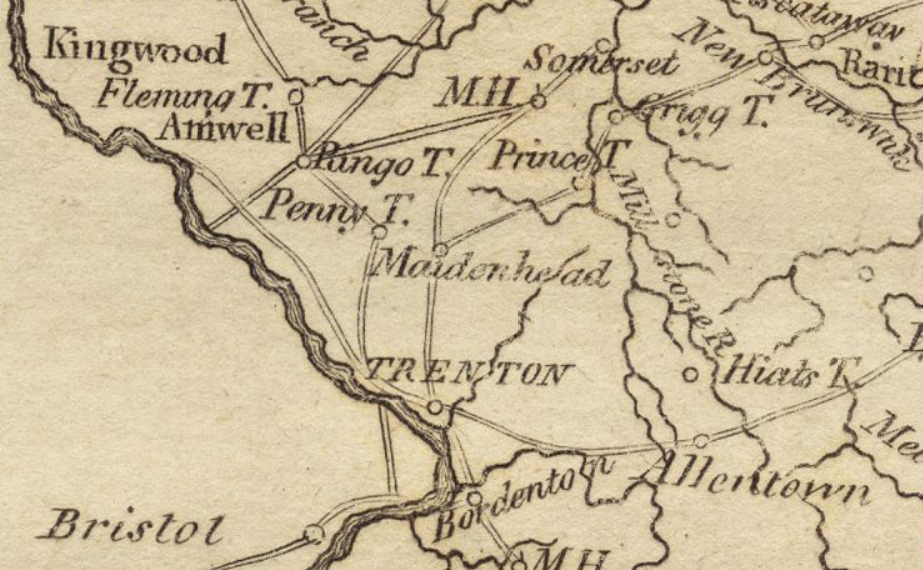
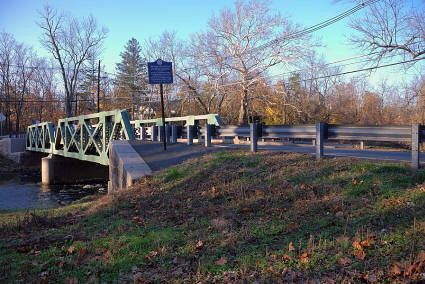
On January 20, 1777, Dickinson led a combined force of 350 Jersey militiamen and 50 Pennsylvania riflemen in a daring attack against a British foraging party of about 500 Regulars and Hessians. Dickinson divided his force into two groups. His brave men waded through the icy waist-deep Millstone River and ambushed the enemy during a running gun battle that forced them back to their base at New Brunswick. Dickinson’s men seized thirty-six supply wagons and over 100 horses. This was perhaps Dickinson’s most notable single battle where he was in overall command.
The bold assault sent shockwaves through the British command because, although they claimed it was a successful rearguard action, it proved that the militia was not going home for the winter. Instead, these citizen soldiers (along with some Continental troops) opted to stay and fight an enemy eager for “winter quarters.” The skirmish set the tone for a series of militia attacks, ambushes, and raids against the British foraging efforts in the Jerseys—known as the forage war. In June, Dickinson was promoted to Major General and appointed commander-in-chief of the New Jersey militia.
 |
| Jersey Militia and Pennsylvania Riflemen waded the icy Millstone River |
Militia General
In May 1778, he proved his skill as the New Jersey militia commander when his men repelled an attack on Trenton by British forces under Major John Maitland. The battle foreshadowed the British “retrograde” from the occupied American capital. His courage was tested again shortly after. Washington sent him and his militia to disrupt and block the British column when Sir Henry Clinton ordered a retreat from Philadelphia.
Most of the British Army had to march across New Jersey to reach safety in the highlands and the transports back to New York. Dickinson’s 800 men stayed ahead of the advancing column, cutting down trees and destroying bridges to slow its progress so Washington could attack from behind at the Battle of Monmouth on June 28.
 |
| The Jersey militia slowed the retrograde of the British Army leading to the American attack at Monmouth |
Crushing the Cabal
 |
| John Cadwalader |
A dedicated supporter of General Washington during one of the key political and military disputes of the war, the so-called Conway Cabal, Dickinson served as a second to his wife’s cousin, Pennsylvania General John Cadwalader. Cadwalader dueled with Franco-Irish General John Conway over the latter’s insulting remarks about George Washington.
In 18th-century dueling protocol, the Code Duello, the second played a crucial role in organizing, supporting, and sometimes participating in the duel. Clearly, Dickinson proved to be a loyal family member as well as a fierce supporter of his commander in chief. Cadwalader, for his part, won the duel—firing a pistol round into Conway’s mouth. The unlucky Conway survived and, in a twist, declared loyalty to Washington before resigning from the Continental Army.
 |
| John Conway's opposition to Washington led to a dual |
War’s Last Gasp in the Jerseys
The course of the war would soon turn south, but New Jersey’s proximity to New York made it a battleground for covert warfare and small-scale hit-and-run attacks. On June 23, 1780, the last battle in the North was fought at Springfield, New Jersey, where Dickinson played a key role in repelling the renowned Hessian general Wilhelm von Knyphausen.
 |
| The Battle of Springfield |
Soldier to Citizen
Remarkably, but not surprisingly, Dickinson also played a political role during his war years. As the action shifted to the Southern theater, he moved toward a less active form of public service. He ran for governor of New Jersey three times but was unsuccessful each time. However, in 1782, he became a member of the Continental Congress from 1782 to 1783.
Two years later, he served as vice president of the New Jersey state council. He was part of the commission to select a site for the national capital in 1784. When factions emerged, the dedicated Washington supporter aligned with the Federalists. In 1790, he was chosen to serve as a U.S. Senator from New Jersey, a position he held until 1793. Mary had died in 1791, but as was typical for the era, Dickinson remarried.
 |
| Dickinson retired to his estate near Trenton |
Always the model citizen-soldier, Philemon Dickinson eventually retired to his New Jersey estate, “the Hermitage," near Trenton in 1794. He died there on February 4, 1803, and was buried in the Friends Meeting House Burying Ground in Trenton.