Followers

Showing posts with label French Revolution. Show all posts

Saturday, November 30, 2024

Bold Breton

The American Revolution had more than its share of bold warriors and badasses—tough men who, once committed to a Cause, remained undaunted and steadfast. This first patriot is unique among them as he fought for two causes, although he would only succeed with one. Armand Charles Tuffin, Marquis de La Rouërie, was a son of Brittany, that ocean-washed corner of France that shared its heritage with the Britons across the sea.

Young Blood

Born to a noble Breton family in 1750, the Marquis went to Versailles at an early age and became an Ensign in the elite Garde Francaise, the Horse Guards, and earned a reputation as impetuous and hot-tempered nobleman—this among a society of impetuous and hot-tempered noblemen. His exploits included wooing a notorious young actress (unsuccessfully) and dueling (successfully) with the comte de Bourbon-Besset, a cousin of King Louis XVI, in 1775. The latter was, of course, over a woman and got him cashiered in disgrace (the Code Duello was forbidden).

King Louis XVI
 

A New Cause

His opponent lived and the young Marquis fled to an abbey in Brittany where he sought solace among the Trappist monks. At one point he tried to poison himself. Talked out of it by friends, he did the next best thing. He abandoned France for the American cause, which he had admired from afar. His journey began in a tempest when his ship, Morris, was pursued by three British frigates. Armand and the other officers and men fought their way into Chesapeake Bay. Rather than provide a prize ship to the British, they ran Morris aground, torched the vessel, and fled inland. A fiery start for a firebrand. It was April 1777.

Chesapeake Flight

A New Commission

Founder Robert Morris had penned a letter of recommendation to George Washington. The desperate nobleman trekked on foot to Philadelphia to deliver it and other correspondence from France to the Continental Congress.  The Marquis de La Rouërie was commissioned under the name Armand—the name he was known by to the Americans. He soon came to General George Washington’s notice and was authorized to raise a corps of eighty riflemen who would function as rangers. Most of the contingent were Germans, and Armand led them in their first combat at Short Hills, New Jersey, in June 1777. Armand’s rangers took horrific casualties, some thirty men, but boldly retrieved a captured cannon from the enemy. He was promoted to colonel for his exploits and proved his mettle a few months later at the Battle of Brandywine, where he took some sixty Hessian infantry prisoners.


Armand's Germans captured Hessian Infantry

Raising a Legion

His success granted him authority to raise a legion—independent units with a mix of infantry and cavalry called the “Free and Independent Chasseurs.”. Chasseur was the French word for hunter—something similar to riflemen or rangers in French military parlance. Armand was soon deploying his Chasseurs in guerilla warfare around New York City.

Armand's Legion

Night Raid in New York

One of Colonel Armand’s most significant exploits during this time was a daring night raid. His target, a notorious Loyalist officer Major Bearmore. A member of Delancey’s brigade, Bearmore was known for his harsh treatment of Whigs in Westchester. Working his way through Westchester and around the King’s Bridge, with 100 infantry and thirty horsemen, his “hunters” reached William’s Bridge undetected by a nearby regiment of Hessians. He left his infantry to provide security for their withdrawal and led twenty dragoons to Bearmore’s headquarters three miles south. At around nine o’clock, his men swept in, seizing Bearman and five others. Armand is said to have thrown Bearman’s six-foot frame across his saddle and galloped off with him. The legion returned with no losses.


New Theater, New Command

Upon the death of Continental cavalry commander General Count Casimir Pulaski at Savannah in October 1779, Armand’s Chasseurs were transferred to the Southern Department and merged with the remnants of Pulaski’s Legion aptly renamed Armand’s Legion. The year 1780 saw Armand’s Legion in action, notably at Camden, where he helped cover what he could of General Horatio Gates’s Army when it routed.

Casimir Pulaski


French Interlude

Armand sailed back to France in early 1781, where he received King Louis’s forgiveness and the Order of St. Louis. He used his time in France to support the Cause by raising funds and gathering supplies. Although brooding over the lack of promotion in the Continental Army, he returned to America in time to partake in the final major campaign against the British.

Order of St. Louis

The Road to Yorktown

 While he was in France Armand’s Legion had been sent north to Virginia where it was employed trying to check General (and traitor) Benedict Arnold’s raids across the Old Dominion. Although whittled down in number through battle losses and illness, Colonel Armand took command of the Legion as it entered the siege works around General Charles Cornwallis’s Army at Yorktown. Not wanting to be denied glory, he and a handful of his Legion joined Lieutenant Colonel Alexander Hamilton’s storming party at Redoubt Number 10. Armand was the first officer to breach the parapet and helped force the defenders to surrender. Commended for his bravery, Congress finally promoted Armand to brigadier general in 1782.

Storming Redoubt 10

Cavalry Commander

The war did not end for Armand with Yorktown’s fall in October 1781. Instead, he rode south at the head of the newly named 1st Partisan Corps to assist General Nathanael Greene’s campaign to sweep the British from South Carolina and Georgia. Forcing outposts into surrender and seizing towns and territory was crucial as the British strategy in Paris to bargain for possession of what they held. To that end, they failed, although it took scores of small engagements and lots of hard riding and marching to foil them.

Colonel Armand

Laurels at War’s End

Armand and his Legion were sent north and reached the New York area in December 1782. In March of the following year, Congress promoted the bold Breton to brigadier general. Brigadier General Armand was also named chief of all the Continental Army’s cavalry—a title that once belonged to Casimir Pulaski. The two would share the honorific, “Father of the Cavalry.”

Continental Dragoon


Home to Fame and Rebellion

Brigadier General Armand returned home a hero in 1784—not of the Lafayette caliber but highly celebrated. Settling back home in Brittany, he married a noblewoman (who got ill and died soon after) and threw himself into local politics—championing the liberties of his fellow Bretons. He joined several other Breton noblemen in a petition of Breton grievances to the King in 1787. He turned down a military command to protest the loss of Breton liberties. This snub of the monarch got him tossed from the Army and into the Bastille, the notorious prison whose storming was one of the sparks of the violence that would come during the French Revolution.

Storming the Bastille

French Revolution

He was released from prison and later attended the Estates General but soon became disenchanted as he saw even a revolutionary France as a threat to Breton rights. When France broke into revolution and chaos. Armand tried to stay above the fray. Most of it concerned Paris, not his home in Brittany. However, as the Jacobins seized power and began their excesses and repression, the Royalist and conservative Catholic western France rebelled against the rebellion. This area, known as the Vendee, stood up the revolutionaries of Paris and their anti-Catholic policies. Armand formed the Breton Association, which raised troops. When the Austrians and Prussians declared war on France in 1792, they were ready to join them with 10,000 men.
Vendee Resistance was Determined

Defiant Fugitive

But the French victory at Valmy sent the Austrians and Prussians reeling, and the French central government turned on the Vendee. Armand went on the run when revolutionary dragoons raided his estate. He wandered Brittany accompanied by a few faithful companions for the next year. One of his companions caught a fever, and it eventually spread to Armand, who died of pneumonia on 30 January 1793, right after reading of the execution of King Louis XVI by the revolutionary government.

Armand as Marquis de Rouërie in the Vendee


Sadly, our Colonel Armand has gone almost forgotten—a brave B Player in two revolutions separated by an ocean. But he was an A Player to the men he led and the foes he vanquished. And one must suppose he was an A Player in the hearts of those proud Bretons he led and inspired in the struggle for their liberties and their faith.


Tuesday, January 30, 2024

The Lafayette Circle

I have a tradition of writing a blog post about the "back story" of most of the books I write. With the release of The Lafayette Circle, it is time to do it again.

A Friend in Need

About a year ago, a Xavier High School classmate, Peter Reilly, reached out to me with a suggestion that I get involved in celebrating the upcoming 200th Anniversary of the Marquis de Lafayette's celebrated 1824 tour of America. Truth be told, I had never read about or heard of the event, so I was caught off guard. Peter, a CPA and contributor to Forbes.com and Think Outside The Tax Box, is also chair of the Massachusetts committee for the Bicentennial of Lafayette's Farewell Tour 2024-2025. I wondered how to respond.

Lafayette by Bryon Line


Maybe I could repost items about the upcoming celebration on my social media platforms. Or write a book about life in America in 1824? I knew quite a bit about Marie-Joseph-Paul-Yves-Roch-Gilbert du Motier, the Marquis de Lafayette, from my study of the American and French Revolutions, but little of the events after the fall of Napoleon in 1815. Most of what I remembered from that era came from Peter Neary's American History class when I attended Xavier High School in New York City—Jacksonian Democracy and all that.


Background

When in doubt, do some research. I started by rereading two legacy books on Lafayette from my library and immersing myself in a recently released biography. I also took the opportunity to join The Friends of Lafayette, and when I did, I got behind their paywall and found a trove of information about Lafayette's trip and the dynamics behind it. A review quickly led me to conclude that this was more than a feel-good junket—although it certainly was that, too.


A World in Upheaval

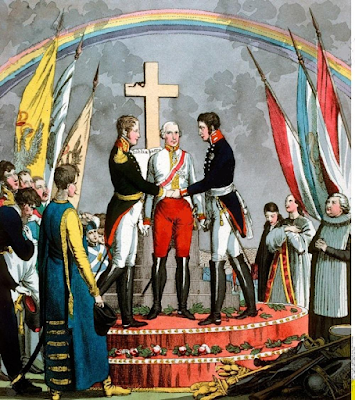
Although the Congress of Vienna, convened after Napoleon Bonaparte's abdication in 1814, set up a framework for a much-needed fifty years of peace among the European powers, the world itself was shaking from the movement of the tectonic plates of liberty. The Spanish colonies in America looked to North America and, to some extent, to revolutionary France as examples. Liberation movements, some long-simmering, began to erupt into rebellion and wars of liberation.


Congress of Vienna

Names like Simon Bolivar and Bernardo O'Higgins would become figures equal to George Washington throughout most of the continent to our south. In Spain itself, the newly formed Asturian battalion, one of ten organized to sail to America to suppress the wars of liberation, revolted, led by its commander, Rafael del Riego y Flórez.


Rafael del Riego y Flórez

Other regiments joined. The soldiers demanded a return to the 1812 Constitution. In March 1820, they surrounded the royal palace, and the king capitulated. A junta ruled Spain for several years until the autocrats of Europe pushed Royalist France to invade, restoring the king to his rightful place as an absolute monarch. Now, General de Riego was put on trial and hanged for treason.

Entry into Geopolitics

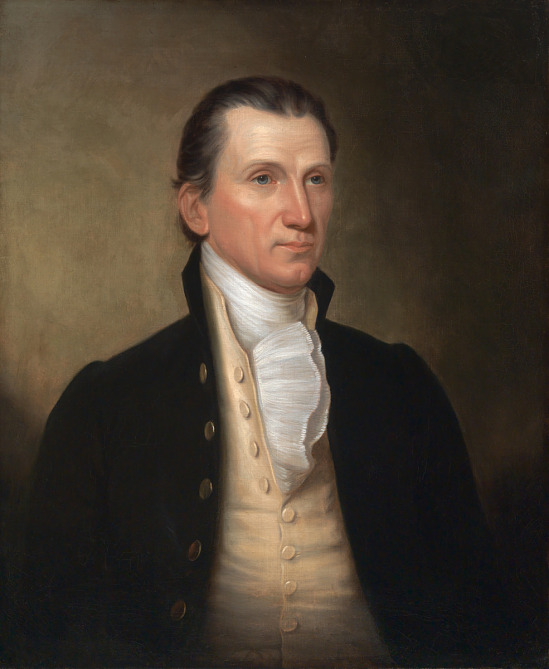
The long-isolationist United States grew concerned about the possibility of some European powers stepping into the void left by Spanish authority in the New World. Britain felt the same, especially fearing Russia's incursions from the North and threats to its holdings in South America and the West Indies. A suggestion for a joint declaration of the status quo ante in the New World resonated somewhat with President Monroe but not with the Secretary of State, John Quincy Adams. After all, two wars had been fought against Britain, one quite recently. America would render its own statement. Adams was the prime drafter of what became, many years later, known as The Monroe Doctrine.


James Monroe


A  Birthday Celebration—and More

Monroe's administration was nearing its close as the nation approached its 50th anniversary. He would be out of office by April 1825, yet he wanted to do something celebratory before his departure. Inviting the last surviving Continental Army general to return to his adopted land seemed a fitting way to begin the celebration on his watch, to underscore the young republic's arrival on the world stage, and to rebuild patriotic fervor. Lafayette was beloved in America and a world-renowned figure for his leading role in two revolutionary movements.th Anniversary. He would be lawfully out of office by April 1825, yet he wanted to do something celebratory before his departure. Inviting the last surviving Continental Army general to return to his adopted land seemed a great way to begin the party on his watch, underscore the young republic's arrival on the world stage, and rebuild patriotic fervor. Lafayette was beloved in America and was a world-renowned figure for his lead role in two revolutionary movements.


Lafayette in Winter


The Plot Thickens

As I learned all this, I realized the tour was more than a feel-good event; it was a tool for both internal and external politics. This was pretty slick. Others thought so, too. Among them were the members of the Holy Alliance, a reactionary (and not so holy) pact among the Empire of Austria, the Kingdom of Prussia, and the Empire of Russia, aimed at curbing the spread of democracy and buttressing autocracy.


Holy Alliance?

Of course, I built on this by creating the fictional subcommittee of the Holy Alliance, which I named the Aulic Council. The historical Aulic Council was an executive-judicial council for the Holy Roman Empire, active from the Late Middle Ages until Napoleon dissolved the Holy Roman Empire in 1806. I spin it into a Spectre-like organization run by villainous barons who answer to Austen Powers's Mr. Evil.


Mister Evil

Protecting the Man

How does a country with no Secret Service or FBI and a small military scattered across coastal forts and western outposts protect a dignitary during a highly publicized series of events? That's the central theme of the tale. An eclectic mix of characters, both inside and outside government, come together with minimal help from federal and state governments. Catholic monks, diplomats, US naval officers, US Marines, the New York militia, and others all play a role in protecting the general. They call themselves The Lafayette Circle. 


New York Militia Guarding Lafayette

Boris and Natascha x Three

Three assassin teams, each consisting of one male and one female, are dispatched to seek out Lafayette and kill him. This is another eclectic cast of characters, intentionally evil yet, like the famed "nogoodnik" Boris Badanoff and his sultry sidekick Natasha in the Rocky and Bullwinkle Show, not entirely unlikeable. Their struggle to "acquire" their target as they roam early 19th-century America adds to the suspense.


Boris and Natasha

Who's Your President?

The fact that one of the most controversial presidential contests in America's history took place in the middle of all this provided a subplot I could not resist. The events prove that the more things change, the more they stay the same, with backroom deals, fights for votes, and a "rigged election" that was also, curiously, legitimate. The events that deprived Andrew Jackson of the White House in the 1824 election are more obscure to most Americans than Julius Caesar's assassination, which at least was celebrated in a play by the Bard himself. 


1824 Election was Controversial

Yet the election took place during Lafayette's visit, and he was known to all the principals involved when the election was thrown to the House of Representatives for just the second time in America's history. Deals were struck, and John Quincy Adams went to the White House. The man with the most electoral votes went home to his estate, The Hermitage, outside Nashville. Lafayette would go out of his way to meet the war hero Jackson while Jackson was home, licking his wounds.


The Hermitage

Companions

Lafayette's journey was captured by his personal secretary, Auguste Levasseur, who penned an account titled Lafayette en Amérique, en 1824 et 1825 ou Journal d'un voyage aux États-Unis. His son, Georges Washington Lafayette, also accompanied the general. Both appear in fictionalized scenes meant to move the plot along while revealing different sides of the great man. Likewise, Fanny Wright, a socialist activist (and Lafayette's purported mistress) from Scotland, who was some thirty years younger than Lafayette, accompanies him for part of the trip.


Frances "Fanny" Wright

Glimpses

The novel includes several flashback sections—scenes meant to place Lafayette back in his youth, fighting in the American Revolution, leading the French Revolution, and dealing with the consequences of both. These are intended to give a bit of historical perspective to those uninformed about his role in those earlier significant events that shaped the Western world.


Flashback: Lafayette's wounding at Brandywine 1777

The Ordeal

I also attempted to offer a look at America and the world in 1824. Travel was by wind, steam, and horse. It was slow and steady, always an ordeal with hundreds of stops across a vast continent. Meetings with folks from all walks of life. Reminiscing with old comrades. Shaking thousands and thousands of hands around the clock. Lafayette's prodigious schedule of events and speeches was like a MAGA tour of the day and bound to take a toll on a man approaching seventy. Yet he did it with aplomb and graciousness. One has to ask why, and the answer is simple. Indeed, he loved America and what it stood for. But even more than that, he loved its people.


The Lafayette Circle is available now!


Sunday, November 11, 2018

The Prediction


The French Connection


Most people know that Marie-Joseph Paul Yves Roch Gilbert du Motier, Marquis de Lafayette, known in the United States simply as Lafayette, was a 19-year-old French aristocrat and military officer who fought in the American Revolutionary War, leading American troops in several battles, including the Siege of Yorktown.


Lafayette leading troops at Yorktown


 Reform, Revolution & Chaos in France


The young general and confidant of General George Washington later returned to France, where he played a crucial and tragic role in his own country's revolution. Lafayette led the original reform movement and remained committed, hoping to act as a moderate influence as the French shifted to the left and violence entered the political scene. He commanded the National Guard and the French Army when his country was invaded. Ultimately, Lafayette and his family became caught up in the Reign of Terror in Paris in 1792. Accused of treason, he fled to the Austrian Netherlands (Belgium), where Austrian troops captured him, and he spent over five years in prison.


Marie Adrienne Francoise de Noailles,
Lafayette's wife


Meanwhile, his wife, Adrienne, was imprisoned in Paris, held by the revolution's Committee of Public Safety. There, she and her daughter waited in fear as the Reign of Terror sent thousands of her fellow nobles (and others) to the guillotine. In fact, Adrienne’s mother, grandmother, and sister were all executed during the bloodbath in the name of Liberty, Equality, and Fraternity.


The Reign of Terror stained the revolutionary cause
and the streets of Paris


Elizabeth Monroe
future First Lady
In 1794, his former comrade in arms and future American president, James Monroe, became the American Minister to France. Monroe and his wife, Elizabeth, arranged for a carriage so that Elizabeth could ride to the prison, where she managed to meet and embrace Adrienne in front of a crowd of Parisians. The emotional event compelled the Committee of Public Safety to grant Adrienne’s freedom, and she and her daughter traveled to Austria to be with Lafayette. He remained there under dire conditions until Napoleon Bonaparte secured his release in 1797. However, upon his return to France, Lafayette refused to support Napoleon's government and lived as a private citizen until the restoration government, during which he served as a member of the Chamber of Deputies. On Christmas Eve in 1807, Adrienne died from illness.

The Return of Lafayette


Samuel Morse
(telegraph inventor)
portrait of Lafayette 
By 1824, Lafayette was the last surviving French general of the American Revolutionary War. As he neared his own "evening parade," he toured the 24 states of the United States from July 1824 to September 1825. This was his first return trip since the American Revolution. The people greeted the former Continental Army general with a hero's welcome at many stops, and numerous honors and monuments were given to commemorate and memorialize this visit. On New Year’s Day in 1825, Congress held a dinner in honor of the hero. At the event, Lafayette responded to the warm words and gestures of his American hosts with a toast that foreshadowed the future: “The perpetual union of the United States: It has always saved us in time of storm; one day it will save the World.” He might have added, "and France twice..."


NYC parade honoring Lafayette was one of many across the new nation


We are Here


Almost a century after the Marquis celebrated the power of the nation he helped establish, Charles E. Stanton, the nephew of Lincoln's Secretary of War, Edwin Stanton, took the Marquis's vision seriously. Stanton, a career Army officer, arrived in France as an aide to General John J. Pershing during World War I. They were on a secret mission to start planning for the arrival and training of the American Expeditionary Force. After three years of observing from the sidelines, America declared war on the German Empire and its allies.


President Wilson asked Congress to declare war
on Imperial Germany in April 1917


On July 4, 1917, Stanton, serving on John J. Pershing's staff, visited Lafayettes tomb and said, "Lafayette, we are here!" to honor the nobleman's help during the Revolutionary War and to assure the French people that the United States would support them in World War I. Stanton’s remarks were initially attributed to Pershing because the press was under strict censorship that banned printing the name and location of any U.S. soldier in Europe, with the only exception being General Pershing.


Charles Stanton is third from the left in the photo
Pershing is at the forefront facing

The Prediction


Lafayette's toast predicting his adopted land's role in saving the world is more than just a polite acknowledgment. By the early 19th century, the growth and potential power of the new nation were widely recognized. Lafayette's dedication to the country's fundamental goodness and its possibilities gave him every reason to make such a bold statement. As it turned out, his faith in his adopted country was more than a wise gamble.


Lafayette