Followers

Showing posts with label Marquis de Lafayette. Show all posts

Wednesday, May 29, 2024

The Enslaved Spy

 A Secret Meeting

James Armistead stood before Lafayette in tattered work clothes and a ragged jacket. Months earlier, he had offered his services to the Continental Army and became a spy in the traitorous Benedict Arnold’s camp. His secret reports enabled Lafayette to wage a brilliant campaign to check, if not repulse, the renegade Arnold, now a Brevet Brigadier General in British employ.


Lafayette and Armistead

“Is spying on Lord Cornwallis the same as spying on Arnold?”

Armistead’s coal-black eyes flashed. “It’s always more satisfying to deceive a deceiver, sir.”

Lafayette smiled mischievously. “Well put, Monsieur Armistead.”

“Sir, it’s better if you just call me Junius.” His eyes shifted left and right. “You know, just in case.”

The comment impressed Lafayette, and he nodded in agreement. He eyed the papers Armistead had drawn up. The spy’s reports were always concise and precise. “Are you sure of this, Junius?”

“Indeed, sir. If you move forces to that position at that time, you will deny General Cornwallis his last chance of reinforcement and, more importantly, replenishment. His men also suffer miserably from lack of food and other vitals. Even their officers mumble about it.”

Lafayette nodded. “How fitting, as the Americans have gone all these years of struggle on empty bellies and wearing….” He paused as he eyed the rags on Armistead’s back. “Insufficient clothing.”

“It will be dark soon. I must return as soon as I have the cover of the night.”

Lafayette eyed the man with wonder. “You have risked your neck for many months. That is commendable enough for any man, but for a slave, it is a thing of wonder.”

“I believe in the cause and that I will justly earn my liberty.”

Lafayette’s head moved slowly from side to side. “I truly hope so.”

Enslaved Spy

The above excerpt from my novel, The Lafayette Circle, is a fictionalized event. Still, it portrays the actual derring-do of a man whose commitment and courage transcended his race, his welfare, and his bondage. Just who was this man? James Armistead was a slave owned by one Wallace Armistead of New Kent County, Virginia. Born on his master’s plantation, little is known of Armistead’s early years. Even his birth year is debated—estimates range anywhere between 1746 and 1760.


Area of Armistead's Birth and Yorktown Campaign

In 1781, the Marquis de Lafayette was leading American forces near Yorktown, where the British commander, Major General Charles Cornwallis, and his Army had dug in. The Franco-American forces were enroute. It was Lafayette’s task to prevent Cornwallis from escaping the cauldron he was soon to be in. When young James Armistead received permission from Wallace to join the American Army, it was with the proviso he would remain a slave after his service.

Lafayette’s Agent

Lafayette, a champion of emancipation, might have had other ideas, but he needed the services of the young man who knew the area—he needed a spy. Since the British emancipated escaped slaves, that became Armistead’s cover story when he entered the British camp as Juniper, the runaway. His task initially was to courier intelligence from spies behind British lines. When they learned he belonged to a local planter, the British took no heed of the young black man.


British camp at Yorktown


Armistead’s race and status as an enslaved person were perfect—his lowly position enabled him to slip in and out of both sides' camps without drawing attention. His knowledge of the land helped him to avoid detection when needed and find the best routes to travel. The unsuspecting British paid him no heed as he ambled through the camp, listening to conversations.


Benedict Arnold


Slipping out of camp, he would bring Lafayette details on British plans, capabilities, and, most of all, the state of their morale. The British trusted him. At one point,  the traitor Benedict Arnold tasked Armistead to gather information directly from Lafayette’s headquarters. By the height of the Yorktown campaign, Arnold had gone back to New York. Cornwallis was holed up in the port on the York River, hoping for reinforcements from General Henry Clinton, the British commander-in-chief.

Double Agent

As the stakes grew higher, Cornwallis grew desperate and decided to use him to spy on the Americans, tasking him to bring back information on American troop strength and movements. Armistead was now a double agent, playing the dangerous game in the espionage business. Of course, he reported right to Lafayette, who decided to use the opportunity to deceive his opponent—a classic use of a double agent.


Major General Charles Cornwallis

Deception

Lafayette scribbled a letter to American general Daniel Morgan, citing completely bogus units. After crumpling it up and rubbing some dirt on it, Armistead tucked it in his jacket and took off. Once in the British camp, he told the officers questioning him that he had observed American regiments marching and was returning with the “intelligence” when he found the paper on the road. Explaining he could not read it but took it just in case it might prove of value. Upon reading the note, the British were impressed with the intel coup.


Armistead's note fooled the British


Armistead’s daring had helped Lafayette pull off a high-stakes deception—the appearance of new units kept them on the defensive. The British would soon face the combined Franco-American forces and capitulate at Yorktown on 19 October 1781.


Yorktown Surrender


An unlikely postscript written years later (in the 19th century, in fact) puts Armitage at a post-surrender dinner where General Washington hosted Cornwallis. The vanquished British general is said to have remarked. “Ah, you rogue, you have been playing me a trick all this time!”

Struggle for Freedom

James Armistead’s post-war fate was a sad reminder of the cruelty of slavery and the law. The Virginia Emancipation Act of 1783 granted manumission to slaves who rendered considerable military service to the cause. In a cruel twist of fate, Armistead’s service as a spy was not deemed military service, and thus, he remained the property of Wallace. As egregious as this seems, one needs to remember that a spy was considered contemptible and spying dishonorable to the eighteenth-century mind.


James Lafayette Armistead

However, the good angels finally intervened when General Lafayette endorsed James Armistead’s petition for freedom to the Virginia Assembly, which they granted in 1787. To honor the man who came to his aid, James, on manumission, officially changed his name to James Armistead Lafayette.


Lafayette's letter helped bring freedom

Freedom and Friendship

The freeman James Armistead Lafayette purchased land in New Kent County. Eventually, he married and had children. Like so many other veterans of war, he fought a long-standing battle to gain a pension, which he finally received in 1819. When General Lafayette made his celebrated tour of America in 1824, he acknowledged Armistead at the Yorktown commemoration. Before the assembled crowd, the spymaster embraced the spy—a unique event and a fitting recognition for the former slave’s bravery and resourceful service to the Glorious Cause.


Yorktown Victory Monument


Tuesday, January 30, 2024

The Lafayette Circle

I have a tradition of writing a blog post about the "back story" of most of the books I write. With the release of The Lafayette Circle, it is time to do it again.

A Friend in Need

About a year ago, a Xavier High School classmate, Peter Reilly, reached out to me with a suggestion that I get involved in celebrating the upcoming 200th Anniversary of the Marquis de Lafayette's celebrated 1824 tour of America. Truth be told, I had never read about or heard of the event, so I was caught off guard. Peter, a CPA and contributor to Forbes.com and Think Outside The Tax Box, is also chair of the Massachusetts committee for the Bicentennial of Lafayette's Farewell Tour 2024-2025. I wondered how to respond.

Lafayette by Bryon Line


Maybe I could repost items about the upcoming celebration on my social media platforms. Or write a book about life in America in 1824? I knew quite a bit about Marie-Joseph-Paul-Yves-Roch-Gilbert du Motier, the Marquis de Lafayette, from my study of the American and French Revolutions, but little of the events after the fall of Napoleon in 1815. Most of what I remembered from that era came from Peter Neary's American History class when I attended Xavier High School in New York City—Jacksonian Democracy and all that.


Background

When in doubt, do some research. I started by rereading two legacy books on Lafayette from my library and immersing myself in a recently released biography. I also took the opportunity to join The Friends of Lafayette, and when I did, I got behind their paywall and found a trove of information about Lafayette's trip and the dynamics behind it. A review quickly led me to conclude that this was more than a feel-good junket—although it certainly was that, too.


A World in Upheaval

Although the Congress of Vienna, convened after Napoleon Bonaparte's abdication in 1814, set up a framework for a much-needed fifty years of peace among the European powers, the world itself was shaking from the movement of the tectonic plates of liberty. The Spanish colonies in America looked to North America and, to some extent, to revolutionary France as examples. Liberation movements, some long-simmering, began to erupt into rebellion and wars of liberation.


Congress of Vienna

Names like Simon Bolivar and Bernardo O'Higgins would become figures equal to George Washington throughout most of the continent to our south. In Spain itself, the newly formed Asturian battalion, one of ten organized to sail to America to suppress the wars of liberation, revolted, led by its commander, Rafael del Riego y Flórez.


Rafael del Riego y Flórez

Other regiments joined. The soldiers demanded a return to the 1812 Constitution. In March 1820, they surrounded the royal palace, and the king capitulated. A junta ruled Spain for several years until the autocrats of Europe pushed Royalist France to invade, restoring the king to his rightful place as an absolute monarch. Now, General de Riego was put on trial and hanged for treason.

Entry into Geopolitics

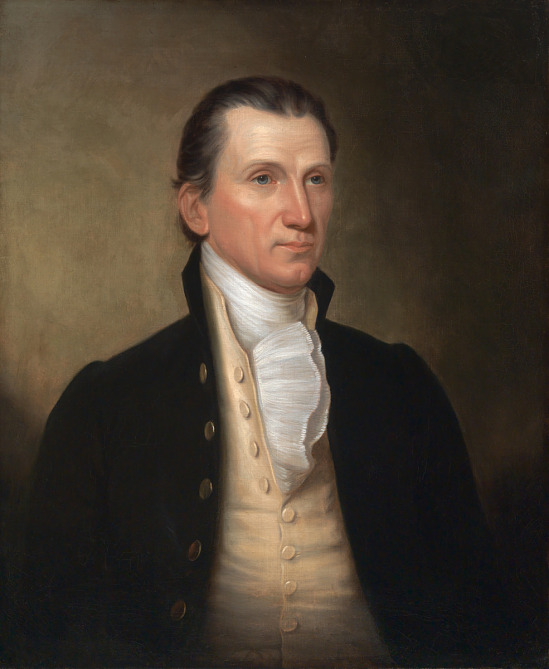
The long-isolationist United States grew concerned about the possibility of some European powers stepping into the void left by Spanish authority in the New World. Britain felt the same, especially fearing Russia's incursions from the North and threats to its holdings in South America and the West Indies. A suggestion for a joint declaration of the status quo ante in the New World resonated somewhat with President Monroe but not with the Secretary of State, John Quincy Adams. After all, two wars had been fought against Britain, one quite recently. America would render its own statement. Adams was the prime drafter of what became, many years later, known as The Monroe Doctrine.


James Monroe


A  Birthday Celebration—and More

Monroe's administration was nearing its close as the nation approached its 50th anniversary. He would be out of office by April 1825, yet he wanted to do something celebratory before his departure. Inviting the last surviving Continental Army general to return to his adopted land seemed a fitting way to begin the celebration on his watch, to underscore the young republic's arrival on the world stage, and to rebuild patriotic fervor. Lafayette was beloved in America and a world-renowned figure for his leading role in two revolutionary movements.th Anniversary. He would be lawfully out of office by April 1825, yet he wanted to do something celebratory before his departure. Inviting the last surviving Continental Army general to return to his adopted land seemed a great way to begin the party on his watch, underscore the young republic's arrival on the world stage, and rebuild patriotic fervor. Lafayette was beloved in America and was a world-renowned figure for his lead role in two revolutionary movements.


Lafayette in Winter


The Plot Thickens

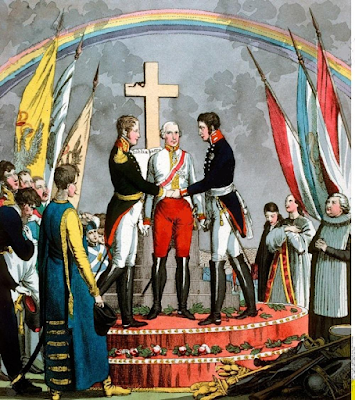
As I learned all this, I realized the tour was more than a feel-good event; it was a tool for both internal and external politics. This was pretty slick. Others thought so, too. Among them were the members of the Holy Alliance, a reactionary (and not so holy) pact among the Empire of Austria, the Kingdom of Prussia, and the Empire of Russia, aimed at curbing the spread of democracy and buttressing autocracy.


Holy Alliance?

Of course, I built on this by creating the fictional subcommittee of the Holy Alliance, which I named the Aulic Council. The historical Aulic Council was an executive-judicial council for the Holy Roman Empire, active from the Late Middle Ages until Napoleon dissolved the Holy Roman Empire in 1806. I spin it into a Spectre-like organization run by villainous barons who answer to Austen Powers's Mr. Evil.


Mister Evil

Protecting the Man

How does a country with no Secret Service or FBI and a small military scattered across coastal forts and western outposts protect a dignitary during a highly publicized series of events? That's the central theme of the tale. An eclectic mix of characters, both inside and outside government, come together with minimal help from federal and state governments. Catholic monks, diplomats, US naval officers, US Marines, the New York militia, and others all play a role in protecting the general. They call themselves The Lafayette Circle. 


New York Militia Guarding Lafayette

Boris and Natascha x Three

Three assassin teams, each consisting of one male and one female, are dispatched to seek out Lafayette and kill him. This is another eclectic cast of characters, intentionally evil yet, like the famed "nogoodnik" Boris Badanoff and his sultry sidekick Natasha in the Rocky and Bullwinkle Show, not entirely unlikeable. Their struggle to "acquire" their target as they roam early 19th-century America adds to the suspense.


Boris and Natasha

Who's Your President?

The fact that one of the most controversial presidential contests in America's history took place in the middle of all this provided a subplot I could not resist. The events prove that the more things change, the more they stay the same, with backroom deals, fights for votes, and a "rigged election" that was also, curiously, legitimate. The events that deprived Andrew Jackson of the White House in the 1824 election are more obscure to most Americans than Julius Caesar's assassination, which at least was celebrated in a play by the Bard himself. 


1824 Election was Controversial

Yet the election took place during Lafayette's visit, and he was known to all the principals involved when the election was thrown to the House of Representatives for just the second time in America's history. Deals were struck, and John Quincy Adams went to the White House. The man with the most electoral votes went home to his estate, The Hermitage, outside Nashville. Lafayette would go out of his way to meet the war hero Jackson while Jackson was home, licking his wounds.


The Hermitage

Companions

Lafayette's journey was captured by his personal secretary, Auguste Levasseur, who penned an account titled Lafayette en Amérique, en 1824 et 1825 ou Journal d'un voyage aux États-Unis. His son, Georges Washington Lafayette, also accompanied the general. Both appear in fictionalized scenes meant to move the plot along while revealing different sides of the great man. Likewise, Fanny Wright, a socialist activist (and Lafayette's purported mistress) from Scotland, who was some thirty years younger than Lafayette, accompanies him for part of the trip.


Frances "Fanny" Wright

Glimpses

The novel includes several flashback sections—scenes meant to place Lafayette back in his youth, fighting in the American Revolution, leading the French Revolution, and dealing with the consequences of both. These are intended to give a bit of historical perspective to those uninformed about his role in those earlier significant events that shaped the Western world.


Flashback: Lafayette's wounding at Brandywine 1777

The Ordeal

I also attempted to offer a look at America and the world in 1824. Travel was by wind, steam, and horse. It was slow and steady, always an ordeal with hundreds of stops across a vast continent. Meetings with folks from all walks of life. Reminiscing with old comrades. Shaking thousands and thousands of hands around the clock. Lafayette's prodigious schedule of events and speeches was like a MAGA tour of the day and bound to take a toll on a man approaching seventy. Yet he did it with aplomb and graciousness. One has to ask why, and the answer is simple. Indeed, he loved America and what it stood for. But even more than that, he loved its people.


The Lafayette Circle is available now!


Monday, October 30, 2023

Noble Patriot

 Noble Patriot

The American War for Independence gained the attention of all the European powers, and even the nobility and royalty were, at least initially, enthralled by it as the embodiment of the ideals of The Age of Reason. It did not take long before many of the nobility and upper class were scrambling to join the effort to secure liberty. Soon, names like Steuben, Kosciusko, de Kalb, and Pulaski joined the ranks of the Continental Army. Each made his mark in the Glorious Cause, but none so much as Marie-Joseph-Paul-Yves-Roch-Gilbert du Motier, Marquis de Lafayette.

Major General Lafayette


Old Blood, Old Money

Lafayette was born into one of the oldest families in France's aristocracy on 6 September 1757. The young Lafayette had a troubled youth despite a rich lineage, wealth, and privilege. His father, Michel de Lafayette, was struck by a cannonball fighting the British at the Battle of Minden, leaving him an orphan and marquis at two. As was typical of his class, Lafayette was commissioned into a French royal musketeer regiment at thirteen. However, his actual leadership experience was limited to parade and garrison duties when not partaking of the pleasures at court.

Lafayette senior fell at Minden

He was early on engaged to Marie Adrienne Françoise, the daughter of a powerful Duc d'Ayen, whom he married at sixteen (she was two years younger). The arranged match also proved a love match, and despite many trials and tribulations, the pair stayed together until she died in 1807. In 1776, the young marquis received a commission as a captain of dragoons, which should have begun his climb up the French military hierarchy, but for events across the ocean.

A Young Idealist

Lafayette was well-read in the classics and the principles of the Enlightenment, and from an early age, hoped to make a difference for mankind. By 1776, the political friction in America had erupted into open rebellion against the King of England. Like so many others, he followed the events with interest. Unlike so many others, he decided to act on his principles, which he saw enshrined in the sentiments of The Declaration of Independence — he determined to throw his lot in with the Americans and strike a blow for liberty. Equality and fraternity would have to wait, however.

The Declaration of Independence inspired Lafayette 


An American Agent

But what to do? Silas Deane, an American politician from Connecticut, represented the American Continental Congress in Paris — in effect, he was an American agent. Many European officers approached Deane to solicit commissions in the Continental Army. Deane's job was to screen them and make referrals of those with bona fide military experience or who provided some other advantage to the American cause. Lafayette's youth and inexperience would have usually precluded a referral, but his pedigree and connections at court, combined with his evident enthusiasm, got him a referral.

Silas Deane


Outlaw

Lafayette's family, especially his powerful father-in-law, objected to the move. As did his wife. She was pregnant. Influenced by the Duc d'Ayen, the government also refused permission for Lafayette to travel, expressly forbidding it. At the time, Deane was negotiating secret assistance from the French government and overt support. The presence of such a nobleman fighting for America would alarm the British. But the headstrong idealist bucked authority and managed to sneak into Spain, where he eventually boarded the ship Victoire, loaded with ordnance for the American cause. King Louis XVI subsequently declared him an outlaw. How much of this was actual pique at his disobedience or to throw off the British is hard to say, but likely both.

Lafayette escaped France via a subterfuge

Coming to America

The nineteen-year-old marquis landed in South Carolina in 1777, accompanied by several officers, including Baron Johann de Kalb, a French nobleman who would give his life for the American cause. He then traveled to Philadelphia to claim his promised commission as a major general. Congress hesitated due to his youth and inexperience. Major general was the army's highest rank at the time, and only a few were serving, but because of his connections, they finally appointed him — without command.

Johann de Kalb


Meeting His Excellency

Lafayette met Washington for the first time at a reception held in Philadelphia in August 1777 when the commander-in-chief came to the capital to consult with Congress on military matters. The two shook hands in the receiving line and then met privately — bonding almost immediately. Washington was impressed by his enthusiasm and military bearing. He returned to camp with Washington, but his status was still unclear. Lafayette still expected a field command. Was his commission actual or honorary? Washington took him into his "military family" and made him a sort of senior advisor.

Meeting with Washington

First Battle, First Blood, First Winter

The youthful general's mettle was tested the following month at the Battle of Brandywine, where Lafayette received a leg wound while helping rally a regiment fleeing the field. His mentor was pleased. His gallantry earned him a small command. In late  November, he led a detachment of 300 infantry in a skirmish against a large force of the vaunted Hessians at Gloucester, New Jersey — repulsing the Germans. His enthusiasm and energy throughout the harsh winter quarters at Valley Forge and his willingness to suffer along with the rest of the army further endeared him to Washington. A father-son relationship had developed. The childless Washington and fatherless Lafayette had a unique bond.

Wounded at Brandywine

Warmth of Spring

As winter ebbed, the sun's rays warmed the earth, and both the Continental and British forces uncoiled from hibernation and began to stir. Lord George Germain had recalled General William Howe to London to be replaced by his number two, General Henry Clinton. A new strategy was in motion, and Germain ordered Clinton to abandon Philadelphia for the security of New York, as a chunk of his troops were being sent to protect British interests in the West Indies.

Major General William Howe


Aware of upcoming changes, General Washington sent with an even larger command, a division of 2,000 troops and five guns, to observe British movements in and out of Philadelphia. Lafayette deployed his division in the vicinity of Barren Hills, Pennsylvania. Howe had not yet departed and decided to thrash the upstart Frenchman before he left. He dispatched the formidable General James Grant with 5,000 men and fifteen guns to entrap Lafayette. A three-pronged maneuver by Grant had British and Hessian columns on three sides of Lafayette's command, but he saw the trap about to be sprung and wisely slipped away via a road he knew would evade British observation.

British grenadiers advancing at Barren Hills

Lafayette's ability to quickly assess a tactical situation maneuver to safety pleased Washington, who entrusted him with a more significant command the following month. By the end of June 1778, Howe was gone, and Clinton led the bulk of his army overland to NewYork, crossing the hot, humid fields of New Jersey with the Continental Army following. 

Foul Up and Success at Monmouth

At Monmouth Court House, the British paused for a rest. Not ready to commit to an all-out attack, Washington agreed to send a  force to strike Clinton's rear guard. When his second in command, General Charles Lee, demurred from leading the attack, Lafayette offered his services. Wahington accepted the offer, but the wily Lee decided he wanted the command after all and marched off with Lafayette.

Washington at Monmouth


When the Americans launched their attack, the British, rather than retreat as was hoped, turned and fought, then when reinforced, the British rear guard counterattacked. Faced with a stiff fight, Lee gave conflicting orders, causing chaos in the American ranks. Seeing the American line crumbling and confusion growing, Lafayette sent a message to Washington to urge him to ride forward and take command. Washington was incensed when he arrived and began rallying the troops and relieved Lee of command (in a famous confrontation). The line steadied, and the Continental Army fought toe toe-to-toe with the Britsh, the swirl of combat ending at dark with both sides sleeping on the line. The following day, Lafayette rose and awakened Washington. As the two generals peered across the misty fields at dawn, the Britsh had retreated.

Summer in Newport

Lafayette was given command of two brigades as part of General John Sullivan's hapless expedition to Rhode Island that summer. The taking of the vital port hinged on cooperation with the naval forces of France's admiral Charles-Hector Theodat, comte d'Estaing. One of Lafayette's tasks was to convince the obstinate d'Estaing to support the American effort, but d'Estaing demurred. On 9 August, Sullivan's land forces attacked the British without d'Estaing, who refused to place his ships in Narragansett Bay. A storm struck, scattering the French and British fleets, and the land force attack failed. Sullivan's northern army withdrew, with Lafayette playing a pivotal role in keeping it an orderly retreat.

Admiral d'Estaing


 Home for the Holidays

In January 1779, the young marquis went on furlough, returning to France to advocate for wider French involvement in the war. Lafayette was initially arrested after landing on French soil, but the king quickly pardoned him. He was received in Paris as a hero, a sort of rock star — King Louis actually promoted him to colonel in the French Army. 

Louis XVI


Things were different with France and Spain openly at war with Britain. Lafayette proposed a joint invasion of Britain with him in command. However, the Spanish ships did not arrive until August, and a British fleet of fast ships complicated the plan, which was eventually abandoned. 

The Francp-Spanish  naval invasion of Britain was canceled

So, Lafayette refocused on gaining more support for the American cause, collaborating with American Commissioner Benjamin Franklin to arrange French troops for North America. He also refocused on his family, and in December, Adrienne gave birth to a son, whom he proudly named George Washington Lafayette. 

Benjamin Franklin

Meanwhile, the king had agreed to send more forces to America. He dispatched Lafayette to return with news of General Jean-Baptiste,comte de Rochambeau's impending arrival with some 6,000 men. Lafayette dutifully sailed from Rochefort to America aboard the frigate Hermione, arriving in Boston on 27 April 1780.

Fighting for Liberty

Washington, the commander-in-chief of both nation's forces, used Lafayette as a high-level liaison between Rochambeau and himself. Little was accomplished during the remainder of 1780. Washington and Rochambeau's forces postured while the generals pondered and planned. Most of the fighting was taking place in the Carolinas, where the British launched a successful invasion but then got tied down, trying to hold on to what they grabbed. 

General Rochambeau


But by 1781, trouble and opportunity beckoned in the warmer climes of Virginia when General Charles Cornwallis marched north from the Carolinas to establish firm British control over the Old Dominion in a desperate ploy to reshape the balance of power. British forces under Generals William Phillips and Benedict Arnold ( the same) based out of Portsmouth had advanced as far as the new capital in Richmond and raided as far as Charlottesville. 

British Brigadier General Benedict Arnold


General Friedrich von Steuben's small detachment of Virginia militia did what they could to block and harass. Still, it was not enough, and now the impending arrival of another army from the Carolinas put von Steuben and Washington's home state at grave risk. 

The Old Dominion

But with risk came opportunity. So, in response, Washington sent Lafayette to Virginia to support and take command of all American forces. Lafayette spent several weeks sparring with Cornwallis around Richmond and Petersburg. The canny veteran, Cornwallis, made several efforts to overpower the young general. But  Lafayette was up to the task. 

Lafayette led the way in the Old Dominion


At Green Spring on 6 July 1781, he moved quickly to support the beleaguered forces under General Anthony Wayne. Cornwallis was soon boxed into the Virginia peninsula, where Lafayette pushed him slowly toward Williamsburg and the supposed refuge on the York River. Tipped off by an African-American spy named James Armistead,  the young marquis carefully shadowed Cornwallis to Yorktown and helped trap him in his works. 

Yorktown

By August, Cornwallis had established his base at Yorktown, and the marquis positioned his forces on Malvern Hill, placing guns zeroed in on the British. Cornwallis's tired and now disease-ridden army waited for supplies and reinforcement from or evacuation to New York. Thanks to the French fleet, it would come too late for him and his men.

Major General Charles Cornwallis


Washington and Rochambeau's forces converged on Williamsburg after force marching from New York. Lafayette met them and helped plan the final phase of the campaign — besieging Yorktown. Time was critical as the weather would allow the French navy to linger only a few more weeks. 

Storming the Redoubt


Lafayette commanded the Light Infantry Division during the siege and was in overall command of the French and American forces that stormed Redoubts Nine and Ten, the final nail in the British coffin. On 19 October 1781, Cornwallis's army grounded arms and marched into captivity. The war would not end for two long years, but most major combat on land had ended.

Surrender at Yorktown

What Next?

The British still clung stubbornly to garrisons throughout the Carolinas and firmly held Savannah, Georgia. Lafayette offered to command forces to capture them, but Washington was confident in Major General Nathanael Green's handling of the South. Besides, Lafayette would prove more valuable as an advocate for more naval and monetary support from France.

General Nathanael Greene


Lafayette traveled north to Philadelphia, where Congress appointed him its advisor to the commissioners in Europe, Ben Franklin (Paris), John Jay (Madrid), and John Adams (The Hague), and sent a letter of commendation for the marquis to the King of France.

Hero of Two Worlds

On 18 December 1781, the young hero of two worlds sailed from Boston for France. Everywhere welcomed the hero, Lafayette had an audience with the king at the Palace of Versailles on 22 January 1782. Louis XVI named him maréchal de camp and a Knight of the Order of Saint Louis. Lafayette went to work helping plan a Spanish-French expedition against the West Indies as the war was now a world war and, despite Yorktown, far from over. He also helped advise the negotiations that led to The Treaty of Paris in 1783.

Treaty of Paris signing


But possibly Lafayette's greatest triumph and joy was reuniting with his family. He was there for the birth of his daughter, Marie Antoinette Virginie Motier de la Fayette, on 17 September 1782. Prospects for the marquis and his family were bright. Wealth, nobility, military success, and fame glorified him. Freedom had triumphed in the New World. Now, the young idealist sought ways to replicate the same in the Old World.