Followers

Showing posts with label John Quincy Adams. Show all posts

Monday, February 16, 2026

The Magnificent Seven

This special Presidents Day Yankee Doodle Spies post profiles The Magnificent Seven.  No, not the rogues in the iconic 1960 John Sturges film, or the high-flying tech stocks on Wall Street, but the presidents of the United States who played a role in the American Revolution and War for Independence. 


Foundary of Freedom

The flames of revolution ignited in 1775, and from the smoke of muskets and the ink of bold declarations emerged seven men whose youthful or mature efforts during the American Revolutionary War (1775–1783) would propel them to the presidency of the United States. George Washington, John Adams, Thomas Jefferson, James Madison, James Monroe, John Quincy Adams, and Andrew Jackson each answered the call in their own way—some with sword in hand on frozen battlefields, others with eloquent words in candlelit chambers or through daring diplomacy across the Atlantic. 


The Magnificent Seven


Their stories intertwine personal courage, intellectual fire, and unyielding commitment to liberty, forming the very foundation upon which the nation stood. No president after this remarkable group bore the direct imprint of those revolutionary years, making their collective legacy a vivid reminder of how sacrifice and vision gave birth to a republic.


The Essential Man


First among the magnificent, George Washington (1732–1799), the towering Virginian whose calm resolve anchored the revolution, stepped forward as commander-in-chief of the Continental Army in 1775. Nominated by John Adams, Washington drew on his French and Indian War experience to lead a ragtag force against the world's premier military power. Picture the icy Delaware River on Christmas night 1776: Washington, cloak whipping in the wind, guiding boats through sleet to surprise Hessian troops at Trenton, a daring gamble that revived flagging spirits. 


George Washington


He endured the soul-testing winter at Valley Forge, where hunger and disease ravaged his men, yet he emerged stronger, drilling the army into a disciplined force with the aid of Baron von Steuben. His masterstroke came at Yorktown in 1781, where French allies sealed a trap around Cornwallis, forcing surrender and turning the tide. Washington's greatest gift to the cause was restraint—he crushed whispers of monarchy in the Newburgh Conspiracy and resigned his commission in 1783, embodying republican virtue. This path culminated in his unanimous election as the first president (1789–1797), the "Father of His Country," whose leadership set the tone for a free nation.


Colossus of Independence


Brilliant lawyer and architect of a nation, John Adams (1735–1826), the fiery Massachusetts lawyer, wielded intellect as a weapon in the political arena. At the First Continental Congress in 1774, he advocated for unity against British tyranny, nominated Washington as commander, and championed a navy to challenge British sea power. In 1776, he helped form the Committee of Five, persuaded Thomas Jefferson to draft the Declaration of Independence, and then fought tirelessly for its adoption. 


John Adams


As a diplomat, Adams secured Dutch loans that kept the war machine funded and co-negotiated the 1783 Treaty of Paris, ending hostilities on favorable terms. His blunt honesty and tireless advocacy for independence helped shape a stable government, culminating in his election to the vice presidency and, later, to the second presidency (1797–1801).


Father of the Declaration 


The sage of Monticello, Thomas Jefferson (1743–1826), the eloquent Virginian, penned words that still echo: "We hold these truths to be self-evident." As a delegate to the Continental Congress in 1776, he drafted the Declaration, crystallizing the revolution's ideals of liberty and equality. 


Thomas Jefferson


Back in Virginia, he reformed laws—abolishing primogeniture and championing religious freedom—while serving as governor (1779–1781), rallying defenses against British raids and narrowly escaping capture at Monticello. His pen and principles sustained the revolutionary spirit, foreshadowing his transformative third presidency (1801–1809), which included the Louisiana Purchase, which doubled the young nation's size.


The Little Giant


With a mind as large as his stature was small, James Madison (1751–1836), the quiet intellectual often called the "Father of the Constitution," honed his skills in wartime politics. In the Virginia legislature from 1776, he supported religious liberty and raised troops. 


James Madison


By 1780, in Congress, he grappled with the weaknesses of the Articles of Confederation, advocating fiscal reforms and a stronger union to support the war effort. His behind-the-scenes diplomacy and governance insights bridged the revolutionary chaos to postwar stability, influencing his fourth presidency (1809–1817) during the War of 1812.


Hero of Trenton


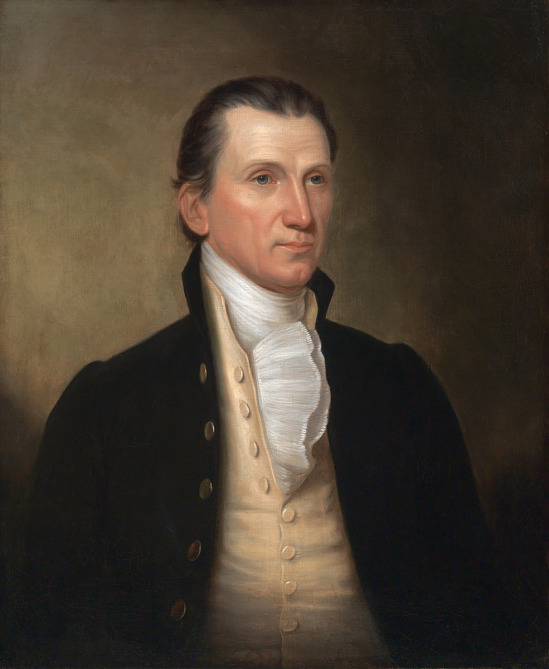
James Monroe (1758–1831) embodied youthful valor. At 17, he left college to join the Third Virginia Regiment, crossing the Delaware with Washington and charging Hessian cannons at Trenton—earning a severe wound that nearly killed him. He fought at Brandywine, Germantown, and Monmouth, later serving as a militia scout. Those trials forged his republican zeal, as evidenced by his fifth presidency (1817–1825) and the Monroe Doctrine, which warned Europe to stay out of the Americas.


James Monroe


The Prodigy


Learning at the knee of one of the era’s giants, John Quincy Adams (1767–1848), the precocious son of John Adams, tasted diplomacy at a young age. At 11, he sailed to France with his father; by 14, he served as secretary to the American envoy in Russia, aiding efforts to secure recognition. Though the mission faltered, the experience immersed him in global intrigue, shaping the diplomat who became the sixth president (1825–1829).


Young John Quincy Adams


Heroic Youth of the Waxhaws


Later known as “Old Hickory,” Andrew Jackson (1767–1845), the orphaned boy of the Carolina frontier, faced the war's harshest realities. At 13, he served as a militia courier through the guerrilla chaos, witnessing battles such as the Battle of Hobkirk's Hill. Captured by British troops, he refused to shine an officer's boots and was slashed across the face and hand—scars he carried forever. Imprisoned, he lost his brothers and mother to disease and hardship. That raw defiance fueled his later triumphs and his populist seventh presidency (1829–1837).


Andrew Jackson


In the crucible of revolution, these seven presidents were indeed magnificent—through command, conviction, courage, and cunning, they wove the threads of independence into enduring governance. Their lives remind us that America's story began not only in quiet halls but also in the roar of battle, the scratch of a quill, and the bold dreams of those who dared to build a new world. 


Happy Presidents' Day!


Tuesday, January 30, 2024

The Lafayette Circle

I have a tradition of writing a blog post about the "back story" of most of the books I write. With the release of The Lafayette Circle, it is time to do it again.

A Friend in Need

About a year ago, a Xavier High School classmate, Peter Reilly, reached out to me with a suggestion that I get involved in celebrating the upcoming 200th Anniversary of the Marquis de Lafayette's celebrated 1824 tour of America. Truth be told, I had never read about or heard of the event, so I was caught off guard. Peter, a CPA and contributor to Forbes.com and Think Outside The Tax Box, is also chair of the Massachusetts committee for the Bicentennial of Lafayette's Farewell Tour 2024-2025. I wondered how to respond.

Lafayette by Bryon Line


Maybe I could repost items about the upcoming celebration on my social media platforms. Or write a book about life in America in 1824? I knew quite a bit about Marie-Joseph-Paul-Yves-Roch-Gilbert du Motier, the Marquis de Lafayette, from my study of the American and French Revolutions, but little of the events after the fall of Napoleon in 1815. Most of what I remembered from that era came from Peter Neary's American History class when I attended Xavier High School in New York City—Jacksonian Democracy and all that.


Background

When in doubt, do some research. I started by rereading two legacy books on Lafayette from my library and immersing myself in a recently released biography. I also took the opportunity to join The Friends of Lafayette, and when I did, I got behind their paywall and found a trove of information about Lafayette's trip and the dynamics behind it. A review quickly led me to conclude that this was more than a feel-good junket—although it certainly was that, too.


A World in Upheaval

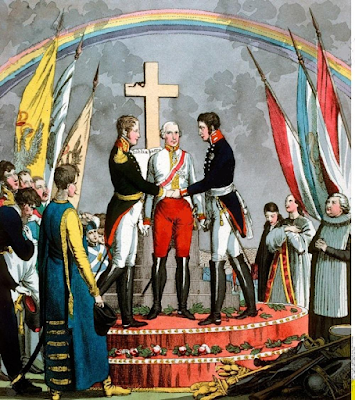
Although the Congress of Vienna, convened after Napoleon Bonaparte's abdication in 1814, set up a framework for a much-needed fifty years of peace among the European powers, the world itself was shaking from the movement of the tectonic plates of liberty. The Spanish colonies in America looked to North America and, to some extent, to revolutionary France as examples. Liberation movements, some long-simmering, began to erupt into rebellion and wars of liberation.


Congress of Vienna

Names like Simon Bolivar and Bernardo O'Higgins would become figures equal to George Washington throughout most of the continent to our south. In Spain itself, the newly formed Asturian battalion, one of ten organized to sail to America to suppress the wars of liberation, revolted, led by its commander, Rafael del Riego y Flórez.


Rafael del Riego y Flórez

Other regiments joined. The soldiers demanded a return to the 1812 Constitution. In March 1820, they surrounded the royal palace, and the king capitulated. A junta ruled Spain for several years until the autocrats of Europe pushed Royalist France to invade, restoring the king to his rightful place as an absolute monarch. Now, General de Riego was put on trial and hanged for treason.

Entry into Geopolitics

The long-isolationist United States grew concerned about the possibility of some European powers stepping into the void left by Spanish authority in the New World. Britain felt the same, especially fearing Russia's incursions from the North and threats to its holdings in South America and the West Indies. A suggestion for a joint declaration of the status quo ante in the New World resonated somewhat with President Monroe but not with the Secretary of State, John Quincy Adams. After all, two wars had been fought against Britain, one quite recently. America would render its own statement. Adams was the prime drafter of what became, many years later, known as The Monroe Doctrine.


James Monroe


A  Birthday Celebration—and More

Monroe's administration was nearing its close as the nation approached its 50th anniversary. He would be out of office by April 1825, yet he wanted to do something celebratory before his departure. Inviting the last surviving Continental Army general to return to his adopted land seemed a fitting way to begin the celebration on his watch, to underscore the young republic's arrival on the world stage, and to rebuild patriotic fervor. Lafayette was beloved in America and a world-renowned figure for his leading role in two revolutionary movements.th Anniversary. He would be lawfully out of office by April 1825, yet he wanted to do something celebratory before his departure. Inviting the last surviving Continental Army general to return to his adopted land seemed a great way to begin the party on his watch, underscore the young republic's arrival on the world stage, and rebuild patriotic fervor. Lafayette was beloved in America and was a world-renowned figure for his lead role in two revolutionary movements.


Lafayette in Winter


The Plot Thickens

As I learned all this, I realized the tour was more than a feel-good event; it was a tool for both internal and external politics. This was pretty slick. Others thought so, too. Among them were the members of the Holy Alliance, a reactionary (and not so holy) pact among the Empire of Austria, the Kingdom of Prussia, and the Empire of Russia, aimed at curbing the spread of democracy and buttressing autocracy.


Holy Alliance?

Of course, I built on this by creating the fictional subcommittee of the Holy Alliance, which I named the Aulic Council. The historical Aulic Council was an executive-judicial council for the Holy Roman Empire, active from the Late Middle Ages until Napoleon dissolved the Holy Roman Empire in 1806. I spin it into a Spectre-like organization run by villainous barons who answer to Austen Powers's Mr. Evil.


Mister Evil

Protecting the Man

How does a country with no Secret Service or FBI and a small military scattered across coastal forts and western outposts protect a dignitary during a highly publicized series of events? That's the central theme of the tale. An eclectic mix of characters, both inside and outside government, come together with minimal help from federal and state governments. Catholic monks, diplomats, US naval officers, US Marines, the New York militia, and others all play a role in protecting the general. They call themselves The Lafayette Circle. 


New York Militia Guarding Lafayette

Boris and Natascha x Three

Three assassin teams, each consisting of one male and one female, are dispatched to seek out Lafayette and kill him. This is another eclectic cast of characters, intentionally evil yet, like the famed "nogoodnik" Boris Badanoff and his sultry sidekick Natasha in the Rocky and Bullwinkle Show, not entirely unlikeable. Their struggle to "acquire" their target as they roam early 19th-century America adds to the suspense.


Boris and Natasha

Who's Your President?

The fact that one of the most controversial presidential contests in America's history took place in the middle of all this provided a subplot I could not resist. The events prove that the more things change, the more they stay the same, with backroom deals, fights for votes, and a "rigged election" that was also, curiously, legitimate. The events that deprived Andrew Jackson of the White House in the 1824 election are more obscure to most Americans than Julius Caesar's assassination, which at least was celebrated in a play by the Bard himself. 


1824 Election was Controversial

Yet the election took place during Lafayette's visit, and he was known to all the principals involved when the election was thrown to the House of Representatives for just the second time in America's history. Deals were struck, and John Quincy Adams went to the White House. The man with the most electoral votes went home to his estate, The Hermitage, outside Nashville. Lafayette would go out of his way to meet the war hero Jackson while Jackson was home, licking his wounds.


The Hermitage

Companions

Lafayette's journey was captured by his personal secretary, Auguste Levasseur, who penned an account titled Lafayette en Amérique, en 1824 et 1825 ou Journal d'un voyage aux États-Unis. His son, Georges Washington Lafayette, also accompanied the general. Both appear in fictionalized scenes meant to move the plot along while revealing different sides of the great man. Likewise, Fanny Wright, a socialist activist (and Lafayette's purported mistress) from Scotland, who was some thirty years younger than Lafayette, accompanies him for part of the trip.


Frances "Fanny" Wright

Glimpses

The novel includes several flashback sections—scenes meant to place Lafayette back in his youth, fighting in the American Revolution, leading the French Revolution, and dealing with the consequences of both. These are intended to give a bit of historical perspective to those uninformed about his role in those earlier significant events that shaped the Western world.


Flashback: Lafayette's wounding at Brandywine 1777

The Ordeal

I also attempted to offer a look at America and the world in 1824. Travel was by wind, steam, and horse. It was slow and steady, always an ordeal with hundreds of stops across a vast continent. Meetings with folks from all walks of life. Reminiscing with old comrades. Shaking thousands and thousands of hands around the clock. Lafayette's prodigious schedule of events and speeches was like a MAGA tour of the day and bound to take a toll on a man approaching seventy. Yet he did it with aplomb and graciousness. One has to ask why, and the answer is simple. Indeed, he loved America and what it stood for. But even more than that, he loved its people.


The Lafayette Circle is available now!


Saturday, December 30, 2023

The Prodigy

 This final post of 2023 features another historical figure from my novel, The Lafayette Circle. Although John Quincy Adams plays a relatively small role in this tale of intrigue and chaos in early 19th-century America, he seeds ideas that made Marquis de Lafayette's 1824-1825 visit more than just a celebration of friendship between two nations.

John Quincy Adams - 
the youthful diplomat


Apprentice Diplomat

John Quincy Adams was destined to grow up in the shadow of his father, John, an accomplished lawyer, statesman, and politician who helped shape the American Revolution and establish the foundation of the United States, becoming its second chief executive. Young John Quincy was born on July 11, 1767, at the family home in Braintree, Massachusetts, which is present-day Quincy. His intensely patriotic and accomplished parents influenced his early upbringing and provided him with a classical education. The American Revolution unfolded before his eyes as he was among the many people in and around Boston who nervously watched the patriots battle lines of redcoats at Bunker Hill in 1775. 


Watching Bunker Hill

Exchange Student

Three years later, he left his mother to go with his father on a diplomatic mission to Europe, marking the start of his real education. From 1778 to 1779, he studied at a private school in Paris, where he improved his fluency in French, the language of diplomats. After this, he attended the University of Leiden in the Netherlands, where he learned some Dutch.


The Boy Prodigy


By 1781, he had become proficient enough in French for his father to secure a position for John Quincy as private secretary to one of America's leading diplomats, Francis Dana, who had been appointed US Envoy to the court of Russia in St. Petersburg. When Dana's mission failed, he returned to Paris, where he served as a secretary to the American Commissioners during their negotiations with the British. 

The Law and the Hague

When the Treaty of Paris was signed, he returned to the U.S. to study at Harvard College and then in Newburyport under the guidance of Theophilus Parsons, where he studied law. By 1790, he was a member of the bar in Boston. Adams began private practice but also started writing pamphlets on political doctrine and foreign policy, supporting President George Washington's firm stance on neutrality in foreign affairs. This led to his appointment as U.S. minister to the Netherlands in 1794.


President George Washington

The wars of the French Revolution were raging, and The Hague was a hub of diplomatic intrigue. Adams's dispatches and letters provided the Washington administration (which included his father as Vice President) with valuable information. He held a temporary position in London to help facilitate the 1794 Jay Treaty—a pivotal and controversial foreign policy initiative.

The Diplomat

For his commendable service, in 1796, President Washington appointed him as the US Envoy to Portugal. However, when Dad became the nation's second president, he changed his son's assignment to Prussia. But pleasure before business—Adams married Louisa Catherine Johnson, a diplomat's daughter whom he met in Paris when he was just twelve. She proved to be a charming and capable partner to the rising young diplomat. They married in London before heading to Berlin, where he negotiated a treaty of amity and commerce with the Prussians. But in 1800, politics turned against him with the election of Thomas Jefferson, who recalled Adams from his post.


Louisa Catherine Johnson Adams

Political Life

Adams returned to Boston, where state and federal politics became his new arena. By 1802, he was a member of the Massachusetts State Senate, and in 1803, he was elected as a U.S. Senator from Massachusetts. "Battleground" is actually a more accurate description. Adams was as sharp-tongued as his father and did not favor "factions." He voted according to his conscience, which often put him at odds with one party or the other. He grew estranged from his father's Federalist Party, which by then had turned against him. 


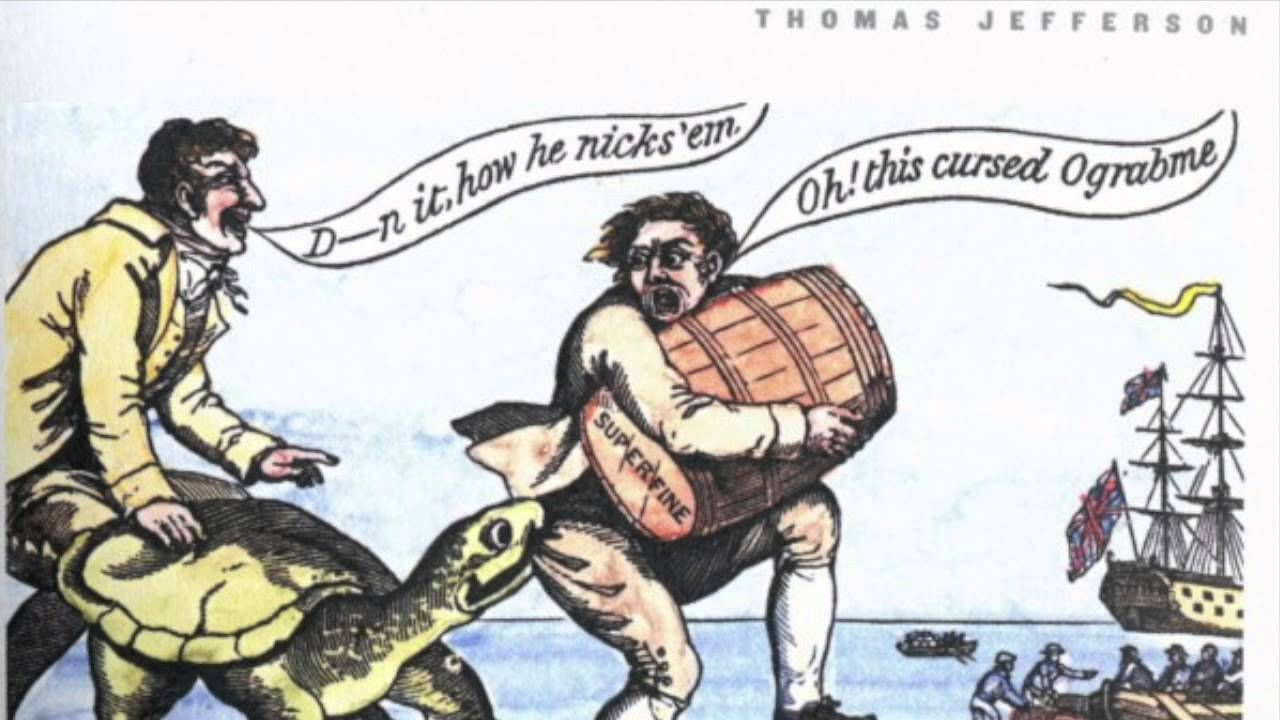
Support for the Embargo Act Cost Adams His Job

This all reached a boiling point when he supported Thomas Jefferson's Embargo Act, a measure opposed by New Englanders who valued Britain as a trading partner. In 1808, the Massachusetts Senate voted him out of office, which led to his resignation. Adams aligned with the Republicans and took a position as a professor of rhetoric and oratory at Harvard College.

Envoy to Russia

The world was at war with Napoleonic France, and President Madison needed a key player to handle the situation. The highly experienced Adams was the right choice, especially since he had broken away from the Federalists. From that position, the sharp Adams watched the collapse of Emperor Napoleon Bonaparte's army in 1812 and the fall of his empire over the next two years. Adams was present at the Court of St. Petersburg just as Czar Alexander rose in stature as a leader in the coalition against Napoleon.


Czar Alexander I - Power Broker

Treaty of Ghent

Meanwhile, war had erupted between the U.S. and Great Britain, which was Russia's ally. Adams eagerly accepted Czar Alexander's offer to mediate in the fall of 1812. The initiative, with Adams as one of the lead commissioners, ultimately failed. However, a follow-up effort in 1814 under Adams's leadership resulted in the Treaty of Ghent. This face-saving status quo ante arrangement changed little diplomatically or politically. Still, it gave the small U.S. the confidence and morale boost of having gone toe-to-toe with what was now the world's reigning superpower.


Signing the Treaty of Ghent

Like Father, Like Son

After a brief stay in Paris during Napoleon's short return to power in 1815, he followed in his father's footsteps. He traveled to London, where he and Henry Clay negotiated a "Convention to Regulate Commerce and Navigation." Soon afterward, he became the U.S. minister to Great Britain, just as his father had been before him and as his son Charles was to be afterward. His time at the Court of St. James was brief, as Adams returned to the United States in the summer of 1817 to serve as secretary of state in President James Monroe's cabinet. This appointment was mainly based on his diplomatic experience, but also because the president aimed to have a sectionally balanced cabinet during what became known as the Era of Good Feelings.


St. James Palace

Manifest Destiny

Adams's tenure as Secretary of State was, as expected, outstanding—especially for someone groomed for the job since the age of fourteen. He worked diligently with Spain to resolve the long-standing dispute over America's western and southwestern borders. The Spanish Minister Onis agreed that Spain would relinquish its claims to lands east of the Mississippi River. In return, Adams decided that the United States would waive its claims to Texas. The two countries agreed on a boundary stretching from the Atlantic to the Pacific Ocean. Years of dispute were settled through the signing of what was called the Adams-Onis Transcontinental Treaty.


In 1818, he also resolved the northern frontier dispute with Great Britain by establishing the 49th parallel all the way to the Rocky Mountains.

The Monroe Doctrine

Adams was a principal architect of U.S. policy on foreign interference in the Western Hemisphere. This is his main role in my novel, The Lafayette Circle. Instead of a joint U.S.-British declaration to European powers and the Spanish territories in America, he convinced President James Monroe to act independently. 

The letter he helped draft to Congress in late 1823 and issued in 1824 served as a firm warning to those hoping to exploit the former colonies, which seemed vulnerable to certain powers. What later became known as The Monroe Doctrine aimed to shield the newly independent lands from recolonization and laid the foundation of U.S. foreign policy for more than a century.


James Monroe

The Second President Adams

The 1824 election was marked by chaos and political maneuvering, all within the boundaries set by the US Constitution. With none of the four candidates—Adams, Andrew Jackson, Henry Clay, and William Crawford—receiving the required number of electoral votes, the election was decided by the House of Representatives, which chose from the top three (Jackson, Adams, Clay) in a one-vote-per-state "play-off." Henry Clay saw Jackson as a dangerous demagogue and supported Adams, effectively helping him secure the presidency. The Jacksonians protested when Adams later appointed Clay as Secretary of State.


Henry Clay


Adams worked long and hard as president, but the anger of the Jacksonians (who suspected a corrupt bargain) hovered like a cloud over his term, as they opposed him on everything. Adams's hopes of creating a national university and a national astronomical observatory were crushed. His idea that the western territories should develop gradually was rejected outright. Even his infrastructure plans—building bridges, ports, and roads with federal funding—were blocked. Jackson defeated Adams in the 1828 election.


Andrew Jackson


In an interesting link to my novel, The Lafayette Circle, one of Adams's earliest acts as president was to join General Lafayette on a farewell visit to former President James Monroe at his estate in Leesburg, Virginia.

Representative of the People

In a move that stunned many as "degrading to a former president," Adams ran for a seat in the House of Representatives in 1831, asserting that serving the public as a representative in Congress was not degrading. He represented the people in Congress until he died in 1848. During those years, he fought tirelessly against slavery and its expansion, as well as the various tactics employed by the slave bloc in Congress to expand and uphold their peculiar institution.


President John Quincy Adams

Bold Advocate

When Africans arrested aboard the slave ship Amistad were marked to be returned to their owners, John Quincy Adams took up their cause, defending them before the U.S. Supreme Court—and winning their freedom. Adams's entire career had aimed at one main goal—doing the right thing. In this, he faced a mix of success and failure, but his consistent efforts made him one of the top leaders of early America after the founding fathers.


Defending the Armistead Slaves

The Lion's Last Roar

Adams was in the House of Representatives, fighting a bill to honor Mexican War veterans. He had strongly opposed the war, viewing it as an act of aggression partly aimed at expanding slavery. He was about to criticize the vote when he collapsed. He was rushed to the Speaker's Room and died two days later, on February 23, 1848, from a stroke. The boy prodigy, now a prominent figure in Congress, passed away working and fighting at age 81, with his wife Louisa by his side. It is said that his last words were, "This is the last of earth, but I am composed."

  
Adams Died a Servant of  the People