Followers

Showing posts with label Battle of Bennington. Show all posts

Monday, May 30, 2022

Bold Dragoon

 Bennington, New York (Vermont)

A volley of musket fire suddenly sprayed just over their heads, and, contrary to tradition, training, and inclination, both officers ducked.

His jaw stiff with determination, Friedrich Baum rose to his feet and pointed his saber in the direction of the rebel fire. "The Iroquois must have fled. Why else would we receive rebel fire from there? Move a platoon to the south. Then bring up the cannon and quickly before they overrun us."

"We are already low on ammunition," said Glich.

"Then bring up the last caisson. No sense saving powder now."

Excerpt from The North Spy

This edition of the Yankee Doodle Spies features another profile of a character from my upcoming novel, The North SpyOberstleutnant Friedrich Baum. Since very little is known about Baum's background, I will need to fill in some gaps with speculation.


Professional Soldier

Friedrich Baum commanded a rare commodity in North America—a cavalry regiment. In this case, it was the Dragoon Regiment Prinz Ludwig, better known as the Brunswick Dragoons. The regiment's name came from its benefactor, Prinz Ludwig Ernst, the younger brother of Duke Karl, who ruled Brunswick. The Prinz Ludwig regiment was one of seven hired by the King of England from the Duke of Brunswick. The other six were infantry units: four musketeer regiments, one grenadier regiment, and one jaeger regiment. The Duchy of Brunswick (Braunschweig) is a northern German principality that provided a skilled professional army to allies like Prussia or generous supporters like Britain.


Prinz Ludwig Ernst

A Storied Regiment

The regiment was established in 1688 and was officially classified as a dragoon regiment in 1772. It was made up of four troops at full strength, totaling 330 officers and enlisted soldiers. These impressive horse soldiers wore bicorne hats and bright blue jackets, armed with carbines and sabers. Although they carried swords, dragoons were mounted infantry who rode into battle and dismounted to fight as infantry with light muskets or carbines. It was assumed that the unit would need their horses while in Canada, but they did not, and later many swapped their heavy boots for shoes with black gaiters.


Brunswick Dragoon


Typical of the time, the commander was a colonel who did not actually lead the unit—Oberst Friedrich von Riedesel. Instead, the lieutenant colonel (Oberstleutnant) was in command. Von Riedesel was later promoted to major general and given command of the entire Brunswick contingent, which was "leased" to King George to serve as auxiliaries to the British Army during the American Revolutionary War under the 1776 treaty between Great Britain and the Principality of Brunswick-Wolfenbüttel.

Vague Origins

Friedrich Baum was born in 1727, but his exact birthplace is unknown. Little is known about Baum's background, but he was a tough, professional officer from the small principality ruled by Friedrich Graf zu Schaumburg-Lippe-Bueckeburg. Young Baum rose to become captain of the Graf's Carabiner Corps, an elite troop unit. He fought in some battles during the Seven Years' War in Europe but had little battlefield command experience before serving in the American Revolution.


Dragoons in the Seven Years' War

A New Allegiance, A New World

Baum transferred his service to the Duke of Brunswick in 1762 and, by 1776, had become a lieutenant colonel. Baum and the Brunswick Dragoon Regiment left the German duchy in February 1776 as part of two Brunswick divisions hired to fight the United States under the now General Friedrich von Riedesel. 


General Friedrich von Riedesel

After arriving in Quebec, the Brunswickers assisted Governor Guy Carleton in policing the Americans who were struggling to retreat to New York. In the summer of 1777, Baum's regiment was assigned to the army of General John Burgoyne, which was preparing for an important campaign in the Lake Champlain region of New York. 

Northern Invasion

The invasion began in late June and started strongly with a quick advance along Lake Champlain, capturing the large Fort Ticonderoga through a surprise attack and pursuing the rapidly retreating rebel army. However, by August, Burgoyne's forces started to slow down and become exhausted in dense, difficult terrain. More critically, the supply line became overextended, and the army ran out of supplies. Intelligence reports told Burgoyne that Loyalists were rallying to the king and that livestock and food were only a few miles away at Bennington in the New Hampshire Grants – a disputed area stretching between New York and New Hampshire that would later become Vermont.
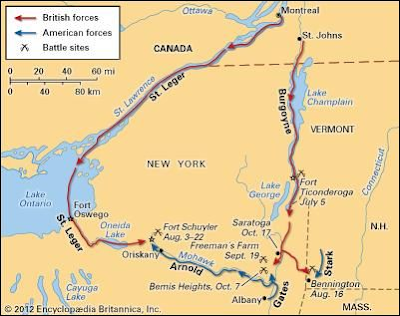

The invasion route


A Special Mission

Burgoyne ordered Baum to lead 800 men through the Grants, seize cattle and horses, and rally the many Loyalist sympathizers in the area. Baum's men marched east on August 11, 1777. Additionally, his force, which included over 374 Brunswick Dragoons, about 50 Jaegers, 30 artillerymen, along with 300 Loyalists, Canadians, and Indians, set out on what was expected to be a straightforward mission. 


Indian allies 


True to his Seven Years War experience and European training, Baum moved slowly through the rough, wooded terrain. He would occasionally stop the column to dress the ranks and realign them. But time was not a major concern, as Baum was told. The numerous Loyalists in the area were expected to rally to him. Unfortunately, word of the Iroquois attacks on the settlers had the opposite effect. Loyalists did not show up, but the Patriots were rallying.

Rebel Resistance

This became clear the next day when a group of rebels engaged Baum's column in a firefight at Cambridge. His "spider-sense" tingling, the cautious Baum sent Burgoyne a request for reinforcements. He also expressed frustration that Loyalist bands had not rallied to him as he expected. What to do? Dig in, of course. He had his men build several redoubts east of Bennington and waited for reinforcements and for the situation to unfold. 


Baum's first contact with the militia sent off an alarm


Rising Tide

Unfortunately, his redoubts were so spread out that they could not support each other. Although some Loyalists had come into his camp to join his column, there were rebel spies among them. Two American forces were also preparing to attack Baum's exposed position. The spies soon relayed details about Baum's defenses. About 2,000 rebels, mostly New Hampshire militia under John Stark and Seth Warner's Green Mountain Boys, were ready to strike against Baum's positions. Stark pushed units around Baum's flanks and nearly surrounded him, and on the morning of August 16, Stark ordered the attack.


John Stark was the wrong opponent for Baum's first action


Shock and Awe in the Grants

The veteran Baum was caught off guard by the speed and shock of the rebel attack. The Brunswick Dragoons and other Germans fought back fiercely, skillfully using their redoubts. But they fell for a trick by Stark, who deliberately sent units out to draw the defenders' fire and deplete their scarce powder and balls. When the defenders' volleys began to weaken, the Americans advanced and took the redoubts one at a time. 


New Hampshire militia storming Baum's redoubts


Last Redoubt

Baum, commanding the last stronghold, assessed his situation. The rebels swarmed and peppered them with constant fire. The air hummed with the sound of musket balls, and the hollering of angry rebels fired up for the final attack. Most of his Loyalist and Indian allies had fled. It was down to him and the dragoons. The professionals who had followed him across the deadly battlefields of Europe and across a vast ocean now faced a land and a people even more threatening.


One by one, the redoubts fell

 Desperate Gambit

With ammunition nearly exhausted, surrounded, and outnumbered three to one, our brave dragoon recognized his dire situation and resorted to a desperate measure. His remaining dragoons drew their long sabers. Although they had no horses, they had gravity! Blades shining in the sun, the tall, mustached warriors in pale blue charged downhill at the startled Americans. Seven brave dragoons fought their way out and eventually limped into Fort George. Sadly, our brave dragoon was not among them. Oberstleutnant Braun took a musket ball, was captured by the rebels, and died in the American camp on August 18. 


Scheme of battle

Battle Lost

The final musket shots fell silent at dusk. The anticipated reinforcements, a force of Brunswick jaegers and grenadiers under Lieutenant Colonel Heinrich von Breymann, arrived too late to turn the tide. Some accounts say Breymann disliked Baum and moved at a pace of less than a mile an hour, but the terrain and other factors could explain this. Breymann himself would be killed in action a few months later - shot by his own men! Yes, "fragging" was a real thing in the 18th century and throughout military history.

Campaign Lost

The impact of Baum's defeat cannot be overstated. Over 700 soldiers from Baum's command were either taken prisoner or reported missing—almost the entire force. American casualties numbered around 70. 


Aftermath of battle


The failed expedition meant Burgoyne lacked enough food, supplies, and draft animals for the ongoing fight at Saratoga—not to mention the absence of a corps of professional soldiers. The Indian allies lost confidence in Burgoyne's chances of success and began to drift away, leaving Burgoyne without native "cavalry" to scout and screen in the vast New York wilderness. 


Baum's defeat  helped seal Burgoyne's fate


And, of course, Baum's defeat was the precursor to Burgoyne's army suffering a more important loss two months later at Saratoga, turning the tide of war in favor of the Americans.

Legacy

So our bold dragoon's legacy is not a good one. Baum's first experience leading an independent command became his last. He did his duty, but his mission failed. Still, our bold dragoon gave the last full measure. I believe, in some way, as a professional officer, he might have preferred to give his all than face the shame of defeat at the hands of rebels.


Marker near where Baum died

They buried Lieutenant Colonel Friedrich Baum on the north bank of the Walloomsac River, though the exact spot is unknown. He died in a nearby house that was torn down around 1870. A marker placed at the site of the house in 1927 by the Sons of the American Revolution serves as the only connection to the man whose death may have marked the start of a turning point in the American War for Independence.


Final Epitaph


Saturday, April 30, 2022

The Granite General

The American War for Independence had many fierce fighters, but few senior officers were tougher than the Granite State's own John Stark. Stark was an American made from the same rough cloth as Anthony Wayne and Daniel Morgan, yet also possessed the sharp tactical mind of Benedict Arnold and the strategic vision of Nathanael Greene. Still, John Stark is little known outside his home state of New Hampshire, and even there, he's mostly remembered for his statue in Manchester. 


John Stark statue in Manchester


A Rugged American

John Stark, the son of Scottish immigrants, was born on August 28, 1728, in Londonderry, New Hampshire. As a boy, he moved with his family to Derryfield, now called Manchester. It was Stark's home whenever he was not out hunting or fighting.


Trapping in Deep Forests


In the mid-18th century, much of New Hampshire was a frontier of rugged mountains, dense forests, plenty of game—and native tribes. Stark grew up in this wild wilderness, spending much of his time in the forests hunting, trapping, and honing the skills of a backwoodsman. And he was no stranger to the region's violence. These experiences helped shape his rugged individualism and self-confidence, which would later serve him and the nation.


The Hunter or the Hunted?


Frontier Hostage 

On April 28, 1752, a group of Abenaki warriors captured young Stark while he was out hunting game and trapping fur along the Baker River. One of their members, David Stinson, was killed. Luckily, Stark managed to warn his brother William, who escaped in a canoe. However, the warriors took John and his companion, Amos Eastman, to Canada. 


Abenaki Hostages


His time as a prisoner toughened him. He and fellow captive Amos were ordered to "run the gauntlet" of braves wielding clubs during their captivity. Few get through the ordeal of the gauntlet without suffering a savage beating, and some succumbed. Stark was not intimidated. Showing the grit he would later be known for, the young man jumped on the first warrior, seized his club, and attacked the astonished braves. 


Running the Gauntlet


His bravery and strength impressed the Abenakis, and the chief took Stark as a member of their tribe, where he spent the winter. Later, the colony sent representatives to ransom the two captives, with Stark alone costing the treasury 103 Spanish dollars. Stark returned home but now had a strong bond with the clan he had lived with.

Let's Go Rangers!

In 1755, the simmering conflict on the western frontier erupted in North America. The French and Indian War (Seven Years' War in Europe) pulled Stark and his brother William into the fighting. To the British, the war was about building an empire in North America and around the world. For the colonists, it was a fight for survival against relentless enemies.


John william joined Major Robert Rogers's company of rangers. Rogers's Rangers became the most famous frontier fighting force of their time and the inspiration for books and movies. Tough men, accustomed to the hardships of the frontier, the rangers knew and used every trick to venture deep into the forests and cause trouble for the French and their Native American allies. 


Rogers's Rangers


Young John Stark distinguished himself in the battles at Lake George, Bloody Pond, Halfway Creek, Fort William Henry, the Battle of Snowshoes, as well as the 1758 Battle of Fort Carillon and the 1759 campaign during which Fort Carillon was abandoned. 


Crisis of Conscience

In a strange twist, the gritty and hardened Stark faced a unique crisis of conscience in 1759 when British General Jeffery Amherst ordered the rangers to march from Lake George (NY) to the village of St. Francis in Quebec. The town was founded by Jesuit missionaries for converted Indians and was the home of the Abenaki, who had become his foster parents during captivity. Although now a captain and serving as Roger's second in command, the rugged young frontiersman refused to take part in the attack. He soon left the rangers and returned to New Hampshire to spend time with his wife of one year, Molly Page.


Rangers move against St. Francis


Home

When the war ended in 1763, Captain Stark retired and returned home to Derryfield to join Molly and raise a family of eleven children. Unlike most of his peers, young John Stark refused to participate in local politics and declined to attend political meetings, even as the American Revolution approached. However, he overcame his natural aversion to authority when he sensed his country was in peril. In 1774, he joined the local Committee of Safety, which organized the colonies' self-defense and served as the foundation for resistance against British authority. Local safety committees prepared the colonies' towns and counties for political action, self-defense, and war.


Committee Meeting


Call to Arms

When word of Lexington and Concord reached him, Stark left his farm and sawmill with musket in hand, heading for Boston, where New England was rallying to face the British. Appointed a colonel, Stark was put in charge of the regiment he recruited—tough New Hampshire men. He quickly got into action on 27 May 1775, leading a raid on a British foraging party on Boston harbor's Noodles Island. 


Raiding in the Harbor

Mystic Beach

But his real debut came at a place called Bunker (Breed's) Hill on June 17. Stark's regiment was among the first to face the heavy British naval fire to seize the vital ground below the crest. Stark now commanded his own unit plus the Second New Hampshire. On site, Colonel Prescott, the commander, told Stark to decide where he wanted his regiments to defend. 

The former ranger quickly saw that the north flank was the weak spot of the American position. There, he placed his men behind a rail fence running from the hill to the Mystic River bank and had them reinforce the rails with straw to fool the British. He also instructed the men to pile boulders along the exposed beach to create a makeshift wall. Then Stark stepped in front of the defenses, marked a spot about eighty paces away, and ordered his men not to fire until the redcoats reached that point.


Facing the Welch Fusiliers

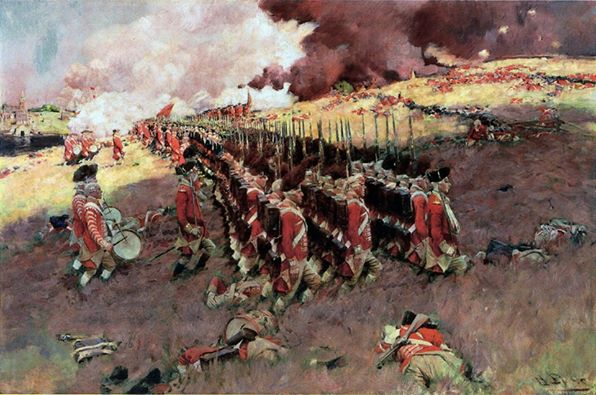
The sound of the advancing elite Welch Fusiliers at the front of the British army caused men to check their flints as they waited patiently for Stark's command to "aim at their waistbands!" A horrific volley killed ninety fusiliers, causing the rest to panic and flee. The next wave fared no better, as a second volley blasted them. The final British assault was also repelled, ending the attack on the American flank. 


Bunker Hill: synonymous with Pyrrhic  victory


Similar results occurred on Bunker Hill itself until a lack of powder forced an American withdrawal, which Starks's men covered with disciplined musket fire. The British took the hill but with the devastating loss of officers and men. Over 1,000 officers and other ranks were killed or wounded. And so, typical of 18th-century warfare, many wounded would eventually succumb. 

Passed Over

Sadly, many promotions and appointments, especially early in the war, were driven by politics. When the post-Bunker Hill round of promotions occurred, the Continental Congress passed over Colonel John Stark in favor of less accomplished officers. This would anger Stark and fuel his resentment toward authority.

Continental Line

After the battle, Colonel Stark's command was incorporated into the Continental Army as the 5th New Hampshire Line. The unit distinguished itself while serving with General George Washington's army during the New York and New Jersey campaigns. Stark's men fought fiercely against the enemy in several battles, including Trenton, Assunpink Creek (2nd Trenton), and Princeton. 


Taking Trenton


At Trenton, Washington recognized his bravery and leadership skills in battle, entrusting him with command of the crucial right flank of Nathanael Greene's advance guard. 


Nathanael Greene


In the case of Assenpink Creek, he famously led a determined and gritty "forward defense" that stalled the British advance on the main army. Stark's actions at Assenpiunk Creek are vividly portrayed in my novel, The Winter Spy


Stark's defense at Assenpink Creek


But the headstrong and quick to take offense, Stark took issue when the Continental Congress promoted Enoch Poor to brigadier general ahead of him. In March 1777, he resigned from the army in a huff, refusing to obey either man or Congress. But unlike that other famously wronged general, Benedict Arnold, Stark's resentment never turned to treason, only a desire to prove himself.

Stubborn Patriot

While Stark now simmered at his New Hampshire farm, a new threat appeared in the north: a large British invasion force led by Major General John Burgoyne. Conditions in the north were so dire in the summer of 1777 that the New Hampshire authorities urged him to return to active duty in August. He agreed—on the condition that he commanded independently and was not under anyone's control. Then, rallying nearly 2,000 militia, he took the field. However, true to his independent spirit (and stubbornness), he refused a command from the local leader, General Benjamin Lincoln, and kept his men on the east bank of the Hudson River, separate from the main army in New York. 


General Burgoyne

Glory at Bennington

Burgoyne's army was moving south, but his supply lines soon became stretched thin. Hearing about an American supply depot near Bennington, he sent a large force of Germans under the experienced Lieutenant Colonel Friedrich Baum east toward what is now Vermont. When Stark learned of the move, he quickly marched to stop the advance. When Seth Warner's 600 men joined him, the combined forces attacked Baum near Bennington. 


Stark's militia would join with Seth Warner's


Before the main body commenced its attack, Stark stood before his men as he did at Bunker Hill and exhorted them, "There are the red coats, and they are ours or this night Molly Stark sleeps a widow."


Stark leading the attack


The ensuing battle was decisive. The American muskets wore down the exhausted Germans, and soon Stark's men launched an attack, killing 200 and capturing 700 of the Germans. Baum was among those killed. The victorious Americans only suffered 100 casualties but gained a significant psychological and material victory. John Stark's decisive action at Bennington is an exciting part of my upcoming novel in the Yankee Doodle Spies series, The North Spy.

Saratoga Sunset

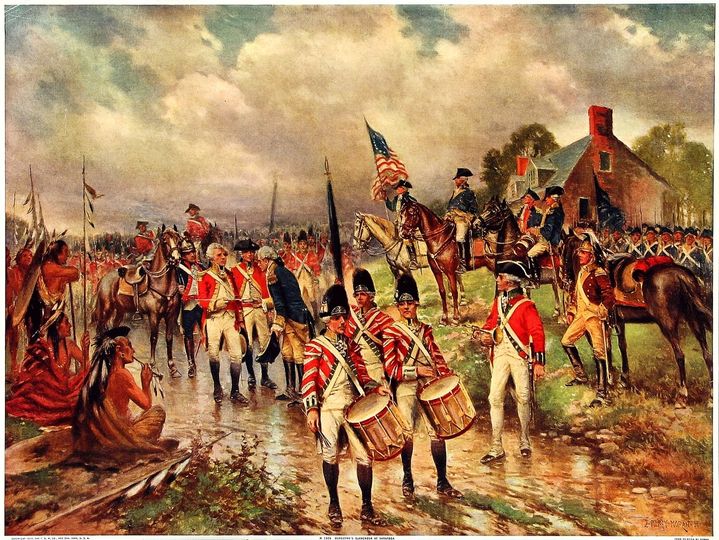
In September, news of the victory rallied more Americans to the cause – men desperately needed as Burgoyne's final push to Albany clashed with General Horatio Gates's army south of Saratoga, New York. After a second encounter in October, Burgoyne retreated around Saratoga as he debated whether to risk another attack, hold his ground, or retreat along his supply line for the winter. When he finally decided to withdraw, Colonel John Stark had already taken that option away. The Granite General's troops swarmed the woods north of the British forces and cut them off from the safety of Fort Ticonderoga. Burgoyne was forced to surrender, marking a turning point in the struggle.


British troops in captivity


Getting His Due

In recognition of his distinguished leadership in the campaign that defeated the threat from Canada, Congress finally promoted Colonel John Stark to brigadier general. Congress later awarded him command of the Northern Department, where he twice assisted General John Sullivan during the Rhode Island campaign of 1778. Ironically, Sullivan was a general promoted over Stark earlier in the war. 


Brigadier General Stark

Brigadier General Stark last distinguished himself in combat in June 1780 against General Wilhelm von Knyphausen's Hessians at Springfield, New Jersey. He commanded two New Hampshire regiments that helped stop one of the advancing enemy columns. As a result, Knyphausen retreated, leaving several hundred casualties. This American victory was the last major battle in the north. The British remained holed up in New York City, content to leave major maneuvers to Lord Cornwallis's southern army.


Battle of Springfield


Although not part of major operations during this period, Stark contributed to the most significant espionage case of the war when he was called to serve on the board of generals for the court-martial of British spy Major John Andre. Andre had gone behind American lines in civilian clothes to meet the traitor Benedict Arnold. While Arnold escaped, Andre was captured while trying to return to British lines. Though Andre was a sympathetic figure, he was nevertheless rightly convicted and received the punishment assigned to spies: death by hanging.


Major John Andre


Stark finally left the army in 1783 with the rank of major general. Since George Washington was a lieutenant general (the highest position in the army at the time), Stark had reached the top level of serving Continental officers. 


Major General Stark


Granite State Citizen

Unlike many of his peers, John Stark did not use his wartime patriotism as a platform for political or economic gain. In 1809, the state of Vermont asked him to travel to Bennington to speak on the 32nd anniversary of the battle. However, Stark was too debilitated from rheumatism to make the trip. Instead, he wrote an eloquent letter praising those who served and everyone who fought, civilian or military, for independence. The old general issued a stern (or perhaps, stark) warning to always stay vigilant in the cause of liberty. The stoic general concluded his letter in a way only he could, injecting some of his fighting spirit with this warning: "Live free or die—Death is not the worst of evils." 


Stark's Monument at Bennington


Although it should, John Stark's name does not come to mind for most when thinking of Revolutionary War heroes, even in his home state. Interestingly, New Hampshire and Vermont have numerous places named after Molly Paige Stark, while John has only a few monuments. Stark's passionate use of Molly's name before Bennington made her more celebrated than him.


Molly Stark statue


John Stark died, the longest-living Continental Army general of the war, in Manchester, New Hampshire, on May 8, 1822. John Stark was more than a tough fighter—he struck the enemy hard whenever and wherever he could. He lived a life that reflects ideals cherished by all Americans: independence, rugged individualism, and defiance against unjust authority. These ideals remain the Granite General's enduring legacy. 


Stark's grave in Manchester