Followers

Showing posts with label Fort Dusquesne. Show all posts

Sunday, July 9, 2017

Road to Destruction

A Prequel


This is a rare Yankee Doodle Spies "prequel" post. In many ways, the roots of the American fight for independence were laid with the bloodshed of the French and Indian War. Coincidentally, George Washington's actions on the western frontier (in Virginia, Pennsylvania, and Ohio) contributed to its beginning. 

A young Washington explored the frontier for the then-Governor of Virginia, Robert Dinwiddie. During one mission, an encounter with a group of French and Indians triggered both nations (and much of Europe) into a long, costly war. As one of the few Americans who had traveled through the wilderness, Washington was appointed as a special aide to the commander in chief of British forces in North America, Edward Braddock. However, Washington did not hold a Royal commission and was considered a colonial officer. This was a major factor in Washington's later shift from being English to becoming American.


Washington became a special assistant
due to his experience in the West


The Campaign


Gen Braddock
Because the war began over a dispute about the western boundaries of British North America, Britain's main goal was to secure the French forts near the Ohio River. In summer 1755, General Edward Braddock, the newly appointed commander-in-chief of the British Army in America, decided to personally lead the primary effort against the Ohio Country with about 2,100 men. He had two regular line regiments, the 44th and 48th (around 1,350 men), along with about 500 colonial troops and militiamen.

To seize the forts, he brought some artillery and other support personnel, including engineers and artificers. Braddock, a confident if somewhat arrogant Scotsman, believed he could easily take Fort Duquesne (today's Pittsburgh). He planned to then move north to capture the other French forts, ultimately reaching Fort Niagara. Two additional campaigns were planned to push directly north into French Quebec, but this was to be the main effort.


The Western Theater of Operations

The Road to Victory


There is some controversy about which direction the British should take. There were two main routes to the west: one through Virginia (present-day West Virginia) and another through western Pennsylvania. Washington was connected to the commercial interests supporting the southern route. Both sides believed that British military improvements to the chosen road would make it the main artery for westward expansion.

Sketch of Braddock's Route


In either case, Braddock chose the southern route, which went through tougher and more heavily wooded terrain. The march to Fort Duquesne depended on a road built by Braddock and his men, who used an old Indian trail called Nemacolin’s Path to cross the Allegheny Mountains. Braddock's troops traveled from Alexandria to Winchester to Cumberland (MD), where the wilderness road started. It took just over a month to build this 12-foot-wide, 110-mile-long road. Fifty years later, Congress funded it as the first National Road. However, it never directly led to Fort Duquesne.


The thickly forested Allegheny Mountains would
prove a formidable obstacle for Braddock's column

The Road to Destruction


On July 9, 1755, Braddock's force crossed the Monongahela River west of a place called Turtle Creek. Braddock's advance guard of 300 grenadiers and colonials, along with two cannons under Lieutenant Colonel Thomas Gage (later infamous in Boston), began to move forward. Washington tried to warn him about the flaws in his plan, but Gage ignored him.

Confident that there was no enemy nearby, they advanced in a column along a narrow path under the heavy wooded canopy. Suddenly, Gage's advance guard encountered French and Indian warriors rushing to stop the British at the river. However, because they were behind schedule and too late to set an ambush, they collided directly with Gage's men. The enemy forces were led by French Captain Beaujeu, who was mortally wounded early in the fight.

The first clash between the two forces caught both sides off guard. Yet, the French and Indians quickly regrouped and fired a deadly volley into the British column. After exchanging gunfire, Gage's men fell back. In the narrow road, they ran into Braddock's main force, which had moved quickly after hearing the shots.

Chaos broke out as Canadian militia and Indian fighters surrounded them and continued sniping at the British from the woods along the road. Musket balls zinged through the trees, cracking limbs and rustling leaves. But it was the silent rounds that hit man after man. War cries and death from behind the thick undergrowth also took a toll, as did the heat. Soon, French regulars started advancing along the road and pushed the British back. The British organized defense crumbled.
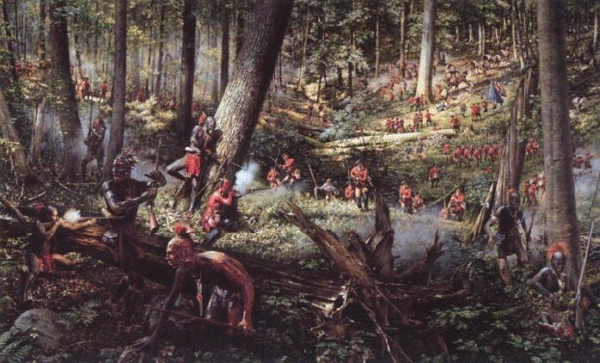


Indians ambush the British column


Despite deadly bullets coming from seemingly all directions, the British officers tried to rally their men. They also attempted to use some of their cannons, but the narrow confines prevented effective firing once again. The colonial militias and troops rallied and fired at the Indians, but some received "friendly fire" from panicked British regulars who were still trying to maintain their formations. 

The fighting lasted several hours, with Washington moving around trying to take charge wherever he could. He regrouped small units, and when Braddock was shot from his horse, he set up a rearguard to ensure the wounded commander reached safety. Many other officers died trying to rally and lead their men. The Indians did a remarkable job of picking off officers, who suffered a very high casualty rate. Washington himself had two horses shot out from under him, and bullets went through his clothes, yet he emerged unscathed. By sunset, the remaining British and colonial forces were retreating back down the road they had built.


Gen Braddock falls wounded

The Aftermath


The French won this battle, commonly called the Battle of the Monongahela, and suffered 40 casualties, which was less than 10 percent. The British, on the other hand, suffered nearly 900 casualties, making up more than 60 percent of their forces. Braddock himself died from his wounds on July 13.

The next day, Washington buried him under the road near the front of the column. The spot for his burial was chosen to prevent the French and Indians from desecrating his grave. Despite being outnumbered, the French did not pursue the British, while the Indians began looting and scalping.

These two factors helped save the column from further destruction. Hopes for a quick British push toward the Ohio were decisively crushed on this path of destruction. Those hopes would not be revived until three years later, ironically, through the northern route known as Forbes Road.


Monday, January 2, 2017

The Surgeon General

Tomorrow marks the anniversary of the Battle of Princeton, the culmination of a week of daring action that literally saved the American Revolution—at least until its next crisis. The battle featured a daring night march by Washington's army—pinned and shivering between the Assunpink Creek and the frozen Delaware River, awaiting possible annihilation by General Cornwallis and 5,000 British and Hessians hell-bent on revenge for the first battle of Trenton. 

Washington's men abandoned camp in the dark winter night. Tramping through frozen marshlands, they circled around the British, arriving several miles behind them and preparing to seize the British base at Princeton. Washington succeeded in one of the rare open-field engagements of the campaign, demonstrating decisiveness and personal bravery by leading his men across the snow-covered fields in a gallant charge. But the victory came at a great cost: two of his top generals fell that day. One of them was Hugh Mercer, the Scottish-born surgeon turned soldier.


Young Hugh Mercer


Early Life: Scalpel, Claymore, and Tomahawk


Mercer fought with the clans at Culloden


Mercer was born in Aberdeenshire, Scotland, in 1725, and earned a medical degree from the university of that name in 1744. Apparently a lover of hopeless (not lost) causes, the young Mercer joined the Jacobite army under Prince Charles Edward, known as the Pretender, until that struggle for freedom was crushed by the Duke of Cumberland's redcoats at Culloden on April 16, 1746. 

After a period in hiding, Mercer fled to America and settled in Pennsylvania, where he established his medical practice. At the outbreak of the French and Indian War in 1756, Mercer joined the colony's forces. Throughout the war, Pennsylvania's western region faced relentless Indian raids, encouraged by the French. Mercer began his service as part of Colonel John Armstrong's expedition against the Indians at Kittanning, where he was wounded. 

In 1758, he served as a lieutenant colonel in the siege of Fort Duquesne and was later given command there to secure the West. Around that time, he befriended a colonel named George Washington, who commanded the Virginia Regiment, which performed similar duties protecting Virginia's western frontier.


The British capture of Fort Duquesne

Colonial Life: Prosperity and Family


When the war ended in 1763, Mercer moved to Fredericksburg, Virginia, and reopened his medical practice. It makes one wonder if his connection with Washington influenced his decision to relocate to the Old Dominion. When Mercer arrived in Fredericksburg, it was a lively Scottish community. 

Fellow Scot John Paul Jones's brother farmed nearby, and Jones himself hoped to settle there permanently. He became a well-known figure and businessman in town, purchasing land and engaging in local trade. His medical practice brought him into contact with many prominent Virginians, including George Washington's mother, Mary Ball Washington, who became one of his patients. 

In Fredericksburg, Mercer married Isabella Gordon, started a family, and had five children. Later, he purchased George Washington's childhood home, Ferry Farm, with the hope of making it his permanent residence.


Mary Washington was a patient
of Mercer's (seen here as a younger woman)

Run up to War


Like many Virginians, Mercer supported the Patriot cause as the American Revolution approached. He joined the Fredericksburg Committee of Safety and, on April 25, was among the members of the Independent Company of Fredericksburg who wrote a letter to then-Colonel George Washington, expressing concern when the British removed gunpowder from the Williamsburg magazine. Because he was Scottish, the Virginia Convention skipped over him for command of the first Virginia regiments in 1775. 
However, he was appointed commander of all the minuteman companies in the four counties around Fredericksburg. Early in 1776, Mercer's military experience led the provincial congress to appoint him as colonel (commander) of the 3rd Virginia Continental Line. Future President James Monroe and future Supreme Court Justice John Marshall served under him.


James Monroe served under Mercer


From Surgeon to General


In June 1776, General George Washington, in urgent need of experienced commanders, persuaded the Continental Congress to appoint Mercer as a brigadier general. Mercer's experience and reputation led Washington to place him in command of the "Flying Camp' during the New York campaign. These were inexperienced militias requiring strong leadership and strategic training. The Flying Camp served as a special military reserve, but despite Mercer's efforts, it suffered from shortages of equipment and men and was disbanded by year's end. Mercer also oversaw the construction of Fort Lee, which overlooked the North River across from Fort Washington in Manhattan. 

During the darkest days of the war, Mercer played a key role in Washington's night march on Trenton on December 26, 1776. He helped plan and execute the crossing and led his brigade into Trenton from the west—driving the Hessians out of the town and into an orchard, where they were almost annihilated. Mercer was also instrumental in repulsing the British during the second Battle of Trenton on January 2, 1777. The next day, Washington's army advanced on the British garrison at Princeton, New Jersey. 

Mercer's brigade, consisting of 350 men, encountered Lieutenant Colonel Charles Mawhood's force—two British regiments and some dragoons, totaling about 1,200 men—near Stony Brook Bridge. A fierce firefight erupted in an orchard grove. The fiery Mercer refused to retreat despite the overwhelming odds and charged into battle. 

The better-trained British forces pushed his men back, causing them to break ranks. As Mercer attempted to rally his troops, his horse was shot from under him. He quickly got to his feet but was soon surrounded by British soldiers who mistook him for George Washington and ordered him to surrender. 

Outnumbered, Mercer drew his saber and fought fiercely. He was eventually knocked to the ground, bayoneted seven times, and left for dead. When Washington learned of the British attack and saw some of Mercer's men retreating, he personally entered the battle, famously rallying Mercer's men and forcing the British regiments to retreat.


Death of Hugh Mercer at Princeton

A Nation's Loss


After the battle, Mercer's body was taken to a nearby farmhouse where Washington's leading physician, Dr. Benjamin Rush, attended him. However, Mercer died of his wounds on January 12, 1777. His loss was a significant personal blow for Washington, but it was an even greater loss for the new nation, which would have benefited from his leadership both in peace and in war.


Mercer Statue at Fredericksburg