This is the third profile in a series highlighting a character from book four of the Yankee Doodle Spies series, The North Spy, which is set to be released next year. Since my previous profile featured a Scotsman who fought for America, it only makes sense to follow up with a Scotsman who fought for England. Not just any Scotsman, but a member of the famous Fraser clan of Highland warriors.

Proud Lineage
Simon Fraser was born into a proud Scottish Highland lineage in Balnain, Scotland, on May 26, 1729. His family and clan were courageous warriors, and many of them fell at the pivotal Battle of Culloden in 1745. Those who survived lost their lands and heritage and were forced into exile.

Dutch Service
The Scots, like their cousins across the Irish Sea, often fight for the English even when they are not technically fighting against them. This is what young Fraser did, starting with a period in one of the Scottish Brigades hired by the Netherlands—the 4th Brigade, specifically. In the final years of the War of Austrian Succession, young Simon fought in the 1747 siege of Bergen-op-Zoom. The attacking French forces overwhelmed the defenses and flooded into the town, where fierce fighting took place. During the attack and counterattack, Fraser was wounded.

Royal American
With the end of the war, the Dutch Brigade was reduced to a single battalion, prompting Fraser to look for opportunities elsewhere. The start of the Seven Years' War provided a prime chance for an eager and now experienced young Highlander. In 1756, Fraser joined the British Army’s 62nd Royal American Regiment of Foot. Renumbered as the 60th the following year, it later became known as The King’s Royal Rifle Corps.

Back to the Clan
Fraser did not stay with the 60th for long. In January 1757, he accepted a commission in a newly formed regiment of highlanders, the 63rd Highlander Regiment of Foot. The regiment was led by Simon’s cousin, Lord Lovat, who was also named Simon Fraser. The unit was called Fraser’s Regiment, and its ranks mostly consisted of Frasers. This was probably the main reason for joining—the chance to fight alongside and for kin.

Fighting French & Indians
Fraser traveled to America to fight the French, taking part in the siege of Louisbourg, which, when captured, gave Britain control of the mouth of the Saint Lawrence River. He served under British General James Wolfe during the 1759 attack on Quebec, the decisive battle of the war in America. The 78th Regiment climbed the Heights of Abraham with Wolfe, and Lieutenant Fraser was wounded in the fierce fighting, while Wolfe was mortally wounded in this great victory.

Fraser’s time with the 60th and his service in America with the 78th opened his eyes to a different style of fighting in the wooded wilderness—the need for disciplined troops who could fight outside of massed formations and rely on terrain and marksmanship to take down enemies like the Indian allies of the French. After Quebec, Fraser’s unit had garrison duty in the city and spent some time in New York, but the French and Indian war was nearing its end.

Seven Year Itch
By 1760, Fraser was back in Europe—though the Seven Years' War had not yet ended. This led to another transfer—this time to the 24th Regiment of Foot, which was sent to Germany to serve in Lord Granby’s Corps. Over the next two years, the 24th fought in more than half a dozen sieges and major battles against the French. He was recognized for heroism at the Battle of Wezen in November 1761. Fraser led a hand-picked company of fifty men in an attack that drove off about 400 French troops. He was promoted to major during this time, learning a lesson about what specially trained men could accomplish against greater odds.

Post-Treaty of Paris
After the Treaty of Paris was signed in 1763, Fraser continued his military service in Germany, Ireland, and Gibraltar. From 1763 to 1769, Simon Fraser and the 24th Regiment were stationed in Gibraltar. He performed well and was promoted to Lieutenant Colonel of the 24th in 1768. Fraser trained the regiment in specialized light infantry tactics, making it one of the first British regiments to focus on this approach.

It was also in Gibraltar that he met Margarita Hendrika Beck Grant, the widow of Major Alexander Grant, a fellow Scot. After exchanging letters for some time, they married. Soon afterward, they moved to Ireland when the 24th was transferred there. The couple had no children.

Brigadier General Simon Fraser
War Clouds in America
Fraser had watched as the North American colonies went into rebellion and war. The rebels expelled a British Army from Boston in 1775 and invaded Canada. More troops were needed to put down the rebellion. More importantly, Britain needed experienced officers. So, as commander of a brigade of five battalions, Fraser set sail from Ireland and returned to North America in April 1776. He was sent to support the beleaguered Governor-General Guy Carleton, who was surrounded in Quebec by American rebels. Carleton had held off the invading army against all odds during a brutal winter campaign. Fraser’s arrival helped him go on the offensive.

In the Vanguard
Fraser wasted no time; he defeated American General William Thompson’s division at Trois Rivieres in June. Named brevet Brigadier General by Carleton, Fraser took command of the Advance Guard of the British counterattack into New York’s Champlain Valley. Although Carleton’s campaign was successful, the stubborn American defense, led by Brigadier General Benedict Arnold, disrupted his schedule by engaging him at Valcour Island. The battle was won, but winter was approaching.

An Unsavory Pause
Rather than risk a final descent into Albany as winter approached, Carleton retreated to the northernmost part of Lake Champlain, planning to move again the following year. Fraser, like many other officers, was unhappy with this cautious strategy, but they had to wait for a new season—and a new commander. During the winter quarters, Fraser trained his troops in light infantry tactics and prepared them for operations in the rugged American wilderness.
New Boss, New Plan
In the spring of 1777, Major General John Burgoyne returned from London with 8,000 British and German troops and a new invasion plan. This plan involved three separate pushes from the west, north, and south, all aimed to meet at Albany. It also specified that Burgoyne, not Carleton, would command the main attack from Canada.

Advance Guard Again
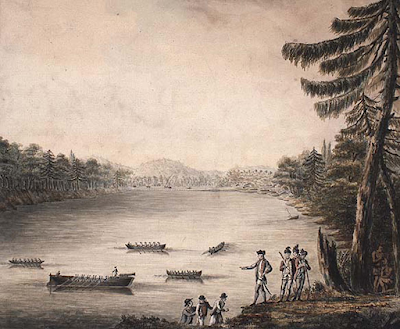
Brigadier General Fraser took command of Burgoyne’s advance guard, consisting of about 1,200 troops now trained as light infantry. The army launched from the mouth of the Richelieu River into Lake Champlain in an array of bateaux and canoes. Moving swiftly, Fraser’s forces protected the advance toward Fort Ticonderoga and captured it during a surprise attack as the American defenders retreated into the night. Fraser himself led the troops and raised a British flag.

A Hot Pursuit
Fraser then sent his advance guard in hot pursuit as the Americans chose to retreat through the dense forests to the south and east instead of taking the waterways that led south. The British vanguard continued on their trail and eventually cornered the American rear guard under Colonel Seth Warner, also an experienced fighter in the woods, near Hubbardton. In a back-and-forth struggle, the larger American force actually started to gain the upper hand, but a column of Germans under General von Riedesel helped turn the tide of battle.

Supply Chain Blues
The rest of Burgoyne’s army was now moving south again, with Fraser’s brigade leading the way. Albany was within reach with just one final push. However, Burgoyne faced a supply chain problem because he was far from his base, and shortages began to occur. Additionally, Fraser’s scouts, including some Canadians and Iroquois, reported a large concentration of Americans just north of Albany, under the command of a former British officer, General Horatio Gates.

Burgoyne began to lose his nerve. The other two attacks failed, and he was on his own. Instead of launching a full-scale assault, he ordered a reconnaissance in force with Fraser leading the right wing through thick woods and rugged terrain.

Clash of Titans
There, Fraser’s elite force clashed head-on with their American counterparts, the Virginia and Pennsylvania riflemen led by Colonel Daniel Morgan. Morgan’s riflemen wielded long rifles with grooved barrels that allowed for accurate fire over distances of more than one hundred yards. Fraser's brigade consisted of the best marksmen in the British Army. The lead flew as the top soldiers from each side exchanged fire, and ultimately, Morgan’s force was pushed back, creating an opportunity to exploit the situation and maneuver around the American flank.

A Pause and a Probe
But Burgoyne did not approve and instead withdrew his army back to camp to assess the supply situation. That situation only worsened, and as autumn advanced, Burgoyne found himself in a desperate predicament. This time, he launched a probing attack. The idea was to gauge the enemy and exploit any weaknesses. He initiated his probe on October 7 in what would become the Battle of Bemis Heights.

Frenzied Fighting
Once again, Fraser found himself in the thick of things with his brigade. However, the Americans showed no signs of backing down and launched fierce counterattacks all along the front, led by General Benedict Arnold. The British forces held their ground and, under the relentless pressure of American volleys and bayonet charges, withdrew. Time and again, Fraser rallied units and formed the line. Mounted, and despite the sheets of lead whistling all around, he waved his saber.

In the Crosshairs
From somewhere far off, an American rifleman cocked his hammer and gazed down the long barrel of his rifle, leveling it on a red-coated figure on horseback. Legend has it that the sniper was Private Tim Murphy, who allegedly said, “That is a gallant officer, but he must die.” He squeezed the trigger; the hammer cracked down, igniting the firing pan and launching a ball that just missed Fraser. A second shot struck his saddle, but Fraser ignored the fire. Ignoring pleas from his aides, he continued until a third shot hit home with a ball into his belly – a mortal wound.

A Blow to an Army
The fall of Fraser shocked the entire British Army—especially Burgoyne, who quickly ordered his battered forces back to their camp north near Saratoga.

Desperate hands dragged the dying general to the rear, where von Riedesel's wife, Baroness Fredericka, who had traveled with her husband on the wilderness campaign, cared for him.

The brave highlander died the next day and was buried at the Great Redoubt in a solemn ceremony held under the guns and muskets of the surrounding rebel army. A stray round from the American artillery nearly disrupted the event. Upon learning of it, Horatio Gates ordered a gun salute instead. Burgoyne would soon surrender his army, ending the campaign and influencing the indecisive King of France to favor the Americans.

Death's Legacy
Fraser’s life of action and service ended in a way any warrior would have chosen. But Britain lost more than a warrior; it lost one of its best generals, a man who truly understood the kind of fighting and the kind of fighting man required to win the war. Had he not fallen on that October day, he might have risen as the leader capable of subduing the colonies for the Crown, just as he once subdued his own Highland clans. Yet, ironically, the gallant Scot who fought for England, Holland, and German allies never fought for Scotland and is most remembered in America.


