Followers

Showing posts with label George Washington. Show all posts

Monday, February 16, 2026

The Magnificent Seven

This special Presidents Day Yankee Doodle Spies post profiles The Magnificent Seven.  No, not the rogues in the iconic 1960 John Sturges film, or the high-flying tech stocks on Wall Street, but the presidents of the United States who played a role in the American Revolution and War for Independence. 


Foundary of Freedom

The flames of revolution ignited in 1775, and from the smoke of muskets and the ink of bold declarations emerged seven men whose youthful or mature efforts during the American Revolutionary War (1775–1783) would propel them to the presidency of the United States. George Washington, John Adams, Thomas Jefferson, James Madison, James Monroe, John Quincy Adams, and Andrew Jackson each answered the call in their own way—some with sword in hand on frozen battlefields, others with eloquent words in candlelit chambers or through daring diplomacy across the Atlantic. 


The Magnificent Seven


Their stories intertwine personal courage, intellectual fire, and unyielding commitment to liberty, forming the very foundation upon which the nation stood. No president after this remarkable group bore the direct imprint of those revolutionary years, making their collective legacy a vivid reminder of how sacrifice and vision gave birth to a republic.


The Essential Man


First among the magnificent, George Washington (1732–1799), the towering Virginian whose calm resolve anchored the revolution, stepped forward as commander-in-chief of the Continental Army in 1775. Nominated by John Adams, Washington drew on his French and Indian War experience to lead a ragtag force against the world's premier military power. Picture the icy Delaware River on Christmas night 1776: Washington, cloak whipping in the wind, guiding boats through sleet to surprise Hessian troops at Trenton, a daring gamble that revived flagging spirits. 


George Washington


He endured the soul-testing winter at Valley Forge, where hunger and disease ravaged his men, yet he emerged stronger, drilling the army into a disciplined force with the aid of Baron von Steuben. His masterstroke came at Yorktown in 1781, where French allies sealed a trap around Cornwallis, forcing surrender and turning the tide. Washington's greatest gift to the cause was restraint—he crushed whispers of monarchy in the Newburgh Conspiracy and resigned his commission in 1783, embodying republican virtue. This path culminated in his unanimous election as the first president (1789–1797), the "Father of His Country," whose leadership set the tone for a free nation.


Colossus of Independence


Brilliant lawyer and architect of a nation, John Adams (1735–1826), the fiery Massachusetts lawyer, wielded intellect as a weapon in the political arena. At the First Continental Congress in 1774, he advocated for unity against British tyranny, nominated Washington as commander, and championed a navy to challenge British sea power. In 1776, he helped form the Committee of Five, persuaded Thomas Jefferson to draft the Declaration of Independence, and then fought tirelessly for its adoption. 


John Adams


As a diplomat, Adams secured Dutch loans that kept the war machine funded and co-negotiated the 1783 Treaty of Paris, ending hostilities on favorable terms. His blunt honesty and tireless advocacy for independence helped shape a stable government, culminating in his election to the vice presidency and, later, to the second presidency (1797–1801).


Father of the Declaration 


The sage of Monticello, Thomas Jefferson (1743–1826), the eloquent Virginian, penned words that still echo: "We hold these truths to be self-evident." As a delegate to the Continental Congress in 1776, he drafted the Declaration, crystallizing the revolution's ideals of liberty and equality. 


Thomas Jefferson


Back in Virginia, he reformed laws—abolishing primogeniture and championing religious freedom—while serving as governor (1779–1781), rallying defenses against British raids and narrowly escaping capture at Monticello. His pen and principles sustained the revolutionary spirit, foreshadowing his transformative third presidency (1801–1809), which included the Louisiana Purchase, which doubled the young nation's size.


The Little Giant


With a mind as large as his stature was small, James Madison (1751–1836), the quiet intellectual often called the "Father of the Constitution," honed his skills in wartime politics. In the Virginia legislature from 1776, he supported religious liberty and raised troops. 


James Madison


By 1780, in Congress, he grappled with the weaknesses of the Articles of Confederation, advocating fiscal reforms and a stronger union to support the war effort. His behind-the-scenes diplomacy and governance insights bridged the revolutionary chaos to postwar stability, influencing his fourth presidency (1809–1817) during the War of 1812.


Hero of Trenton


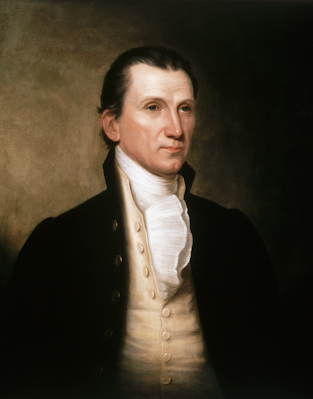
James Monroe (1758–1831) embodied youthful valor. At 17, he left college to join the Third Virginia Regiment, crossing the Delaware with Washington and charging Hessian cannons at Trenton—earning a severe wound that nearly killed him. He fought at Brandywine, Germantown, and Monmouth, later serving as a militia scout. Those trials forged his republican zeal, as evidenced by his fifth presidency (1817–1825) and the Monroe Doctrine, which warned Europe to stay out of the Americas.


James Monroe


The Prodigy


Learning at the knee of one of the era’s giants, John Quincy Adams (1767–1848), the precocious son of John Adams, tasted diplomacy at a young age. At 11, he sailed to France with his father; by 14, he served as secretary to the American envoy in Russia, aiding efforts to secure recognition. Though the mission faltered, the experience immersed him in global intrigue, shaping the diplomat who became the sixth president (1825–1829).


Young John Quincy Adams


Heroic Youth of the Waxhaws


Later known as “Old Hickory,” Andrew Jackson (1767–1845), the orphaned boy of the Carolina frontier, faced the war's harshest realities. At 13, he served as a militia courier through the guerrilla chaos, witnessing battles such as the Battle of Hobkirk's Hill. Captured by British troops, he refused to shine an officer's boots and was slashed across the face and hand—scars he carried forever. Imprisoned, he lost his brothers and mother to disease and hardship. That raw defiance fueled his later triumphs and his populist seventh presidency (1829–1837).


Andrew Jackson


In the crucible of revolution, these seven presidents were indeed magnificent—through command, conviction, courage, and cunning, they wove the threads of independence into enduring governance. Their lives remind us that America's story began not only in quiet halls but also in the roar of battle, the scratch of a quill, and the bold dreams of those who dared to build a new world. 


Happy Presidents' Day!


Friday, August 30, 2024

Tradesman Spy


Patriotic Sons of the American Revolution
 marker near Trenton, New Jersey


Fort Lee, New Jersey, November 1776. The tall soldier in a blue jacket opened the door. "Your visitor is here, Your Excellency."

General George Washington wiped the dark liquid from his pen tip and nodded. A nondescript man in farmer's clothes stepped in. Washington motioned toward a seat. "Thank you for coming, sir. I hope the journey did not discommode you."

"Not at all, sir. When we last met I gave you my word that I was at your service."

"Your nation thanks you for it. Our situation is bleak. The British regulars will be here within forty-eight hours. But the Army is too weak to make another stand."

"What will you do, Your Excellency?"

"Better you not know. Suffice it to say this state will be under British occupation for some time. That's where you come in."

"Me?"

Washington nodded. "I must trouble you to proceed to Trenton and its environs. Establish yourself there as a Loyal Tory. You are a hero of the last war—service under the great General Wolfe."

"He was a great man. As are you, Your Excellency. Now, what are your orders?"

"I need a spy in their midst."

The Spy?

Washington's visitor was one of the most mysterious figures of the Yankee Doodle Spies era. An Irishman born in Scotland, John Honeyman became a vital agent when the American cause was at its lowest point. His chameleon-like ability to hide in plain sight may have inspired the protagonist Harvey Birch in James Fenimore Cooper's important work, The Spy, although most associate that role with New Yorker Enoch Crosby.

James Fenimore Cooper


Historians disagree over Honeyman's role, as his narrative was written a century later by a grandson. However, this is common among secret soldiers whose actions remained undocumented due to secrecy and security concerns. Retired CIA Case Officer and Revolutionary War Historian Kenneth Daigler argued that Honeyman was one of Washington's operatives. 

Honeyman came from County Armagh, born to frugal Scottish parents. Though his father was a struggling farmer with little access to education, Honeyman learned to read and write. He had a talent for trades like weaving. But at age twenty-nine, Honeyman chose a new path by joining the British Army and sailing to America to fight the French and Indians.

Honorable Service

At sea, he caught the attention of General Wolfe and became his servant and bodyguard. He participated in the action at Louisbourg, but his military career ended tragically. Private Honeyman was beside Wolfe when the bold general was struck down in his moment of triumph on the Plains of Abraham outside Quebec.

Death of Wolfe at Quebec


With his officer gone, Honeyman mustered a sort of hero with a letter vouching for his service with and for Wolfe, who became a beloved figure among all Britons, especially those in America.

Tradesman and Family Man

Honeyman traveled to Pennsylvania, where he established himself as a butcher and weaver, and married a girl from Ireland named Mary Henry in September 1764. Around the time of the Shot Heard Round the World, Honeyman had moved to Philadelphia, the hub of the Continental Congress and a center of political debate and schemes. During that period, he may have caught the attention of George Washington. Some accounts say he offered the soon-to-be commander-in-chief his services.

A Spy Among Them

Honeyman left Fort Lee and arrived in Trenton. He had little trouble blending in with the local Tories—his letter from the late Wolfe and his discharge made him a respected Briton and servant of the King. He established his butcher and weaving businesses with the British and soon gained their attention as a Loyal Briton. His home was behind rebel lines at Griggstown, and John Honeyman, a Tory openly supporting Washington's plan, traveled back and forth trading while gathering intelligence. Sometimes, plans can succeed too well. With tensions running high that year in the Jerseys, a patriot mob attacked his home. His family escaped unharmed, though it took a note from Washington to ensure the Tory family’s safe passage to Trenton, now garrisoned by Colonel Johann Rall's brigade of Hessians.

Violence was not confined to the battlefield


Great Scheme Hits Paydirt

Using Trenton as his base for business and espionage, Honeyman was able to gather intelligence on the garrison's strength, morale, defenses, and other activities. A plan was devised to give him cover—Honeyman let himself get captured by a rebel patrol assigned to take him to Washington's headquarters.

Washington meeting a spy


The commander in chief personally "interrogated" the "prisoner." Afterward, he ordered the notorious Tory to be thrown into a jail cell. Washington arranged a diversionary fire that allowed the Tory to escape. The skilled line crosser made his way past guards and sentries from both sides and reached the safety of Trenton. There, the loyal Tory dutifully reported his capture and escape. Under Johann Rall's questioning, he was able to plant a significant piece of disinformation—the rebels were so low in morale and equipment that the Hessian commander did not need to fear an attack.

Johann Rall


Deception Brings Defeat

Although the Hessians had been on high alert for the past two weeks, Rall believed Honeyman's story and felt confident enough to relax security on the nights of December 25-26. The deception gave Washington just enough of an advantage—his army crossed the Delaware River and marched through the snowy night to surprise the garrison, which soon surrendered. His victory rescued the cause from certain defeat and may have turned the tide of the war.

Attack on Trenton


The Spy Who Stayed Out in the Cold

With fighting raging around Trenton, Honeyman headed north to New Brunswick, the logistics hub for British forces in New Jersey. There, Honeyman maintained the cover of being a Loyalist tradesman to avoid British retaliation for his espionage. Whether he continued to play an espionage role for Washington remains unknown. He did not return to his Griggstown home until the war ended.

Honeyman led a quiet post-war life on a small farm near Bedminster, New Jersey. None of his neighbors or friends suspected his connection to Washington, let alone his role in espionage. Honeyman remarried after Mary died in 1801. He died peacefully on August 18, 1822, at the age of 93. The spy and tradesman was buried in the Lamington Presbyterian Church Cemetery in Lamington, New Jersey.

Honeyman's gravesite


Sunday, March 31, 2024

The Once and Future Spy

Hogan’s Heroes

Fans of TV Land probably remember the hit comedy from the 1960s, Hogan’s Heroes. The story centered on a team of spies who were shot down over Nazi Germany to set up a spy network operating from a prison camp (Luft Stalag 13) deep inside Germany. From there, Colonel Hogan and his diverse group kept radio contact with “London” while planning various activities, from espionage to sabotage. Much of the show revolved around jokes at the expense of their clumsy captors, Colonel Klink and Sergeant Schultz, but they often sneaked out of the prison camp to nearby Hammelberg for secret missions. Yet, unlike other POWs—they would slip back in.


POWs as Spies - but for laughs

Winter War

Something like this happened during the height of the American War for Independence when General Washington needed intelligence after his victory at Trenton. Word had arrived that General Charles Cornwallis was leading an army south to seek revenge for the embarrassment. Washington ordered that someone be sent to Brunswick to evaluate the size of the British forces, especially the troops guarding the recently captured General Charles Lee. The status of British supply trains was also of interest because Washington considered marching north to seize their baggage and supplies for his under-supplied army.

Trenton


Daring Mission

Lieutenant Lewis Costigan of the 1st New Jersey Continental Line Regiment volunteered for the task. He was well-suited for the mission since he had been a merchant in the area and knew it well. Costigan’s mission is similar to Lieutenant Jeremiah Creed’s spying in my novel, The Cavalier Spy. He traveled north over icy roads during a bitterly cold winter that chilled the soul. He evaded British patrols, sentries, and Loyalist informers, successfully avoiding detection. Costigan gathered the intelligence Washington needed until British light dragoons swept in and captured him. The brave officer was in uniform, so his captors did not treat him as a spy.


British Light Dragoon


Prisoner on Parole

The British sent their new prisoner to New York City, where he was soon granted parole—a common practice that allowed officers to move freely. Less fortunate prisoners, usually enlisted men, were sent to the Sugar House or, worse, to prison hulks (ships) to wither away and die. However, officers, who had pledged certain restrictions as gentlemen, fared better. Paroled officers were not allowed to engage in military activities, communicate with colleagues, or criticize the British war effort. They agreed to report back to the British if instructed. Costigan led a dull life as a parolee, idling in the garrison city, visiting taverns, and mingling with locals. He was formally released in September 1778 as part of an exchange for a British officer.


Prison Hulk HMS Jersey

Learning about this, Washington wrote to his Commissary General for Prisoners, Colonel John Beatty, who was responsible for handling prisoner affairs, including exchanges. Washington urged him to free Gostigan quickly but to avoid appearing too eager to the British. His Excellency had plans for his past and future spy. General William Alexander, who called himself Lord Stirling, was to pressure Costigan to re-enter the fray once more. 

Costigan took a boat to New Brunswick, where he received a new mission from one of Stirling’s subordinates, Colonel Ogden, who urged the exchanged parolee to return to New York for a few more months and spy for the Continental Army! Washington must have been desperate for intelligence at the time, as the mission was highly unorthodox and fraught with significant risk. For his part, Costigan must have had a lot of guts and nerves of steel to agree.


Lord Stirling

Agent Z

What disguise would Costigan use to slip past the British and sneak around a garrison filled with enemy troops, Loyalists, and the rogue Provost William Cunningham’s thugs? Actually, none. His handlers were betting that the British prison bureaucracy wouldn't realize he had come back, nor would they alert the garrison regiments, Loyalist units, and Cunningham’s provosts when they exchanged prisoners. Stirling and Ogden were counting on the communication channels not connecting, and they were risking Costigan’s life. Costigan was given the code name Agent Z for this unusual mission.


Agent Z would walk among the NY garrison that winter

Prisoner Spy

Costigan made his way back and adopted the disguise of hiding in plain sight—living as the prisoner on parole he had been. Since he was legally exchanged, his previous parole restrictions no longer applied. Interestingly, no one seemed to pay much attention to Costigan as he wandered the city, observing troop movements, living conditions, supply issues, and more. Word of his exchange clearly hadn't spread among the dockside dives or the city’s many taverns and coffee houses. To everyone, he was just another parolee out in the town. Using his code name, Agent Z, the volunteer prisoner sent his intelligence reports to Washington through Colonel Ogden and Lord Stirling.


Agent Z had the run of the City

Intelligence

Agent Z successfully sent out three reports before leaving New York. The first was dated December 7, 1778. It included intelligence on troop and ship movements, the location of the British commander, General Sir Henry Clinton, the supply situation (low on bread), the names of captured prize vessels, and the origins of British provisions from sympathizers and profiteers in New Jersey. His correspondence mentioned several other reports concerning troop strength, but it remains unclear whether these ever made it through.


Sir Henry Clinton


A second report to Washington, dated December 13, 1778, provided more details on British activity that amounted to "indications and warning” of British forces sailing south for Georgia. Lord Sackville (George Germain), the British Secretary for the Colonies, had implemented his Southern Strategy, which would start with the capture of Savannah on December 29. He mentioned the notorious former Royal Governor William Tryon and reported on the movements and promotions of other senior officers. 


Agent Z provided I&W on Germain's 
Southern Strategy

Costigan’s final report from December 19 outlined British officers who had deserted in Florida, as well as the status and size of “the Jamaica fleet,” which he estimated to be about 40 or 50 vessels. 

The Spy Who Came in from the Cold

Agent Z clearly had a talent for observation and elicitation. There is no record of how he sent out his reports. Did he co-opt legal travelers? Send correspondence under a false name? Whatever method he used must have encountered a problem, because he left New York in mid-January 1779, presumably posing as an exchanged parolee. In March of 1779, General Washington inquired of Lord Stirling about his reporting (or lack thereof). Stirling replied tersely that Agent Z was no longer active and believed to be “out” (presumably of the city and the intel game) and thought to be residing in Brunswick.


Lieutenant Lewis Costigan - Agent Z

Lieutenant Lewis Costigan’s activities demonstrate how Washington used multiple channels of intelligence, as he was not connected to the Culper Ring organized by Major Benjamin Tallmadge but reported through Colonel Ogden to Lord Stirling. His exploits provide a unique glimpse into espionage during the American Revolution. As Agent Z, he took on the role originally meant for the unfortunate Nathan Hale, although his clever use of a “non-cover” added an elegant twist. Hiding in plain sight seems to have been all the tradecraft he needed.


Tuesday, November 28, 2023

The Third Virginian


It is a sad commentary that most Americans are more familiar with Marilyn Monroe than with the first patriot sharing her last name. And who knows? Maybe the Hollywood star who renamed Norma Jean was a history buff? But I digress. This profile shines a light on one of those diligent founders who quietly left his mark on America and the world. The fact that James Monroe is also a significant historical figure in my novel, The Lafayette Circle, makes his story even more compelling.


Norma Jean

Planter Orphan

James Monroe was born at the aptly named Monroe Hall in Westmorland County, Virginia, on April 28, 1758. His father was a moderately successful planter. Both of his parents died when Monroe was a teenager, and he took over the plantation and cared for his siblings under the guidance of his mother's brother, Joseph Jones, a member of the House of Burgesses. Jones took young Monroe to Williamsburg and enrolled him in the College of William and Mary. His uncle also introduced him to prominent Virginians like George Washington, Thomas Jefferson, and Patrick Henry—future leaders who would help shape the world, just as young James would.

Williamsburg

Patriotic Student

Williamsburg was alive with patriotic enthusiasm. Monroe was still attending William and Mary College when the Revolutionary War started in April 1775. Eager to join the fight like many other young Virginians, he left William and Mary, and on September 28, 1775, Monroe was commissioned as a second lieutenant in the 3rd Virginia Continental Infantry. His first commander was Colonel Hugh Mercer, who would become one of General George Washington's most trusted generals until his early death at Princeton caused by British bayonets. Lieutenant Monroe marched north to New York City with his regiment the next year.

The Virginia Line

Years of Combat

There, he first saw combat at Harlem Heights on September 16, 1776, and volunteered to join Major Thomas Knowlton's rangers. Knowlton, who was mortally wounded in that skirmish, became the namesake of the Military Intelligence Corps' honorary award, which bears his name.


After more fighting at White Plains in October, British General William Howe managed to flank the Continental Army but let it escape to New Jersey. Monroe's regiment moved south and west in a series of retreats, causing the Continental Army to shrink and American morale to drop. By late December, Washington's small force was gathered on the Pennsylvania side of the Delaware River and was in serious trouble.

An Army in Retreat


Things changed with the arrival of General John Sullivan as the leader of General Charles Lee's division. Interestingly, Lee had allowed himself to be captured at Bosking Ridge, New Jersey, by a group of British dragoons, including a young Banastre Tarleton. 


John Sullivan


Crossing the Delaware

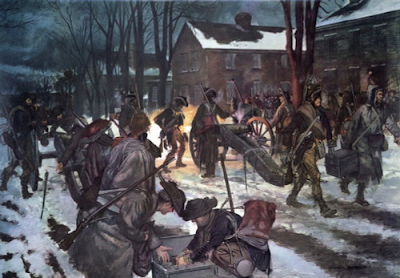
The additional troops allowed Washington to execute the plan he had been considering since crossing into Pennsylvania—a return across the Delaware River. With Howe's forces in control of New York City and most of the Jerseys, the situation was at its lowest point. He needed a daring move, so on Christmas night, Lieutenant James Monroe and Captain William Washington's company of Colonel Weedon's Third Virginia were steering their long Durham boats through the ice floes clogging the Delaware River. It was the night of the 25th and about as quiet as Washington could hope for, as his troops marched through the cold, windy night along icy wooded trails. Monroe had encountered a man named Riker along the way. He was initially thought to be a Loyalist, but it turned out he was a true patriot who then joined the ragged force heading toward the Hessian-occupied town of Trenton.


Crossing the Delaware


Christmas Surprise

At daylight on the 26th, the Continental forces launched an attack on the sleeping town. Sentries were pushed from their posts as the Virginians advanced from the north. Their target was a two-gun battery manned by Hessians, positioned to fire on the approaching troops of Nathanael Green's brigade. The town was thrown into chaos as sleepy musketeers and grenadiers stumbled from their quarters, shouldering their muskets.


Nathanael Greene


The pop, pop of desultory musket fire filled the cold morning air. It soon grew louder, causing Monroe's company to scatter for cover—they were the vanguard of their regiment and brigade. The Americans started to return fire, and more Continentals arrived on King Street. 

The boom of cannon from behind boosted their confidence. General Henry Knox's batteries were in action. Musket fire to the south also indicated that General Sullivan's brigades were attacking. But ahead stood that stubborn Hessian battery, ready to cut down the advancing column and stop the attack. 


American Artillery Opens Fire

The order came from Captain Washington, "Forward!" The company all rose together and moved forward at a trot, the men's fingers frozen to their muskets as the icy mix of sleet seared their faces and stung their eyes. The buzz of lead was all around them, and Captain Washington suddenly dropped to a knee, clutching his hands, which were streaming blood. Lieutenant Monroe suddenly took command.


William Washington


He charged forward with the company moving at double time, and soon, the Hessian gunners, who weren't shot or on the run, were surrendering their weapons and being marched to captivity. But not before a lead ball tore into Monroe's chest, staggering him and soaking his uniform in blood. Carried to an aid post where Washington was being treated, it was soon clear the ball had torn an artery—a mortal wound.


Monroe led the charge toward the Hessian guns

But fortune smiled on James Monroe as well as George Washington that morning. As it turned out, Riker—whose first name Monroe never learned—was a surgeon. And rare for those times, a highly competent surgeon. He managed to close the artery and prevent the future president from bleeding to death in a battle that resulted in no soldiers killed and only five wounded, including Monroe and Washington. He was promoted to captain for his gallantry.

Battles Lost and Won

Monroe recovered fully from his wound and performed capably at the Battle of Brandywine and Germantown in the fall of 1777. His success in those battles earned him a promotion to major and the appointment as aide-de-camp to General William Alexander on 20 November 1777. 

Major Monroe fought at the Battle of Monmouth on 28 June 1778, one of the fiercest battles of the war and the last major engagement in the North. However, Monroe, who was practically broke and unable to recruit troops, resigned from the Continental Army on 20 November. This was common; many Continental Army officers who served honorably went on to pursue business, return to farming, or enter politics. Alexander Hamilton is just one example.


Battle of Brandywine


Law and Politics

Back in civilian life, Monroe studied law under Governor Thomas Jefferson, a relationship that would influence their lives and the nation's future. When Charleston fell in 1781, Virginia planned to raise several new regiments, and Monroe was given the rank of lieutenant colonel, although he never saw combat.


Thomas Jefferson


His military career stagnated, but Monroe's political journey was rising—initially with a seat in the Virginia House of Delegates, then in the Confederation Congress. Later, he participated in the state constitutional convention. Like many notable Virginians (Patrick Henry, George Mason), he opposed the proposed constitution due to its centralized authority. Nonetheless, he took a seat in the new US Senate in 1790. 

Diplomacy

Monroe's international and diplomatic career began in 1794 when President George Washington appointed him US Envoy to France. His involvement in factional politics started three years later when he returned to Virginia and joined the anti-Federalist opposition organized by Thomas Jefferson and James Madison. This Virginia triumvirate would deeply influence US politics and the future course of the new nation. 


James Madison

Monroe was elected Governor of Virginia in 1799. However, in 1802, President Jefferson appointed him Envoy to France to support Robert Livingston's negotiations with Napoleon Bonaparte over the Louisiana Territory, which the US bought from France the following year for 15 million dollars—doubling the size of the US. Afterwards, Monroe served as minister to Great Britain, where he negotiated a commercial treaty in 1806, which the US Senate rejected because it didn’t address the hot-button issue of the day, impressment.


Napoleon Bonaparte

A Second War with England

After another period in Virginia politics, Monroe served as President Madison's Secretary of State in 1811. Tensions with Great Britain at that time led to the war. The War of 1812 was going poorly, so in August 1814, Madison temporarily appointed him Secretary of War. The third member of the Virginia triumvirate, James Monroe, was elected the nation's fifth president in 1816—showing strong teamwork.


British Army Burns Washington in 1814

Chief Executive

The nation was expanding rapidly when Monroe took office, and a growing sense of American patriotism and exceptionalism, if not outright nationalism, was everywhere. During this so-called Era of Good Feelings, Monroe and his Secretary of State, John Quincy Adams, aimed to strengthen America's position on the global stage. A brief war in 1819 against the Florida Seminoles, fought successfully by General Andrew Jackson, resulted in the Spanish selling West Florida to the US in 1820, helping him secure a second term.


President James Monroe

The Era of Good Feelings

In 1819, James Monroe became the first American president since George Washington to tour the country for goodwill. The nation was expanding west into the Louisiana Territory, the war with Britain had ended, and America had stood on its own against the world's only superpower. The Spanish colonies in South America were breaking free from Spanish rule and building their own democracies. America appeared to be the model of the future. As the nation's 50th anniversary approached, the American experiment seemed headed toward a prosperous future.


President Washington


The Holy Alliance

Not all nations welcomed the success of American democracy and the collapse of the Spanish empire. At the 1815 Congress of Vienna, the autocratic countries Prussia, Austria, and Russia formed a political alliance called the Holy Alliance. Holy because they still believed their rulers' authority came from God—the divine right of kings. They now turned their attention to the Spanish colonies. This did not go unnoticed by Britain, which had its own interests in the New World and did not welcome outsiders.


Congress of Vienna

The Monroe Doctrine

In 1822, Monroe's administration officially recognized the newly independent countries of America: Argentina, Peru, Colombia, Chile, and Mexico, after they gained independence from Spain. The British approached Monroe with the idea of issuing a joint statement of the status quo ante in the New World, but when he discussed it with his Secretary of State, John Quincy Adams, Adams hesitated. Why shouldn't the US issue its own policy? After all, Britain was still a rival, and we had just fought a war with them. He offered to help draft a letter to Congress explaining that external powers should not interfere in the Americas' affairs—no new colonies. Drafted in 1823, it was made public in early 1824.


Crafting the Monroe Doctrine

Vive Lafayette

As all this unfolded, Monroe's administration chose to capitalize on the popularity of the last surviving general of the Continental Army, the Marquis de Lafayette. What better way to showcase American exceptionalism, mark the upcoming anniversary, honor a war hero, and send a political message to nations like the Holy Alliance? The year-long visit started in August 1824, coinciding with the election of John Quincy Adams, who took office after Monroe in 1825. 


General Lafayette's Visit was a Tour de Force


Final Years

The former planter, politician, soldier, and statesman retired to his estate outside Leesburg, Virginia, with his wife, Elizabeth (Kortright) Monroe. President John Quincy Adams and General Lafayette visited the couple shortly before Lafayette's return to France. They had plenty of memories to share. After all, both were wounded while serving America—and the young General Lafayette had also fought at Trenton, Brandywine, and Monmouth. 


Elizabeth (Kortright) Monroe


Ironically, the last member of the Virginia triumvirate moved to New York City after Elizabeth's death in 1830. He lived with his daughter and her family at 63 Prince Street—on Lafayette Square. James Monroe became the third president to die on Independence Day when he succumbed to heart failure and tuberculosis on July 4, 1831.


Monday, October 30, 2023

Noble Patriot

 Noble Patriot

The American War for Independence gained the attention of all the European powers, and even the nobility and royalty were, at least initially, enthralled by it as the embodiment of the ideals of The Age of Reason. It did not take long before many of the nobility and upper class were scrambling to join the effort to secure liberty. Soon, names like Steuben, Kosciusko, de Kalb, and Pulaski joined the ranks of the Continental Army. Each made his mark in the Glorious Cause, but none so much as Marie-Joseph-Paul-Yves-Roch-Gilbert du Motier, Marquis de Lafayette.

Major General Lafayette


Old Blood, Old Money

Lafayette was born into one of the oldest families in France's aristocracy on 6 September 1757. The young Lafayette had a troubled youth despite a rich lineage, wealth, and privilege. His father, Michel de Lafayette, was struck by a cannonball fighting the British at the Battle of Minden, leaving him an orphan and marquis at two. As was typical of his class, Lafayette was commissioned into a French royal musketeer regiment at thirteen. However, his actual leadership experience was limited to parade and garrison duties when not partaking of the pleasures at court.

Lafayette senior fell at Minden

He was early on engaged to Marie Adrienne Françoise, the daughter of a powerful Duc d'Ayen, whom he married at sixteen (she was two years younger). The arranged match also proved a love match, and despite many trials and tribulations, the pair stayed together until she died in 1807. In 1776, the young marquis received a commission as a captain of dragoons, which should have begun his climb up the French military hierarchy, but for events across the ocean.

A Young Idealist

Lafayette was well-read in the classics and the principles of the Enlightenment, and from an early age, hoped to make a difference for mankind. By 1776, the political friction in America had erupted into open rebellion against the King of England. Like so many others, he followed the events with interest. Unlike so many others, he decided to act on his principles, which he saw enshrined in the sentiments of The Declaration of Independence — he determined to throw his lot in with the Americans and strike a blow for liberty. Equality and fraternity would have to wait, however.

The Declaration of Independence inspired Lafayette 


An American Agent

But what to do? Silas Deane, an American politician from Connecticut, represented the American Continental Congress in Paris — in effect, he was an American agent. Many European officers approached Deane to solicit commissions in the Continental Army. Deane's job was to screen them and make referrals of those with bona fide military experience or who provided some other advantage to the American cause. Lafayette's youth and inexperience would have usually precluded a referral, but his pedigree and connections at court, combined with his evident enthusiasm, got him a referral.

Silas Deane


Outlaw

Lafayette's family, especially his powerful father-in-law, objected to the move. As did his wife. She was pregnant. Influenced by the Duc d'Ayen, the government also refused permission for Lafayette to travel, expressly forbidding it. At the time, Deane was negotiating secret assistance from the French government and overt support. The presence of such a nobleman fighting for America would alarm the British. But the headstrong idealist bucked authority and managed to sneak into Spain, where he eventually boarded the ship Victoire, loaded with ordnance for the American cause. King Louis XVI subsequently declared him an outlaw. How much of this was actual pique at his disobedience or to throw off the British is hard to say, but likely both.

Lafayette escaped France via a subterfuge

Coming to America

The nineteen-year-old marquis landed in South Carolina in 1777, accompanied by several officers, including Baron Johann de Kalb, a French nobleman who would give his life for the American cause. He then traveled to Philadelphia to claim his promised commission as a major general. Congress hesitated due to his youth and inexperience. Major general was the army's highest rank at the time, and only a few were serving, but because of his connections, they finally appointed him — without command.

Johann de Kalb


Meeting His Excellency

Lafayette met Washington for the first time at a reception held in Philadelphia in August 1777 when the commander-in-chief came to the capital to consult with Congress on military matters. The two shook hands in the receiving line and then met privately — bonding almost immediately. Washington was impressed by his enthusiasm and military bearing. He returned to camp with Washington, but his status was still unclear. Lafayette still expected a field command. Was his commission actual or honorary? Washington took him into his "military family" and made him a sort of senior advisor.

Meeting with Washington

First Battle, First Blood, First Winter

The youthful general's mettle was tested the following month at the Battle of Brandywine, where Lafayette received a leg wound while helping rally a regiment fleeing the field. His mentor was pleased. His gallantry earned him a small command. In late  November, he led a detachment of 300 infantry in a skirmish against a large force of the vaunted Hessians at Gloucester, New Jersey — repulsing the Germans. His enthusiasm and energy throughout the harsh winter quarters at Valley Forge and his willingness to suffer along with the rest of the army further endeared him to Washington. A father-son relationship had developed. The childless Washington and fatherless Lafayette had a unique bond.

Wounded at Brandywine

Warmth of Spring

As winter ebbed, the sun's rays warmed the earth, and both the Continental and British forces uncoiled from hibernation and began to stir. Lord George Germain had recalled General William Howe to London to be replaced by his number two, General Henry Clinton. A new strategy was in motion, and Germain ordered Clinton to abandon Philadelphia for the security of New York, as a chunk of his troops were being sent to protect British interests in the West Indies.

Major General William Howe


Aware of upcoming changes, General Washington sent with an even larger command, a division of 2,000 troops and five guns, to observe British movements in and out of Philadelphia. Lafayette deployed his division in the vicinity of Barren Hills, Pennsylvania. Howe had not yet departed and decided to thrash the upstart Frenchman before he left. He dispatched the formidable General James Grant with 5,000 men and fifteen guns to entrap Lafayette. A three-pronged maneuver by Grant had British and Hessian columns on three sides of Lafayette's command, but he saw the trap about to be sprung and wisely slipped away via a road he knew would evade British observation.

British grenadiers advancing at Barren Hills

Lafayette's ability to quickly assess a tactical situation maneuver to safety pleased Washington, who entrusted him with a more significant command the following month. By the end of June 1778, Howe was gone, and Clinton led the bulk of his army overland to NewYork, crossing the hot, humid fields of New Jersey with the Continental Army following. 

Foul Up and Success at Monmouth

At Monmouth Court House, the British paused for a rest. Not ready to commit to an all-out attack, Washington agreed to send a  force to strike Clinton's rear guard. When his second in command, General Charles Lee, demurred from leading the attack, Lafayette offered his services. Wahington accepted the offer, but the wily Lee decided he wanted the command after all and marched off with Lafayette.

Washington at Monmouth


When the Americans launched their attack, the British, rather than retreat as was hoped, turned and fought, then when reinforced, the British rear guard counterattacked. Faced with a stiff fight, Lee gave conflicting orders, causing chaos in the American ranks. Seeing the American line crumbling and confusion growing, Lafayette sent a message to Washington to urge him to ride forward and take command. Washington was incensed when he arrived and began rallying the troops and relieved Lee of command (in a famous confrontation). The line steadied, and the Continental Army fought toe toe-to-toe with the Britsh, the swirl of combat ending at dark with both sides sleeping on the line. The following day, Lafayette rose and awakened Washington. As the two generals peered across the misty fields at dawn, the Britsh had retreated.

Summer in Newport

Lafayette was given command of two brigades as part of General John Sullivan's hapless expedition to Rhode Island that summer. The taking of the vital port hinged on cooperation with the naval forces of France's admiral Charles-Hector Theodat, comte d'Estaing. One of Lafayette's tasks was to convince the obstinate d'Estaing to support the American effort, but d'Estaing demurred. On 9 August, Sullivan's land forces attacked the British without d'Estaing, who refused to place his ships in Narragansett Bay. A storm struck, scattering the French and British fleets, and the land force attack failed. Sullivan's northern army withdrew, with Lafayette playing a pivotal role in keeping it an orderly retreat.

Admiral d'Estaing


 Home for the Holidays

In January 1779, the young marquis went on furlough, returning to France to advocate for wider French involvement in the war. Lafayette was initially arrested after landing on French soil, but the king quickly pardoned him. He was received in Paris as a hero, a sort of rock star — King Louis actually promoted him to colonel in the French Army. 

Louis XVI


Things were different with France and Spain openly at war with Britain. Lafayette proposed a joint invasion of Britain with him in command. However, the Spanish ships did not arrive until August, and a British fleet of fast ships complicated the plan, which was eventually abandoned. 

The Francp-Spanish  naval invasion of Britain was canceled

So, Lafayette refocused on gaining more support for the American cause, collaborating with American Commissioner Benjamin Franklin to arrange French troops for North America. He also refocused on his family, and in December, Adrienne gave birth to a son, whom he proudly named George Washington Lafayette. 

Benjamin Franklin

Meanwhile, the king had agreed to send more forces to America. He dispatched Lafayette to return with news of General Jean-Baptiste,comte de Rochambeau's impending arrival with some 6,000 men. Lafayette dutifully sailed from Rochefort to America aboard the frigate Hermione, arriving in Boston on 27 April 1780.

Fighting for Liberty

Washington, the commander-in-chief of both nation's forces, used Lafayette as a high-level liaison between Rochambeau and himself. Little was accomplished during the remainder of 1780. Washington and Rochambeau's forces postured while the generals pondered and planned. Most of the fighting was taking place in the Carolinas, where the British launched a successful invasion but then got tied down, trying to hold on to what they grabbed. 

General Rochambeau


But by 1781, trouble and opportunity beckoned in the warmer climes of Virginia when General Charles Cornwallis marched north from the Carolinas to establish firm British control over the Old Dominion in a desperate ploy to reshape the balance of power. British forces under Generals William Phillips and Benedict Arnold ( the same) based out of Portsmouth had advanced as far as the new capital in Richmond and raided as far as Charlottesville. 

British Brigadier General Benedict Arnold


General Friedrich von Steuben's small detachment of Virginia militia did what they could to block and harass. Still, it was not enough, and now the impending arrival of another army from the Carolinas put von Steuben and Washington's home state at grave risk. 

The Old Dominion

But with risk came opportunity. So, in response, Washington sent Lafayette to Virginia to support and take command of all American forces. Lafayette spent several weeks sparring with Cornwallis around Richmond and Petersburg. The canny veteran, Cornwallis, made several efforts to overpower the young general. But  Lafayette was up to the task. 

Lafayette led the way in the Old Dominion


At Green Spring on 6 July 1781, he moved quickly to support the beleaguered forces under General Anthony Wayne. Cornwallis was soon boxed into the Virginia peninsula, where Lafayette pushed him slowly toward Williamsburg and the supposed refuge on the York River. Tipped off by an African-American spy named James Armistead,  the young marquis carefully shadowed Cornwallis to Yorktown and helped trap him in his works. 

Yorktown

By August, Cornwallis had established his base at Yorktown, and the marquis positioned his forces on Malvern Hill, placing guns zeroed in on the British. Cornwallis's tired and now disease-ridden army waited for supplies and reinforcement from or evacuation to New York. Thanks to the French fleet, it would come too late for him and his men.

Major General Charles Cornwallis


Washington and Rochambeau's forces converged on Williamsburg after force marching from New York. Lafayette met them and helped plan the final phase of the campaign — besieging Yorktown. Time was critical as the weather would allow the French navy to linger only a few more weeks. 

Storming the Redoubt


Lafayette commanded the Light Infantry Division during the siege and was in overall command of the French and American forces that stormed Redoubts Nine and Ten, the final nail in the British coffin. On 19 October 1781, Cornwallis's army grounded arms and marched into captivity. The war would not end for two long years, but most major combat on land had ended.

Surrender at Yorktown

What Next?

The British still clung stubbornly to garrisons throughout the Carolinas and firmly held Savannah, Georgia. Lafayette offered to command forces to capture them, but Washington was confident in Major General Nathanael Green's handling of the South. Besides, Lafayette would prove more valuable as an advocate for more naval and monetary support from France.

General Nathanael Greene


Lafayette traveled north to Philadelphia, where Congress appointed him its advisor to the commissioners in Europe, Ben Franklin (Paris), John Jay (Madrid), and John Adams (The Hague), and sent a letter of commendation for the marquis to the King of France.

Hero of Two Worlds

On 18 December 1781, the young hero of two worlds sailed from Boston for France. Everywhere welcomed the hero, Lafayette had an audience with the king at the Palace of Versailles on 22 January 1782. Louis XVI named him maréchal de camp and a Knight of the Order of Saint Louis. Lafayette went to work helping plan a Spanish-French expedition against the West Indies as the war was now a world war and, despite Yorktown, far from over. He also helped advise the negotiations that led to The Treaty of Paris in 1783.

Treaty of Paris signing


But possibly Lafayette's greatest triumph and joy was reuniting with his family. He was there for the birth of his daughter, Marie Antoinette Virginie Motier de la Fayette, on 17 September 1782. Prospects for the marquis and his family were bright. Wealth, nobility, military success, and fame glorified him. Freedom had triumphed in the New World. Now, the young idealist sought ways to replicate the same in the Old World.