Followers

Showing posts with label Princeton. Show all posts

Friday, March 31, 2023

Delaware Patriot


When I started writing the Yankee Doodle Spies Blog many years ago, one of the first patriots I wanted to feature was someone from Delaware. An immigrant preacher who left Ireland for a better life and fought in two wars, one for Britain and one against it, this underrated patriot is John Haslet. 

A Londonderry Man

Born around 1727 in Dungiven, near Londonderry, Ireland, this son of a tenant farmer grew up to be a devout man and, when necessary, a passionate leader. As a young man, he traveled to Glasgow, Scotland, and studied Divinity. He finished his studies in 1749, sailed home, and soon married. His wife was Shirley Stirling, the daughter of a preacher. John was ordained as a Presbyterian minister in 1752 and, later that year, delivered his first sermon to his new congregation at Ballykelly. Around that time, the Haslet family had their first child, Mary (or Polly).


Preaching


Tragedy and Immigration

The year 1757 was a time of tragedy and change for Haslet. Shirley lost their second child and died during childbirth. Soon after, Haslet decided to emigrate. Following a common practice of the time, he left young Polly in his brother's care and sailed to America for a new life in a place called Delaware. The young widower quickly remarried there, taking Jemima Molleston as his second wife. 

Against the French and Indians

Haslet joined the Pennsylvania militia. His degree from the University of Glasgow and his experience speaking to and inspiring his congregations marked him as a leader, and he quickly rose to the rank of captain. The French and Indian War was ongoing when Haslet arrived in America. The campaign to expel the French from the frontier took Haslet and his militia company to western Pennsylvania, where they fought in the 1758 Battle of Fort Duquesne.


Fort Duquesne


Country Doctor

The war ended with the Treaty of Paris in 1763. Haslet returned with his company to Delaware. He and Jemima settled in Milford, where he established a medical practice and bought a property called "Longfield." John and Jemima had four children. Additionally, his daughter Polly immigrated to Delaware in 1765. An ideal life as a country doctor and farmer awaited him. 

From Friction to Fighting

But the political friction after the war grew into armed resistance, and Haslet became involved, eventually advocating for independence from Britain. The Continental Congress appointed him a Colonel and commander of the Delaware Regiment (sometimes called the Delaware Blues), one of the largest (800 men) and most well-uniformed and equipped regiments in the Continental Army. Their blue jackets with white waistcoats and breeches set the standard for all the regiments of the Continental Line. 


Haslet's Regiment leaves for war

Valor on Long Island

John Haslet's regiment marched to New York and into the defense works on Long Island in the late summer of 1776. General George Washington had occupied the city, but the British armada under Lord Howe sailed south and descended on Staten Island before invading Long Island at Brooklyn's Gravesend.


When the British surrounded the Americans, Haslet's regiment and the First Maryland held firm against the attack. At the peak of the fight, Lord Stirling, an American general and Scottish peer named William Alexander, took command of both regiments and led them in a series of brave charges against British General Cornwallis's regular troops. 


Haslet's Delaware Regiment faces British regulars on Long Island


Absorbing volley after volley from the red-coated ranks, the two regiments were torn to shreds. However, their discipline and sacrifice allowed the rest of the American army to retreat to the safety of the defenses near Brooklyn Heights. This event is a pivotal moment in my novel, The Patriot Spy. Ironically, Haslet and the Maryland commander, Colonel John Smallwood, were on court-martial duty in New York City and only returned after the battle had ended.


Colonel John Smallwood


Retreat, Fight, and Retreat

Haslet and his regiment fought bravely during the months that followed as the Continentals were forced out of New York City. During the retreat, Haslet and his men defeated a Loyalist corps at Mamaroneck.

At White Plains on October 28, Haslet and Smallwood stood bravely with their regiments on Chatterton Hill. When the militia they were sent to reinforce broke and fled, the two Continental regiments held their ground until the enemy's numbers and firepower forced a retreat. However, the stand on Chatterton Hill denied General Howe a complete victory, and the Americans would live to fight another day.


Chatterton Hill


War on the Run

General Washington's army was on the run for the next two months. Fort Washington fell, and his men abandoned Fort Lee as they hurried across New Jersey toward the Delaware and Pennsylvania, where Washington hoped to regroup and make a stand. Haslet and his men fought many small battles—skirmishing during a "fighting retreat" that reduced the Delaware Regiment to no more than 100 "effectives"—men capable of fighting by the time they crossed the Delaware River to rejoin the main army.


War on the Run

Trenton

Knowing he needed to strike within days, Washington launched his famous Christmas surprise attack, crossing the ice-clogged Delaware River on the night of December 25, 1776. The army trudged the nine miles under a dark and cold sky to their target: the Hessian garrison at Trenton, which had over a thousand troops. Although barely two companies strong, Haslet and his men led the charge. After a brief but fierce exchange of musket and artillery fire, the garrison surrendered, giving Washington one of the war's greatest victories. Before Haslet had time to refit, enlistments were expiring, as they were across the entire army. 


Taking Trenton


Assunpink Creek

Days later, the army returned to Trenton, defending a low ridgeline behind a creek south of the town and waiting for the British counterattack with more than 5,000 fresh redcoats under an angry General Cornwallis. A late afternoon firefight on January 2, 1777, caused Cornwallis to stand down and strike with all his force the next day. However, Washington outmaneuvered them and executed an 18-mile night march around the British to attack their supply base at Princeton.


Holding Assunpink Creek


Destiny at Princeton

The dawn of January 3rd broke bright but cold, with snow covering fields and roads. Colonel Haslet's regiment was now just a handful of officers. Months of fighting and expired enlistments had worn down his regiment. However, Haslet's experience and capable leadership remained crucial, so Washington appointed him as second in command to General Hugh Mercer, his best commander.


General Hugh Mercer bayonetted at Princeton


Mercer's division was at the forefront, marching through William Clarke's orchard when two crack regiments of British regulars unleashed a horrific barrage of volleys, shooting Mercer's horse out from under him. Mercer quickly got to his feet and drew his saber as the wave of red moved in on him. When he refused to be taken prisoner, they clubbed him and then bayonetted him while he lay helpless in the snow. He died from his wounds.

The Field of Honor

Seeing Mercer go down, Haslet took command of the remnants. But just moments later, a curtain of lead filled the air, and a musket ball struck him in the head. The remaining troops began to waver, but General Washington rode into their midst and rallied them. Then, combined with reinforcements, they drove the British from the field and took Princeton. The gallant John Haslet died on the field of honor like his commander, Hugh Mercer.


Washington rallying the troops

Washington's Loss, America's Loss

The history books record Princeton as a victory. However, the loss of Mercer and Haslet robbed Washington of two of his most capable lieutenants, whose talents the commander-in-chief would desperately miss over the next five years of war. Mercer is rightfully honored, but Haslet, being second in command and from a small state, often goes unmentioned. I count John Haslet among the many unsung heroes whose early death deprived the Continental Army and the future United States of leadership, integrity, and patriotism.

Delaware's Son

The son of Delaware was buried outside his home state and laid to rest in the graveyard of the First Presbyterian Church. It wasn't until an Act of the Delaware Assembly was passed in 1841 that his remains were moved to the Presbyterian Cemetery in Dover, Delaware. However, it wasn't until 2001 that his state finally honored him with a monument at Princeton. 


Haslet Monument at Princeton


Monday, September 28, 2020

The Winter War


“I shall constantly bear in Mind, that as the Sword was the last Resort for the preservation of our Liberties, so it ought to be the first thing laid aside, when those Liberties are firmly established.”

Letter from General George Washington to the Executive Committee of the Continental Congress, January 1, 1777


                                                Washington's pen was as mighty as his sword


January 1777

The Jerseys are aflame in a deep winter-war!

Backs against a frozen river and facing a column of crack redcoats intent on their destruction, George Washington’s army has a serious gut-check. They must outfight or outwit the British to preserve the faltering struggle for independence. With the help of the winter spy, General Washington intends to do both…

Back cover of The Winter Spy, June 2020


The Genesis

This is a book I never expected to write. But as I finished book two in the Yankee Doodle Spies series, my research and curiosity guided me to a straightforward question: what did Washington do AFTER crossing the Delaware? It turns out, quite a bit. I became so interested that I created a follow-up story to capture the feel and action of this important yet little-understood chapter in the American War for Independence.


                                       What did Washington do after he crossed the Delaware?


Winter Quarters

In the 18th century, armies typically fought from late April or early May through November. During the off-season, some soldiers and officers were sent home on furlough, but most simply tried to survive the winter while the armies were restocked and equipped for the next season of marching and fighting. The British had the advantage of quartering many of their forces in towns and cities, using stores, shops, stables, public buildings, and private homes.


                                         Gen Steuben drilling American troops at Valley Forge


For Americans, winter quarters were often a harsh experience of cold, disease, and starvation. For the British, it was a time of relative comfort between grueling military duties. Naturally, both sides had to keep guards and sentries posted. Some patrols were dispatched. During the 1778 Valley Forge encampment, winter quarters became a training ground with the arrival of General Steuben as Inspector-General and Drillmaster.


Winter Action


My readings for my second novel, The Cavalier Spy, opened my eyes to the actions General George Washington took after the Battle of Trenton: two major battles (2nd Trenton, Princeton), along with many skirmishes, marches, and hardships before his increasingly small army reached its final destination at Morristown, New Jersey. 

That decision was highly tactical. His actions compelled the British to withdraw most of their outposts in the Jerseys, leaving them in control of the area around Brunswick, Paulhus Hook (Jersey City), and their main strongholds in Staten Island, Long Island, and Manhattan. With the British in winter quarters, most armies would have hunkered down, recovered, and rearmed. The choice was tactical because Washington could monitor enemy movements with his forces safely behind the Watchung Hills, ready to move in any direction the British advanced in the spring. That was the original plan.


                                        Princeton was one of two actions fought in as many days


But as the British sent out foraging parties into New Jersey to buy or requisition foodstuffs, the Jersey militia responded. Small groups were ambushed, leading to larger foraging parties and bigger ambushes. The numbers grew until Washington authorized some of his Continental regiments, including those led by Generals Philemon Dickinson, William Alexander (Lord Stirling – an American who claimed a Scots peerage), and Ulster-born William “Scotch Willie” Maxwell. By the end of this winter of discontent, the British had lost roughly as many men killed or wounded during “winter quarters” as they did in the previous three pitched battles. Losses that British commander-in-chief, General William Howe, could not afford.


                                                     Gen William Alexander - Lord Stirling


The Plot

No spoiler alerts here – read the book! But needless to say, Lieutenant Jeremiah Creed and his White Knights are thrown into action once again, operating both within and outside the Continental Army. They clash again with the ruthless British dragoon, Major Sandy Drummond, who continues to use his intelligence network to break the rebellion. Along the way, a variety of soldiers and citizens clash, make friends, make enemies, fall in love, and struggle to stay sane during a time that tests men’s souls. Woven into the plot are two themes: the bonding of men in conflict and the war’s impact on families. And, there is always the weather—winds that can cut a man in two, frigid temperatures, and ice-covered roads and rivers play a significant role in a story that, after all, was named for them.


The Book


All three books in the Yankee Doodle Spies series are published by Lanyard Press.

The Winter Spy is available on Amazon in Paperback or Kindle.

https://www.amazon.com/Winter-Spy-Yankee-Doodle-Spies/dp/B08JVNPPKG/ref=tmm_pap_swatch_0?_encoding=UTF8&qid=&sr=


Tuesday, January 28, 2020

The Surgeon General from Scotland


Fans of Outlander will instantly recognize the unique connection this first patriot shares with the main characters of the cherished books and TV series. A strong, passionate Scotsman with fiery temper meets a calm, strategic medical professional who faces the British across two continents. Yet in this case, both qualities are embodied in one person—Hugh Mercer, a man who blazed a trail from the streets of Aberdeen to the bloody fields of Culloden, through the war-torn mountains of Pennsylvania and the frozen farmlands of New Jersey.


General Hugh Mercer


The Streets of Aberdeen


Hugh Mercer was born in Aberdeenshire, Scotland, in 1725 to Reverend William Mercer, a Church of Scotland minister, and Ann Monro. He graduated from the University of Aberdeen with a medical degree in 1744. That same year, he joined the Jacobite army of Prince Charles Edward, the Pretender, and served as an assistant surgeon during the disastrous engagement at Culloden in April 1746. He escaped the massacre that followed the battle, and after months on the run, fled to America.


Country Doctor


The young surgeon, a war veteran and fugitive, settled in present-day Mercersburg, Pennsylvania, to work as a doctor. When the French and Indian War started in 1755, he put aside his eight years of comfortable medical practice and offered his services to the provincial forces, taking part in several notable battles. 

Another Massacre


On the western frontier of Pennsylvania, Mercer helped care for the survivors of General Braddock’s defeat on the Monongahela River. Shocked by the suffering of the wounded, Mercer set aside his disdain for the crown and joined Britain’s fight for America.


Punitive Expedition


In September 1756, the newly appointed captain joined Colonel John Armstrong on his punitive expedition against the Indian villages at Kittanning and was severely wounded. Isolated, he survived for two weeks on his own, wandering over 100 miles before reaching the friendly outpost at Fort Shirley. His devotion and gallantry were recognized. 


Mercer served under Col John Armstrong
in western Pennsylvania raid

Fort Duquesne


Two years later, he served as a lieutenant colonel during the capture of Fort Duquesne (renamed Fort Pitt, now Pittsburgh) and later took command of the fort. Mercer's first task was to build a temporary fort to control the two forks of the Ohio in case the French returned from the northwest. During this campaign, Mercer met and formed a lasting friendship with Colonel George Washington of the Virginia Regiment. 


The Old Dominion


The war ended in 1763, and because he had befriended several Virginians, he chose to settle in a small port town with a tight-knit community of Scottish ex-pats. Although Mercer arrived in Fredericksburg to start a medical practice, he discovered much more. The town filled a void that had existed since he left his homeland.


Mercer opened an Apothecary in his
adopted town of Fredericksburg


First Mother's Physician


Besides practicing medicine, Mercer opened an apothecary in town. Like many settlers, he bought land. He served as a doctor to George Washington’s mother, Mary Ball Washington, and acquired the Ferry Farm from her as his family homestead. 


One of Mercer's celebrated patients
was Mary Ball Washington

Civic Leader


He became active in local town issues and was a prominent businessman. Along the way, he joined the Masonic lodge, which included Washington and many other notable Virginians. To say he was finally comfortable with life is an understatement. But he would soon leave his comfort to follow the drum one last time.


Mercer, George Washington, and numerous founders
belonged to the Fredericksburg Masonic Lodge

The Minuteman


By 1775, the tensions between Britain and its colonies in North America had shifted from resistance to rebellion and eventually to war. It was only natural that the brave freedom-lover Mercer would join the cause and face his former enemies again. He became a member of the Fredericksburg Committee of Safety. In September, Mercer was appointed commander of all Minuteman companies in the four counties around Fredericksburg. 


Virginia Minutemen


The Continental


In January 1776, his talents were once again recognized. Virginia’s provincial congress appointed him a colonel in the 3rd Virginia Continental Line. He set to work training it into a sharp, disciplined unit, but that command was short-lived. His old friend and fellow soldier, George Washington, was now the commander in chief of the new Continental Army. Mercer enjoyed a strong military reputation, so Washington petitioned the Continental Congress to appoint him brigadier general that June.


Mercer commanded a Continental Line regiment
but was quickly promoted to the rank of
Brigadier General

Flying Camp Days


Washington quickly assigned him to lead the so-called Flying Camp, a mobile military reserve. He tried to use it to support the main army during the New York campaign, but the unit faced desertions, manpower shortages, and supply problems. The Flying Camp was disbanded that winter. 


Fort Lee before evacuation

Battle Across the Jerseys


Mercer was also responsible for constructing what became Fort Lee on the New Jersey side of the North (Hudson) River. Although the fort fell without resistance during the British invasion of the Jerseys in late 1776, Mercer still held Washington’s full confidence. He played a key role during the bold and skillful counter-attack at Trenton on December 1776, 1776. His brigade was instrumental in pushing the Hessian garrison out of the town, where they were compelled to surrender in a nearby field.


Mercer commanded a brigade at the crucial
assault on the Hessian garrison at Trenton

Escape from Assunpink

The Americans eventually moved to Assunpink Creek to wait for the inevitable British counterattack by a column of about 5,000 troops led by Major General Charles Earl Cornwallis. Some say Mercer may have suggested the famous ruse of leaving fires burning. Regardless, the British were fooled when the Americans slipped away into the night, got behind Cornwallis’s column, and launched an attack on Princeton. 


After repulsing Cornwallis's columns at Assunpink Creek
the Americans slipped away in the night

Advance on Princeton


On January 3, 1777, Mercer, leading the advance unit ahead of the main force, faced a brigade of about 1200 British regulars under Lieutenant Colonel Charles Mawhood of the 17th Regiment of Foot. A fierce volley exchange broke out near Stony Brook Bridge. Instead of retreating from the redcoats' pressure, the formidable Scot charged into battle against the better-trained British troops. However, his men were pushed back after intense combat.


Mawhood's brigade was all that stood
between Mercer and Princeton

Clash and Flurry of Blades

While trying to rally his men, Mercer was shot from his horse. Refusing to surrender, he drew his saber but was overpowered and stabbed multiple times by furious British soldiers (who might have thought he was Washington). Wounded fatally, he was carried to the nearby home of Thomas Clarke, where a British surgeon's mate and some local women cared for him. When Washington learned his fate, he contacted Cornwallis, who kindly allowed Washington’s top doctor, Dr. Benjamin Rush, to tend to the dying general. 


British bayonets mortally wounded
the gallant Scot turned Yankee

Final Home


The brave soldier-surgeon Mercer lingered but eventually died from his wounds on January 12, 1776. His body was taken to Philadelphia for burial. Had Mercer survived, he likely would have played an even more important role in fighting for America's independence. Still, the greater tragedy is that this educated and committed soldier-surgeon never got the chance to help build the nation whose freedom was bought with his blood.


Gen Hugh Mercer's grave 

Monday, January 2, 2017

The Surgeon General

Tomorrow marks the anniversary of the Battle of Princeton, the culmination of a week of daring action that literally saved the American Revolution—at least until its next crisis. The battle featured a daring night march by Washington's army—pinned and shivering between the Assunpink Creek and the frozen Delaware River, awaiting possible annihilation by General Cornwallis and 5,000 British and Hessians hell-bent on revenge for the first battle of Trenton. 

Washington's men abandoned camp in the dark winter night. Tramping through frozen marshlands, they circled around the British, arriving several miles behind them and preparing to seize the British base at Princeton. Washington succeeded in one of the rare open-field engagements of the campaign, demonstrating decisiveness and personal bravery by leading his men across the snow-covered fields in a gallant charge. But the victory came at a great cost: two of his top generals fell that day. One of them was Hugh Mercer, the Scottish-born surgeon turned soldier.


Young Hugh Mercer


Early Life: Scalpel, Claymore, and Tomahawk


Mercer fought with the clans at Culloden


Mercer was born in Aberdeenshire, Scotland, in 1725, and earned a medical degree from the university of that name in 1744. Apparently a lover of hopeless (not lost) causes, the young Mercer joined the Jacobite army under Prince Charles Edward, known as the Pretender, until that struggle for freedom was crushed by the Duke of Cumberland's redcoats at Culloden on April 16, 1746. 

After a period in hiding, Mercer fled to America and settled in Pennsylvania, where he established his medical practice. At the outbreak of the French and Indian War in 1756, Mercer joined the colony's forces. Throughout the war, Pennsylvania's western region faced relentless Indian raids, encouraged by the French. Mercer began his service as part of Colonel John Armstrong's expedition against the Indians at Kittanning, where he was wounded. 

In 1758, he served as a lieutenant colonel in the siege of Fort Duquesne and was later given command there to secure the West. Around that time, he befriended a colonel named George Washington, who commanded the Virginia Regiment, which performed similar duties protecting Virginia's western frontier.


The British capture of Fort Duquesne

Colonial Life: Prosperity and Family


When the war ended in 1763, Mercer moved to Fredericksburg, Virginia, and reopened his medical practice. It makes one wonder if his connection with Washington influenced his decision to relocate to the Old Dominion. When Mercer arrived in Fredericksburg, it was a lively Scottish community. 

Fellow Scot John Paul Jones's brother farmed nearby, and Jones himself hoped to settle there permanently. He became a well-known figure and businessman in town, purchasing land and engaging in local trade. His medical practice brought him into contact with many prominent Virginians, including George Washington's mother, Mary Ball Washington, who became one of his patients. 

In Fredericksburg, Mercer married Isabella Gordon, started a family, and had five children. Later, he purchased George Washington's childhood home, Ferry Farm, with the hope of making it his permanent residence.


Mary Washington was a patient
of Mercer's (seen here as a younger woman)

Run up to War


Like many Virginians, Mercer supported the Patriot cause as the American Revolution approached. He joined the Fredericksburg Committee of Safety and, on April 25, was among the members of the Independent Company of Fredericksburg who wrote a letter to then-Colonel George Washington, expressing concern when the British removed gunpowder from the Williamsburg magazine. Because he was Scottish, the Virginia Convention skipped over him for command of the first Virginia regiments in 1775. 
However, he was appointed commander of all the minuteman companies in the four counties around Fredericksburg. Early in 1776, Mercer's military experience led the provincial congress to appoint him as colonel (commander) of the 3rd Virginia Continental Line. Future President James Monroe and future Supreme Court Justice John Marshall served under him.


James Monroe served under Mercer


From Surgeon to General


In June 1776, General George Washington, in urgent need of experienced commanders, persuaded the Continental Congress to appoint Mercer as a brigadier general. Mercer's experience and reputation led Washington to place him in command of the "Flying Camp' during the New York campaign. These were inexperienced militias requiring strong leadership and strategic training. The Flying Camp served as a special military reserve, but despite Mercer's efforts, it suffered from shortages of equipment and men and was disbanded by year's end. Mercer also oversaw the construction of Fort Lee, which overlooked the North River across from Fort Washington in Manhattan. 

During the darkest days of the war, Mercer played a key role in Washington's night march on Trenton on December 26, 1776. He helped plan and execute the crossing and led his brigade into Trenton from the west—driving the Hessians out of the town and into an orchard, where they were almost annihilated. Mercer was also instrumental in repulsing the British during the second Battle of Trenton on January 2, 1777. The next day, Washington's army advanced on the British garrison at Princeton, New Jersey. 

Mercer's brigade, consisting of 350 men, encountered Lieutenant Colonel Charles Mawhood's force—two British regiments and some dragoons, totaling about 1,200 men—near Stony Brook Bridge. A fierce firefight erupted in an orchard grove. The fiery Mercer refused to retreat despite the overwhelming odds and charged into battle. 

The better-trained British forces pushed his men back, causing them to break ranks. As Mercer attempted to rally his troops, his horse was shot from under him. He quickly got to his feet but was soon surrounded by British soldiers who mistook him for George Washington and ordered him to surrender. 

Outnumbered, Mercer drew his saber and fought fiercely. He was eventually knocked to the ground, bayoneted seven times, and left for dead. When Washington learned of the British attack and saw some of Mercer's men retreating, he personally entered the battle, famously rallying Mercer's men and forcing the British regiments to retreat.


Death of Hugh Mercer at Princeton

A Nation's Loss


After the battle, Mercer's body was taken to a nearby farmhouse where Washington's leading physician, Dr. Benjamin Rush, attended him. However, Mercer died of his wounds on January 12, 1777. His loss was a significant personal blow for Washington, but it was an even greater loss for the new nation, which would have benefited from his leadership both in peace and in war.


Mercer Statue at Fredericksburg


Sunday, January 11, 2015

Somerset Court House

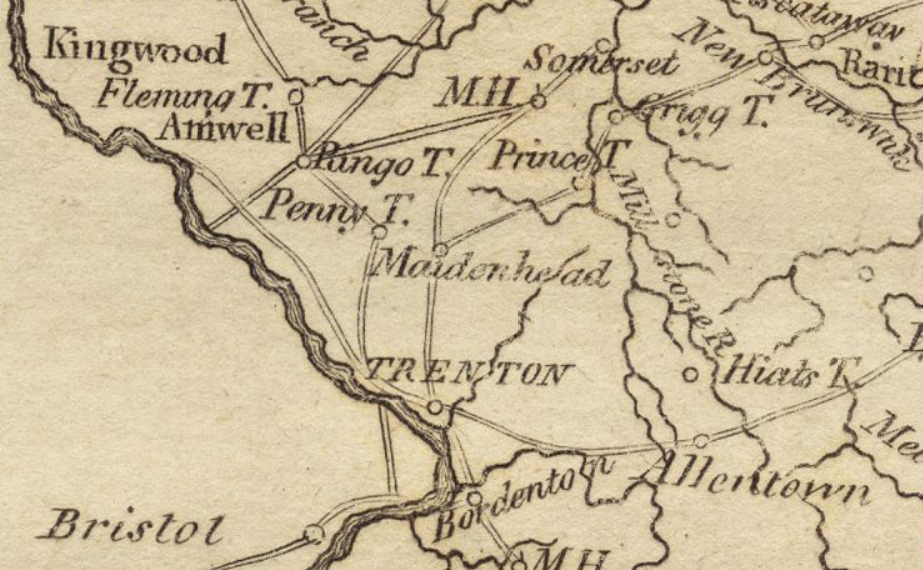
The area around Somerset Court House in central New Jersey saw an extraordinary amount of Revolutionary War military activity. Reason: it was on the main approach between north Jersey and Princeton, and between Princeton and New Brunswick, a British stronghold in Jersey. Not unexpectedly, the militia around Somerset Court House, now Millstone, New Jersey, saw action on several occasions. Somerset lay in that "middle area" between the British and American outposts, which had some quite vicious but little-celebrated fighting. Besides being in a strategic crossroads, the area around Somerset Court House was full of thriving farms with an abundance of crops and animals. During the winter in particular the ground was often frequented by British foraging parties from nearby New Brunswick.


Background


After General Washington took Trenton for the second time and fought past the British under General Cornwallis at  Princeton on January 3, 1777, he faced being caught between Cornwallis and the main the British Army around New Brunswick. But Washington's troops were exhausted after weeks of marching and fighting in extreme weather with inadequate food and clothing. So His Excellency decided to send his beleaguered regiments up the Millstone River valley toward Morristown, which could provide suitable and secure winter quarters. Morristown was protected by the Watchung Mountains, which could be strongly fortified at the passes to stop a British attack.


New Jersey was a battleground


 After the rebels fought at Princeton, Washington moved north to Somerset Court House. The advanced guard, part of the Delaware Line, came upon the village of Stone Brook (seat of Somerset Court House)  15 miles up the valley from Princeton, arriving around at twilight. However, the British had already evacuated supplies desperately needed by the Patriots. And the Americans were simply to exhausted to pursue. But within a few weeks, the winter war for forage between both sides would be in full swing and the area around Somerset was one of the prime battlegrounds of that campaign.


The Forage War Begins


At the urging of General William Maxwell, New Jersey Militia General Philemon Dickinson, and others, Washington ordered his Continental regiments and the local  New Jersey militia to engage  British outposts, patrols, couriers, and most especially forage parties Washington wanted to contain, harass and tire the British and Loyalists so they couldn't (or wouldn't) leave the main bases at New Brunswick and Amboy without sending considerable forces of say 1500 to 2000 men. The militia responded to this call with enthusiasm. Thus began a series of actions in the middle of what was normally the quiet time in 18th-century warfare. But warfare in North America, especially the war for independence took a different turn.


Militia General Philemon Dickinson


Battle of Millstone or Van Nest's Mill


On January 20th, 1777, British Lieutenant Colonel Abercromby, with 500 men and several cannon, went on a foraging party towards Hillsborough. American militia patrols spotted them and sent word back to  General Dickinson that "the enemy were out plundering." Dickinson had around 400 men in hand plus a company of 40 or so Pennsylvania Continental Riflemen under the command of Captain Durkee from the Wyoming Valley. The British were posted at a bridge over the Millstone River, near Abraham Van Nest's mill, about two miles from Somerset Court House. The Millstone ran into the nearby Raritan River. Abercromby had placed three field pieces on a hill, about 50 yards from the bridge to prevent any rebel forces from crossing there. The rivers were covered with a crust of ice and the water beneath, about waist high by most accounts, and of course ice cold.


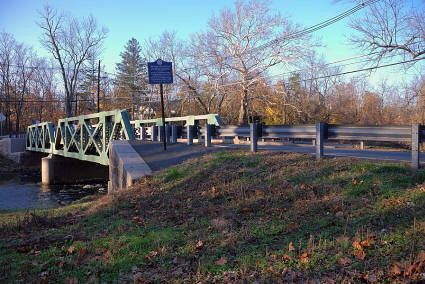
Millstone River Today

The Action


Seeing the bridge crossing protected,  Dickinson ordered his men downriver (towards the Raritan), where they broke through the ice and waded into the cold waters that reached well above their knees. Dickinson divided his forces, sending one force to meet the front of the British wagon train, while a second moved to flank them. One wing of the American attack successfully surprised the British wagon train in the lane near Van Nest's Mill, cutting it off before it reached the main road and the bridge toward New Brunswick. Well-placed fire struck horses from the first wagon, halting the train,  Panicked, the wagon drivers scattered. This caused the British to beat a hasty retreat to the bridge, leaving their booty behind. But when the pursuing militiamen reached the bridge, the Hessian rearguard fired grapeshot from its artillery to cover the retreat. After an exchange of fire across the river, the British withdrew. As was the case with most such actions, the actual combat was brief. The British taking the brunt of causalities and lost around a dozen prisoners and twice that in killed and wounded. The British admitted that the rebel surprise attack "occasion'd such disorder Amongst the Waggon Drivers that 42 Waggons were left behind." They also lost 104 horses, 115 head of cattle, and about 60 or 70 sheep. Valuable livestock denied the enemy in winter quarters and most needed by the always deprived rebels.


Militias defeat Regulars: How Could this Happen?


This was no major battle or great victory. Yet it proved significant. Stalwart and determined, these once disparaged New Jersey militiamen had gained confidence and were less in awe of redcoats and Hessians due to American successes Princeton and Trenton. Even before Trenton, exaggerated reports of enemy depredations across the Jerseys began to stir the fires of revenge and retribution in many (but not all).  This was not the only instance when anger fired up the militia into ferocity against enemy regulars and Loyalists. In fact, it would become a growing theme throughout the remainder of the war. So in many ways, the action at this place called Somerset Court House was a harbinger of greater things to come.


Saturday, September 20, 2014

Middelbrook

Background


Nestled at the start of the Watchung Mountains in New Jersey is the colonial town of Middlebrook. During the time of the Yankee Doodle Spies, Middlebrook was a small village northwest of Bound Brook. Although the village of Middlebrook no longer exists, it has been absorbed into the town of Bound Brook. During the American Revolution, this small farming community sat along the route of two armies engaged in more than just a fight for a continent – it was a struggle for ideas. For the Continentals, it was a fight for a new nation and a new concept of government. For the British Army, it was a fight to preserve the old order and the rights of a King.


Good ground


Gen Washington at Princeton
General George Washington had marched past Middlebrook after the Battle of Princeton on his way to Morristown in January 1777. Its advantage as a strategic position did not go unnoticed by the former surveyor. Late in the spring of 1777, Washington moved his small army of about 7,000 from their winter encampment at Morristown to Middlebrook Heights. 

Why? The ground was good, enabling the Americans to observe the British troops at New Brunswick and Perth Amboy. He moved Anthony Wayne's Brigade onto the forward slopes to defend the approaches to the pass. The Americans fortified the already defensible terrain. From these positions, Washington could keep watch on the British garrisons in New York and New Brunswick. But even better, it gave him a position to flank the British if they attempted to cross New Jersey to Philadelphia.


Battleground


However, the British also recognized the strategic advantages of the positions around Middlebrook for the rebels. So on the night of June 13th, 1777, General Lord Cornwallis moved out of New Brunswick, hoping to lure Washington out of his Middlebrook defenses into the open flat land for battle. With Hessians leading his columns, Cornwallis launched a four-pronged attack on the village. Washington responded, but not in the way the British had hoped. 

The commander-in-chief sent the militia, reinforced with some Continentals, to harass the enemy columns. However, most of the Continental Army stayed in their secure positions. By the end of June, a frustrated Cornwallis and his British forces retreated to Staten Island. The British maintained ground near New Brunswick, the Amboys, and at Paulhus Hook (Jersey City), but much of the rest of Jersey was a no man's land where Loyalist and Patriot factions, militias, and criminal elements from both sides fought. Middlebrook was at a critical point in this no man's land.


Lord Cornwallis

Observation point


The attack on Middlebrook, along with other forays and feints, caused General Howe to change his strategy. The British commander-in-chief launched a naval operation toward the Chesapeake to capture the rebel capital at Philadelphia from the south. Most of the British regiments left their fortress in New York for a combined sea-land campaign aimed at driving the rebels from their capital, but they left British General Burgoyne's army to struggle in the wilderness of upstate New York. 

Thus, the small engagement at Middlebrook played a crucial role in a chain of events that helped alter the course of the war. Recognizing the need for a new plan for the 1778 summer campaign, the British abandoned Philadelphia and again focused on New York. Washington struck from the rear, and the largest pitched battle of the American Revolution took place at Monmouth. When the British column retreated to its secure zone around New York and nearby areas, Washington once more used the Middlebrook region as a base to observe and threaten the British.


Winter Encampment


In November 1778, George Washington once again moved the army back to the Middlebrook area. It provided a natural defensive position and allowed him to monitor the British foothold in New Jersey. Washington established his headquarters at the Wallace House in what is now Somerville. 

The main army, made up of brigades from Virginia, Maryland, and Pennsylvania, along with the Delaware regiment, the artillery corps, and support units, camped along the base of the Watchung Mountains. There, they benefited from some shelter from the weather, abundant trees for construction and firewood, and support from a mostly patriotic local population and an active militia. Fortunately, the winter was relatively mild. The Continental Army stayed at the second Middlebrook encampment until late June 1779. That winter at Middlebrook would later be known for a symbolic event.


First Flag


There is an interesting footnote to the story of Middlebrook. On June 14, 1777, Congress adopted the Flag Resolution, establishing the famous Betsy Ross flag as the national flag of the United States. An official flag was brought from Philadelphia to be flown at the Middlebrook encampment before the soldiers took the field for the summer campaign season. 

In an act of great symbolism for the young and struggling nation, the first thirteen-star American flag was flown at an American army base. One wonders what the beleaguered but determined soldiers would think if they could see into a future where their descendants would champion the very ideas they fought for in campaigns across the globe. Or a future in which the flag they flew over Middlebrook would be flown as a symbol of liberty at hundreds of army bases across the yet unexplored continent and later on scores of foreign shores.


Flag at Middlebrook Encampment