Followers

Showing posts with label History. Revolutionary War. Show all posts

Tuesday, May 26, 2026

Defender of the Charleston Neck

In the spring of 1780, the American cause in the South hung by a thread. British forces under Sir Henry Clinton descended on Charleston like a gathering storm, and one South Carolina officer found himself holding a critical—and ultimately doomed—position at the city’s northern approaches. That officer was Brigadier General Isaac Huger, a steady Continental commander tasked with guarding the Charleston Neck and the vital supply lines feeding the besieged garrison. Though not a major figure in the fictional plot, Huger’s actions in and around Charleston are captured in my novel, The South Spy.


Isaac Huger


South Carolina Son

Like so many South Carolina patriots, Isaac Huger came from solid Huguenot stock. Born in 1743 near Charleston, he grew up on the family plantations along the Santee River. Like many sons of the Low Country elite, he gained early military experience during the Cherokee War of 1760-61. Those frontier campaigns taught him the hard lessons of irregular warfare in swamps and pine barrens—knowledge that would serve him well in the Revolution. When the troubles with Britain escalated in the 1770s, Huger aligned with the patriots. He served in the Provincial Congress and helped raise South Carolina troops. By 1776, he held the rank of colonel, and his performance in the Southern theater earned him promotion to brigadier general in the Continental Army in 1779. He fought at Savannah and earned a reputation as a reliable leader capable of commanding mixed forces of regulars, militia, and light troops.


Hunger gained military experience 
against the Cherokee\


British Invasion!

By early 1780, General Benjamin Lincoln’s command in Charleston faced mounting pressure. To keep the northern lifeline open, Lincoln dispatched Huger to Monck’s Corner, about thirty miles northwest of the city. The position centered on Biggin Bridge and nearby Biggin Church—a key crossroads where the road from the interior crossed swampy terrain between the Ashley and Cooper Rivers.


Charleston and environs

Huger commanded roughly 500 men: remnants of Pulaski’s Legion dragoons, South Carolina militia, and a handful of Georgia horsemen. Many were farmers in homespun, armed with whatever muskets they could find. Equipment was scarce—some infantry companies lacked adequate powder and ball. Huger’s orders were clear: hold the causeway and bridge to prevent British forces from cutting off the city.

The threat materialized quickly. In mid-April, intelligence indicated a rapid British advance led by the hard-charging Lieutenant Colonel Banastre Tarleton and his British Legion.

Night Attack

On the night of April 13-14, Tarleton struck. His mounted infantry and dragoons thundered out of the darkness in a classic surprise assault. American pickets managed a few ragged volleys, but the speed and shock of the British cavalry quickly overwhelmed the position. In the moonlight, fighting swirled around the bridge and church grounds. Huger rallied what men he could, but the attackers' numbers and momentum favored them. 


Tarleton's Attack


The result was a decisive American defeat. Casualties approached one hundred, with many killed, wounded, or captured. Worse, the British seized nearly four hundred horses—precious mounts Charleston desperately needed for mobility and supply. Huger himself escaped with part of his force, slipping northwest through the pine barrens. He sustained minor wounds but lived to fight another day.

Consequences

The action at Monck’s Corner (sometimes called Biggin Bridge) proved decisive. With the northern approaches severed, Lincoln’s garrison lost its last practical hope of reinforcement or resupply. Isolated and under constant siege, Charleston surrendered on May 12, 1780—the Revolutionary War’s largest American capitulation. For the patriot cause in the South, it marked a bitter low point.


Fall of Charleston


Later Service and Legacy

Yet Isaac Huger’s story did not end in the swamps of 1780. He recovered and continued to serve under Nathanael Greene during the grueling Southern Campaign of 1781. He commanded troops at Guilford Courthouse in March and contributed at Hobkirk’s Hill in April, helping to erode British strength through persistent operations.


Guilford Court House


After the war, Huger returned to his life as a planter and to public service. He represented South Carolina in the Continental Congress and supported ratification of the new U.S. Constitution. He died in 1797, remembered as one of the steadfast Southern officers who held the line when the odds were longest.


Serving in Congress


In the era of the Yankee Doodle Spies, figures like Isaac Huger rarely made the headlines or entered the annals of legend. No dramatic espionage coups or flashy charges defined him. Instead, he embodied the quiet determination that kept resistance alive despite defeat after defeat. His stand on the Charleston Neck could not save the city, but it exemplified the grit that ultimately helped turn the Southern theater—and the war—around in the years that followed.


Saturday, July 29, 2023

Clan Mother

The Clandestine Challenge

The difficulty with any espionage study is the lack of unclassified sources — since clandestine work must remain secret by nature. This is especially true when looking back to the time of the Yankee Doodle spies, when nearly all espionage activity was "off the books," with few reports or records kept. Spies operated in all theaters throughout the war, but identifying who they were and what they did is difficult, requiring lots of "fill in the blank" and connect-the-dots analysis.


Spying on the Spies

Savage War of Peace

The American Revolution in the Mohawk Valley involved years of internecine conflict and small-scale combat that often reached a fever pitch. Patriot Whigs and Loyalist Tories went head to head in battles ranging from a few dozen to a few hundred fighters, rarely involving large-scale clashes with thousands. Add six Iroquois tribes, Canadians, Continentals, and British regulars into the mix, and you get a stew of conflict and chaos. But unlike many other areas of the war, the central New York region was never quiet. Instead, a relentless savage war of peace raged on. 


The Mohawk Valley


The role of the native tribes added an objective layer of complexity to the struggle in New York. The powerful Iroquois Confederacy was mostly aligned with the British, thanks to the outstanding efforts of the Crown's Indian Agent, Sir William Johnson, and his son. 


Sir William Johnson

Of the Iroquois nations, the most powerful, warlike, and pro-British were the Mohawks, who controlled the easternmost part of the territory. Our subject is one of those Mohawks, a woman born Konwatsi'tsiaiĆ©nni, but now known as Mary or Molly Brant, older sister to Joseph Brant, who became a Mohawk War Chief and British officer during the war for independence. 

Youth in Two Worlds

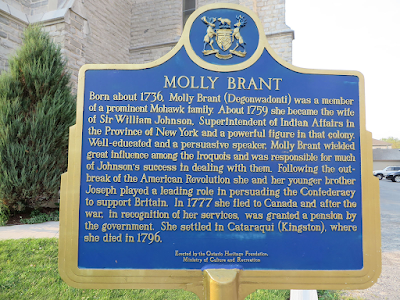
Molly Brant was born around 1736 in the Ohio Valley, although her family's ancestral home was the village of Canajoharie, on the upper Mohawk near Little Falls, New York. Her parents were Margaret (Onagsakearat) and Peter (Tehowaghwengaraghkwin), who were Anglicans. When Peter died while the family lived on the Ohio River, Molly's mother returned to Canajoharie with her and her brother Joseph.


Iroquois Village

Both Brant children grew up in two worlds, becoming fluent in English and comfortable with English culture. Molly was educated in the Mohawk Valley, and because she spoke English well, she accompanied twelve Mohawk tribal elders on a delegation to Philadelphia in 1755. After that trip, Molly met the most powerful man in these two worlds, the renowned British Indian Agent Sir William Johnson — her beauty and grace deeply affected him. Johnson handled all the deals involving the tribes and was known to be an honest broker who cared for both the Iroquois and the white settlers in central New York. He was also quite wealthy.

Lady of the Manor

By 1759, the twenty-three-year-old Molly was officially listed in Johnson's records as his "housekeeper," but she was, in fact, his common-law wife—possibly married under Iroquois customs. She would have seven children with him and served in all respects as the powerful Johnson's partner. 


Molly Brant was the Lady of Johnson Hall

Anglo visitors who visited Johnson's estate, Johnson Hall, remarked on her beauty, delicate features, olive skin, excellent manners, and understated but commanding presence. In all but name, Brant was the Lady of the  Johnson Hall estate.

The Clan Mother

During her time with Johnson, she also rose to become a Clan Mother, receiving the Mohawk name Tekonwatonti (Many Opposed to One). Molly led a society of Six Nations (Iroquois Confederacy) matrons. In the matriarchal hierarchy of the Iroquois, Clan Mothers held great power and influence, traditionally choosing and dismissing leaders. They also had the authority to veto their decisions.


Clan Mothers wielded significant influence

Sir William died the year before Lexington and Concord erupted and plunged the colonies into open war with the Crown. 

Loyal to the Crown

Molly Brant and her brother Joseph remained loyalists, dedicated to the British cause. Joseph became a well-known Loyalist commander and Mohawk War Chief whose actions frustrated the patriots. 


Chief Joseph Brant

His sister's role was more ambiguous but equally important. She provided food and ammunition to nearby Loyalist units. Most importantly, she passed valuable intelligence to her brother and other Loyalist and British leaders in central New York. 

Spymaster

Although there's little recorded about this (for reasons mentioned above), she probably heard reports on American movements in the Mohawk Valley from travelers, hunters, and traders passing through her village.


Molly Brant: Mother Clan, Mother.Spy

The best example of this occurred in August 1777. British Lieutenant-Colonel Barry St. Leger's force, composed of British troops, Loyalists, Canadians, and Indians, had besieged the American garrison at Fort Stanwix (located in today5s Rome, NY). When the Tryon County militia learned of the siege, a brigade-sized force marched west along the river to relieve the post.


Battle of Oriskany

When Molly learned of their movement, she sent word to St. Leger, who dispatched a force of Loyalists and Indian allies that set a well-planned ambush in the dense cypress forests near Oriskany. The relief column was pushed back with heavy losses, and its commander, Colonel Nikolas Herkimer, was mortally wounded.


Fort Stanwix

In retaliation, the American-Allied Oneidas attacked her village of Canajoharie, destroying it and nearby Fort Hunter. 

On the Road

Molly moved her family through various Loyal Iroquois villages. Brant and her family lost most of their belongings. They sought refuge at Onondaga near Syracuse, New York, the capital of the Six Nations Confederacy, first going to Syracuse, then Cayuga, and finally Niagara.


Iroquois Village along the Mohawk River

At each of these, she proved to be a strong and effective supporter of the Loyalist cause, helping to keep most of the Iroquois aligned with the British. As a result, the British were able to use the Iroquois war bands to strengthen their diminishing Loyalist and British forces in New York.


Iroquois War Band

Resilient Leader

As the war continued in New York, the British and their Indian allies were gradually pushed westward. The British asked Molly Brant to help lead the thousands of starving refugees fleeing the Americans to the safety of Fort Niagara — the last stronghold in the area. She proved to be a capable leader, organizer, and spokesperson for the tribes. Her influence and power grew among both the tribes and the British authorities.


Fort Niagra: last bastion of British 
power in New York

One British officer remarked that her influence on the tribes was such that "their uncommon good behaviour in great measure to be ascribed to Miss Molly Brant's influence over them, which [was] far superior to that of all their Chiefs put together."

A Separate Peace

But when the Treaty of Paris was signed, the rug was pulled out from under the Iroquois and Loyalists in New York. The British made little effort to protect their ancestral lands, leaving the Iroquois to face their enemies alone — and it did not go well. Many of the Iroquois and all the Loyalists fled to Canada. 


Treaty of Paris signing

A Bitter Nation

The Iroquois who stayed behind became bitter toward Molly and her British masters. Molly left the home the British built for her on Carleton Island, as it was now on the American side of the border. The Clan Mother moved to a village called Cataraqui and, with other Loyalists, founded what later became Kingston, Ontario.

A Grateful Crown

The grateful British awarded her land and a pension large enough to turn down the Americans' offers to return to New York. They recognized her leadership's importance. But she was dismissive of the people who had destroyed the Iroquois lands during eight years of bloody warfare.

Founding Canadian

Molly Brant's family became well-known in Upper Canada. Five of her six daughters married Canadian men. George, her surviving son, got a position in the Indian department. Her older son died fighting for the British. 


At age sixty, the Clan Mother died in Brantford, Ontario, in 1796. Her exact burial site is unknown, but many believe the good, lifelong Anglican rests somewhere beneath St. Paul's Church in today's Kingston, Ontario, Canada. Her legacy is that of a remarkable woman who cared for her family, clan, tribe, and nation in both peace and war.


St. Paul's Church and Burial Ground


Friday, March 31, 2023

Delaware Patriot


When I started writing the Yankee Doodle Spies Blog many years ago, one of the first patriots I wanted to feature was someone from Delaware. An immigrant preacher who left Ireland for a better life and fought in two wars, one for Britain and one against it, this underrated patriot is John Haslet. 

A Londonderry Man

Born around 1727 in Dungiven, near Londonderry, Ireland, this son of a tenant farmer grew up to be a devout man and, when necessary, a passionate leader. As a young man, he traveled to Glasgow, Scotland, and studied Divinity. He finished his studies in 1749, sailed home, and soon married. His wife was Shirley Stirling, the daughter of a preacher. John was ordained as a Presbyterian minister in 1752 and, later that year, delivered his first sermon to his new congregation at Ballykelly. Around that time, the Haslet family had their first child, Mary (or Polly).


Preaching


Tragedy and Immigration

The year 1757 was a time of tragedy and change for Haslet. Shirley lost their second child and died during childbirth. Soon after, Haslet decided to emigrate. Following a common practice of the time, he left young Polly in his brother's care and sailed to America for a new life in a place called Delaware. The young widower quickly remarried there, taking Jemima Molleston as his second wife. 

Against the French and Indians

Haslet joined the Pennsylvania militia. His degree from the University of Glasgow and his experience speaking to and inspiring his congregations marked him as a leader, and he quickly rose to the rank of captain. The French and Indian War was ongoing when Haslet arrived in America. The campaign to expel the French from the frontier took Haslet and his militia company to western Pennsylvania, where they fought in the 1758 Battle of Fort Duquesne.


Fort Duquesne


Country Doctor

The war ended with the Treaty of Paris in 1763. Haslet returned with his company to Delaware. He and Jemima settled in Milford, where he established a medical practice and bought a property called "Longfield." John and Jemima had four children. Additionally, his daughter Polly immigrated to Delaware in 1765. An ideal life as a country doctor and farmer awaited him. 

From Friction to Fighting

But the political friction after the war grew into armed resistance, and Haslet became involved, eventually advocating for independence from Britain. The Continental Congress appointed him a Colonel and commander of the Delaware Regiment (sometimes called the Delaware Blues), one of the largest (800 men) and most well-uniformed and equipped regiments in the Continental Army. Their blue jackets with white waistcoats and breeches set the standard for all the regiments of the Continental Line. 


Haslet's Regiment leaves for war

Valor on Long Island

John Haslet's regiment marched to New York and into the defense works on Long Island in the late summer of 1776. General George Washington had occupied the city, but the British armada under Lord Howe sailed south and descended on Staten Island before invading Long Island at Brooklyn's Gravesend.


When the British surrounded the Americans, Haslet's regiment and the First Maryland held firm against the attack. At the peak of the fight, Lord Stirling, an American general and Scottish peer named William Alexander, took command of both regiments and led them in a series of brave charges against British General Cornwallis's regular troops. 


Haslet's Delaware Regiment faces British regulars on Long Island


Absorbing volley after volley from the red-coated ranks, the two regiments were torn to shreds. However, their discipline and sacrifice allowed the rest of the American army to retreat to the safety of the defenses near Brooklyn Heights. This event is a pivotal moment in my novel, The Patriot Spy. Ironically, Haslet and the Maryland commander, Colonel John Smallwood, were on court-martial duty in New York City and only returned after the battle had ended.


Colonel John Smallwood


Retreat, Fight, and Retreat

Haslet and his regiment fought bravely during the months that followed as the Continentals were forced out of New York City. During the retreat, Haslet and his men defeated a Loyalist corps at Mamaroneck.

At White Plains on October 28, Haslet and Smallwood stood bravely with their regiments on Chatterton Hill. When the militia they were sent to reinforce broke and fled, the two Continental regiments held their ground until the enemy's numbers and firepower forced a retreat. However, the stand on Chatterton Hill denied General Howe a complete victory, and the Americans would live to fight another day.


Chatterton Hill


War on the Run

General Washington's army was on the run for the next two months. Fort Washington fell, and his men abandoned Fort Lee as they hurried across New Jersey toward the Delaware and Pennsylvania, where Washington hoped to regroup and make a stand. Haslet and his men fought many small battles—skirmishing during a "fighting retreat" that reduced the Delaware Regiment to no more than 100 "effectives"—men capable of fighting by the time they crossed the Delaware River to rejoin the main army.


War on the Run

Trenton

Knowing he needed to strike within days, Washington launched his famous Christmas surprise attack, crossing the ice-clogged Delaware River on the night of December 25, 1776. The army trudged the nine miles under a dark and cold sky to their target: the Hessian garrison at Trenton, which had over a thousand troops. Although barely two companies strong, Haslet and his men led the charge. After a brief but fierce exchange of musket and artillery fire, the garrison surrendered, giving Washington one of the war's greatest victories. Before Haslet had time to refit, enlistments were expiring, as they were across the entire army. 


Taking Trenton


Assunpink Creek

Days later, the army returned to Trenton, defending a low ridgeline behind a creek south of the town and waiting for the British counterattack with more than 5,000 fresh redcoats under an angry General Cornwallis. A late afternoon firefight on January 2, 1777, caused Cornwallis to stand down and strike with all his force the next day. However, Washington outmaneuvered them and executed an 18-mile night march around the British to attack their supply base at Princeton.


Holding Assunpink Creek


Destiny at Princeton

The dawn of January 3rd broke bright but cold, with snow covering fields and roads. Colonel Haslet's regiment was now just a handful of officers. Months of fighting and expired enlistments had worn down his regiment. However, Haslet's experience and capable leadership remained crucial, so Washington appointed him as second in command to General Hugh Mercer, his best commander.


General Hugh Mercer bayonetted at Princeton


Mercer's division was at the forefront, marching through William Clarke's orchard when two crack regiments of British regulars unleashed a horrific barrage of volleys, shooting Mercer's horse out from under him. Mercer quickly got to his feet and drew his saber as the wave of red moved in on him. When he refused to be taken prisoner, they clubbed him and then bayonetted him while he lay helpless in the snow. He died from his wounds.

The Field of Honor

Seeing Mercer go down, Haslet took command of the remnants. But just moments later, a curtain of lead filled the air, and a musket ball struck him in the head. The remaining troops began to waver, but General Washington rode into their midst and rallied them. Then, combined with reinforcements, they drove the British from the field and took Princeton. The gallant John Haslet died on the field of honor like his commander, Hugh Mercer.


Washington rallying the troops

Washington's Loss, America's Loss

The history books record Princeton as a victory. However, the loss of Mercer and Haslet robbed Washington of two of his most capable lieutenants, whose talents the commander-in-chief would desperately miss over the next five years of war. Mercer is rightfully honored, but Haslet, being second in command and from a small state, often goes unmentioned. I count John Haslet among the many unsung heroes whose early death deprived the Continental Army and the future United States of leadership, integrity, and patriotism.

Delaware's Son

The son of Delaware was buried outside his home state and laid to rest in the graveyard of the First Presbyterian Church. It wasn't until an Act of the Delaware Assembly was passed in 1841 that his remains were moved to the Presbyterian Cemetery in Dover, Delaware. However, it wasn't until 2001 that his state finally honored him with a monument at Princeton. 


Haslet Monument at Princeton