Followers

Showing posts with label Battle of Long Island. Show all posts

Friday, March 31, 2023

Delaware Patriot


When I started writing the Yankee Doodle Spies Blog many years ago, one of the first patriots I wanted to feature was someone from Delaware. An immigrant preacher who left Ireland for a better life and fought in two wars, one for Britain and one against it, this underrated patriot is John Haslet. 

A Londonderry Man

Born around 1727 in Dungiven, near Londonderry, Ireland, this son of a tenant farmer grew up to be a devout man and, when necessary, a passionate leader. As a young man, he traveled to Glasgow, Scotland, and studied Divinity. He finished his studies in 1749, sailed home, and soon married. His wife was Shirley Stirling, the daughter of a preacher. John was ordained as a Presbyterian minister in 1752 and, later that year, delivered his first sermon to his new congregation at Ballykelly. Around that time, the Haslet family had their first child, Mary (or Polly).


Preaching


Tragedy and Immigration

The year 1757 was a time of tragedy and change for Haslet. Shirley lost their second child and died during childbirth. Soon after, Haslet decided to emigrate. Following a common practice of the time, he left young Polly in his brother's care and sailed to America for a new life in a place called Delaware. The young widower quickly remarried there, taking Jemima Molleston as his second wife. 

Against the French and Indians

Haslet joined the Pennsylvania militia. His degree from the University of Glasgow and his experience speaking to and inspiring his congregations marked him as a leader, and he quickly rose to the rank of captain. The French and Indian War was ongoing when Haslet arrived in America. The campaign to expel the French from the frontier took Haslet and his militia company to western Pennsylvania, where they fought in the 1758 Battle of Fort Duquesne.


Fort Duquesne


Country Doctor

The war ended with the Treaty of Paris in 1763. Haslet returned with his company to Delaware. He and Jemima settled in Milford, where he established a medical practice and bought a property called "Longfield." John and Jemima had four children. Additionally, his daughter Polly immigrated to Delaware in 1765. An ideal life as a country doctor and farmer awaited him. 

From Friction to Fighting

But the political friction after the war grew into armed resistance, and Haslet became involved, eventually advocating for independence from Britain. The Continental Congress appointed him a Colonel and commander of the Delaware Regiment (sometimes called the Delaware Blues), one of the largest (800 men) and most well-uniformed and equipped regiments in the Continental Army. Their blue jackets with white waistcoats and breeches set the standard for all the regiments of the Continental Line. 


Haslet's Regiment leaves for war

Valor on Long Island

John Haslet's regiment marched to New York and into the defense works on Long Island in the late summer of 1776. General George Washington had occupied the city, but the British armada under Lord Howe sailed south and descended on Staten Island before invading Long Island at Brooklyn's Gravesend.


When the British surrounded the Americans, Haslet's regiment and the First Maryland held firm against the attack. At the peak of the fight, Lord Stirling, an American general and Scottish peer named William Alexander, took command of both regiments and led them in a series of brave charges against British General Cornwallis's regular troops. 


Haslet's Delaware Regiment faces British regulars on Long Island


Absorbing volley after volley from the red-coated ranks, the two regiments were torn to shreds. However, their discipline and sacrifice allowed the rest of the American army to retreat to the safety of the defenses near Brooklyn Heights. This event is a pivotal moment in my novel, The Patriot Spy. Ironically, Haslet and the Maryland commander, Colonel John Smallwood, were on court-martial duty in New York City and only returned after the battle had ended.


Colonel John Smallwood


Retreat, Fight, and Retreat

Haslet and his regiment fought bravely during the months that followed as the Continentals were forced out of New York City. During the retreat, Haslet and his men defeated a Loyalist corps at Mamaroneck.

At White Plains on October 28, Haslet and Smallwood stood bravely with their regiments on Chatterton Hill. When the militia they were sent to reinforce broke and fled, the two Continental regiments held their ground until the enemy's numbers and firepower forced a retreat. However, the stand on Chatterton Hill denied General Howe a complete victory, and the Americans would live to fight another day.


Chatterton Hill


War on the Run

General Washington's army was on the run for the next two months. Fort Washington fell, and his men abandoned Fort Lee as they hurried across New Jersey toward the Delaware and Pennsylvania, where Washington hoped to regroup and make a stand. Haslet and his men fought many small battles—skirmishing during a "fighting retreat" that reduced the Delaware Regiment to no more than 100 "effectives"—men capable of fighting by the time they crossed the Delaware River to rejoin the main army.


War on the Run

Trenton

Knowing he needed to strike within days, Washington launched his famous Christmas surprise attack, crossing the ice-clogged Delaware River on the night of December 25, 1776. The army trudged the nine miles under a dark and cold sky to their target: the Hessian garrison at Trenton, which had over a thousand troops. Although barely two companies strong, Haslet and his men led the charge. After a brief but fierce exchange of musket and artillery fire, the garrison surrendered, giving Washington one of the war's greatest victories. Before Haslet had time to refit, enlistments were expiring, as they were across the entire army. 


Taking Trenton


Assunpink Creek

Days later, the army returned to Trenton, defending a low ridgeline behind a creek south of the town and waiting for the British counterattack with more than 5,000 fresh redcoats under an angry General Cornwallis. A late afternoon firefight on January 2, 1777, caused Cornwallis to stand down and strike with all his force the next day. However, Washington outmaneuvered them and executed an 18-mile night march around the British to attack their supply base at Princeton.


Holding Assunpink Creek


Destiny at Princeton

The dawn of January 3rd broke bright but cold, with snow covering fields and roads. Colonel Haslet's regiment was now just a handful of officers. Months of fighting and expired enlistments had worn down his regiment. However, Haslet's experience and capable leadership remained crucial, so Washington appointed him as second in command to General Hugh Mercer, his best commander.


General Hugh Mercer bayonetted at Princeton


Mercer's division was at the forefront, marching through William Clarke's orchard when two crack regiments of British regulars unleashed a horrific barrage of volleys, shooting Mercer's horse out from under him. Mercer quickly got to his feet and drew his saber as the wave of red moved in on him. When he refused to be taken prisoner, they clubbed him and then bayonetted him while he lay helpless in the snow. He died from his wounds.

The Field of Honor

Seeing Mercer go down, Haslet took command of the remnants. But just moments later, a curtain of lead filled the air, and a musket ball struck him in the head. The remaining troops began to waver, but General Washington rode into their midst and rallied them. Then, combined with reinforcements, they drove the British from the field and took Princeton. The gallant John Haslet died on the field of honor like his commander, Hugh Mercer.


Washington rallying the troops

Washington's Loss, America's Loss

The history books record Princeton as a victory. However, the loss of Mercer and Haslet robbed Washington of two of his most capable lieutenants, whose talents the commander-in-chief would desperately miss over the next five years of war. Mercer is rightfully honored, but Haslet, being second in command and from a small state, often goes unmentioned. I count John Haslet among the many unsung heroes whose early death deprived the Continental Army and the future United States of leadership, integrity, and patriotism.

Delaware's Son

The son of Delaware was buried outside his home state and laid to rest in the graveyard of the First Presbyterian Church. It wasn't until an Act of the Delaware Assembly was passed in 1841 that his remains were moved to the Presbyterian Cemetery in Dover, Delaware. However, it wasn't until 2001 that his state finally honored him with a monument at Princeton. 


Haslet Monument at Princeton


Saturday, August 31, 2019

Marblehead Men

Sailors become Soldiers who become Sailors

One of the most overlooked units in the Continental Army also played a vital role in saving the American cause, paving the way for several iconic commemorative paintings. The people who live along the rocky New England coast are as tough and rugged as the landscape itself. 

At least, they were during the era of the Yankee Doodle Spies. Hard, gritty men and women were the first to take meaningful action against what they saw as the injustices of British rule. I suppose carving out a civilization from a weather-beaten wilderness requires folks of tough mettle and stubborn ways.


New England's coast bred tough people


Among the toughest and most resourceful of that group were the men who sailed the cold and stormy waters along the North Atlantic coast, fishing, trading, and smuggling in both fair and foul weather. It is only natural that a militia regiment drawn from such stock would prove to be one of the go-to units of the struggle.

Marblehead Militia


All counties and some towns in New England had militia units that established a long-standing tradition dating back to at least the late 17th century. These units had experience from several wars fought against native tribes, Canadian neighbors, and their French rulers.

At the start of the fight against Britain, the Marblehead militia was among these. Because it was formed along the rugged New England coast, it was naturally composed of men who spent their civilian lives at sea.

Marblehead Militia


As tensions peaked in April 1775, the regiment was lucky to get a commander who proved to be as tough and resourceful as the men he led – Colonel John Glover. Under Glover, the regiment marched to Cambridge, where they joined the New Englanders besieging the British at Boston.


During the siege, Congress formed the new Continental Army under General George Washington's command. The Marblehead Militia, known as “Glover’s Regiment,” joined the Continental Army in June. It was originally called the 23rd Massachusetts Regiment. Only the best militia units were combined into the Continental regiments, creating America's first “professional” army.

The Continental Line


With their new status, they also received a new name, and the Marblehead militia was quickly renamed the 14th Massachusetts Continental Line. As a continental regiment, they would now be required to march and fight wherever the army moved, and wherever George Washington led them. He soon took them south to face new dangers and seek new opportunities for glory.

Nevertheless, the regiment of about 750 sailors never completely abandoned their heritage. Unlike other continental regiments, which started wearing similar uniforms of dark blue tunics, white or buff breeches, and leggings topped with a cocked hat, the Marblehead sailors dressed more like traditional sailors. The Marbleheaders wore distinctive blue jackets, white pants, and white caps. However, it was the skill, not their appearance, that was the greatest trait of these hardy sailors.

Washington’s Navy


As the siege of Boston went on, Washington decided he needed a naval force to stop supplies from reaching the British garrison. He assigned the 14th Massachusetts Line to outfit and crew four schooners for this purpose. Glover even offered his own schooner, the Hannah. His port at Beverly became the base of “Washington’s Navy.” Operating with a limited budget, the small fleet of five schooners managed to disrupt British supply lines and bring in captured supplies to support the Americans. Sailors from Marblehead also built most of the defenses that kept the British from taking the base.


Washington's Navy consisted of
fast schooners manned by experienced sailors


The Miracle on Long Island


Long before it became a traffic nightmare, Long Island was the scenic and rural breadbasket of New York. In the summer of 1776, it became the focal point of the British plan to crush the American rebellion.

Driven from Boston earlier that year, Lord William Howe’s reinforced army of over twenty thousand sailed into New York Harbor and landed at Staten Island. Soon, he moved his troops across the water and quickly encircled George Washington’s forces along the heights of Brooklyn. Although there was fierce fighting, the British numbers and well-positioned guns made Washington’s hold on the island a dangerous liability. He faced a difficult choice: defend with little hope or attempt to escape.


British Landing at Long Island would soon threaten the
American Army and the cause


In some ways, the latter was the toughest decision. The British naval strength was even more powerful than their land forces. Crossing despite these two hurdles would almost certainly cause disaster. But when a sudden fog rolled into New York harbor on the night of August 29th, Washington seized a brief chance to act.


So under cover of darkness and a thick fog, he made a risky decision and ordered his army to move against the enemy. His advantage was the 14th Massachusetts’ sailor-soldiers. For hour after hour, Glover’s men rowed boat after boat, carrying soldiers, horses, and equipment they could manage without alerting the British, who waited just a few hundred yards away.


Glover worked his men through the night to save an army


Despite the darkness and fog, the Marblehead men moved smoothly and silently. A splash or the bumping of a boat against another could easily have alerted the Royal Navy, whose warships lay anchored nearby. By the next morning, they had evacuated around 9,000 men from the jaws of the British lion to the safety of Manhattan.


The miracle retreat from LI saved the army and the cause


A War of Maneuver


The regiment’s usefulness was evident during the “war of maneuver,” which caused Washington to hurriedly relocate positions to avoid being destroyed by the British. Glover’s men slowed down the British advance at Kips Bay, giving the rest of the army time to retreat to the safety of Harlem. As the campaign moved north to Westchester, the regiment again played a vital role—this time as soldier-sailors.


Glover's sailor-soldiers stymied the British at Pelham


On October 13th, about 4,000 British and Hessian troops advanced inland from Pelham Bay. However, along the stone walls crossing the farmland, 750 men from the 14th Massachusetts and John Glover’s forces stood ready. They kept the British at bay, trading space for time and allowing the Continental Army a chance to prepare for the next attack. Glover’s men, skilled in scouting and raiding, showed they were just as comfortable on land as they were on their schooners’ decks. They captured supplies and enemy prisoners, then helped operate the artillery during Washington and Howe’s clash at White Plains.

The Crossing that Shocked the World


By December of that year, a battered and severely diminished Continental Army reached its breaking point as it looked across the Delaware River. Just hours behind, the advanced guard of a British column led by Major General Charles Cornwallis was closing in quickly. The men from Marblehead collected anything that floated along the river for miles and quickly ferried the ragtag army to safety.


Gen Charles Cornwallis nearly bagged
Washington, but for the Marblehead Regt.


But their greatest challenge still lay ahead. With enlistments dwindling as a new year approached, Washington had a short window to do something with his army besides fleeing from the redcoats. General Howe gave him the chance. Believing the Americans beaten, he scattered his army into winter quarter garrisons, leaving only a few isolated brigades in West Jersey.


The Glover Regiment brought Washington to destiny


Washington turned to Glover’s men once again. In another secret nighttime operation, Washington enlisted the experienced sailors to operate a different kind of boat. Long and sleek, the Durham boats were powered by pushing long poles into the riverbed. 

On a night when snow mixed with rain, file after file of Continentals, poorly dressed and poorly fed but determined, silently boarded the boats under the watchful eyes of the sailors. Throughout the night, strong arms pushed staffs into the swirling water. Strong legs and backs moved the boats, filled with men and equipment, across the swift current toward the dark and dangerous Jersey side. Despite the ice flows, Glover’s sailors managed to ferry over 2,000 troops and 18 guns.


Sailors to soldiers as Glover's Marblehead Regiment
 joins the night march on Trenton


But their work was not finished. The sailors then became soldiers and marched the grueling nine miles to Trenton, fighting valiantly in the short battle that shocked the world and saved the cause. Their final act was to lead the army back across the river, as their enlistments had expired and the regiment was disbanded.


Down to the Sea in Ships


Glover stayed with the Continental Army, but his men went home. New England was never a major battlefield for the rest of the war, but it still played a crucial role—providing support and attacking the British at sea. Glover’s experienced soldiers now became sailors again, engaging in a different kind of war, less showy but just as damaging to the British.

Privateers devastated British merchant shipping and tied down
the Royal Navy


Some people resorted to smuggling, a crucial way to support the war effort. Others went even further and turned to privateering, attacking British merchant ships in a conflict that deprived the British of wealth and supplies while boosting America’s limited resources. The Marblehead men played a key role in capturing more than 3,000 vessels during the war.


Monday, May 30, 2016

Mister Smith fights for Washington

Coincidence?


Lord Stirling

While writing The Patriot Spy, I researched and continued to explore various people, places, and events involved in the campaigns around New York in 1776. One key event in the campaign—and in the book—was the daring attack of the "Maryland 400." The number of Marylanders was about 250, with remnants of Haslet's Delaware Regiment joining in to make up the difference. 

This was a desperate hope attack led by New Jersey General "Lord" Stirling against a large force of redcoats commanded by General Lord Cornwallis. While Stirling claimed the title of lord (or, in his case, laird, as he claimed Scottish peerage), Cornwallis held real authority. 

Cornwallis had the advantage of good ground and about 2,000 of the best troops in the army, along with two guns, to face the small American force, which was now hopelessly cut off. Stirling led attacks that showcased some of the bravest moments of the entire eight-year war. Intense musket fire was exchanged, and the Americans from Maryland and Delaware made several attempts to reach the British line, but in the end, the force was decimated. All were killed, wounded, or captured, except for the Maryland commander, Major Mordecai Gist, and a handful of others, including the resolute Captain Samuel Smith.


Major Mordecai Gist


In The Patriot Spy, a young officer named Lieutenant Jeremiah Creed, a mysterious Irish immigrant, performs a daring withdrawal and escapes across Gowanus Creek. That act of heroism is observed from the American defenses by General George Washington, who then decides to recruit the talented Creed for an intelligence war against the British. The rest you will have to discover in the novel.


In my research, I, of course, read about the event and the escape of several, including Gist. However, with literary license, I included the fictional Creed, commander of the Maryland Light Infantry company. What I did not know at the time was that a very real commander of the light infantry had indeed escaped with a few of his men.


Haslet's Delaware Line on Long Island


Fact Meets Fiction


The high point of the Battle of Long Island
So, who was this real-life person I unintentionally channeled in my novel? His name was Captain Samuel Smith. Oddly, although he was born in Pennsylvania, he also had Irish roots, as his family came from County Tyrone. 

Smith's family moved to Baltimore when he was young, and he eventually worked in his father's successful merchant business. Young Smith sailed to Europe, where he traveled widely. The fictional Creed also visited various parts of Europe and other locations before settling in Maryland. 

Smith returned to America after the battles at Lexington and Concord in 1775. By early 1776, he was appointed commander of the 6th company in First Maryland, Colonel Smallwood's Regiment. 

As noted in The Patriot Spy, Smallwood was absent from the action on Long Island while serving (with Colonel John Haslet) on court-martial duty in Manhattan. Ironically, it was an espionage trial!


Mordecai Gist, urging the Maryland 400 to glory on Long Island


As an 18th-century company commander, Smith would lead his troops in the attack and be at the rear during the withdrawal. He likely faced enemy fire many times because, make no mistake about it, this was a battle of hellish proportions: massed volleys, withering skirmish fire, smoke everywhere, the crack of muskets, and the boom of cannon, overpowering the screams and cries of the dead and dying. 

The evacuation by Smith and his men was no small feat. To do this, they had to withstand enemy musket and cannon fire, avoid the close pursuit of bayonet-wielding regulars, navigate rough terrain, and finally cross swampland and the Gowanus Creek itself. 

During the battle, Washington watched the action from a redoubt on nearby Cobble Hill (the intersection of today's Court Street and Atlantic Avenue). Upset by the destruction of the best troops, he is reported to have said, "Good God, what brave fellows I must this day lose!"


Captain Samuel Smith leads his men on Long Island


I should note that the action there was the largest and bloodiest of the war—and the first pitched battle fought by the United States as a nation, happening just weeks after the Declaration of Independence. Smith's military career kept gaining momentum after the action on Long Island. He fought prominently at White Plains and Brandywine. In 1777, he was promoted to Lieutenant Colonel and tasked with defending Fort Mifflin, located on an island in the Delaware River.

Mifflin was one of two key forts protecting Philadelphia from Admiral Lord Richard Howe's British fleet. The fort was mainly made of mud walls and had a garrison of just 400 men. Still, Smith repelled a determined attack by a squadron of British ships in October. A ship of the line and a sloop-of-war both ran aground under intense fire from Mifflin's defenders. 

However, the British returned in force in November, this time with frigates, floating batteries, and land-based artillery. They battered Mifflin from all sides with a brutal bombardment, often at close range. The defenders fought bravely but paid a heavy price. They kept firing until all their guns were silenced by the more powerful British shot.

Toward the end, Smith was seriously wounded and had to be evacuated. Soon after, the remaining defenders also left the fort. But not before they had done an admirable job against great odds. Smith received a commendation from Congress for his actions and was awarded a commemorative sword. He recovered and went on to fight at the Battle of Monmouth in 1778. After the battle, he resigned his commission and returned to Baltimore, where he became a privateer, sending ships out to harass and seize the British merchant fleet.


Sketch of British naval assault on Fort Mifflin in 1777


A Man of Peace... and then again of War...


 Following the war, Smith resumed his mercantile pursuits and became one of Maryland's wealthiest men. In 1791, he was appointed commander of the state militia to help suppress the Whiskey Rebellion in western Pennsylvania. His popularity earned him a seat in the House of Representatives in 1792, where he served four terms. 

Smith supported Thomas Jefferson in the 1800 election and served as Acting Secretary of the Navy until 1803. Afterwards, he became a U.S. Senator. When tensions with Britain escalated, Smith opposed going to war. Yet, he donned his uniform again in 1814 when a combined fleet attacked Baltimore.

As a major general and militia leader once more, Smith organized the city’s defenses against a combined land and sea attack. The results are legendary: the naval victory at Fort McHenry (which inspired "The Star-Spangled Banner") and the lesser-known defense at North Point of the British landing force under another Irishman, British General Robert Ross. 

The British land forces at North Point were routed—a rare feat of arms that was overshadowed by the more famous defeat at New Orleans. In many ways, Samuel Smith saved the nation. If the British had captured America's most strategic port and split the states geographically, the outcome could have been disastrous.


Major General Smith  at Baltimore in 1814


Final Years


Smith served multiple terms in the Senate before becoming the mayor of Baltimore in 1836. During his career, he helped establish the Bank of Maryland and was among the founders of the Washington Monument and the Battle Monument in Baltimore.


Samuel Smith as Senator


The brave captain of the Maryland 400 passed away in his city on April 22nd, 1839. His funeral was a tribute to one of Maryland and Baltimore's greatest, as well as one of America's earliest patriots.

One of his biographers reminds us that these last rites were:

"...a tribute to the political achievements of the man who represented his State in the national legislature through the administration of seven presidents. As the procession reached Baltimore Street and turned east along the waterfront, the ships in the Patapsco lowered their colors to half-mast for the merchant whose ships had known the ports of the world from Europe to China. And as the throng of citizens watched the hearse with its military escort ascend Hampstead Hill, the guns of Fort McHenry boomed a final salute..."

Samuel Smith's life was noteworthy and well-lived by any measure. The former Captain of the Maryland 400 became one of the most popular and accomplished men of his time, although sadly, he enjoys little fame today. First Patriot Samuel Smith is buried at the Old Western Burying Ground, at the intersection of Fayette and Greene Streets, Baltimore, Maryland.


Samuel Smith Burial Site


Saturday, February 20, 2016

The Maryland Line

Who Were These Guys?


Few Americans (sadly) know much about the eight-year American War for Independence. Likewise, few of the war's units have resonated with the public, other than perhaps the Minutemen, Dan Morgan's Rifle Corps, and maybe "Swamp Fox" Francis Marion's partisans. However, at the time, contemporary writers and some members of the public were aware of the exploits of the Continental Line units. These specially formed regiments, drawn from the states by order of Congress, were the closest thing to regulars Washington had to face the highly professional British and Hessians. I intentionally placed my protagonists in the Yankee Doodle Spies series within one of the most renowned units of the American War for Independence - the Maryland Line. With George Washington's birthday upon us, it is fitting to present the story of one of his favorite units of the war.


The Formation of a Fighting Machine


The 1st Maryland Regiment (Smallwood's Regiment) originated with the authorization of a Maryland Battalion of the Maryland State Troops on the 14th of January 1776. It was organized that spring at Baltimore, Maryland (three companies) and Annapolis, Maryland (six companies) under the command of Colonel William Smallwood. The regiment was established with eight line companies (fight shoulder to shoulder) and one light infantry company (fight like Indians) from the northern and western counties of the colony of Maryland.  On 6 July 1776, the Maryland Battalion was assigned to the main Continental Army. On 12 August 1776, it was assigned to Stirling's Brigade and five days later (17 August 1776) adopted into the main Continental Army. The regiment was well-equipped and was one of the few American units to have bayonets, a key factor in its later performance. The regiment was also well trained and disciplined. Arguably the best outfit in the Continental Army at the time.


William Smallwood


Laurels on Long Island


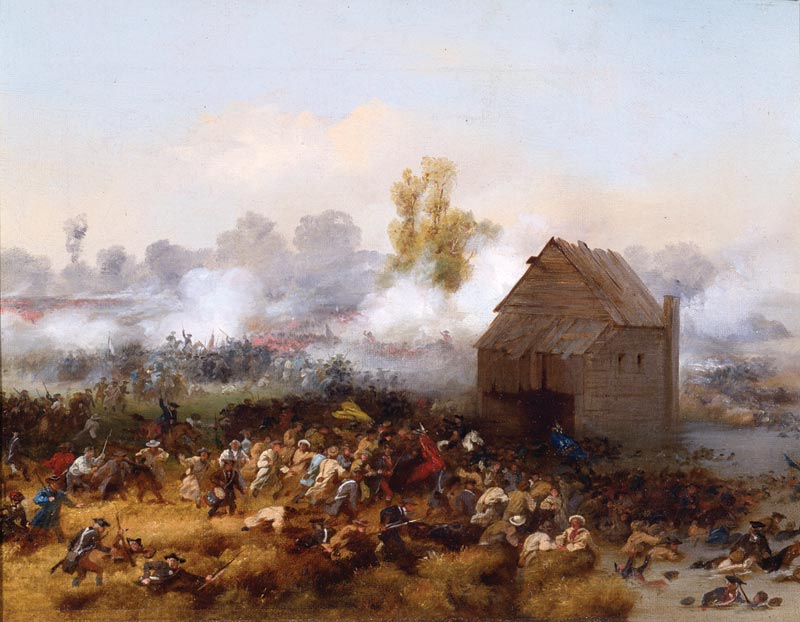
The Maryland Regiment had joined the Continental Army barely two weeks before the Battle of Long Island. When the British under Cornwallis surprised the Americans by circling around their rear, Stirling ordered all forces, other than the Marylanders, who were outside the fortified position on Brooklyn Heights, to retreat there, leaving behind himself and four companies of the 1st Maryland and Haslett's Delaware Regiment.  Stirling led these men against Cornwallis' 2,000 British soldiers who were massed around the Old Stone House, a thick-walled field-stone and brick.


Long Island


The Marylanders charged the British forces six times to give their comrades time to make their way to safety with the rest of Washington's army in the Heights. Twice, they managed to drive the British from the house, but as more British reinforcements arrived and the Marylanders' casualties mounted, they finally had to give up the assault and try to get to safety themselves. “Good God, what brave fellows I must this day lose,” Washington remarked to Israel Putnam as he witnessed the Marylanders repeatedly charge Cortelyou House, effectively holding back the British advance. Later, Washington described their efforts as an "hour more precious to American liberty than any other."

Only Major Mordecai Gist and nine others managed to reach the American lines. Note and spoiler alert - this is a critical scene in The Patriot Spy, where Lieutenant Jeremiah Creed leads some of his men and Gist to safety. Washington witnessing this fighting withdrawal gets Creed assigned to special intelligence missions.


Mordecai Gist


Back to the story: Of the others, 256 lay dead in front of the Old Stone House, and more than 100 were wounded/and or captured. The dead patriots were buried in a mass grave consisting of six trenches in a farm field. The result of the brief battle was a hard blow for the Americans. More than a thousand men were killed, captured, or missing. Generals Stirling and Sullivan were  British prisoners of war. The battalion had lost more than 250 of their number. Most of the Marylanders' casualties occurred in the retreat and desperate covering action at the Cortelyou House. Ultimately, of the original Maryland 400 muster, 96 returned, with only 35 fit for duty. As few troops would stand and fight in the face of England’s battle-tested professional army, the fact that the Maryland Line functioned and operated as a disciplined unit was not lost on Washington.


Apres Brooklyn


After reorganization and reconstitution, the Maryland regiment won more laurels in the desperate actions that followed against numerically superior British forces at White Plains (October 28, 1776), where they faced Colonel Johann Von Rall's Hessians. From 10 December 1776 to January 1777, the regiment was assigned to General Hugh Mercer's Brigade.


Trenton


During the critical winter "that tried men's souls," the regiment, though much reduced in size, was at the forefront of the fighting at Trenton (December 26, 1776) and Princeton (January 3, 1777). The following year, the re-designated 1st Maryland helped defend Pennsylvania and fought at Brandywine (September 11, 1777) and Germantown (October 4, 1777).


Germantown


The battle-worn survivors of this regiment ostensibly reorganized in December 1777, continuing their enlistments “for three years or during the war.” But by the close of 1777, few remained from the original line Washington witnessed at Long Island. Bled weak by fighting in the vanguard of the war, they received reinforcements from the Maryland companies of the Flying Camp. They earned recognition for their sacrifices by a nickname bestowed by General Washington himself, "The Old Line."


Moving South


Cowpens
In 1780, the Maryland Line (the first two battalions) reorganized as the first and second Maryland and became the backbone of the Southern Department. They provided a solid cadre of "regulars" around which various militia units could rally. At the disastrous Battle of Camden, SC  (August 16, 1780), the second Maryland served on the army's flank under General De Kalb while the first Maryland formed the army's reserve under General Horatio Gates  When General Nathanael Greene was sent south to relieve the disgraced Gates, the Maryland Line served with distinction in several battles. At the end of the decisive victory at the Battle of Cowpens (17 January 1781), the Maryland Line (the 2nd Maryland) held the center of General Daniel Morgan's command. The Maryland Line also served at Guilford Court House, NC (15 March 1781), where Greene tried to stop Lord Cornwallis's invasion of that state. Although a technical loss, the Americans put up a fight and inflicted unacceptable losses on the British, making it a Pyrrhic victory.


Guilford Court House


A Faded Legacy of Honor


After the war, many members of the Maryland Line continued to maintain relationships formed during the long struggle for independence. In the last days of the war, the Society of the Cincinnati formed chapters in each of the thirteen original states. William Smallwood called for the first assembly of the Maryland Society of the Cincinnati on 20 November 1783 and Smallwood and Mordecai Gist became the first officers of the Maryland chapter of the society, which consisted entirely of officers of the Maryland Line. One of the express purposes of the society was to foster fraternal camaraderie and honor their collective military history. Effectively meeting for reunions as long as there were survivors, the first members of the Cincinnati likely cultivated and propagated the story of the old line. As the revolutionary generation dwindled, perhaps the first “greatest generation” in American history, so faded the memory of gallant service and sacrifice. Unfortunately, this would become the case for the follow-on patriots of the 19th, 20th, and 21st centuries.


Washington was the first National President of
The Society of the Cincinnati


Friday, May 23, 2014

Heath in the Highlands

First Patriot


I often use the term "First Patriot" to describe those who served in the American War for Independence or who played a role in the political thought and action leading up to it. Many of my Yankee Doodle Spies Blogs discuss these men and women. As I researched the first few books in the series, a name kept appearing: Heath. More precisely, the name "Heath" was often printed across maps showing activity around New York, primarily in the lower Hudson Valley, western Connecticut, and the area now known as the Bronx (Kings Bridge). William Heath was one of those serious men, a New Englander like many others, who stayed committed to the cause from start to finish and served it in whatever way was needed. Certainly, many American officers were self-serving and easily offended by slights or secondary tasks. Not Heath, who I believe served professionally and effectively throughout the war.


Citizen Soldier


William Heath
William Heath was born in 1737. He made his home at his farm in Roxbury, Massachusetts. Like many of his generation, he became active in the militia as a young man, and by 1770, he was a colonel and leader of the Suffolk County militia. At the beginning of the war, Massachusetts named him a brigadier general, and he commanded Massachusetts forces during the final stage of the Battle of Lexington and Concord in April 1775. As the siege of Boston started, Heath focused on training the militia involved in the siege. In June of that year, Massachusetts appointed him a major general in the state troops, and the Continental Congress made him a brigadier general in the new national army, the Continental Army.


Solid Service


Charles Lee

In 1776, Heath took part in defending New York City, where he fought at Long Island and was among those who urged General Washington not to abandon the city. Heath's role involved overseeing the defense of the northern approaches to Manhattan. He did a reliable job monitoring potential British landings, dispatching intelligence missions, and gathering supplies. Heath served under Washington at Harlem Heights and White Plains, where he commanded the left flank of the Continental Army. In November, he was put in charge of forces in the Hudson River Highlands. When Washington conducted a frantic rearguard action across New Jersey to avoid destruction in the final months of 1776, he left Major General Charles Lee and Heath to guard critical communication lines between the mid-Atlantic and New England. When Lee finally responded to Washington's call to join him in the Jerseys, William Heath remained steadfast in defending the Hudson Valley. It was a command that demanded duty, not glory. After the British took control of New York City in 1776, the defenses just north of there became highly important. The ongoing presence of British land and naval forces in New York underscored the significance of the Hudson River, and both sides recognized the need to control this vital waterway. The Americans built fortifications, including West Point with its chain across the river. Washington assigned Continental troops under General Heath to the Highlands on November 12, 1776, and a Continental Army garrison remained there until the end of the war. Heath's assignment effectively created a military department. The British aimed to gain control during the Saratoga campaign in 1777 and frequently raided the southern parts of the department to disrupt military logistics and movement. One of the most notable incidents in this department's history was Benedict Arnold's defection in September 1780.


Hessain Grenadiers Advance


The Dog House?


Robert Rogers
Heath faces scrutiny during this period. In January 1777, Washington directed Heath to attack Fort Independence in the Bronx, New York, to support the American operations at Trenton and Princeton. Over ten days amid a harsh winter, Heath commanded 6,000 men in three attack columns heading south to seize the fort that guarded access from Spuyten Duyvil to the Kings Bridge crossing into Manhattan. Initially, the attack went well as British outposts were quickly taken. However, when they reached the fort, they encountered 2,000 disciplined Hessians. Unfazed, the Hessians responded to Heath's plea to surrender with heavy artillery fire. Heath attempted to flank the enemy, but a sudden thaw made crossing the creek impossible. After several days of skirmishes, a surprise movement by British troops on the American flank and rear forced Heath to consider retreat. The weather worsened, and Heath and his commanders decided to withdraw, which Washington criticized. Nonetheless, Washington understood the importance of avoiding a defeat—his own retreat across New Jersey proved that retreat can be a strategic choice. Had Heath's forces been defeated or captured, it could have cut off New England from the Middle Colonies and destabilized the overall strategic situation.

But Heath was never again assigned command of troops in action. Still, he remained in important posts, which was common at that time. Heath was a dependable commander of this American army of observation (my words) patrolling the no man's land north of Manhattan. His presence maintained the vital link between the colonies, protected the Hudson River, and helped keep the British in check. Heath's forces assisted in gathering and relaying intelligence to Washington. Reading his dispatches, one realizes he had a good eye for terrain, people, and the enemy situation. Heath worked diligently on logistics and overall helped sustain the Patriot presence in a crucial region. His handling of the Daniel Strang Court Martial for espionage shows the wide range of his duties as a commander and administrator. He approved the death sentence, which was duly carried out. Strang was found guilty of spying and recruiting for the notorious Loyalist Colonel Robert Rogers. Later, Heath was put in charge of the Convention Army of John Burgoyne's surrendered troops after the Battle of Saratoga in October 1777. However, in 1780, he returned to command the Highland Department following Benedict Arnold's treason. And in July 1783, he was given command of the Lower Hudson District while George Washington was with the Main Army in Yorktown—again standing watch over the powerful British forces in New York.
Post-War Patriot


After the war, Heath was a member of the Massachusetts Convention that ratified the United States Constitution in 1788. He served in the state Senate from 1791 to 1792 and as a probate court judge. In 1806, he was elected Lieutenant Governor of Massachusetts but declined the office. Heath was listed as an original member of the Massachusetts Society of the Cincinnati. Our first patriot died at home in Roxbury on January 24, 1814, and was buried nearby in Forest Hills Cemetery. The town of Heath, Massachusetts, is named in his honor.


Heath's Monument at
Forest Hills Cemetery

Saturday, April 12, 2014

A Blog about a Blog?

Finding the First Maryland 400


The heading recalls the famous Seinfeld episode where they were trying to sell a TV series to NBC. The concept was a show about nothing! Of course, it was anything but that.  I was going to take a pass on doing a blog this week as it is, after all, Easter week. But I received a post from a blog I follow and I decided to review the Blog as it directly connects to The Patriot Spy, book one in the Yankee Doodle Spies series. So this week we have a blog about a blog!

The Blog


Several months ago, a Facebook friend sent me a link to a Blog established by the State of Maryland Archives.  The Archives commissioned a research project on Maryland's First Continental Line regiment called "Finding the Maryland 400."  As the Blog's home page explains:

The attack of the Maryland 400 
"During the Revolutionary War, men from all over Maryland joined the Continental Army to fight the British. In August of 1776, a group of these men under Col. Smallwood were sent to New York to help defend the city from an attack; the ensuing conflict is remembered as the Battle of Brooklyn (or Battle of Long Island). The battle was a resounding defeat for the Americans under the command of Gen. George Washington, and they were forced to retreat and give up the island. The story of the Maryland 400 goes that during  these
events, 400 of Maryland’s soldiers were sent to cover the retreat from the field and bravely threw themselves at a much stronger and better positioned British force repeatedly. Though they succeeded in buying enough time for the retreat, they suffered heavy losses, perhaps over half of their number. Who exactly these men were has remained unknown, with little to commemorate their actions in the battle."

So in the summer of 2013, the Maryland State Archives and the Maryland Military Department, Office of the Adjutant General, the Maryland Military Historical Society, and other partner groups hired some interns to research the identities of the First Patriots who served in the Maryland 400 at the Battle of Long Island. Their goal was to create an accurate list of the Maryland soldiers who participated in the battle and write biographies about some of the men. The chronicles the research progress as well as new discoveries.


The Design


The blog is well designed and appealing.  The key sections are:

William Smallwood
Updates - These are articles about individuals or events the research has uncovered or that otherwise relate to the Maryland 400. The latest discusses Larkin Dorsey, a sixteen-year-old from Anne Arundel County who enlisted in the Ninth Company of the First Maryland Regiment. Readers of The Patriot Spy might recall my fictional Lieutenant Jeremiah Creed originally commanded the Light Company but later led men from several companies, perhaps even the Ninth. Larkin's  father asked Lieutenant Colonel Francis Ware to keep an eye on Larkin Dorsey."  Apparently, such fostering was common in a time when people were linked by bonds of family and place. As the post explains... "Ware was second in command of the Regiment. Ware, who did not have children of his own, agreed to take on the responsibility for young Larkin. It should be noted that both Smallwood and Ware missed the seminal action on Long Island due to other duties and arrived at the end of the engagement. Major Mordecai Gist led the attacks.

Biographies - This is a list of members of the 400 with links to their biographies. Among them are Smallwood, Mordecai Gist (who has a role in The Patriot Spy), and Ware (mentioned above).  The biographies are listed by the company, a nice touch.

Mordecai Gist
Roster - Although not fully complete, this section provides a very comprehensive roster of those identified as members of the unit. The gaps in understanding who served and fought are explained, as is the paper and field strength of the unit when it fought. There is a search capability included.

Interactive Map - This is my favorite part of the blog. Everyone has to be somewhere and the researchers do a really nice job geospatially portraying the movement of the members of the 400 based on pension records, unit rolls, correspondence, etc. As more data is uncovered and added, this will prove a fun and easy research tool. One can note quickly, for example, that several members migrated to the reaches of Tennessee, Kentucky, Ohio, and Pennsylvania after the war, indicative of the new nation's trend west that ended (ironically) when the Brooklyn Dodgers moved to Los Angeles. The original Brooklyn Dodgers clubhouse was a building at the center of the battle in which the gallant 400 fought.


The Maryland Monument in Prospect Park


The Rating


Those who want to see for themselves (and let us know via this blog) can go to directly to the Blog, which is on Word Press (can I mention another blog platform?):  http://msamaryland400.wordpress.com/about/
You do not have to be from Maryland or even a Revolutionary War, or even a history buff to appreciate and enjoy "Finding the Maryland 400" Blog. Although still a work in progress, based on what the researchers have put together so far, and the quality of the display, I give "Finding the Maryland 400" a full Five Fifes