I wanted to devote more time to this particular blog, but the computer gods hosed my operating system, which then imploded, causing me to spend about fifteen hours over three different days trying to get things back in order. Thus, my time has been consumed in less creative ways than I would like. On the positive side, I now have some very good friends in India...
Continental Nurse Corps?
One significant way women contributed to the Continental Army was through nursing. Female nurses were preferred over their male counterparts because every woman nursing meant one more man freed to fight. Women willing to care for the sick were in constant demand yet short supply throughout the war. A woman serving as a nurse received regular pay (which often turned out to be irregular or nonexistent), but the job carried many risks, including exposure to deadly diseases like smallpox, along with other viruses and infections. Nursing was one of the most challenging roles within the medical profession, leading many women around the camps to be bribed and coerced into the position. The promise of full rations and an allowance for volunteer nurses, or threats to withhold rations from women who refused to volunteer, often proved effective.
Shortly after the establishment of the Continental Army on June 14, 1775, Maj. Gen. Horatio Gates reported to Commander-in-Chief George Washington that “the sick suffered much for want of good female Nurses.” Gen. Washington then asked Congress for “a matron to supervise the nurses, bedding, etc.,” and for nurses “to attend the sick and obey the matron’s orders.”
| General Horatio Gates recognized the need for nurses early in the war |
In July 1775, a plan was presented to the Second Continental Congress that designated one nurse for every ten patients and stated “that a matron be allotted to every hundred sick or wounded.”
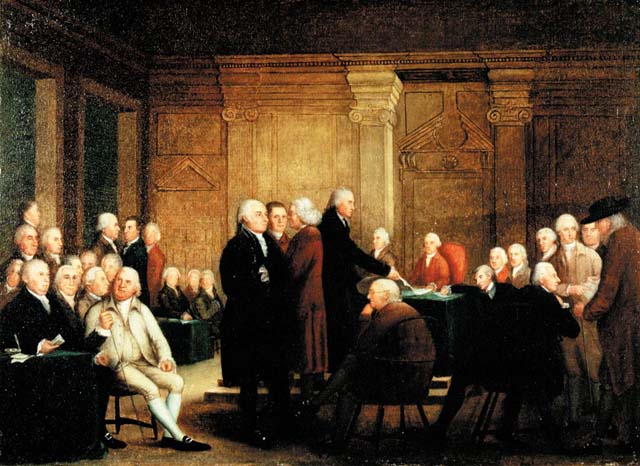 |
| Second Continental Congress |
Big Bucks
Congress allowed two dollars per month as a salary for these nurses, while matrons (women who supervised nurses and acted as liaisons to surgeons) received four dollars monthly. In 1776, Congress raised nurses’ pay to four dollars per month, and in 1777, to eight dollars, possibly to attract more women to nursing or to keep those who were dissatisfied with their jobs.
Despite Congressional efforts to boost the number of female nurses for the army, a shortage persisted throughout the war. Regiments consistently sought women to care for their sick and wounded. Newspapers in Massachusetts and Virginia advertised requests for nurses to serve in the Continental Army. In July of 1776, Nathanael Greene wrote: "The sick Being Numerous in the Hospital And But few Women Nurses to be Had, the Regimental Surgeon must Report the Number Necessary for the sick of the Regt and the colonels are Requested to supply accordingly."
Nurse or Spy?
The demand for nurses was so high that commanders often overlooked suspicious circumstances to secure women for nursing roles. In April of 1777, General Israel Putnam questioned a woman named Elisabeth Brewer after she left British-occupied New Brunswick, New Jersey. Putnam wrote to Governor William Livingston that Brewer...

Israel Putnam
" . . . has an Inclination of entering the Hospital as a Nurse; in which employment she has been before
employ'd at this place, and the Surgeon giving her a good Character, I have that purpose to detain her here for that purpose—If you have any Objections and will let me know, I will send her Immediately to you."
Brewer was allowed to take up nursing duties with Putnam's units. The fact that she had come from a British-held town did not raise enough suspicion to stop a desperate army from utilizing her skills. However, Putnam should have investigated Brewer’s background more thoroughly, as she was found guilty of espionage in June 1777.
First Patriots
But for the most part, true patriot nurses answered the call. In July 1776, orders for the Pennsylvania battalions at Ticonderoga stated that one woman was chosen from each company to go to the hospital at Fort George to nurse the sick. The returns for the hospital in Albany in July 1777 list nine female nurses. In 1778, Washington ordered his regimental commanders to employ as many nurses as possible to assist regimental surgeons.

In March 1780, an Albany hospital provided provisions for female nurses and their children, as well as for female and child patients. Nurses Rachel Clement (with two children) and Mary DeCamp (with one child) received two rations each, while Mrs. Perkins (with three children) and Sarah Lancaster (with one child) received one ration each. Nurses working there without children received one ration each.
| Continental Nurse treating at the front line |
In contrast to the skilled and highly educated professionals of today, Continental nurses' duties primarily focused on maintaining cleanliness for both the hospital and its patients. The "Rules and Directions for the better regulation of the military Hospital of the United States" outlined nurses' responsibilities. They were required to remain clean and sober, empty chamber pots as soon as possible after use, wash new patients, wash the hands and faces of existing patients, comb patients' hair daily, change linens, sweep the hospital, sprinkle the wards with vinegar (as a disinfectant) three to four times a day, and deliver deceased patients' belongings to the ward master. Nurses were prohibited from being absent without the permission of their supervising physicians, surgeons, or matrons.
These devoted women served tirelessly and without glory, status, or substantial compensation. Like nurses today, they cared for their patients with quiet and selfless dignity. These First Patriot nurses should be given all the accolades granted to their male counterparts. So this week—and every week—we should honor them above all...


