Followers

Showing posts with label Boston. New York. Show all posts

Sunday, December 8, 2013

Gambling through Defeat and Victory

The Gambler


Apologies to Kenny Rogers, and no, His Excellency did not have a gambling problem. Although, as a landed Virginia planter, he was no stranger to money won and lost at the horse race or whist table. Ever the champion of order and integrity, Washington knew that excessive gambling was problematic. He is quoted on the subject: "Gambling is the child of avarice, the brother of iniquity, and the father of mischief." But during the time of the Yankee Doodle Spies, it was sometimes a necessity, at least on the field of battle.

The Gambler


The North and Early Success


Even as he adopted a risk-averse Fabian strategy for the war, Washington understood that a successful commander must be willing to take calculated risks. Since his army was almost always outnumbered and outgunned, the need to take risks arose frequently. In Boston in 1775, Washington took three significant chances: outfitting ships to challenge the British Navy, dispatching troops to Canada, and sending a small force to capture Fort Ticonderoga and its formidable artillery. 


Guns of Ticonderoga


The Canada campaign failed, and the navy's efforts highlighted the need for a Continental Navy, but Ticonderoga was taken by a surprise attack. This victory gave the Americans control of the largest fortress in the colonies and, more importantly, the heavy guns the Continental Army needed to make the siege of Boston a success.


The Middle Brings Failure


After Boston fell, the British threatened the middle states (or colonies, as you prefer) with an attack on New York. Not yet the largest city in North America, New York was strategically important because of its location and its excellent harbor. Additionally, New York had a larger Loyalist base than New England. Washington hurried his forces south in anticipation of a sea invasion. When the British took Staten Island, Washington risked dividing his forces and deployed about a third of his army on Long Island to stop an expected phased approach to capturing Manhattan. 

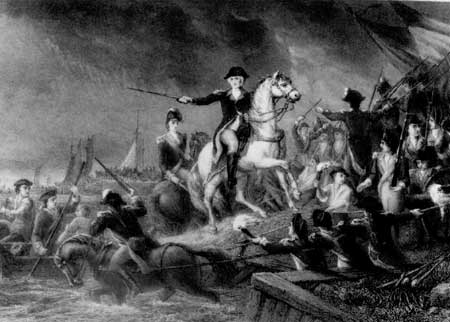
The result was a severe defeat, as the vastly outnumbered forces on Long Island only escaped total destruction by taking the risk of a night move through a storm while the enemy was nearby. Two principles of war were abandoned out of desperation. Washington also gambled in the secret war — sending the unready Captain Nathan Hale behind British lines and launching the "wonder weapon" (not) - the submarine Turtle. 

The last gamble in New York was leaving a sizeable force of valuable troops at the fort named Washington on upper Manhattan. This was done to keep a foothold on the island, with the hope of retaking it later. However, the result was the loss of the fort and its troops, who could have been more useful in the upcoming campaign for the Jerseys. 


Americans faced overwhelming British forces at Long Island

The South Brings Triumph


That area would be south (some might say central) Jersey. Most Americans are familiar with Washington crossing the Delaware, and a few know it resulted in a victory at Trenton. But few understand that this unlikely win was one of Washington's biggest gambles. His forces were exhausted and demoralized after a chaotic retreat across the Jerseys. Washington's army abandoned Fort Lee to General Cornwallis and hurriedly moved from Hackensack through Newark, New Brunswick, and Princeton. 

In December, Washington managed to get his small force across the Delaware to safety in Pennsylvania. After a tough year of fighting, with barely fifteen hundred underfed and poorly equipped soldiers and a demoralized nation ready to give up the glorious cause, Washington's situation was dire. Enlistments were ending, supplies were scarce, and a panicked Congress had fled the capital, Philadelphia. To make things worse, the British captured Washington's second-in-command, General Charles Lee, in a daring cavalry raid. Those were the times that tried men's souls, and the whole world thought the end was near.
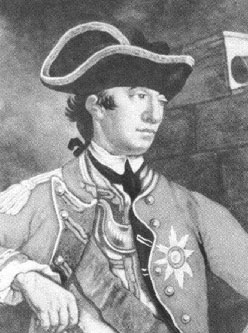


General Howe

 Nobody would have blamed Washington for taking his small forces into winter quarters and trying to come back in the spring. That's what the British commander was expecting and doing himself. To the alarm of many of his senior officers, General William Howe put his army into winter quarters just when he had Washington beaten. 

Brigade-sized units garrisoned Princeton, Trenton, and Bordentown, while the rest of Howe's army remained in or near the comforts of New York. Luckily, Lee's division made it to Pennsylvania without their commander, giving Washington the boost he needed to try a risky gamble to save the revolution from ending that winter. How he pulled off this gamble will be our next discussion.

Saturday, July 13, 2013

How I Spent My Summer Vacation

New York - resort?


I took my annual summer resort vacation...in New York City! Now many folks wouldn't think of New York City as a resort and certainly not as a summer resort. But for most of its history, New York was precisely that - especially for the poor and middle class that make/made up so much of the city's populace. Why? Because they couldn't afford the time or the money to reach out to the numerous lakes in the mountains north of town or the expansive beaches of eastern Long Island. Nope, hundreds of thousands made do with the likes of the Bronx's Orchard Beach and City Island. The trolley and later the subway brought droves to Brooklyn's Coney Island, Manhattan Beach, Plum Beach, and Brighton Beach. Sheepshead Bay (it looks like a sheep's head from the air) offers deep-sea fishing at a reasonable price. And the prime resort area remains the Rockaways.  Queens's seven mile-plus stretch of sand from Far Rockaway to Rockaway Point with views of New Jersey's Atlantic Highlands provides some of the finest beaches on the east coast.


Some work - some play


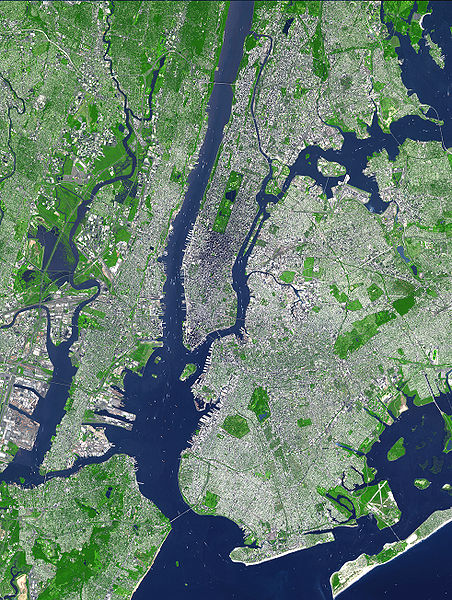
Although I was in Rockaway, this year my resort activity was somewhat curtailed.  I was under a deadline to get the edited manuscript of The Cavalier Spy reviewed and back to the publisher (done). So my summer fun in the sun was restricted to a one day visit to the beach. However, I took advantage of a special deal set up by NYC as a result of Hurricane Sandy.  Because of Sandy's impact on mass transit in the Rockaways, the city contracted a fast boat to go from Beach 108th Street and Jamaica Bay around the end of the Rockaways and up New York bay to lower  Manhattan. Readers of The Patriot Spy know Manhattan was called The Island of New York during the time of the American Revolution. The trip takes an average of 38 minutes each way for the round trip cost of $4! Like that, badabing, you are staring up at the lofty buildings of New York's financial district.  So what the heck does this have to do with the American Revolution? Well, the boat ride passed many of the critical points of the British invasion of New York back in the summer of 1776.


Sailing into the past


British cross the harbor towards Gravesend Bay


As the boat eased out of Jamaica Bay and turned into New York's impressive lower harbor, I could look to the southwest and see Sandy Hook, New Jersey. But back in 1776, the Sandy Hook included a sand bar that blocked the lower harbor, preventing large British warships from crossing over it except during extreme high tide. A few minutes later we were approaching the Verrazano Narrows. The British went through the narrows and landed an army of twenty-four thousand or so on Staten Island, then a Tory stronghold. After recovering for a few weeks they launched barges and longboats across the narrows and landed troops at Gravesend Bay. This was on my right (starboard side) just before I reached the narrows, not far from today's Fort Hamilton. The few American defenders there ran off at the sight of the British. We continued on another ten minutes with Bayonne on our port and Bay Ridge, then Red Hook, on our starboard. Near Red Hook is the Gowanus Canal: the remnant of the Gowanus Creek that played such a critical role in Washington's defenses on Long Island. The boat soon approached Governor's Island, where the Royal Governors resided during colonial times.  The last  Royal Governor of colonial New York, nasty William Tryon, evacuated a year earlier but returned in 1776 with the British armada.


The Sea Streak sails from the Rockaway peninsula on the lower right and up
the harbor to the lower extreme of Manhattan. Note the narrows and
 Governors Island. The Sandy Hook is just off the bottom of the photo,


The final heading


The Gloucester Regiment evacuates Washington's army from its defenses
near the Heights of Brooklyn
Passing the narrow channel between Governor's Island and Brooklyn, the boat entered the waters of the lower East River. To our starboard front lay Brooklyn Heights, just south of the famed Brooklyn Bridge. This was the location of Washington's headquarters during the battle for Long Island, and the point from which the Gloucester seamen evacuated the beleaguered army on a stormy night with the British front lines not more than a few hundred yards distant! The crossing from Brooklyn to New York was considerably wider than it is today, as the Manhattan's expansive use of landfill has narrowed the river by almost a quarter-mile.


The (old) City of New York


We arrived at lower New York, which during the time of the Yankee Doodle Spies extended not too far beyond today's Wall Street. We landed in the lower central portion of this image of early colonial New York. Note how the city abruptly ends at the Wall Street, it extended past Chambers Street by the mid-1700s.


Pearl Street was a contemporary thoroughfare about a half-mile north of where we landed. It probably looked little different from this image from the Dutch era, although the docks and buildings would be more extensive as the city had grown. I will do a future blog on some of the revolutionary war era sites that still remain in the city.  Of course, the march of history (not progress) has limited them to only a few.

Dutch-style buildings still dominated New York during the
time of the Yankee Doodle Spies


I

Thursday, May 23, 2013

A Yankee Doodle Memorial

This is Memorial Day weekend.  For most Americans, just another reason to have a party, go to ball games or watch the Indianapolis 500 or Preakness.

But for some, especially those who have a military connection, Memorial Day is truly something special because it is the one day that commemorates those who have fallen in the service of their country. Memorial Day was promulgated on 5 May 1868 by General John Logan, the Commander of the Grand Army of the Republic, a Civil War veterans group made up of northern vets -sort of the American Legion/VFW of its day. To honor Civil War fallen, flowers were placed on the graves of Union and Confederate dead on 30 May although most southern sympathizers clung to separate holidays to commemorate their fallen. This changed after World War 1 when veterans of both regions who had served side by side began to be honored as well.


General John A. Logan


The trauma of the Civil War, followed by that of the Great War brought industrial age carnage to new heights and the need for some sense of spiritual closure for those fallen in massed attacks such as those at Gettysburg, Cold Harbor, or the Marne and the Meuse-Argonne offensives.  To honor them, huge cemeteries and memorials span the nation and the battlefields of Europe and Asia honoring the hundreds of thousands of fallen. By "modern" standards casualties during the War for Independence were laughable and most soldiers died from sickness and starvation while in service to their nation.


But our First Patriots cherished and honored their fallen no less. And after the war, the need to honor those who gave all for an idea sanctified both the idea and those whose sacrifice enabled it.  Here are just a few examples:


General Montgomery Memorial
at St. Paul's
The first commemoration was ordered by the Continental Congress in 1776 to honor General Richard Montgomery, who fell during the American assault on Quebec, Canada. Our first fallen general's monument was designed and built under the supervision of Benjamin Franklin by one of France's best artists, King Louis XVI's personal sculptor, Jean Jacques Caffieri. Shipped to America upon completion, it rested in Edenton, NC.  Although Congress originally intended to place it in Philadelphia, it ultimately ended up in
New York City, where, in 1788, it was installed under the direction of France's Pierre Charles L'Enfant (who later designed Washington, DC)  beneath the portico of St. Paul's Chapel, which served as George Washington's church during his time in New York as the United States' first president in 1789, and where it remains to this day. Montgomery's body, which was originally interred on the site of his death in Quebec, was moved to St. Paul's in 1818.


Those who read my earlier blogs also know that I began the Yankee Doodle Spies idea, and particularly The Patriot Spy because as a boy I was inspired by the Maryland Monument in Brooklyn's Prospect Park (scroll down to read of it). But an important and little known monument was erected at the site of the Brooklyn Navy Yard.  Why? Because there the remains of perhaps as many as 15,000 First Patriots were interred there.  These were prisoners of war, the victims of the notorious British prison ships anchored as "hulks," that is de-masted sailing ships, docked in an area called Wallabout Bay.  These First Patriots later became known as the "Prison Ship Martyrs."


Unveiling Prison Ship Memorial at Ft Greene Park 1908


For years after the war, the bones of Martyrs would wash up on shore and finally  a monument was erected near the site of the hulks at the famed Brooklyn Navy Yard at a place called Vinegar Hill.  In the mid 19th century a stone crypt was erected at nearby Fort Greene Park and the bones were interred there. Fort Greene was one of several forts erected by Washington to defend Brooklyn from the British in 1776 (you can read about that in The Patriot Spy). In the late 19th century the martyrs' remains were once again moved to a new Fort Greene monument  - a tall (148 foot) obelisk that looked down on Brooklyn. When President Taft dedicated it in 1908, it was one of the finest structures in the nation and a fitting final resting place for the Prison Ship Martyrs.


General Wooster Monument

One of my recent blogs was on Connecticut's General David Wooster who was killed in the fighting that followed the British/Loyalist raid on the arsenal at Danbury, CT. On June 17, 1777, Congress voted that a
suitable monument should be erected in his memory, but measures were never inaugurated to execute the resolution. His grave was not identified until 1854 when the Connecticut legislature laid the cornerstone of a monument. Today, a monument 30 feet high marks his final resting place at Mount Moriah in Danbury. Coincidentally, Wooster fought at Quebec as Montgomery's second in command and took much unjust blame for the campaign and its result.


Many argue that Philadelphia, our nation's first capital, marks the spiritual, political, and geographic center of the American War for Independence and in 1954 an impressive monument was built to commemorate those who fell in the war. The Tomb of the Unknown Revolutionary War Soldier is  located in
Philadelphia's Washington Square. It honors the thousands of soldiers who died during the American Revolutionary War, but especially those who were buried in mass graves in that park.
The actual  plaque upon the tomb of the Unknown Soldier reads: "Beneath this stone rests a soldier of Washington's army who died to give you liberty."

Tomb of the Unknown Revolutionary War Soldier
Philadelphia

Bunker Hill Monument
Boston
If Philadelphia was the heart of the new nation, Boston was the heart and soul of the rebellion that forged the nation. The entire area is a virtual monument to the American Revolution but I'll single out one for this piece - the Bunker Hill Monument. The battle of Bunker Hill (which took place on Breed's Hill) is legendary, and for years General Washington (vainly) sought to replicate the scenario of entrenched Americans mowing down disciplined British troops who calmly marched into a hale of rebel lead. The first monument on the site was an 18-foot wooden pillar with a gilt urn erected in 1794 by King Solomon's Lodge of Masons to honor fallen patriot and mason, Dr. Joseph Warren. In 1823, a group of prominent citizens formed the Bunker Hill Monument Association to construct a more permanent and significant monument to commemorate the famous battle. The existing monument was finally completed in 1842 and dedicated on June 17, 1843, in a major national ceremony. The exhibit lodge was built in the late nineteenth century to house a statue of Dr. Warren.


So this weekend and throughout the year, we should remember all Americans who died in their nation's service. But we should especially recollect those who died to establish the nation and the idea of a free and independent people. Wherever and however you decide to celebrate the occasion, take a moment to think of those who had no Arlington - the fallen at Saratoga, Brandywine, Brooklyn, Harlem, Paoli, Bennington, Germantown, Charleston, King's Mountain, Guilford Court House, Valley Forge, Yorktown, and hundreds of battlefields fields so small only the local patriots know of them. Give them a roaring "Huzzah" for duty well done.

Arlington

Saturday, March 2, 2013

Old Put


Old Put


The topic for this blog is People—the subject is Israel Putnam. Full disclosure: I was born in Putnam County, New York, and my other nom de plume is Kent Putnam (since I was born in the Town of Kent). However, the reason I chose Old Put as this week's subject is that a Yankee Doodle Spies Facebook friend recommended it. Simple as that!  


Israel Putnam


Israel Putnam isn't a name that immediately comes to mind when asked about military leaders of the American Revolution. Besides His Excellency, Lieutenant General George Washington, people more readily think of Nathaniel Greene, Henry Knox, Horatio Gates, and even Benedict Arnold. This is somewhat understandable since Putnam's notable achievements came early in the war, and age and health issues slowed him down and eventually stopped him when a stroke left him paralyzed.

A French and Indian War Hero


Born in Massachusetts, Putnam moved to Connecticut as a young man, where he became a landholder. When the French and Indian War erupted, he joined the renowned Rogers' Rangers, where he rose to the rank of Major. Putnam fought fiercely and participated in combat on Lake Champlain, then ranged as far north as Montreal, as far south as Cuba (where he is said to have brought the first Cuban tobacco seeds to Connecticut, sparking an industry), and as far west as Detroit. 

Putnam Joined Roger's Rangers


In an era when a 100-mile trip could be life-threatening, this was no small feat. His exploits during the French and Indian War became legendary in colonial America. His capture and brutal torture by the Indians particularly struck a chord at a time when such an incident was every frontier American's worst nightmare. Ironically, a French officer saved him from the worst abuses and death. Later, he was released but soon joined the British attack on Cuba, where he helped seize the famous Spanish fortress, El Moro.

The Siege of Boston


By the time of the American Revolution, Putnam was a wealthy landowner and businessman. However, when the fighting intensified around Boston in 1775, he left his comfortable farm and hurried east to offer his services, becoming second in command of the rebel forces outside Boston. His most notable achievement was at Bunker (Breed's Hill), where he was largely credited with the brave efforts that caused the British Army to suffer greater losses than it could afford.


Bunker Hill:  Old Put is on the far left

The Battle of New York


The following year, he was in New York, where he worked tirelessly to strengthen the city's defenses. When George Washington arrived with the main army, Old Put was given command of a division and the daunting task of defending western Long Island (today's Brooklyn). Unfortunately, he contracted a virus just as the British commander, Lord Howe, sent over 20,000 men against his small force. This is where we see him in The Patriot Spy. In a brief scene, Old Put has recovered from his illness and is offering advice to my fictional character, Jeremiah Creed.

Command on Long Island


Fighting on despite Ill Health

After the New York campaign, age and illness slowed him down, preventing him from taking on another major field command. However, later in the war, Putnam played a leading role commanding Continental and militia forces "in observation" from the North (now Hudson) River to western Connecticut. A large British force under New York Royal Governor Tryon invaded Connecticut in February 1779. The Loyalist and British troops devastated eastern Connecticut in a blitzkrieg-style attack, burning farms and towns while trying to root out rebels.


Governor Tryon


The famed Horseneck Escape 


While trying to block the British advance near Greenwich, Connecticut, Put's small observation force was caught off guard by an enemy column with cavalry leading the way. While shaving that cold morning, Putnam saw the approaching British column before his scouts did. Dropping his straight razor and drawing his sword, he leaped onto his horse and rallied his men, narrowly avoiding capture. 


Old Put's Ride

British dragoons and the notorious Delancey Tories galloped after the general as his men eluded them. After a long and desperate chase, he made a dramatic escape by riding his horse over a precipice and down a very steep, icy ravine. The surprised enemy halted at the edge and fired their pistols in vain at Old Put. Putnam waved his sword back with taunting words to the frustrated British, whose balls whizzed past him. One of the bullets is said to have pierced his military cap.