Followers

Showing posts with label Continental Army. Show all posts

Tuesday, November 28, 2023

The Third Virginian


It is a sad commentary that most Americans are more familiar with Marilyn Monroe than with the first patriot sharing her last name. And who knows? Maybe the Hollywood star who renamed Norma Jean was a history buff? But I digress. This profile shines a light on one of those diligent founders who quietly left his mark on America and the world. The fact that James Monroe is also a significant historical figure in my novel, The Lafayette Circle, makes his story even more compelling.


Norma Jean

Planter Orphan

James Monroe was born at the aptly named Monroe Hall in Westmorland County, Virginia, on April 28, 1758. His father was a moderately successful planter. Both of his parents died when Monroe was a teenager, and he took over the plantation and cared for his siblings under the guidance of his mother's brother, Joseph Jones, a member of the House of Burgesses. Jones took young Monroe to Williamsburg and enrolled him in the College of William and Mary. His uncle also introduced him to prominent Virginians like George Washington, Thomas Jefferson, and Patrick Henry—future leaders who would help shape the world, just as young James would.

Williamsburg

Patriotic Student

Williamsburg was alive with patriotic enthusiasm. Monroe was still attending William and Mary College when the Revolutionary War started in April 1775. Eager to join the fight like many other young Virginians, he left William and Mary, and on September 28, 1775, Monroe was commissioned as a second lieutenant in the 3rd Virginia Continental Infantry. His first commander was Colonel Hugh Mercer, who would become one of General George Washington's most trusted generals until his early death at Princeton caused by British bayonets. Lieutenant Monroe marched north to New York City with his regiment the next year.

The Virginia Line

Years of Combat

There, he first saw combat at Harlem Heights on September 16, 1776, and volunteered to join Major Thomas Knowlton's rangers. Knowlton, who was mortally wounded in that skirmish, became the namesake of the Military Intelligence Corps' honorary award, which bears his name.


After more fighting at White Plains in October, British General William Howe managed to flank the Continental Army but let it escape to New Jersey. Monroe's regiment moved south and west in a series of retreats, causing the Continental Army to shrink and American morale to drop. By late December, Washington's small force was gathered on the Pennsylvania side of the Delaware River and was in serious trouble.

An Army in Retreat


Things changed with the arrival of General John Sullivan as the leader of General Charles Lee's division. Interestingly, Lee had allowed himself to be captured at Bosking Ridge, New Jersey, by a group of British dragoons, including a young Banastre Tarleton. 


John Sullivan


Crossing the Delaware

The additional troops allowed Washington to execute the plan he had been considering since crossing into Pennsylvania—a return across the Delaware River. With Howe's forces in control of New York City and most of the Jerseys, the situation was at its lowest point. He needed a daring move, so on Christmas night, Lieutenant James Monroe and Captain William Washington's company of Colonel Weedon's Third Virginia were steering their long Durham boats through the ice floes clogging the Delaware River. It was the night of the 25th and about as quiet as Washington could hope for, as his troops marched through the cold, windy night along icy wooded trails. Monroe had encountered a man named Riker along the way. He was initially thought to be a Loyalist, but it turned out he was a true patriot who then joined the ragged force heading toward the Hessian-occupied town of Trenton.


Crossing the Delaware


Christmas Surprise

At daylight on the 26th, the Continental forces launched an attack on the sleeping town. Sentries were pushed from their posts as the Virginians advanced from the north. Their target was a two-gun battery manned by Hessians, positioned to fire on the approaching troops of Nathanael Green's brigade. The town was thrown into chaos as sleepy musketeers and grenadiers stumbled from their quarters, shouldering their muskets.


Nathanael Greene


The pop, pop of desultory musket fire filled the cold morning air. It soon grew louder, causing Monroe's company to scatter for cover—they were the vanguard of their regiment and brigade. The Americans started to return fire, and more Continentals arrived on King Street. 

The boom of cannon from behind boosted their confidence. General Henry Knox's batteries were in action. Musket fire to the south also indicated that General Sullivan's brigades were attacking. But ahead stood that stubborn Hessian battery, ready to cut down the advancing column and stop the attack. 
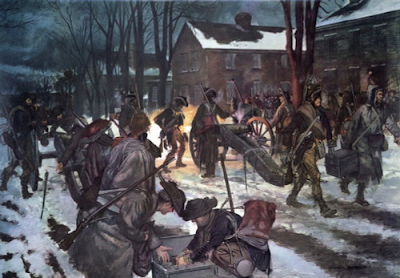

American Artillery Opens Fire

The order came from Captain Washington, "Forward!" The company all rose together and moved forward at a trot, the men's fingers frozen to their muskets as the icy mix of sleet seared their faces and stung their eyes. The buzz of lead was all around them, and Captain Washington suddenly dropped to a knee, clutching his hands, which were streaming blood. Lieutenant Monroe suddenly took command.


William Washington


He charged forward with the company moving at double time, and soon, the Hessian gunners, who weren't shot or on the run, were surrendering their weapons and being marched to captivity. But not before a lead ball tore into Monroe's chest, staggering him and soaking his uniform in blood. Carried to an aid post where Washington was being treated, it was soon clear the ball had torn an artery—a mortal wound.


Monroe led the charge toward the Hessian guns

But fortune smiled on James Monroe as well as George Washington that morning. As it turned out, Riker—whose first name Monroe never learned—was a surgeon. And rare for those times, a highly competent surgeon. He managed to close the artery and prevent the future president from bleeding to death in a battle that resulted in no soldiers killed and only five wounded, including Monroe and Washington. He was promoted to captain for his gallantry.

Battles Lost and Won

Monroe recovered fully from his wound and performed capably at the Battle of Brandywine and Germantown in the fall of 1777. His success in those battles earned him a promotion to major and the appointment as aide-de-camp to General William Alexander on 20 November 1777. 

Major Monroe fought at the Battle of Monmouth on 28 June 1778, one of the fiercest battles of the war and the last major engagement in the North. However, Monroe, who was practically broke and unable to recruit troops, resigned from the Continental Army on 20 November. This was common; many Continental Army officers who served honorably went on to pursue business, return to farming, or enter politics. Alexander Hamilton is just one example.


Battle of Brandywine


Law and Politics

Back in civilian life, Monroe studied law under Governor Thomas Jefferson, a relationship that would influence their lives and the nation's future. When Charleston fell in 1781, Virginia planned to raise several new regiments, and Monroe was given the rank of lieutenant colonel, although he never saw combat.


Thomas Jefferson


His military career stagnated, but Monroe's political journey was rising—initially with a seat in the Virginia House of Delegates, then in the Confederation Congress. Later, he participated in the state constitutional convention. Like many notable Virginians (Patrick Henry, George Mason), he opposed the proposed constitution due to its centralized authority. Nonetheless, he took a seat in the new US Senate in 1790. 

Diplomacy

Monroe's international and diplomatic career began in 1794 when President George Washington appointed him US Envoy to France. His involvement in factional politics started three years later when he returned to Virginia and joined the anti-Federalist opposition organized by Thomas Jefferson and James Madison. This Virginia triumvirate would deeply influence US politics and the future course of the new nation. 


James Madison

Monroe was elected Governor of Virginia in 1799. However, in 1802, President Jefferson appointed him Envoy to France to support Robert Livingston's negotiations with Napoleon Bonaparte over the Louisiana Territory, which the US bought from France the following year for 15 million dollars—doubling the size of the US. Afterwards, Monroe served as minister to Great Britain, where he negotiated a commercial treaty in 1806, which the US Senate rejected because it didn’t address the hot-button issue of the day, impressment.


Napoleon Bonaparte

A Second War with England

After another period in Virginia politics, Monroe served as President Madison's Secretary of State in 1811. Tensions with Great Britain at that time led to the war. The War of 1812 was going poorly, so in August 1814, Madison temporarily appointed him Secretary of War. The third member of the Virginia triumvirate, James Monroe, was elected the nation's fifth president in 1816—showing strong teamwork.


British Army Burns Washington in 1814

Chief Executive

The nation was expanding rapidly when Monroe took office, and a growing sense of American patriotism and exceptionalism, if not outright nationalism, was everywhere. During this so-called Era of Good Feelings, Monroe and his Secretary of State, John Quincy Adams, aimed to strengthen America's position on the global stage. A brief war in 1819 against the Florida Seminoles, fought successfully by General Andrew Jackson, resulted in the Spanish selling West Florida to the US in 1820, helping him secure a second term.
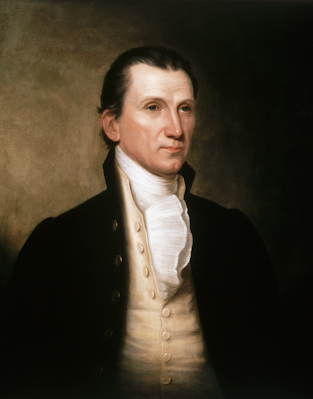

President James Monroe

The Era of Good Feelings

In 1819, James Monroe became the first American president since George Washington to tour the country for goodwill. The nation was expanding west into the Louisiana Territory, the war with Britain had ended, and America had stood on its own against the world's only superpower. The Spanish colonies in South America were breaking free from Spanish rule and building their own democracies. America appeared to be the model of the future. As the nation's 50th anniversary approached, the American experiment seemed headed toward a prosperous future.


President Washington


The Holy Alliance

Not all nations welcomed the success of American democracy and the collapse of the Spanish empire. At the 1815 Congress of Vienna, the autocratic countries Prussia, Austria, and Russia formed a political alliance called the Holy Alliance. Holy because they still believed their rulers' authority came from God—the divine right of kings. They now turned their attention to the Spanish colonies. This did not go unnoticed by Britain, which had its own interests in the New World and did not welcome outsiders.


Congress of Vienna

The Monroe Doctrine

In 1822, Monroe's administration officially recognized the newly independent countries of America: Argentina, Peru, Colombia, Chile, and Mexico, after they gained independence from Spain. The British approached Monroe with the idea of issuing a joint statement of the status quo ante in the New World, but when he discussed it with his Secretary of State, John Quincy Adams, Adams hesitated. Why shouldn't the US issue its own policy? After all, Britain was still a rival, and we had just fought a war with them. He offered to help draft a letter to Congress explaining that external powers should not interfere in the Americas' affairs—no new colonies. Drafted in 1823, it was made public in early 1824.


Crafting the Monroe Doctrine

Vive Lafayette

As all this unfolded, Monroe's administration chose to capitalize on the popularity of the last surviving general of the Continental Army, the Marquis de Lafayette. What better way to showcase American exceptionalism, mark the upcoming anniversary, honor a war hero, and send a political message to nations like the Holy Alliance? The year-long visit started in August 1824, coinciding with the election of John Quincy Adams, who took office after Monroe in 1825. 


General Lafayette's Visit was a Tour de Force


Final Years

The former planter, politician, soldier, and statesman retired to his estate outside Leesburg, Virginia, with his wife, Elizabeth (Kortright) Monroe. President John Quincy Adams and General Lafayette visited the couple shortly before Lafayette's return to France. They had plenty of memories to share. After all, both were wounded while serving America—and the young General Lafayette had also fought at Trenton, Brandywine, and Monmouth. 


Elizabeth (Kortright) Monroe


Ironically, the last member of the Virginia triumvirate moved to New York City after Elizabeth's death in 1830. He lived with his daughter and her family at 63 Prince Street—on Lafayette Square. James Monroe became the third president to die on Independence Day when he succumbed to heart failure and tuberculosis on July 4, 1831.


Saturday, September 30, 2023

The Last Cantonment

 Travels through History

Earlier this month, I traveled to Kennebunkport, Maine, where I delivered a presentation on intelligence activities during the American War of Independence to the Maine Chapter of the Association of Former Intelligence Officers. On the way back, I visited the Continental Army’s last cantonment site and General Washington’s Headquarters, located in the central Hudson Valley. These modest and scenic locations were the focus of some exciting developments as the eight-year fight for independence entered its final stages.


Army at Dusk

Although British General Charles Cornwallis’s surrender at Yorktown, Virginia, in October 1781 marked the final major battle of the eight-year war, small fights continued as both sides looked for advantages in the peace talks. General George Washington sent part of his army south to support Major General Nathanael Greene’s effort to take back the Carolinas from the British, who stubbornly held onto their coastal forts. Meanwhile, Loyalist groups kept fighting wherever they could.


Yorktown Surrender


The rest of Washington’s Army, about 7,500 men, retreated to New York, where Washington hoped to join forces with the French under General comte de Rochambeau and execute his long-planned attack on New York City. However, like the British, the French now saw their main priority as competing for the islands of the West Indies and soon headed south. Washington set up his Army in the mid-Hudson Valley area, close enough to threaten the British garrison, which controlled New York City, Long Island, and parts of Westchester.


comte de Rochambeau

Without support from the French Army or Navy, his main job was to keep an army as a believable threat to the city — making it just another part of the complex diplomatic struggle happening in Paris. This was easier said than done. The only thing harder to manage than an army at dawn is an army at dusk. Still, if negotiations failed, Washington understood that a credible army would be essential to the country’s survival.

Newburg Headquarters

The central Hudson Valley offered a stunning setting for the Army at dusk. The mighty Hudson (then called The North) River was bordered by steep slopes covered with lush forests, green farmland, and neat orchards. Once the land of native tribes and early Dutch settlers, the area had become Anglicized but still retained much of its original Dutch character. 


The Hasbrouck House

Washington’s headquarters was in the town of Newburgh, about four miles north of the main Army encampment. From April 1782 to August 1783, he established the Continental Army headquarters and his residence in a brown fieldstone mansion owned by the Hasbrouck family. He stayed at the Hasbrouck House longer than at any other of his many homes during the eight-year war. Washington was joined by his staff, personal Life Guard, servants, and occasionally, Martha Washington.


Map of Newburgh and New Windsor


He would oversee the final stages of his war from this spacious home overlooking the Hudson from its western bluffs.

New Windsor Cantonment

A few miles south, the remaining brigades of the Continental Army gathered in log huts cut from the nearby Catskill Mountains. He had marched them there in October, and by December, the Army’s engineers and carpenters, helped by the infantrymen, built nearly 600 huts, forming a military community — a cantonment. This cantonment, housing 7,500 soldiers along with 500 women and children, was the most densely populated “town” in the colonies and the second largest “city” in New York State.


Cabins served as barracks and unit headquarters


Although not as harsh as the winter at Valley Forge or the Morristown cantonment, the winter quarters still proved difficult. Officers and soldiers spent much of their time gathering enough wood for camp and stove fires, and, as was common during the war, quartermasters struggled to get enough food, blankets, clothing, and other vital supplies. Some senior officers argued over finding suitable quarters.


Most of the Continental Artillery was at West Point

In addition to forces stationed at New Windsor, Washington, mainly his artillery and the Corps of Invalids, further down the Hudson at West Point. A “duty regiment” was also rotated into lower Westchester, where they monitored the British defenses at Kingsbridge (today’s Bronx). The shortage of forage for horses also forced him to disperse most of his cavalry.

The Man Who Would Not Be King

By 1782, years of poor treatment of the Army by the Continental Congress and, more specifically, the states, had led to widespread discontent. One of Washington’s commanders, Colonel Lewis Nicola, decided that action was necessary. Nicola, a Dublin-born French Huguenot, commanded the Corps of Invalids, wounded soldiers who were limited in capability but kept for guard, garrison, and sentry duties.


Washington rejected monarchy


 In a May 1782 letter to the commander-in-chief, Nicola proposed establishing a monarchy similar to Britain’s, suggesting that Washington could be king. He pointed to the grievances of the Army and its officers, indicating that this idea reflected a widely held belief. Washington's response was immediate and stern; he sharply rebuked Nicola in writing for the proposal and for the suggestion that he would abandon a republic to become a king.

Spring of Discontent

At New Windsor, General George Washington put a stop to a conspiracy among his officers. The issue was, once again, pay. The officers were concerned that the half-pay pensions long promised by the Confederation Congress would not materialize. Many understood that once the treaty with Britain was signed, there would be no incentive for the government to keep its promises. 


Officers who led the troops were promised pensions for service


In fact, the Articles of Confederation Congress had no authority to allocate funds for this—it was the responsibility of the states. Alexander Hamilton, now serving in Congress, and his allies were working to resolve the issue. However, many officers had lost patience, and a movement was forming to take action against Congress itself—the so-called Newburgh Conspiracy.


New Windsor cabins and Temple Hill in the background

Informed of this, Washington composed a stirring paean to duty and country over interest and planned to attend a meeting of the officers scheduled at Temple Hill, a long wooden structure used as a meeting hall and community center for the cantonment. 

Temple Hill Gathering

On March 15, 1783, the officers gathered, and Major General Horatio Gates, who was now the camp commandant, began the session. About three hundred officers had planned to attend, which was too many for the building, so they sent representatives who sat in an angry mood. However, Washington entered the room unexpectedly and expressed his desire to speak to the meeting. Gates was forced to yield the chair to the commander-in-chief.


Site of the gathering

As he addressed them, Washington observed their body language. He was not getting through. Too many promises had been made and broken. He decided to read a letter he had received from a Congressman sympathetic to the officers, which explained what was being done. But as Washington fumbled to put on his reading glasses, he paused and apologized, "Gentleman, you must pardon me, for I have not only grown gray but almost blind in service to my country."


Washington addresses the officers

A hush spread through the room as grown men, all seasoned warriors, started to cry. The towering general was like a war god to them—someone who rode across battlefields on his steed and embodied patriotism, sacrifice, and bravery. The atmosphere cleared, and the rebellion and any chance of military dictatorship were stopped before they could grow.

New Governance

When he wasn't busy managing his Army or corresponding with Congress and thirteen stubborn state governments, Washington had time to think about the nation’s future. He wrote letters to the state governors explaining the principles of republican government he would later put into action. 


Corresponding with Congress & the States


New Award

He also took time to reflect on the sacrifice and courage his troops showed during many years of trials and combat. He ordered the creation of what was called the “Badge of Military Merit.” Awarded to three sergeants for their bravery in storming the British redoubt at Yorktown, it was the precursor to what later became the Purple Heart.


Badge of Military Merit


Evening Parade

At the New Windsor Cantonment, Washington issued the cease-fire orders, ending the eight-year War of Independence. 

Head Quarters Newburgh 18 April 1783

The Commander in Chief orders the cessation of Hostilities, between the United States of America, and the King of Great Britain, to be publickly proclaimed, to morrow at the Newbuilding and that the proclamation, which will be communicated therewith, be read tomorrow evening at the Head of every Regiment and Corps of the Army—After which the Chaplains with the several Brigades will render thanks to the Almighty God, for all his mercies, particularly, for his over-ruling the wra[th] of man, to his own glory, and causing the rage of War, to cease amongst the Nations.

With the official end of hostilities, the cantonment became the site for the Continental Army’s “evening parade.” As regiment after regiment began to demobilize while keeping enough force to ensure that the British commander-in-chief, General Guy Carleton, would evacuate New York City at the scheduled time, the shrinking forces eventually moved downriver to near West Point and Verplank's Point. Communication with the British in New York City became vital as the officers who once managed war now had to oversee a return to peace.


Final task - Mustering out the troops


Sunday, July 31, 2022

The Old Patroon


The Dutch settlers of New York and East Jersey were among the hardest-working Europeans to settle in North America. Thrifty, ambitious, and organized, they expanded their foothold on Manhattan into a collection of settlements that far surpassed the small homeland they left behind. They named the colony New Netherlands. It was governed by a network of extremely wealthy landowners, called patroons, who had been granted large plots of land to cultivate and oversee. 

The Dutch Way

Originally, these patroons had the right to establish courts and levy taxes. Changes occurred when the British arrived in the late 17th century, and by 1775, the patroonships were abolished and renamed estates. By then, a sizable middle class had grown from Long Island and Manhattan, along the Hudson and Mohawk Rivers. Many had crossed the Hudson and settled along the Hackensack River in East Jersey. The cultural and economic influence of the Dutch still affected the renamed colony of New York, and they played an important role in the War for Independence.


Roots Deep and Wide

Philip Schuyler was born into a wealthy Dutch patroon family on November 20, 1733, in Albany, New York. His parents, Cornelia Van Cortlandt and Johannes Schuyler Jr., had extensive connections to the most prosperous patroon families. His maternal grandfather was Stephanus Van Cortlandt, the 17th Mayor of New York City. Educated by tutors at the Van Cortlandt family estate in New Rochelle, he mastered Mathematics and French, in addition to his native fluency in Dutch and English. Young Schuyler actively traded with the Indians and built strong bonds with the leaders of the nearby Iroquois of the Mohawk nation. He became fluent in their language.


First Fight

Like many of his generation, he gained military experience during the French and Indian War, where Schuyler served as a captain in the New York militia. His cousin, Lieutenant Governor James Delancey, had appointed him. His connections were extensive. The wealthy young Schuyler raised a local company. He participated in some of the key battles in upper New York, including Lake George, Oswego River, Carillon, and Fort Frontenac. At Oswego, he served as a quartermaster until the fort fell to the French.


Prosperous Patroon

Post-war, he built on his wealth as a patroon until he became one of the wealthiest and most prominent men in New York. In 1768, he parlayed his wealth and influence into a political career and secured a seat in the New York legislature. Although not a radical Son of Liberty, Schuyler spoke out against British policy. He managed to get himself on a commission to settle a boundary dispute with New Hampshire. This would earn him enemies among the New Hampshire and Massachusetts elites—enemies who would pursue him in years to come.


Philip Schuyler


Continental Congress

At the start of hostilities with Britain in April 1775, Schuyler served as a delegate to the Second Continental Congress in Philadelphia. His experience in the French and Indian War helped him on a committee that developed rules and regulations for the new United Colonies Army. This led to a friendship with General George Washington, who later asked Congress to appoint him as one of the Army's major generals. 


Continental Congress


All In

Despite his wartime experience, his appointment was more about securing New York's support for the Cause than leveraging his military skills. This kind of regional quid pro quo was common and used to ensure that the different colonies were "all in." Virginia's Colonel George Washington had edged out Massachusetts' John Hancock as commander-in-chief of the Army for the same reason.


John Hancock


First  Command

Schuyler's background and experience with upper New York made him a natural choice to command the Northern Department, headquartered in Albany, his old stomping grounds. However, the mission was daunting – assemble an army and invade Quebec (Canada), where it was expected that the local "Habitants" (French settlers) would rally to the Cause. His first move, however, was political. Schuyler managed to secure the neutrality of the powerful Iroquois Confederation – or at least delay their involvement.


Schuyler leveraged strong Iroquois connections


Quebec Disaster

While thus engaged, Brigadier General Richard Montgomery gathered the forces and began his advance without awaiting Schuyler's approval. Faced with a fait accompli and debilitated by a gout attack, Schuyler approved Montgomery's plans and set to work on the logistics support the fiery Irishman would need. The campaign started late in the season, so although initially successful, it collapsed in the depths of December when Montgomery and Benedict Arnold were cut down while storming Quebec City. Montgomery died, but Arnold recovered. Schuyler's New England foes quickly cast blame on the old Dutchman.

Night Assault of Quebec


Defending the North

The British, properly reinforced, launched an offensive in the spring. While Schuyler once again managed political interference, gathered men and supplies, and coordinated the overall effort, General John Sullivan, who fought a desperate retreat from Canada, attempted to garrison the mighty Fort Ticonderoga – The Gibraltar of the North.


John Sullivan


A British fleet gathered at the mouth of the Richelieu River, so Schuyler instructed Benedict Arnold (who had recovered from his wounds at Quebec) to take command of the forward defenses on Lake Champlain. The next phase of America's struggle would be fought on that long, icy body of water. Schuyler instructed Arnold to assemble a fleet to stop the armada of men and boats coming from the north under General Guy Carleton, Governor-General of Canada.


Lake Champlain Basin


Arnold performed a "rock soup" miracle, gathering a small flotilla of gunboats and, using his unique and aggressive cunning, surprised the fleet at Valcour Island. He fought the larger British ships bravely, but the Americans were torn apart by the heavier guns and ships. Still, the stubborn resistance slowed Carleton's advance, and since it was now October, he withdrew to winter quarters, planning to finish the campaign in spring 1777. The Americans had bought some time.


American defeat at Valcour Island 


Winter of Discontent

Schuyler was distracted from his preparations by a winter of bitter political infighting as his New England detractors blamed him for the northern failures. General Horatio Gates replaced him in March 1777, but the New York delegation in Congress raised a ruckus, and Schuyler was reinstated shortly afterward. However, the bitter infighting continued even as Schuyler worked to bolster Ticonderoga and begged his New England foes for more regiments to face the British onslaught forming in Canada.


Gibraltar of the North


By Land and Sea

Despite Schuyler's efforts to prevent another British advance, General John Burgoyne's 8,000-strong force sailed down Lake Champlain and moved uncontested into Fort Ticonderoga. Its commander, General Arthur St. Clair, realizing his forces were too weak to fight and would only be captured by the British, evacuated hours before the British arrived – a crucial decision. Schuyler approved St. Clair's withdrawal and ordered a "Fabian Defense." The garrison vanished into the thick woods, cutting down trees and constructing abatis and other obstacles in an effort to slow Burgoyne's troops, who were hot on their heels. The British were drawn deeper into the wilderness and away from the waterways that supplied their route south and their supplies.


Arthur St. Clair


Rallying the Militia

The Americans distracted the British, causing Burgoyne's advance to slow down and giving time for the militias to finally respond to Schuyler's call for men. British efforts toward New England and reports of Iroquois raids helped fuel this. From his headquarters in Albany, Schuyler made urgent pleas for powder, lead, guns, and supplies. But mainly, he needed men. His plans included establishing another line of defense about 30 miles north of Albany. 


Major General Schuyler


But the blame for Ticonderoga fell on Schuyler, and General Horatio Gates was once again put in charge. Gates halted the British in two decisive battles near Saratoga, where he accepted their surrender in October 1777.


Horatio Gates


Court Martial and Politics

Schuyler demanded and received a court-martial in 1778, which cleared him of wrongdoing, but he resigned his commission and returned to Congress in 1779. Philip Schuyler's legacy was that he was the only major general in the Continental Army never to fight a pitched battle. He continued to offer advice to his friend, General Washington, as his understanding of strategy and logistics was well recognized. His knowledge of Indian affairs also benefited Washington, who sought his counsel during the 1779 campaign against the Iroquois.


General Washington valued Schuyler's counsel


Enemy of the British?

Despite rumors in New England labeling him a Tory, Schuyler was targeted by the British. He faced the threat of personal attack. In October 1777, General John Burgoyne's retreating forces burned down Schuyler's country home. He later rebuilt it, and now it is open to the public. 


Schuyler's Estate Home rebuilt 


In another incident in 1780, British agents attacked Schuyler's Albany mansion under cover of darkness. The attempt, whether kidnapping or murder, was thwarted. Following the incident, Schuyler was under the protection of a bodyguard of Continental Army soldiers. However, he remained a target. On 7 August 1781, Schuyler foiled a kidnapping plot led by John Walden Meyers. It failed when Schuyler managed to escape from his Albany mansion. The Albany mansion served variously as his home, Northern Army headquarters, political center, and business office.


Schuyler Mansion in Albany


Post-War and Politics

The old patroon had powerful New York connections, and after the war, he focused on local politics by serving in the New York State Senate. He also served as a delegate to the state Constitutional Convention in 1789 and worked hard to support the new American Constitution. Schuyler was both a businessman and a soldier plus a politician. He expanded his estate near Saratoga after the war, growing to tens of thousands of acres, with a dozen slaves and tenant farmers, as well as a store and mills for flour, flax, and lumber. To get his goods down the Hudson River to market, he built schooners, naming the first Saratoga.


Schuyler had his own fleet

Federalist

Unsurprisingly, Schuyler was among the first two U.S. Senators appointed to represent the state in the new Congress. Naturally, the longtime ally of George Washington now supported his president as a steadfast Federalist. He especially backed the solid economic policies proposed by Secretary of Treasury Alexander Hamilton, who had married Schuyler's daughter, Elizabeth (more about her below). The whirlwind of New York politics caused him to lose his seat in 1792 but regain it in 1797. At the time, state legislatures, not the voters, elected senators — connections often determined who stayed or went. Schuyler was the first New Yorker to join the controversial Society of Cincinnati, a fraternity of Revolutionary War officers seen by some as a rising aristocracy. Yet most senior officers, including George Washington, had joined the organization.


President George Washington


Domestic Life

Schuyler married into the highly wealthy and influential Van Rensselaer family when he took Catherine Van Rensselaer's hand on September 7, 1755, in Albany. They had a large family of 15 children, eight of whom survived to adulthood. His second child, Elizabeth, later married young Continental Army officer Alexander Hamilton. She gained modern fame through the musical Hamilton. During her life, she used his legacy and family connections to participate in philanthropic efforts, including establishing the first orphanage in New York City.


The Hamiltons

Old Patroon

Schuyler's poor health led him to resign from political life in 1798. He died at his home in Albany in 1804, leaving a complex legacy of both success and failure. His critics saw him as too cautious or reserved to fight. Some accused him of treason—especially his enemies in New England—who were constantly suspicious of his aristocratic Dutch background. Regional conflicts also influenced perceptions. They believed Schuyler supported his own New York land claims over those of Vermont. Ironically, Schuyler later backed the Vermonters, which angered influential New York Governor George Clinton. Fame, wealth, and power drew powerful enemies to the Old Patroon.


Schuyler Grave and Memorial
Albany Rural Cemetery