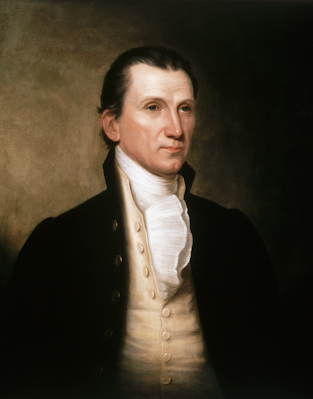
It is a sad commentary that most Americans are more familiar with Marilyn Monroe than with the first patriot sharing her last name. And who knows? Maybe the Hollywood star who renamed Norma Jean was a history buff? But I digress. This profile shines a light on one of those diligent founders who quietly left his mark on America and the world. The fact that James Monroe is also a significant historical figure in my novel, The Lafayette Circle, makes his story even more compelling.

Planter Orphan
James Monroe was born at the aptly named Monroe Hall in Westmorland County, Virginia, on April 28, 1758. His father was a moderately successful planter. Both of his parents died when Monroe was a teenager, and he took over the plantation and cared for his siblings under the guidance of his mother's brother, Joseph Jones, a member of the House of Burgesses. Jones took young Monroe to Williamsburg and enrolled him in the College of William and Mary. His uncle also introduced him to prominent Virginians like George Washington, Thomas Jefferson, and Patrick Henry—future leaders who would help shape the world, just as young James would.

Patriotic Student
Williamsburg was alive with patriotic enthusiasm. Monroe was still attending William and Mary College when the Revolutionary War started in April 1775. Eager to join the fight like many other young Virginians, he left William and Mary, and on September 28, 1775, Monroe was commissioned as a second lieutenant in the 3rd Virginia Continental Infantry. His first commander was Colonel Hugh Mercer, who would become one of General George Washington's most trusted generals until his early death at Princeton caused by British bayonets. Lieutenant Monroe marched north to New York City with his regiment the next year.

Years of Combat
There, he first saw combat at Harlem Heights on September 16, 1776, and volunteered to join Major Thomas Knowlton's rangers. Knowlton, who was mortally wounded in that skirmish, became the namesake of the Military Intelligence Corps' honorary award, which bears his name.

After more fighting at White Plains in October, British General William Howe managed to flank the Continental Army but let it escape to New Jersey. Monroe's regiment moved south and west in a series of retreats, causing the Continental Army to shrink and American morale to drop. By late December, Washington's small force was gathered on the Pennsylvania side of the Delaware River and was in serious trouble.

Things changed with the arrival of General John Sullivan as the leader of General Charles Lee's division. Interestingly, Lee had allowed himself to be captured at Bosking Ridge, New Jersey, by a group of British dragoons, including a young Banastre Tarleton.

Crossing the Delaware
The additional troops allowed Washington to execute the plan he had been considering since crossing into Pennsylvania—a return across the Delaware River. With Howe's forces in control of New York City and most of the Jerseys, the situation was at its lowest point. He needed a daring move, so on Christmas night, Lieutenant James Monroe and Captain William Washington's company of Colonel Weedon's Third Virginia were steering their long Durham boats through the ice floes clogging the Delaware River. It was the night of the 25th and about as quiet as Washington could hope for, as his troops marched through the cold, windy night along icy wooded trails. Monroe had encountered a man named Riker along the way. He was initially thought to be a Loyalist, but it turned out he was a true patriot who then joined the ragged force heading toward the Hessian-occupied town of Trenton.

Christmas Surprise
At daylight on the 26th, the Continental forces launched an attack on the sleeping town. Sentries were pushed from their posts as the Virginians advanced from the north. Their target was a two-gun battery manned by Hessians, positioned to fire on the approaching troops of Nathanael Green's brigade. The town was thrown into chaos as sleepy musketeers and grenadiers stumbled from their quarters, shouldering their muskets.

The pop, pop of desultory musket fire filled the cold morning air. It soon grew louder, causing Monroe's company to scatter for cover—they were the vanguard of their regiment and brigade. The Americans started to return fire, and more Continentals arrived on King Street.
The boom of cannon from behind boosted their confidence. General Henry Knox's batteries were in action. Musket fire to the south also indicated that General Sullivan's brigades were attacking. But ahead stood that stubborn Hessian battery, ready to cut down the advancing column and stop the attack.
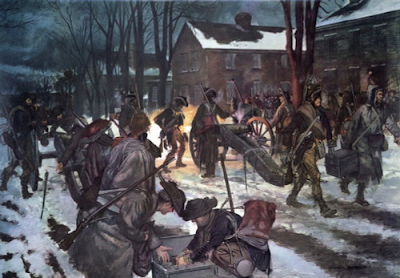
The order came from Captain Washington, "Forward!" The company all rose together and moved forward at a trot, the men's fingers frozen to their muskets as the icy mix of sleet seared their faces and stung their eyes. The buzz of lead was all around them, and Captain Washington suddenly dropped to a knee, clutching his hands, which were streaming blood. Lieutenant Monroe suddenly took command.

He charged forward with the company moving at double time, and soon, the Hessian gunners, who weren't shot or on the run, were surrendering their weapons and being marched to captivity. But not before a lead ball tore into Monroe's chest, staggering him and soaking his uniform in blood. Carried to an aid post where Washington was being treated, it was soon clear the ball had torn an artery—a mortal wound.

But fortune smiled on James Monroe as well as George Washington that morning. As it turned out, Riker—whose first name Monroe never learned—was a surgeon. And rare for those times, a highly competent surgeon. He managed to close the artery and prevent the future president from bleeding to death in a battle that resulted in no soldiers killed and only five wounded, including Monroe and Washington. He was promoted to captain for his gallantry.
Battles Lost and Won
Monroe recovered fully from his wound and performed capably at the Battle of Brandywine and Germantown in the fall of 1777. His success in those battles earned him a promotion to major and the appointment as aide-de-camp to General William Alexander on 20 November 1777.
Major Monroe fought at the Battle of Monmouth on 28 June 1778, one of the fiercest battles of the war and the last major engagement in the North. However, Monroe, who was practically broke and unable to recruit troops, resigned from the Continental Army on 20 November. This was common; many Continental Army officers who served honorably went on to pursue business, return to farming, or enter politics. Alexander Hamilton is just one example.

Law and Politics
Back in civilian life, Monroe studied law under Governor Thomas Jefferson, a relationship that would influence their lives and the nation's future. When Charleston fell in 1781, Virginia planned to raise several new regiments, and Monroe was given the rank of lieutenant colonel, although he never saw combat.

His military career stagnated, but Monroe's political journey was rising—initially with a seat in the Virginia House of Delegates, then in the Confederation Congress. Later, he participated in the state constitutional convention. Like many notable Virginians (Patrick Henry, George Mason), he opposed the proposed constitution due to its centralized authority. Nonetheless, he took a seat in the new US Senate in 1790.
Diplomacy
Monroe's international and diplomatic career began in 1794 when President George Washington appointed him US Envoy to France. His involvement in factional politics started three years later when he returned to Virginia and joined the anti-Federalist opposition organized by Thomas Jefferson and James Madison. This Virginia triumvirate would deeply influence US politics and the future course of the new nation.

Monroe was elected Governor of Virginia in 1799. However, in 1802, President Jefferson appointed him Envoy to France to support Robert Livingston's negotiations with Napoleon Bonaparte over the Louisiana Territory, which the US bought from France the following year for 15 million dollars—doubling the size of the US. Afterwards, Monroe served as minister to Great Britain, where he negotiated a commercial treaty in 1806, which the US Senate rejected because it didn’t address the hot-button issue of the day, impressment.

A Second War with England
After another period in Virginia politics, Monroe served as President Madison's Secretary of State in 1811. Tensions with Great Britain at that time led to the war. The War of 1812 was going poorly, so in August 1814, Madison temporarily appointed him Secretary of War. The third member of the Virginia triumvirate, James Monroe, was elected the nation's fifth president in 1816—showing strong teamwork.

Chief Executive
The nation was expanding rapidly when Monroe took office, and a growing sense of American patriotism and exceptionalism, if not outright nationalism, was everywhere. During this so-called Era of Good Feelings, Monroe and his Secretary of State, John Quincy Adams, aimed to strengthen America's position on the global stage. A brief war in 1819 against the Florida Seminoles, fought successfully by General Andrew Jackson, resulted in the Spanish selling West Florida to the US in 1820, helping him secure a second term.
The Era of Good Feelings
In 1819, James Monroe became the first American president since George Washington to tour the country for goodwill. The nation was expanding west into the Louisiana Territory, the war with Britain had ended, and America had stood on its own against the world's only superpower. The Spanish colonies in South America were breaking free from Spanish rule and building their own democracies. America appeared to be the model of the future. As the nation's 50th anniversary approached, the American experiment seemed headed toward a prosperous future.

The Holy Alliance
Not all nations welcomed the success of American democracy and the collapse of the Spanish empire. At the 1815 Congress of Vienna, the autocratic countries Prussia, Austria, and Russia formed a political alliance called the Holy Alliance. Holy because they still believed their rulers' authority came from God—the divine right of kings. They now turned their attention to the Spanish colonies. This did not go unnoticed by Britain, which had its own interests in the New World and did not welcome outsiders.

The Monroe Doctrine
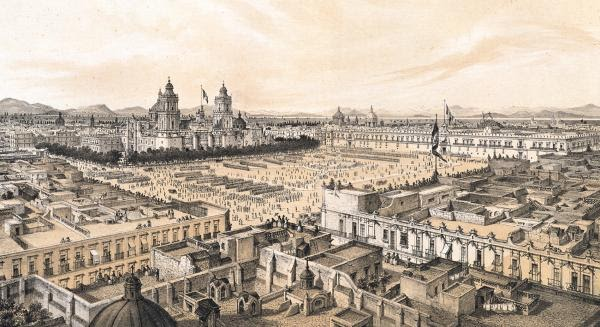
In 1822, Monroe's administration officially recognized the newly independent countries of America: Argentina, Peru, Colombia, Chile, and Mexico, after they gained independence from Spain. The British approached Monroe with the idea of issuing a joint statement of the status quo ante in the New World, but when he discussed it with his Secretary of State, John Quincy Adams, Adams hesitated. Why shouldn't the US issue its own policy? After all, Britain was still a rival, and we had just fought a war with them. He offered to help draft a letter to Congress explaining that external powers should not interfere in the Americas' affairs—no new colonies. Drafted in 1823, it was made public in early 1824.

Vive Lafayette
As all this unfolded, Monroe's administration chose to capitalize on the popularity of the last surviving general of the Continental Army, the Marquis de Lafayette. What better way to showcase American exceptionalism, mark the upcoming anniversary, honor a war hero, and send a political message to nations like the Holy Alliance? The year-long visit started in August 1824, coinciding with the election of John Quincy Adams, who took office after Monroe in 1825.

Final Years
The former planter, politician, soldier, and statesman retired to his estate outside Leesburg, Virginia, with his wife, Elizabeth (Kortright) Monroe. President John Quincy Adams and General Lafayette visited the couple shortly before Lafayette's return to France. They had plenty of memories to share. After all, both were wounded while serving America—and the young General Lafayette had also fought at Trenton, Brandywine, and Monmouth.

Ironically, the last member of the Virginia triumvirate moved to New York City after Elizabeth's death in 1830. He lived with his daughter and her family at 63 Prince Street—on Lafayette Square. James Monroe became the third president to die on Independence Day when he succumbed to heart failure and tuberculosis on July 4, 1831.