Followers

Showing posts with label History. Show all posts

Wednesday, October 30, 2024

The 2nd Duke

Wealthy Scion

It has been a while since we last profiled a British Army officer, so I chose one whose modest yet significant contribution to the Crown is notable—a man with a very typical, straight-out-of-central-casting name: Hugh Percy. Born into a prominent family (his father was the First Earl of Northumberland), young Percy overcame a series of childhood illnesses to pursue a military career, which he himself essentially ended just as he was reaching the height of success.


Hugh Percy


A Call to Arms

Percy joined the 24th Regiment of Foot in 1759 as an ensign. Like many from prominent and well-connected families, young Hugh managed to secure a lieutenant colonelcy and position as aide de camp to Ferdinand of Brunswick. Additionally, like many of his peers, The Seven Years' War offered the chance to earn laurels in combat at the battles of Bergen and Linden.


Battle of Minden

Politician

By 1762, he was a lieutenant colonel in the Grenadier Guards, arguably the most elite unit in the Royal Army and a protector of the monarch. He surprised many by refusing to serve as aide de camp to King George III. Instead, he ran for Parliament, securing a seat in the House of Commons as a Whig. His political beliefs often put him at odds with the Crown, especially regarding colonial policy. Ironically, Percy still maintained a close connection to the King. He married the daughter of George III's tutor and mentor, Lord Bute.


Percy as Politico


A Gentler Colonel

In 1768, Percy was commissioned as a colonel in the Northumberland Fusiliers. He proved to be a very progressive and forward-thinking leader. He adopted a different approach to leadership, treating his men with kindness and rejecting the traditional harsh discipline of the Army. He banned flogging and other severe disciplinary measures. Percy also took care of their financial needs and those of their families, often providing funds to those in need. Instead of ruling through orders, he led by example. His actions quickly earned the affection and trust of his soldiers. His approach resulted in a highly effective unit of men fiercely loyal to their commanding officer.


Northumberland Fusilier

Boston Bound

The political situation in North America kept worsening over the next few years. Despite, or maybe because of, his sympathies for the Americans, Colonel Hugh Percy received orders in 1774 to sail to America, where his regiment joined General Thomas Gage's garrison in Boston. Gage made him a brevet brigadier general and commandant of the British camp. Tensions kept rising in and around Boston, and the next year, Gage started a series of pre-emptive strikes—punitive actions to weaken the militia's power and threat.


Boston and Environs


The Shot Heard Round the World

Things reached a crisis point in April 1775 when Gage dispatched Lieutenant Colonel Francis Smith with about 800 regulars to seize militia gunpowder and arms believed to be at Concord. On April 19, one of Smith's units, led by Major John Pitcairn, faced a militia force on Lexington Green. The brief clash, known as the "Shot Heard Round the World," was followed by a larger gunfight around Cambridge.


The Column Reaches Concord

Column in Chaos

Things went badly for the British, who began a retreat to Boston as thousands of locals grabbed their muskets and started to harass the column, shooting at officers with aimed fire. Near Lexington, Smith's troops were reinforced by a brigade of around 1,400 men led by Hugh Percy. Percy used cannons and volley fire to keep the militia (now, we can call them rebels) at bay and helped bring Smith's demoralized men back into some kind of order.


Percy guides the column home


Unlikely Savior

Throughout the long march back, under relentless and punishing fire from the rebel militia, Percy kept the British column together, maintaining discipline to prevent a disaster. When they reached Menotomy, Percy made a decision that likely saved the army. Instead of pushing toward Cambridge, he changed their route of return and marched to Charlestown. This route had fewer rebels. The column arrived back in Boston. In July, Gage promoted Percy to Major General for his calm actions under pressure. No small irony that an officer sympathetic to the rebels thwarted their best efforts to wipe out the column.


General Thomas Gage


Halifax Hiatus

Percy missed the Battle of Bunker Hill due to illness. To his frustration, his Northumberland Fusiliers were decimated under the heavy-handed command of General William Howe. True to his approach to leadership, Percy funded the return voyage for all the widows and arranged a small stipend for those in need. The British evacuated Boston in March 1776 and regrouped in Halifax, Nova Scotia. Gage had been recalled, and William Howe was now the commander in chief.


Battles for New York

In July, the reinforced British Army landed on Staten Island in New York Harbor. Weeks later, a swift campaign was launched on Long Island. On August 27, Percy distinguished himself by helping lead a night march that cut off a third of the Continental Army. In November, Percy led a British force that drew fire from the defenders at Fort Washington, allowing Hessian General von Knyphausen's men to overrun the garrison and force its surrender.


Percy led regulars in action on Long Island  


Newport Nexus

The following month, Percy and General Henry Clinton led a British expedition that captured Newport, Rhode Island. When Henry Clinton returned to Britain, Percy was appointed commander of the Newport garrison. However, things were not all smooth sailing. Percy was critical of Howe's strategy and how he handled the war. He also struggled with poor health. This combination led him to request relief from his command and a return to Britain. General Howe quickly approved, and Hugh Percy left America for good in May 1777.


Sir Henry Clinton

The 2nd Duke

In 1779, Percy divorced his wife on the grounds of adultery but soon remarried and had nine children with his second wife. After his father’s death in 1784, Percy became the 2nd Duke of Northumberland. He spent the next several decades serving in various military roles in Britain, re-engaging in politics, and managing his estates. He was a kind landlord who took care of the farm workers on his lands. He was a rare noble who earned the respect of his people. Hugh Percy died on his estate in July 1817. His years of poor health finally caught up with him.


2nd Duke of Northumberland

Liberal Legacy

One has to wonder how the course of the war in America would have played out for the British if Percy had remained, possibly even rising to the level of supreme command. His gentle manner might have rallied more Americans to the Crown, and his ability to motivate troops and stay calm under fire could have made a difference in the subsequent campaigns. An interesting fact—Percy had an illegitimate half-brother, James Smithson. The same James Smithson who bequeathed the funds used to establish what became known as The Smithsonian Institution—the world's largest museum and research complex.


The Smithsonian

Saturday, December 30, 2023

The Prodigy

 This final post of 2023 features another historical figure from my novel, The Lafayette Circle. Although John Quincy Adams plays a relatively small role in this tale of intrigue and chaos in early 19th-century America, he seeds ideas that made Marquis de Lafayette's 1824-1825 visit more than just a celebration of friendship between two nations.

John Quincy Adams - 
the youthful diplomat


Apprentice Diplomat

John Quincy Adams was destined to grow up in the shadow of his father, John, an accomplished lawyer, statesman, and politician who helped shape the American Revolution and establish the foundation of the United States, becoming its second chief executive. Young John Quincy was born on July 11, 1767, at the family home in Braintree, Massachusetts, which is present-day Quincy. His intensely patriotic and accomplished parents influenced his early upbringing and provided him with a classical education. The American Revolution unfolded before his eyes as he was among the many people in and around Boston who nervously watched the patriots battle lines of redcoats at Bunker Hill in 1775. 


Watching Bunker Hill

Exchange Student

Three years later, he left his mother to go with his father on a diplomatic mission to Europe, marking the start of his real education. From 1778 to 1779, he studied at a private school in Paris, where he improved his fluency in French, the language of diplomats. After this, he attended the University of Leiden in the Netherlands, where he learned some Dutch.


The Boy Prodigy


By 1781, he had become proficient enough in French for his father to secure a position for John Quincy as private secretary to one of America's leading diplomats, Francis Dana, who had been appointed US Envoy to the court of Russia in St. Petersburg. When Dana's mission failed, he returned to Paris, where he served as a secretary to the American Commissioners during their negotiations with the British. 

The Law and the Hague

When the Treaty of Paris was signed, he returned to the U.S. to study at Harvard College and then in Newburyport under the guidance of Theophilus Parsons, where he studied law. By 1790, he was a member of the bar in Boston. Adams began private practice but also started writing pamphlets on political doctrine and foreign policy, supporting President George Washington's firm stance on neutrality in foreign affairs. This led to his appointment as U.S. minister to the Netherlands in 1794.


President George Washington

The wars of the French Revolution were raging, and The Hague was a hub of diplomatic intrigue. Adams's dispatches and letters provided the Washington administration (which included his father as Vice President) with valuable information. He held a temporary position in London to help facilitate the 1794 Jay Treaty—a pivotal and controversial foreign policy initiative.

The Diplomat

For his commendable service, in 1796, President Washington appointed him as the US Envoy to Portugal. However, when Dad became the nation's second president, he changed his son's assignment to Prussia. But pleasure before business—Adams married Louisa Catherine Johnson, a diplomat's daughter whom he met in Paris when he was just twelve. She proved to be a charming and capable partner to the rising young diplomat. They married in London before heading to Berlin, where he negotiated a treaty of amity and commerce with the Prussians. But in 1800, politics turned against him with the election of Thomas Jefferson, who recalled Adams from his post.


Louisa Catherine Johnson Adams

Political Life

Adams returned to Boston, where state and federal politics became his new arena. By 1802, he was a member of the Massachusetts State Senate, and in 1803, he was elected as a U.S. Senator from Massachusetts. "Battleground" is actually a more accurate description. Adams was as sharp-tongued as his father and did not favor "factions." He voted according to his conscience, which often put him at odds with one party or the other. He grew estranged from his father's Federalist Party, which by then had turned against him. 


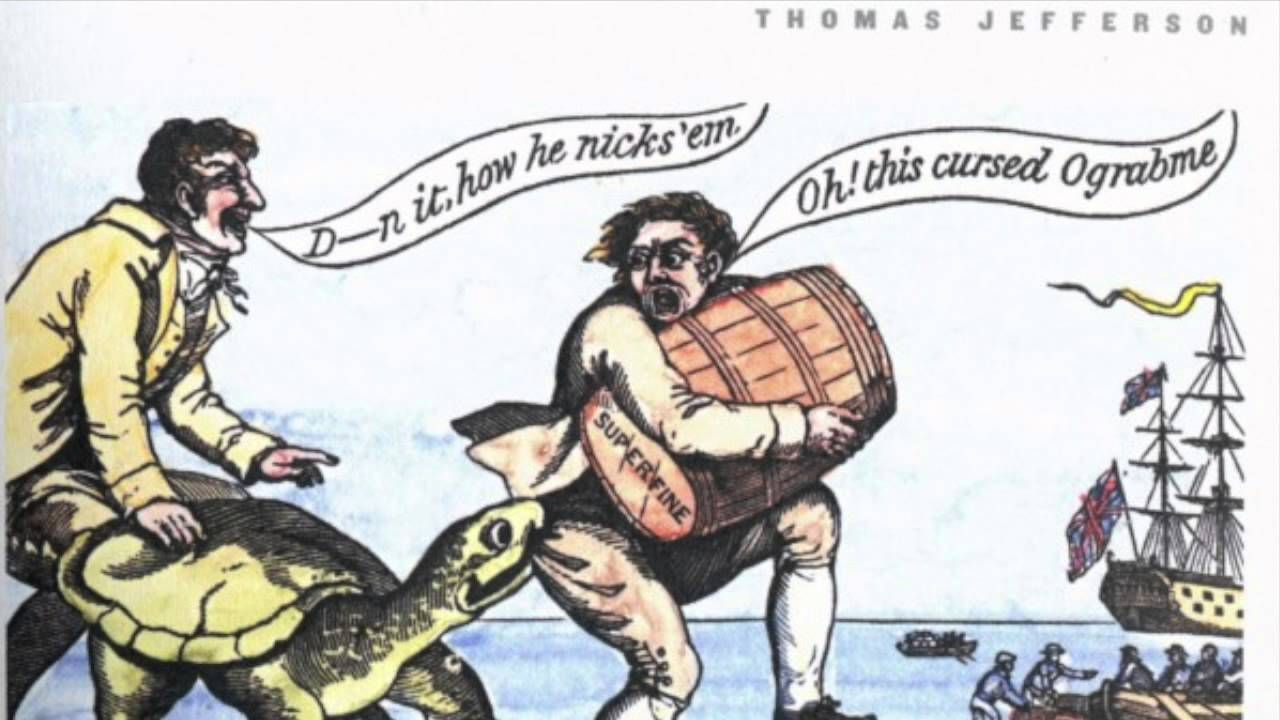
Support for the Embargo Act Cost Adams His Job

This all reached a boiling point when he supported Thomas Jefferson's Embargo Act, a measure opposed by New Englanders who valued Britain as a trading partner. In 1808, the Massachusetts Senate voted him out of office, which led to his resignation. Adams aligned with the Republicans and took a position as a professor of rhetoric and oratory at Harvard College.

Envoy to Russia

The world was at war with Napoleonic France, and President Madison needed a key player to handle the situation. The highly experienced Adams was the right choice, especially since he had broken away from the Federalists. From that position, the sharp Adams watched the collapse of Emperor Napoleon Bonaparte's army in 1812 and the fall of his empire over the next two years. Adams was present at the Court of St. Petersburg just as Czar Alexander rose in stature as a leader in the coalition against Napoleon.


Czar Alexander I - Power Broker

Treaty of Ghent

Meanwhile, war had erupted between the U.S. and Great Britain, which was Russia's ally. Adams eagerly accepted Czar Alexander's offer to mediate in the fall of 1812. The initiative, with Adams as one of the lead commissioners, ultimately failed. However, a follow-up effort in 1814 under Adams's leadership resulted in the Treaty of Ghent. This face-saving status quo ante arrangement changed little diplomatically or politically. Still, it gave the small U.S. the confidence and morale boost of having gone toe-to-toe with what was now the world's reigning superpower.


Signing the Treaty of Ghent

Like Father, Like Son

After a brief stay in Paris during Napoleon's short return to power in 1815, he followed in his father's footsteps. He traveled to London, where he and Henry Clay negotiated a "Convention to Regulate Commerce and Navigation." Soon afterward, he became the U.S. minister to Great Britain, just as his father had been before him and as his son Charles was to be afterward. His time at the Court of St. James was brief, as Adams returned to the United States in the summer of 1817 to serve as secretary of state in President James Monroe's cabinet. This appointment was mainly based on his diplomatic experience, but also because the president aimed to have a sectionally balanced cabinet during what became known as the Era of Good Feelings.


St. James Palace

Manifest Destiny

Adams's tenure as Secretary of State was, as expected, outstanding—especially for someone groomed for the job since the age of fourteen. He worked diligently with Spain to resolve the long-standing dispute over America's western and southwestern borders. The Spanish Minister Onis agreed that Spain would relinquish its claims to lands east of the Mississippi River. In return, Adams decided that the United States would waive its claims to Texas. The two countries agreed on a boundary stretching from the Atlantic to the Pacific Ocean. Years of dispute were settled through the signing of what was called the Adams-Onis Transcontinental Treaty.


In 1818, he also resolved the northern frontier dispute with Great Britain by establishing the 49th parallel all the way to the Rocky Mountains.

The Monroe Doctrine

Adams was a principal architect of U.S. policy on foreign interference in the Western Hemisphere. This is his main role in my novel, The Lafayette Circle. Instead of a joint U.S.-British declaration to European powers and the Spanish territories in America, he convinced President James Monroe to act independently. 

The letter he helped draft to Congress in late 1823 and issued in 1824 served as a firm warning to those hoping to exploit the former colonies, which seemed vulnerable to certain powers. What later became known as The Monroe Doctrine aimed to shield the newly independent lands from recolonization and laid the foundation of U.S. foreign policy for more than a century.


James Monroe

The Second President Adams

The 1824 election was marked by chaos and political maneuvering, all within the boundaries set by the US Constitution. With none of the four candidates—Adams, Andrew Jackson, Henry Clay, and William Crawford—receiving the required number of electoral votes, the election was decided by the House of Representatives, which chose from the top three (Jackson, Adams, Clay) in a one-vote-per-state "play-off." Henry Clay saw Jackson as a dangerous demagogue and supported Adams, effectively helping him secure the presidency. The Jacksonians protested when Adams later appointed Clay as Secretary of State.


Henry Clay


Adams worked long and hard as president, but the anger of the Jacksonians (who suspected a corrupt bargain) hovered like a cloud over his term, as they opposed him on everything. Adams's hopes of creating a national university and a national astronomical observatory were crushed. His idea that the western territories should develop gradually was rejected outright. Even his infrastructure plans—building bridges, ports, and roads with federal funding—were blocked. Jackson defeated Adams in the 1828 election.


Andrew Jackson


In an interesting link to my novel, The Lafayette Circle, one of Adams's earliest acts as president was to join General Lafayette on a farewell visit to former President James Monroe at his estate in Leesburg, Virginia.

Representative of the People

In a move that stunned many as "degrading to a former president," Adams ran for a seat in the House of Representatives in 1831, asserting that serving the public as a representative in Congress was not degrading. He represented the people in Congress until he died in 1848. During those years, he fought tirelessly against slavery and its expansion, as well as the various tactics employed by the slave bloc in Congress to expand and uphold their peculiar institution.


President John Quincy Adams

Bold Advocate

When Africans arrested aboard the slave ship Amistad were marked to be returned to their owners, John Quincy Adams took up their cause, defending them before the U.S. Supreme Court—and winning their freedom. Adams's entire career had aimed at one main goal—doing the right thing. In this, he faced a mix of success and failure, but his consistent efforts made him one of the top leaders of early America after the founding fathers.


Defending the Armistead Slaves

The Lion's Last Roar

Adams was in the House of Representatives, fighting a bill to honor Mexican War veterans. He had strongly opposed the war, viewing it as an act of aggression partly aimed at expanding slavery. He was about to criticize the vote when he collapsed. He was rushed to the Speaker's Room and died two days later, on February 23, 1848, from a stroke. The boy prodigy, now a prominent figure in Congress, passed away working and fighting at age 81, with his wife Louisa by his side. It is said that his last words were, "This is the last of earth, but I am composed."

  
Adams Died a Servant of  the People


Tuesday, November 28, 2023

The Third Virginian


It is a sad commentary that most Americans are more familiar with Marilyn Monroe than with the first patriot sharing her last name. And who knows? Maybe the Hollywood star who renamed Norma Jean was a history buff? But I digress. This profile shines a light on one of those diligent founders who quietly left his mark on America and the world. The fact that James Monroe is also a significant historical figure in my novel, The Lafayette Circle, makes his story even more compelling.


Norma Jean

Planter Orphan

James Monroe was born at the aptly named Monroe Hall in Westmorland County, Virginia, on April 28, 1758. His father was a moderately successful planter. Both of his parents died when Monroe was a teenager, and he took over the plantation and cared for his siblings under the guidance of his mother's brother, Joseph Jones, a member of the House of Burgesses. Jones took young Monroe to Williamsburg and enrolled him in the College of William and Mary. His uncle also introduced him to prominent Virginians like George Washington, Thomas Jefferson, and Patrick Henry—future leaders who would help shape the world, just as young James would.

Williamsburg

Patriotic Student

Williamsburg was alive with patriotic enthusiasm. Monroe was still attending William and Mary College when the Revolutionary War started in April 1775. Eager to join the fight like many other young Virginians, he left William and Mary, and on September 28, 1775, Monroe was commissioned as a second lieutenant in the 3rd Virginia Continental Infantry. His first commander was Colonel Hugh Mercer, who would become one of General George Washington's most trusted generals until his early death at Princeton caused by British bayonets. Lieutenant Monroe marched north to New York City with his regiment the next year.

The Virginia Line

Years of Combat

There, he first saw combat at Harlem Heights on September 16, 1776, and volunteered to join Major Thomas Knowlton's rangers. Knowlton, who was mortally wounded in that skirmish, became the namesake of the Military Intelligence Corps' honorary award, which bears his name.


After more fighting at White Plains in October, British General William Howe managed to flank the Continental Army but let it escape to New Jersey. Monroe's regiment moved south and west in a series of retreats, causing the Continental Army to shrink and American morale to drop. By late December, Washington's small force was gathered on the Pennsylvania side of the Delaware River and was in serious trouble.

An Army in Retreat


Things changed with the arrival of General John Sullivan as the leader of General Charles Lee's division. Interestingly, Lee had allowed himself to be captured at Bosking Ridge, New Jersey, by a group of British dragoons, including a young Banastre Tarleton. 


John Sullivan


Crossing the Delaware

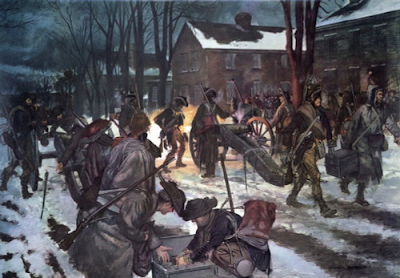
The additional troops allowed Washington to execute the plan he had been considering since crossing into Pennsylvania—a return across the Delaware River. With Howe's forces in control of New York City and most of the Jerseys, the situation was at its lowest point. He needed a daring move, so on Christmas night, Lieutenant James Monroe and Captain William Washington's company of Colonel Weedon's Third Virginia were steering their long Durham boats through the ice floes clogging the Delaware River. It was the night of the 25th and about as quiet as Washington could hope for, as his troops marched through the cold, windy night along icy wooded trails. Monroe had encountered a man named Riker along the way. He was initially thought to be a Loyalist, but it turned out he was a true patriot who then joined the ragged force heading toward the Hessian-occupied town of Trenton.


Crossing the Delaware


Christmas Surprise

At daylight on the 26th, the Continental forces launched an attack on the sleeping town. Sentries were pushed from their posts as the Virginians advanced from the north. Their target was a two-gun battery manned by Hessians, positioned to fire on the approaching troops of Nathanael Green's brigade. The town was thrown into chaos as sleepy musketeers and grenadiers stumbled from their quarters, shouldering their muskets.


Nathanael Greene


The pop, pop of desultory musket fire filled the cold morning air. It soon grew louder, causing Monroe's company to scatter for cover—they were the vanguard of their regiment and brigade. The Americans started to return fire, and more Continentals arrived on King Street. 

The boom of cannon from behind boosted their confidence. General Henry Knox's batteries were in action. Musket fire to the south also indicated that General Sullivan's brigades were attacking. But ahead stood that stubborn Hessian battery, ready to cut down the advancing column and stop the attack. 


American Artillery Opens Fire

The order came from Captain Washington, "Forward!" The company all rose together and moved forward at a trot, the men's fingers frozen to their muskets as the icy mix of sleet seared their faces and stung their eyes. The buzz of lead was all around them, and Captain Washington suddenly dropped to a knee, clutching his hands, which were streaming blood. Lieutenant Monroe suddenly took command.


William Washington


He charged forward with the company moving at double time, and soon, the Hessian gunners, who weren't shot or on the run, were surrendering their weapons and being marched to captivity. But not before a lead ball tore into Monroe's chest, staggering him and soaking his uniform in blood. Carried to an aid post where Washington was being treated, it was soon clear the ball had torn an artery—a mortal wound.


Monroe led the charge toward the Hessian guns

But fortune smiled on James Monroe as well as George Washington that morning. As it turned out, Riker—whose first name Monroe never learned—was a surgeon. And rare for those times, a highly competent surgeon. He managed to close the artery and prevent the future president from bleeding to death in a battle that resulted in no soldiers killed and only five wounded, including Monroe and Washington. He was promoted to captain for his gallantry.

Battles Lost and Won

Monroe recovered fully from his wound and performed capably at the Battle of Brandywine and Germantown in the fall of 1777. His success in those battles earned him a promotion to major and the appointment as aide-de-camp to General William Alexander on 20 November 1777. 

Major Monroe fought at the Battle of Monmouth on 28 June 1778, one of the fiercest battles of the war and the last major engagement in the North. However, Monroe, who was practically broke and unable to recruit troops, resigned from the Continental Army on 20 November. This was common; many Continental Army officers who served honorably went on to pursue business, return to farming, or enter politics. Alexander Hamilton is just one example.


Battle of Brandywine


Law and Politics

Back in civilian life, Monroe studied law under Governor Thomas Jefferson, a relationship that would influence their lives and the nation's future. When Charleston fell in 1781, Virginia planned to raise several new regiments, and Monroe was given the rank of lieutenant colonel, although he never saw combat.


Thomas Jefferson


His military career stagnated, but Monroe's political journey was rising—initially with a seat in the Virginia House of Delegates, then in the Confederation Congress. Later, he participated in the state constitutional convention. Like many notable Virginians (Patrick Henry, George Mason), he opposed the proposed constitution due to its centralized authority. Nonetheless, he took a seat in the new US Senate in 1790. 

Diplomacy

Monroe's international and diplomatic career began in 1794 when President George Washington appointed him US Envoy to France. His involvement in factional politics started three years later when he returned to Virginia and joined the anti-Federalist opposition organized by Thomas Jefferson and James Madison. This Virginia triumvirate would deeply influence US politics and the future course of the new nation. 


James Madison

Monroe was elected Governor of Virginia in 1799. However, in 1802, President Jefferson appointed him Envoy to France to support Robert Livingston's negotiations with Napoleon Bonaparte over the Louisiana Territory, which the US bought from France the following year for 15 million dollars—doubling the size of the US. Afterwards, Monroe served as minister to Great Britain, where he negotiated a commercial treaty in 1806, which the US Senate rejected because it didn’t address the hot-button issue of the day, impressment.


Napoleon Bonaparte

A Second War with England

After another period in Virginia politics, Monroe served as President Madison's Secretary of State in 1811. Tensions with Great Britain at that time led to the war. The War of 1812 was going poorly, so in August 1814, Madison temporarily appointed him Secretary of War. The third member of the Virginia triumvirate, James Monroe, was elected the nation's fifth president in 1816—showing strong teamwork.


British Army Burns Washington in 1814

Chief Executive

The nation was expanding rapidly when Monroe took office, and a growing sense of American patriotism and exceptionalism, if not outright nationalism, was everywhere. During this so-called Era of Good Feelings, Monroe and his Secretary of State, John Quincy Adams, aimed to strengthen America's position on the global stage. A brief war in 1819 against the Florida Seminoles, fought successfully by General Andrew Jackson, resulted in the Spanish selling West Florida to the US in 1820, helping him secure a second term.


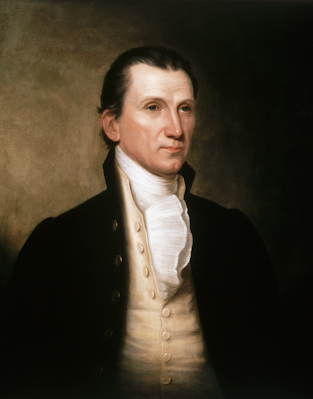
President James Monroe

The Era of Good Feelings

In 1819, James Monroe became the first American president since George Washington to tour the country for goodwill. The nation was expanding west into the Louisiana Territory, the war with Britain had ended, and America had stood on its own against the world's only superpower. The Spanish colonies in South America were breaking free from Spanish rule and building their own democracies. America appeared to be the model of the future. As the nation's 50th anniversary approached, the American experiment seemed headed toward a prosperous future.


President Washington


The Holy Alliance

Not all nations welcomed the success of American democracy and the collapse of the Spanish empire. At the 1815 Congress of Vienna, the autocratic countries Prussia, Austria, and Russia formed a political alliance called the Holy Alliance. Holy because they still believed their rulers' authority came from God—the divine right of kings. They now turned their attention to the Spanish colonies. This did not go unnoticed by Britain, which had its own interests in the New World and did not welcome outsiders.


Congress of Vienna

The Monroe Doctrine

In 1822, Monroe's administration officially recognized the newly independent countries of America: Argentina, Peru, Colombia, Chile, and Mexico, after they gained independence from Spain. The British approached Monroe with the idea of issuing a joint statement of the status quo ante in the New World, but when he discussed it with his Secretary of State, John Quincy Adams, Adams hesitated. Why shouldn't the US issue its own policy? After all, Britain was still a rival, and we had just fought a war with them. He offered to help draft a letter to Congress explaining that external powers should not interfere in the Americas' affairs—no new colonies. Drafted in 1823, it was made public in early 1824.


Crafting the Monroe Doctrine

Vive Lafayette

As all this unfolded, Monroe's administration chose to capitalize on the popularity of the last surviving general of the Continental Army, the Marquis de Lafayette. What better way to showcase American exceptionalism, mark the upcoming anniversary, honor a war hero, and send a political message to nations like the Holy Alliance? The year-long visit started in August 1824, coinciding with the election of John Quincy Adams, who took office after Monroe in 1825. 


General Lafayette's Visit was a Tour de Force


Final Years

The former planter, politician, soldier, and statesman retired to his estate outside Leesburg, Virginia, with his wife, Elizabeth (Kortright) Monroe. President John Quincy Adams and General Lafayette visited the couple shortly before Lafayette's return to France. They had plenty of memories to share. After all, both were wounded while serving America—and the young General Lafayette had also fought at Trenton, Brandywine, and Monmouth. 


Elizabeth (Kortright) Monroe


Ironically, the last member of the Virginia triumvirate moved to New York City after Elizabeth's death in 1830. He lived with his daughter and her family at 63 Prince Street—on Lafayette Square. James Monroe became the third president to die on Independence Day when he succumbed to heart failure and tuberculosis on July 4, 1831.