Followers

Showing posts with label Thomas Jefferson. Show all posts

Monday, February 16, 2026

The Magnificent Seven

This special Presidents Day Yankee Doodle Spies post profiles The Magnificent Seven.  No, not the rogues in the iconic 1960 John Sturges film, or the high-flying tech stocks on Wall Street, but the presidents of the United States who played a role in the American Revolution and War for Independence. 


Foundary of Freedom

The flames of revolution ignited in 1775, and from the smoke of muskets and the ink of bold declarations emerged seven men whose youthful or mature efforts during the American Revolutionary War (1775–1783) would propel them to the presidency of the United States. George Washington, John Adams, Thomas Jefferson, James Madison, James Monroe, John Quincy Adams, and Andrew Jackson each answered the call in their own way—some with sword in hand on frozen battlefields, others with eloquent words in candlelit chambers or through daring diplomacy across the Atlantic. 


The Magnificent Seven


Their stories intertwine personal courage, intellectual fire, and unyielding commitment to liberty, forming the very foundation upon which the nation stood. No president after this remarkable group bore the direct imprint of those revolutionary years, making their collective legacy a vivid reminder of how sacrifice and vision gave birth to a republic.


The Essential Man


First among the magnificent, George Washington (1732–1799), the towering Virginian whose calm resolve anchored the revolution, stepped forward as commander-in-chief of the Continental Army in 1775. Nominated by John Adams, Washington drew on his French and Indian War experience to lead a ragtag force against the world's premier military power. Picture the icy Delaware River on Christmas night 1776: Washington, cloak whipping in the wind, guiding boats through sleet to surprise Hessian troops at Trenton, a daring gamble that revived flagging spirits. 


George Washington


He endured the soul-testing winter at Valley Forge, where hunger and disease ravaged his men, yet he emerged stronger, drilling the army into a disciplined force with the aid of Baron von Steuben. His masterstroke came at Yorktown in 1781, where French allies sealed a trap around Cornwallis, forcing surrender and turning the tide. Washington's greatest gift to the cause was restraint—he crushed whispers of monarchy in the Newburgh Conspiracy and resigned his commission in 1783, embodying republican virtue. This path culminated in his unanimous election as the first president (1789–1797), the "Father of His Country," whose leadership set the tone for a free nation.


Colossus of Independence


Brilliant lawyer and architect of a nation, John Adams (1735–1826), the fiery Massachusetts lawyer, wielded intellect as a weapon in the political arena. At the First Continental Congress in 1774, he advocated for unity against British tyranny, nominated Washington as commander, and championed a navy to challenge British sea power. In 1776, he helped form the Committee of Five, persuaded Thomas Jefferson to draft the Declaration of Independence, and then fought tirelessly for its adoption. 


John Adams


As a diplomat, Adams secured Dutch loans that kept the war machine funded and co-negotiated the 1783 Treaty of Paris, ending hostilities on favorable terms. His blunt honesty and tireless advocacy for independence helped shape a stable government, culminating in his election to the vice presidency and, later, to the second presidency (1797–1801).


Father of the Declaration 


The sage of Monticello, Thomas Jefferson (1743–1826), the eloquent Virginian, penned words that still echo: "We hold these truths to be self-evident." As a delegate to the Continental Congress in 1776, he drafted the Declaration, crystallizing the revolution's ideals of liberty and equality. 


Thomas Jefferson


Back in Virginia, he reformed laws—abolishing primogeniture and championing religious freedom—while serving as governor (1779–1781), rallying defenses against British raids and narrowly escaping capture at Monticello. His pen and principles sustained the revolutionary spirit, foreshadowing his transformative third presidency (1801–1809), which included the Louisiana Purchase, which doubled the young nation's size.


The Little Giant


With a mind as large as his stature was small, James Madison (1751–1836), the quiet intellectual often called the "Father of the Constitution," honed his skills in wartime politics. In the Virginia legislature from 1776, he supported religious liberty and raised troops. 


James Madison


By 1780, in Congress, he grappled with the weaknesses of the Articles of Confederation, advocating fiscal reforms and a stronger union to support the war effort. His behind-the-scenes diplomacy and governance insights bridged the revolutionary chaos to postwar stability, influencing his fourth presidency (1809–1817) during the War of 1812.


Hero of Trenton


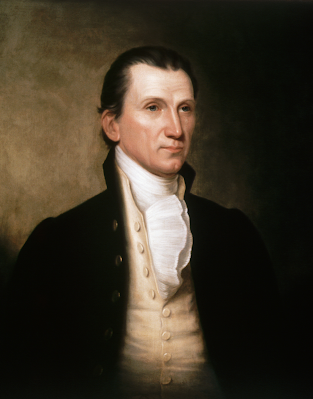
James Monroe (1758–1831) embodied youthful valor. At 17, he left college to join the Third Virginia Regiment, crossing the Delaware with Washington and charging Hessian cannons at Trenton—earning a severe wound that nearly killed him. He fought at Brandywine, Germantown, and Monmouth, later serving as a militia scout. Those trials forged his republican zeal, as evidenced by his fifth presidency (1817–1825) and the Monroe Doctrine, which warned Europe to stay out of the Americas.


James Monroe


The Prodigy


Learning at the knee of one of the era’s giants, John Quincy Adams (1767–1848), the precocious son of John Adams, tasted diplomacy at a young age. At 11, he sailed to France with his father; by 14, he served as secretary to the American envoy in Russia, aiding efforts to secure recognition. Though the mission faltered, the experience immersed him in global intrigue, shaping the diplomat who became the sixth president (1825–1829).


Young John Quincy Adams


Heroic Youth of the Waxhaws


Later known as “Old Hickory,” Andrew Jackson (1767–1845), the orphaned boy of the Carolina frontier, faced the war's harshest realities. At 13, he served as a militia courier through the guerrilla chaos, witnessing battles such as the Battle of Hobkirk's Hill. Captured by British troops, he refused to shine an officer's boots and was slashed across the face and hand—scars he carried forever. Imprisoned, he lost his brothers and mother to disease and hardship. That raw defiance fueled his later triumphs and his populist seventh presidency (1829–1837).


Andrew Jackson


In the crucible of revolution, these seven presidents were indeed magnificent—through command, conviction, courage, and cunning, they wove the threads of independence into enduring governance. Their lives remind us that America's story began not only in quiet halls but also in the roar of battle, the scratch of a quill, and the bold dreams of those who dared to build a new world. 


Happy Presidents' Day!


Tuesday, November 28, 2023

The Third Virginian


It is a sad commentary that most Americans are more familiar with Marilyn Monroe than with the first patriot sharing her last name. And who knows? Maybe the Hollywood star who renamed Norma Jean was a history buff? But I digress. This profile shines a light on one of those diligent founders who quietly left his mark on America and the world. The fact that James Monroe is also a significant historical figure in my novel, The Lafayette Circle, makes his story even more compelling.


Norma Jean

Planter Orphan

James Monroe was born at the aptly named Monroe Hall in Westmorland County, Virginia, on April 28, 1758. His father was a moderately successful planter. Both of his parents died when Monroe was a teenager, and he took over the plantation and cared for his siblings under the guidance of his mother's brother, Joseph Jones, a member of the House of Burgesses. Jones took young Monroe to Williamsburg and enrolled him in the College of William and Mary. His uncle also introduced him to prominent Virginians like George Washington, Thomas Jefferson, and Patrick Henry—future leaders who would help shape the world, just as young James would.

Williamsburg

Patriotic Student

Williamsburg was alive with patriotic enthusiasm. Monroe was still attending William and Mary College when the Revolutionary War started in April 1775. Eager to join the fight like many other young Virginians, he left William and Mary, and on September 28, 1775, Monroe was commissioned as a second lieutenant in the 3rd Virginia Continental Infantry. His first commander was Colonel Hugh Mercer, who would become one of General George Washington's most trusted generals until his early death at Princeton caused by British bayonets. Lieutenant Monroe marched north to New York City with his regiment the next year.

The Virginia Line

Years of Combat

There, he first saw combat at Harlem Heights on September 16, 1776, and volunteered to join Major Thomas Knowlton's rangers. Knowlton, who was mortally wounded in that skirmish, became the namesake of the Military Intelligence Corps' honorary award, which bears his name.


After more fighting at White Plains in October, British General William Howe managed to flank the Continental Army but let it escape to New Jersey. Monroe's regiment moved south and west in a series of retreats, causing the Continental Army to shrink and American morale to drop. By late December, Washington's small force was gathered on the Pennsylvania side of the Delaware River and was in serious trouble.

An Army in Retreat


Things changed with the arrival of General John Sullivan as the leader of General Charles Lee's division. Interestingly, Lee had allowed himself to be captured at Bosking Ridge, New Jersey, by a group of British dragoons, including a young Banastre Tarleton. 


John Sullivan


Crossing the Delaware

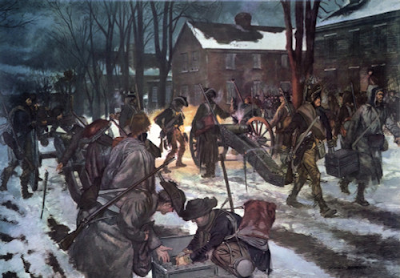
The additional troops allowed Washington to execute the plan he had been considering since crossing into Pennsylvania—a return across the Delaware River. With Howe's forces in control of New York City and most of the Jerseys, the situation was at its lowest point. He needed a daring move, so on Christmas night, Lieutenant James Monroe and Captain William Washington's company of Colonel Weedon's Third Virginia were steering their long Durham boats through the ice floes clogging the Delaware River. It was the night of the 25th and about as quiet as Washington could hope for, as his troops marched through the cold, windy night along icy wooded trails. Monroe had encountered a man named Riker along the way. He was initially thought to be a Loyalist, but it turned out he was a true patriot who then joined the ragged force heading toward the Hessian-occupied town of Trenton.


Crossing the Delaware


Christmas Surprise

At daylight on the 26th, the Continental forces launched an attack on the sleeping town. Sentries were pushed from their posts as the Virginians advanced from the north. Their target was a two-gun battery manned by Hessians, positioned to fire on the approaching troops of Nathanael Green's brigade. The town was thrown into chaos as sleepy musketeers and grenadiers stumbled from their quarters, shouldering their muskets.


Nathanael Greene


The pop, pop of desultory musket fire filled the cold morning air. It soon grew louder, causing Monroe's company to scatter for cover—they were the vanguard of their regiment and brigade. The Americans started to return fire, and more Continentals arrived on King Street. 

The boom of cannon from behind boosted their confidence. General Henry Knox's batteries were in action. Musket fire to the south also indicated that General Sullivan's brigades were attacking. But ahead stood that stubborn Hessian battery, ready to cut down the advancing column and stop the attack. 


American Artillery Opens Fire

The order came from Captain Washington, "Forward!" The company all rose together and moved forward at a trot, the men's fingers frozen to their muskets as the icy mix of sleet seared their faces and stung their eyes. The buzz of lead was all around them, and Captain Washington suddenly dropped to a knee, clutching his hands, which were streaming blood. Lieutenant Monroe suddenly took command.


William Washington


He charged forward with the company moving at double time, and soon, the Hessian gunners, who weren't shot or on the run, were surrendering their weapons and being marched to captivity. But not before a lead ball tore into Monroe's chest, staggering him and soaking his uniform in blood. Carried to an aid post where Washington was being treated, it was soon clear the ball had torn an artery—a mortal wound.


Monroe led the charge toward the Hessian guns

But fortune smiled on James Monroe as well as George Washington that morning. As it turned out, Riker—whose first name Monroe never learned—was a surgeon. And rare for those times, a highly competent surgeon. He managed to close the artery and prevent the future president from bleeding to death in a battle that resulted in no soldiers killed and only five wounded, including Monroe and Washington. He was promoted to captain for his gallantry.

Battles Lost and Won

Monroe recovered fully from his wound and performed capably at the Battle of Brandywine and Germantown in the fall of 1777. His success in those battles earned him a promotion to major and the appointment as aide-de-camp to General William Alexander on 20 November 1777. 

Major Monroe fought at the Battle of Monmouth on 28 June 1778, one of the fiercest battles of the war and the last major engagement in the North. However, Monroe, who was practically broke and unable to recruit troops, resigned from the Continental Army on 20 November. This was common; many Continental Army officers who served honorably went on to pursue business, return to farming, or enter politics. Alexander Hamilton is just one example.


Battle of Brandywine


Law and Politics

Back in civilian life, Monroe studied law under Governor Thomas Jefferson, a relationship that would influence their lives and the nation's future. When Charleston fell in 1781, Virginia planned to raise several new regiments, and Monroe was given the rank of lieutenant colonel, although he never saw combat.


Thomas Jefferson


His military career stagnated, but Monroe's political journey was rising—initially with a seat in the Virginia House of Delegates, then in the Confederation Congress. Later, he participated in the state constitutional convention. Like many notable Virginians (Patrick Henry, George Mason), he opposed the proposed constitution due to its centralized authority. Nonetheless, he took a seat in the new US Senate in 1790. 

Diplomacy

Monroe's international and diplomatic career began in 1794 when President George Washington appointed him US Envoy to France. His involvement in factional politics started three years later when he returned to Virginia and joined the anti-Federalist opposition organized by Thomas Jefferson and James Madison. This Virginia triumvirate would deeply influence US politics and the future course of the new nation. 


James Madison

Monroe was elected Governor of Virginia in 1799. However, in 1802, President Jefferson appointed him Envoy to France to support Robert Livingston's negotiations with Napoleon Bonaparte over the Louisiana Territory, which the US bought from France the following year for 15 million dollars—doubling the size of the US. Afterwards, Monroe served as minister to Great Britain, where he negotiated a commercial treaty in 1806, which the US Senate rejected because it didn’t address the hot-button issue of the day, impressment.


Napoleon Bonaparte

A Second War with England

After another period in Virginia politics, Monroe served as President Madison's Secretary of State in 1811. Tensions with Great Britain at that time led to the war. The War of 1812 was going poorly, so in August 1814, Madison temporarily appointed him Secretary of War. The third member of the Virginia triumvirate, James Monroe, was elected the nation's fifth president in 1816—showing strong teamwork.


British Army Burns Washington in 1814

Chief Executive

The nation was expanding rapidly when Monroe took office, and a growing sense of American patriotism and exceptionalism, if not outright nationalism, was everywhere. During this so-called Era of Good Feelings, Monroe and his Secretary of State, John Quincy Adams, aimed to strengthen America's position on the global stage. A brief war in 1819 against the Florida Seminoles, fought successfully by General Andrew Jackson, resulted in the Spanish selling West Florida to the US in 1820, helping him secure a second term.


President James Monroe

The Era of Good Feelings

In 1819, James Monroe became the first American president since George Washington to tour the country for goodwill. The nation was expanding west into the Louisiana Territory, the war with Britain had ended, and America had stood on its own against the world's only superpower. The Spanish colonies in South America were breaking free from Spanish rule and building their own democracies. America appeared to be the model of the future. As the nation's 50th anniversary approached, the American experiment seemed headed toward a prosperous future.


President Washington


The Holy Alliance

Not all nations welcomed the success of American democracy and the collapse of the Spanish empire. At the 1815 Congress of Vienna, the autocratic countries Prussia, Austria, and Russia formed a political alliance called the Holy Alliance. Holy because they still believed their rulers' authority came from God—the divine right of kings. They now turned their attention to the Spanish colonies. This did not go unnoticed by Britain, which had its own interests in the New World and did not welcome outsiders.


Congress of Vienna

The Monroe Doctrine

In 1822, Monroe's administration officially recognized the newly independent countries of America: Argentina, Peru, Colombia, Chile, and Mexico, after they gained independence from Spain. The British approached Monroe with the idea of issuing a joint statement of the status quo ante in the New World, but when he discussed it with his Secretary of State, John Quincy Adams, Adams hesitated. Why shouldn't the US issue its own policy? After all, Britain was still a rival, and we had just fought a war with them. He offered to help draft a letter to Congress explaining that external powers should not interfere in the Americas' affairs—no new colonies. Drafted in 1823, it was made public in early 1824.


Crafting the Monroe Doctrine

Vive Lafayette

As all this unfolded, Monroe's administration chose to capitalize on the popularity of the last surviving general of the Continental Army, the Marquis de Lafayette. What better way to showcase American exceptionalism, mark the upcoming anniversary, honor a war hero, and send a political message to nations like the Holy Alliance? The year-long visit started in August 1824, coinciding with the election of John Quincy Adams, who took office after Monroe in 1825. 


General Lafayette's Visit was a Tour de Force


Final Years

The former planter, politician, soldier, and statesman retired to his estate outside Leesburg, Virginia, with his wife, Elizabeth (Kortright) Monroe. President John Quincy Adams and General Lafayette visited the couple shortly before Lafayette's return to France. They had plenty of memories to share. After all, both were wounded while serving America—and the young General Lafayette had also fought at Trenton, Brandywine, and Monmouth. 


Elizabeth (Kortright) Monroe


Ironically, the last member of the Virginia triumvirate moved to New York City after Elizabeth's death in 1830. He lived with his daughter and her family at 63 Prince Street—on Lafayette Square. James Monroe became the third president to die on Independence Day when he succumbed to heart failure and tuberculosis on July 4, 1831.


Sunday, February 28, 2021

Shores of Tripoli

 Review: Shores of Tripoli 

This is a rare and unusual Yankee Doodle Spies sequel segment. Although it’s a bit of a stretch, I felt compelled to review this board game because it depicts events that have some surprising links to the time of the Yankee Doodle Spies. What motivates me to review this game? In a word, fun. Shores of Tripoli offers an engaging and intriguing look at this pivotal period in United States national security policy. Players learn as they play and interact while they learn. And they have a good time. But I think I already mentioned that.

                                                           Poster of the 1950s Action Flick


Fort Circle Games

Kevin Bertram, designer and owner of Fort Circle Games, shares that his inspiration for the game came from Brian Kilmeade’s book about the American effort to suppress the Barbary (North African) States and their corsairs (pirates) at the start of the 19th century. I admit—I haven't read the book, though I’ve read others on the topic and watched the John Payne film, Tripoli, as a young person. In his designer notes, Kevin mentions he created the game after realizing no one had addressed this subject. I started playing board wargames when I was in third grade. The first I remember was called Tactics II. I played wargames for many years and even tried miniatures. After reading Kevin’s words, I agreed—he’s right. So, the game is groundbreaking for shining a light on that little-known conflict.


                                                                            Box Cover

The Mechanics

I'm not talking about Paul Revere’s spy network, but about how the game is played. I'll let others give a play-by-play of the rules. You can also find many YouTube clips by Kevin and other players who enjoy the game explaining the rules. 

https://www.youtube.com/watch?v=etnQr4eTy6s&fbclid=IwAR0gOquGCChbCxnXMEHmOIaQVudN7seQoFRStocsAS9QRL1K4SEUAFW11og

The game starts as a board game featuring a simple, attractive map of North Africa. Important ports like Gibraltar (British-controlled and neutral), Malta, Tripoli, Alexandria, and Derne are marked, as these are where most of the action takes place. Players move ship markers, including American, Swedish, and Tripolitan frigates; American cutters; and Tripolitan and allied corsairs. You also manage soldier markers such as US marines, Hamet’s (deposed older brother and rival to Tripolitan ruler Yusuf Karamanli) mercenaries, and Barbary pirates. 


                                                                Pieces, Dice & Board

Combat relies on die rolling, and this game involves a lot of it. Luck often outweighs skill in many situations. I think Napoleon once said he would prefer having a lucky general over a good one. However, the game is mainly driven by card play. Players draw cards from a deck each turn and can discard any card to make a move or play specific cards to bring in reinforcements or perform various actions. The real key is the Event Cards, which influence movement, combat, political actions, and more. Players constantly draw, discard, or play cards as the game unfolds across four seasons each year from 1801 to 1806. The cards bring surprises, both positive and negative. How a player uses the cards dealt to them can make up for poor dice rolls and mistakes. So, watch them closely. And may the odds always be in your favor.


                                            American Frigate takes on a Barbary Corsair


The Result

The game provides players with about an hour of fun and frustration. It's a two-player game featuring a cool solitaire option. The American side has many advantages, such as large ships (frigates), US Marines, and Swedish allies. Yeah — Sweden! But the American side also faces significant risks. Closing the deal, which involves assaulting and capturing Tripoli, can result in a Ragnarök-like end for the game. The American player starts slowly, building firepower with frigates and gunboats, while pesky pirates go on raids.


                                                            The cards make the game


The Barbary player has less firepower but more flexibility. He can run out the clock. If the American player is too cautious, the Barbary player may have time to launch enough raids to win by capturing treasure (gold-colored coins). Or he can win if the American fails to use the right mix of naval and land forces to take Tripoli. And though the American frigates are strong, they are also vulnerable: losing four of them wins the game for the Tripolitan side. This reflects how American and European public opinion reacts to unacceptable losses. A draw favors the Barbary States, but the Americans can use cards and clever maneuvers to force a treaty and secure victory.


                                                        USS Philadelphia under attack


Either way, both sides have fun and learn a lot about this important but little-known event in American history.


                                                            Jefferson's Letter to the Bey


The game features an intelligent historical supplement and designer notes that enhance the rules effectively. The design, artwork, and layout are of top quality. A highlight is the “mock-up” of the 21 May 1801 letter to the Pasha and Bey of Tripoli, Yusuf Karamanli, which explains the reason for the friendly visit of the American squadron to the Mediterranean. It creates an engaging scene with atmosphere as you read President Jefferson’s reassuring words. 

Yankee Doodle Spies Sequel?

The war against the Barbary States was the first effort by America to send military force overseas. One of the results of the American War for Independence and American sovereignty was losing the protection of the powerful British Navy. This was clear during the undeclared naval war with France, an event that led to the rebirth of an American naval force focused on a small fleet of "super-frigates," which served as fast and nimble ships-of-the-line.

Key figures – Rev War Connections

I'll now circle back to the American Revolution with some interesting links between the Tripoli affair and the era of the Yankee Doodle Spies.


                                    1st Lt Presley O'Bannon raises the American flag over Derna


Thomas Jefferson

The most prominent figure is President Thomas Jefferson, the central character in the event. The founding father and the first Secretary of State sought a peaceful way to handle the Barbary States’ demands for tribute—without actually paying it. This approach was influenced by the pride of a newly independent and still uncertain republic and limited funds. His letter dated 21 May 1801 was his last effort to negotiate. However, the Bey of Tripoli had already chosen war, declaring it on 14 May.


                                                            President Thomas Jefferson

William Eaton

William Eaton is one of those tough historical figures who played a major role in a key event. Son of a middle-class New England farmer, young Eaton served in the Continental Army from 1780 to 1783, ending as a sergeant at age 19. He received some schooling after the war and later became a captain in the new American Legion under the famous Revolutionary War hero, Major General “Mad” Anthony Wayne, during the war against western Indian nations. There, he faced some controversy and a court-martial for war profiteering and for releasing a prisoner from jail. He received a two-month “suspended commission.” 

In the quirky world of Federalist-era bureaucracy, he stayed in the army. He was appointed U.S. Consul to Tunis in 1797, making Eaton the main representative of the United States in the region. In 1804, he convinced the government to undertake a special operation to bring Yusuf’s brother, Hamet, into the conflict. The plan was approved, and Eaton led a small expeditionary force to Alexandria, where they joined up with Hamet and his ragtag mercenary army. With Marines and a few sailors as the core, they marched west to Derna and, after a fierce fight, captured the city. However, Hamet’s unreliability and peace overtures ended further efforts. Eaton returned to America, celebrated but bitter.


                                                                        William Eaton


Pressley O’Bannon

Arguably the fiercest warrior of the war (and the U.S. Navy had many of these) was a United States Marine officer, Lieutenant Presley O’Bannon. A native of Virginia and son of a Revolutionary War officer, O’Bannon joined the Marines in 1801 as a 2nd Lieutenant and was promoted to 1st Lieutenant the following year. He held various commands both aboard ship and on land, and during the Derna operation, commanded a squad of 8 marines and an ensign. 

O’Bannon’s bravery and daring were evident on April 27, 1804, at Derna. He led marines, some Greek mercenaries, and a few artillery gunners in a fierce charge through a hail of enemy musket fire. Ignoring the flying lead around him, he seized an enemy battery and raised the American flag on the city’s walls. He then turned the captured cannons on the enemy. After two hours of close combat, the fortress fell. This was the first time the stars and stripes flew over a fortress in the Old World during a time of war. 

O’Bannon was awarded a jeweled Mameluke scimitar for his bravery, and upon returning to Virginia, his home state, he was given a commemorative one as well. To this day, Marine officers wear a similar sword. After the war, he resigned his commission and moved west with his family, settling in Kentucky’s bluegrass region. An interesting Revolutionary connection: Legendary O’Bannon married the granddaughter of the ultimate Revolutionary War badass – the famed rifleman and General Daniel Morgan of Winchester, Virginia.


                                                        1st Lieutenant Presley O'Bannon

Tobias Lear

Another intriguing link to the Revolutionary War was Tobias Lear. The New Hampshire native did not serve in the war but attended Harvard from 1779 to 1783. Lear was an ambitious yet capable individual who moved from tutoring Martha Washington’s grandchildren to becoming George Washington’s secretary and trusted aide. He was visiting Mount Vernon when Washington died. 

Lear later earned the favor of President Thomas Jefferson, who, in 1801, appointed him as Consul-General to the North African coast. On June 4, 1805, Lear negotiated a "Treaty of Peace and Amity" with Yusuf. This was a difficult pill for many Americans to swallow. Lear arranged a ransom of $60,000 (about $1,024,400 today) for the release of sailors from the USS Philadelphia and several American merchant ships. Ironically, the Philadelphia was supposed to be the ship transporting him to the region, but a delay caused by his marriage plans (to a Washington/Custis girl) led him to sail on the Enterprise. 


                                                                            Tobias Lear


Sunday, September 18, 2016

Quarrelsome Patriot

This First Patriot is among the many who served their country in diverse and remarkable ways - yet today, they remain virtually unknown to most Americans. These same Americans can recite trivial details about sports or, worse, reality TV. So, wipe the mindless pop culture from your thoughts and take a few minutes to focus on one of the unsung founders of the American republic.


Early Life & Militia Service


One of nine children, Timothy Pickering was born in Salem, Massachusetts, on July 17, 1745. His father was a successful farmer. Pickering attended Harvard College, where he studied law and became a licensed attorney. However, he chose not to practice law and instead became a local civil servant. In 1774, he was appointed register of deeds in Essex. Soon after, he was elected to represent Salem in the Massachusetts General Court and served as a justice on the Essex County Court of Common Pleas. On April 8, 1776, he married Rebecca White of Salem. He became a notable local Whig during the years leading up to the American Revolution. Like many other New England men, he joined the local militia. By 1775, Pickering had risen to the rank of colonel in the Essex County Militia, and in February of that year, he and his men successfully held off a column of British regulars under Colonel Alexander Leslie (see the Yankee Doodle Spies post on Leslie). "Leslie's Retreat" became one of the key events leading to war with Britain. In April that year, open conflict broke out between the colonists and their king. Pickering served with the army assembled around Boston. Recognizing the need for improved standards among the various colonial forces, he published "An Easy Plan for Discipline for a Militia." This manual functioned as the American army's drill guide until the arrival of General Friedrich von Steuben's renowned Blue Book.


Despite his "retreat" Alexander Leslie became
one of the better British generals of the
War for Independence


A Continental Adjutant General


Pickering eventually accepted a commission in the Continental Army—George Washington's response to the British regulars. He played a notable role in the hectic campaigns in New York and New Jersey during 1776. In December 1776, he led a well-trained regiment of the Essex County militia to New York, where General George Washington took notice and offered Pickering the position of adjutant general of the Continental Army in 1777. In this role, he oversaw the construction of the Great Chain, which was forged at Stirling Iron Works. The chain prevented the Royal Navy from advancing up the Hudson River past West Point and protected the crucial fort from attack throughout the conflict. He was widely praised for his efforts in supplying the troops during the remainder of the war. Pickering took over from General Horatio Gates, a former British officer. He served effectively as Adjutant during the Battle of Germantown in October of that year.


The Stirling Iron Works chain blocked the Hudson


A Continental Quartermaster General


Not long after, Congress appointed him to the newly created Board of War. He performed dual roles, continuing to serve as Washington's Adjutant General while helping organize overall war management. Over time, Pickering distanced himself from Washington and focused more on the functions of the Board of War. Around this period, he also became involved with the infamous Conway Cabal, but the cabal dissolved, and Pickering continued his service. In fact, his abilities soon earned him the most difficult post in the entire war effort—except for Washington's. In the summer of 1780, he took over as Quartermaster General, replacing General Nathanael Greene, while still serving on the Board of War. Supplying the needs of the ragged, yet growing, Continental Army was undoubtedly the greatest challenge facing Washington, and the burden of this impossible task largely fell on the shoulders of the Quartermaster General. Nobody wanted this job. The stubbornness of the states frustrated Congress's efforts to raise funds for food, clothing, and equipment necessary to keep the army going. Dishonest contractors and vendors were common—selling substandard supplies for quick profits. But Pickering took it on. Due to shortages of gold and silver, he pioneered the use of "specie certificates" to buy food and supplies. One of his notable achievements was organizing the food and supplies for the Continental Army's epic 1781 march from New York to Yorktown, Virginia. In that sense, he was a pioneer in logistics. The campaign was crucial in forcing the British government to enter negotiations. Pickering remained Quartermaster General for the rest of the war.


Pickering's logistics enabled the long march to Yorktown


A Servant of the Republic


After a period of controversial land speculation in Pennsylvania, Pickering had a turbulent post-war career in public service, holding successive appointments under George Washington. These included the Postmaster General, the Secretary of War, and the Secretary of State. Like Washington, Pickering helped establish the new republic and set precedents for how the cabinet functioned. In 1791, Washington asked him to negotiate a key treaty with the New York Iroquois under the great chief Corn-Planter. Pickering successfully negotiated what became the Treaty of Canandaigua in 1794.
Pickering allied with 
Hamilton's Federalists.
When John Adams succeeded Washington as president, he asked Pickering to stay on. Pickering did, but he was strongly anti-France and pro-Britain. This put him at odds with Adams, who was trying to avoid war with the French Republic. Politically, Pickering shifted into the camp of fiery New York politician and former cabinet member Alexander Hamilton. He conspired with others against Adams and was eventually dismissed in May 1800. In 1802, the contentious Pickering and a group of Federalists, upset about the lack of support for Federalists, attempted to gain support for the secession of New England from the Jeffersonian United States. It did not go well.


Pickering in the Cabinet


A Partisan in Congress


Despite, or perhaps because of his efforts, he was appointed to the United States Senate as a senator from Massachusetts in 1803, representing the Federalist Party. Pickering proved to be a staunch Federalist, fiercely opposing Thomas Jefferson and later James Madison in their populist initiatives. He opposed the American seizure and annexation of Spanish West Florida in 1810—anything to counter the expansionist policies of the Democrats was fair game to him. He fought strongly against the Embargo Act, calling for its nullification and even colluding with the British. His extreme agitation led him to read confidential documents on the Senate floor—an act that resulted in his censure. After his term as senator ended, Pickering was elected to Congress in 1812. Like most New England Federalists, Pickering opposed the War of 1812 with England and became a leader in the New England separatist movement.


The Embargo Act engendered much polemic and satire


Post-Public Life


Denied re-election in 1816, the passionate, controversial, and often quarrelsome Pickering retired to private life on a farm near Salem, where he pioneered improvements in agriculture. He died in Salem in January 1829, leaving a legacy of pugnacious and relentless public service as an effective military and civilian administrator who helped create and build a new nation. However, he was also one of the original proponents of factionalism, as well as partisan and regional struggles within the political arena.


Salem MA waterfront