Followers

Showing posts with label US Army. Show all posts

Saturday, June 14, 2014

Happy Birthday!

This week marks the 239th birthday of the U.S. Army. Around the world, Army units and many other DoD components will celebrate this day, which also coincides with Flag Day. The U.S. Army was founded on June 14, 1775, when Congress adopted "the American continental army.” The Congressional resolution also absorbed the existing 10,000 New England troops and forces besieging Boston, and it requested an additional 5,000 be raised from New York and Connecticut men to defend New York City. Two million dollars was approved to fund the new army. The Continental Army quickly expanded, and by July, the authorized strength of the new army was nearly double that envisioned on June 14. 


Continental Soldiers


What was the first unit?


The American Rifleman


The first contingent of the new Army was composed of ten companies of riflemen – infantry. Congress’s resolution outlined their terms of enlistment and appointed a committee to establish rules and regulations. It seems that even at its inception, the Army had its red tape! The riflemen authorized on 14 June were the first units raised directly as Continentals, rather than state troops. Congress accomplished this by assigning six of the companies to Pennsylvania, two to Maryland, and two to Virginia. This may represent the beginning of the grand American tradition of using military authorizations to achieve a political end. But in this instance, it wasn't about pork (although that would soon come). It aimed to create a national (my word) army under the banner of “Continental.”


How were they recruited?


Recruitment authority was granted to local county committees in those frontier areas known for skilled marksmen. The response in Pennsylvania's western and northern frontier counties was so substantial that on June 22, the colony's quota was increased from six to eight companies, organized as a regiment. A month later, a ninth company from Pennsylvania was formed in Lancaster County. In Virginia, Captain Daniel Morgan raised a company in Frederick County, while Hugh Stephenson formed another in Berkeley County. In Maryland, the companies of Michael Cresap and Thomas Price both came from Frederick County. Readers of The Patriot Spy know that Lieutenant Jeremiah Creed’s light infantry company was also organized in Frederick County as part of the First Maryland Line. All thirteen rifle companies were sent immediately to Boston to join the siege. These riflemen were recruited solely for their marksmanship and toughness, not their adherence to military protocol. One of General George Washington’s first leadership challenges was managing their frontier attitudes and the resulting disciplinary issues.


Dan Morgan


How were they organized? 


Each rifle company was composed of a captain, three lieutenants, four sergeants, four corporals, a drummer (or horn player), and sixty-eight privates. The enlistment period was set at one year, the same as for militias. The companies were organized into a regiment, but until Congress could appoint field-grade officers (such as adjutant, quartermaster, and commissary), the company grades were filled in. Later, these rifle companies were brigaded under Daniel Morgan (now a colonel) into a Rifle Corps. As Continental Line regiments began forming that summer, they typically consisted of about eight companies, each with around forty privates, plus officers, sergeants, corporals, and drummers. However, organizations varied widely, especially at the beginning.


Who would lead the new Army?


Who else but Colonel George Washington! On June 15, Congress unanimously chose the Virginia planter and renowned hero of the French and Indian War. Washington had been active in the military planning committees of Congress, and by late May, he had begun wearing his old uniform. His colleagues believed that his modesty and competence qualified him to lead the challenging New England troops. Washington was given the rank of Lieutenant General and Commander in Chief. The day after Washington's appointment, Congress authorized other senior officers for the new army. Positions for five major staff officers were established: an Adjutant General, a Commissary of Musters, a Paymaster General, a Commissary General, and a Quartermaster General.

On June 20, the new commander-in-chief received orders to proceed to Massachusetts, take charge of the army there, and capture or destroy the British army occupying Boston. Congress directed him to prepare a report on the strength of the army. In the broader context of army command, his instructions were somewhat vague. His only other real mandate was that he must consult a council of war prior to any major strategic or tactical decisions. Washington had the authority to determine how many men to retain and had the power to temporarily fill any vacancies below the rank of colonel. Permanent promotions and appointments were reserved for the colonial governments. However, Congress appointed general officers. In the future, this led to a range of repercussions, not the least of which was Benedict Arnold's treason.


       General Washington assumes
           command of the new army


Who were his Lieutenants?


It is not surprising that the selection of Washington’s subordinate generals and senior staff officers led to political maneuvering as delegates sought appointments for their favorite sons. On June 17, Congress elected Artemas Ward and Charles Lee as the first and second major generals, respectively, and Horatio Gates as the Adjutant General. A few days later, two more major generals were appointed: Philip Schuyler, a New York delegate with close ties to Washington, and Israel Putnam, another hero of the French and Indian War. The brigadier generals followed. Congress appointed them in proportion to the number of men contributed by each colony, adhering to the recommendations of the colony's delegates for the actual selection. However, Congress created problems by ignoring seniority and status.


 Artemas Ward

Why are the Army Birthday and Flag Day celebrated on June 14th?


By pure coincidence, the Stars and Stripes originated from a resolution adopted by the Marine Committee of the Second Continental Congress in Philadelphia on June 14, 1777. The resolution read: "Resolved, that the flag of the United States be thirteen stripes, alternate red and white; that the union be thirteen stars, white in a blue field representing a new constellation.” The first celebration of the U.S. flag's birthday was held in 1877 on the 100th anniversary of the Flag Resolution of 1777.


Betsy Ross Pattern Flag


Francis Hopkinson Pattrn Flag


Saturday, November 17, 2012

Edgar? Is that you?

Apologies to Joan Rivers.  But I am pleased to report that The Patriot Spy has been submitted for a 2013 Edgar Award!

"What the heck is an Edgar?" 


 A reasonable question.  The Edgar Awards are presented each year by The Mystery Writers of America for achievement in mystery writing. The Edgars are the most prestigious awards in this very popular genre.  The Patriot Spy was submitted in the Best First Novel category.  Personally, I know it is my best first novel because it is my only first novel!  Now we just have to convince the judges.


Founded in 1945, Mystery Writers of America is a storied organization that strives to improve the genre of mystery writing by connecting authors and fans.  To do this, it works with libraries and vendors, and at the chapter level, it sponsors symposiums and events.  Authors, publishers, and fans come together to celebrate the power of the mystery and its special hold on the reading public.  There are eleven Mystery Writers of America chapters throughout the country.  It has its headquarters in New York.


                                                        Edgar Allen Poe was the dean of 
                                                    American mystery and thriller writers


Why "Edgar?" 


The name Edgar is in honor of the literary legend, Edgar Allen Poe.  Poe is among the most famous 19th Century American writers and is considered the father of mystery writing with his seminal work, "Murders in the Rue Morgue."  Poe was born in Boston in 1809.  His grandfather, David Poe, served with distinction in the Revolutionary War and is said to have been a friend of the Marquis De Lafayette and was known to George Washington himself.  There - I managed to make a Poe connection to the Yankee Doodle Spies!

West Point mid 19th Century

Edgar's Life


 Poe's parents were actors.  They died when he was a boy and Richmond tobacco merchant John Allan and his wife adopted him. They sent him to the University of Virginia but gambling debts and drinking led him to leave.  He enlisted in the US Army and served with some distinction in the Field Artillery where he rose to the rank of Sergeant Major.  The military life soon wore him down and strange as it may seem Poe sought a commission at the US Military Academy at West Point as a means of escape.  Poe did well there until he decided the Academy did not suit him.  He could not resign however without John Allan's approval (declined). So he broke numerous regulations, mostly absenting himself from classes (what we call "cutting") until he was, at last, he stood before a court-martial and dismissed in March 1831.

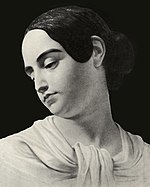
After leaving West Point, he dedicated himself to writing full time. As with many writers, he moved about the country, living variously in New York City, Baltimore, Philadelphia, and Richmond. While in Baltimore he stayed with family and fell in love with and married his 14-year-old cousin Virginia Clemm, who was the love of his life (or maybe he just didn't like saying good-bye).


Virginia Clemm Poe


By 1836 he had returned to Richmond where he worked as a literary critic of some notoriety.  In his professional life, he had worked on the editorial staff of the Southern Literary Messenger of Richmond,  the New York Quarterly Review, and  Graham's Magazine at Philadelphia. It enabled him in 1843 to have a magazine of his own, the Stylus. His dissolute ways estranged him to many and ruined his magazine's prospects.   After his young wife Virginia died in 1847, Poe maintained a pretty continuous downward spiral of drinking bouts, confrontations, and impecunity that overshadowed his inspired body of work.

His Work


In late 1830 Poe published Tales of the Grotesque and Arabesque, a collection of stories. It contained several of his most spine-tingling tales, including "The Fall of the House of Usher," "Ligeia" and "William Wilson." Poe launched the new genre of detective fiction with 1841's "The Murders in the Rue Morgue." A writer on the rise, he won a literary prize in 1843 for "The Gold Bug," a suspenseful tale of secret codes and hunting treasure.  Although best known for short stories steeped in mystery, Poe's most famous and profitable work was a poem, "The Raven." I believe a film by that name was Jack Nicolson's first feature role.  Poe also published a work of poems called, well, "Poems." He released it right after leaving the Academy and dedicated to his fellow cadets, who famously each gave him a dollar and twenty-five to fund the work.  For whatever reason, my favorite Poe short story is "The Cask of Amontillado."

More Edgar Connections


I lived many years in the Bronx and visited the Poe Cottage at Kingsbridge Road and The Grand Concourse. Here Poe lived for a time with his bride Virginia, who speculation credits as the inspiration for the poem Anabel Lee, a ballad of love and death. 

"It was many and many a year ago,
   In a kingdom by the sea,
That a maiden there lived whom you may know
   By the name of Annabel Lee;
And this maiden she lived with no other thought
   Than to love and be loved by me."

                                                                            
                                                                    Poe Cottage, Bronx, NY


While in the Army, I often went on temporary duty to Richmond, Virginia and several times stayed at Linden Row Inn, a street of row houses now turned into an upscale but small and elegant hotel. Returning from a five-year trip to England, the Allans (including Edgar) lived with Mr. Allan’s business partner, Charles Ellis in his house on Linden Row.  Edgar Allan Poe played with the Ellis children in the gardens that had the famous Linden trees. Local legend has it that the enchanted garden is the one that Poe mentions in his famous poem “To Helen.” Poe may have also  courted another life-long love, Elmira Royster, in the garden where the Linden Row Inn now stands.

                                                                            
                                                                The Linden Rowe Inn

His Death


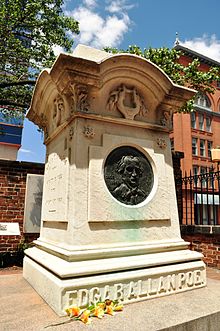
Poe was found lying in a gutter in Baltimore ranting incoherently.  Taken to Washington College Hospital he died on October 7th, 1849. Many legends have circulated as to the causes and situation involving his death but the truth is we will never know the full circumstances of Edgar's demise.  He lives on in his work and the many places that claim his presence during a life and death  punctuated by the simple word from his most famous work, the poem, The Raven:

 "Nevermore!"
Poe grave and monument in Baltimore