Followers

Showing posts with label literature. Show all posts

Friday, February 21, 2025

Book Review: Gone for A Soldier

Avellina Balestri's "All Ye That Pass By: Book 1: Gone for a Soldier" is an important addition to historical fiction. It emphasizes not just facts, deeds, and battles but also the subtle interaction between faith, identity, and the chaos of war in the late 18th century. 


Historical Background

Against the backdrop of the French and Indian War and the American Revolution, "Gone for a Soldier" highlights the lesser-known stories of British Loyalists and Catholic recusants in England. The novel's main character, Edmund Southworth, is a Catholic during a time when his faith could lead to social ostracism or worse, offering a unique look at the struggle between personal beliefs and societal expectations. Balestri uses this setting to explore the complexities of identity during a period of upheaval, where loyalties were often divided among country, faith, and family. All of this takes place across the vast landscapes of Canada and New York during the failed British Saratoga campaign.


The Players

The fictional English Catholic Edmund Southworth is at the center of the story, embodying the conflicts of his time. His path from a boy fascinated by military life to a man wrestling with the contradictions between his Catholic faith and his duties as a soldier is depicted with depth and sensitivity. Balestri's character development reveals Edmund's internal struggles, moments of doubt, and his eventual growth into a morally strong figure. Generals John Burgoyne, Simon Fraser, and other key officers play significant roles across this broad narrative, and the author captures their personalities accurately. Gentleman Johnny Burgoyne has a special role as Edmund's mentor.


General John Burgoyne


Other characters, such as Edmund's Protestant friends, military figures from the British army, and even historical personalities like King George III, are made vivid, creating a grand and intimate narrative. Her characters serve not just as foils to Edmund but also as reflections of society's diverse views on religion, politics, and war.


A Tapestry of Conflict

The novel explores several themes, with faith and loyalty at the core. Balestri investigates how these ideas connect with personal identity and societal roles. Edmund's Catholic faith is a steady influence, shaping his decisions, interactions, and view of the war. This look at faith during conflict adds a philosophical layer to the story, questioning how one balances personal beliefs with the demands of war.


Death of Simon Fraser


Loyalty is another theme woven into the plot. Edmund's loyalty to his faith, king, and comrades in arms often conflicts, creating opportunities for character growth and ethical discussion. The novel also subtly questions the idea of loyalty to a nation or cause when that loyalty might oppose one's morals or spiritual beliefs.


A Bit of the Bard

Balestri's prose is both lyrical and precise, capturing the essence of the 18th-century setting while maintaining a pace that engages the reader. The narrative style is reflective, often pausing to consider the implications of actions and human effort, which fits the novel's introspective themes. Readers who enjoy rich historical detail along with engaging character interactions and plot development will appreciate this. As John Burgoyne was a playwright himself, there are many references to Shakespeare's work.


The Bard

Cultural and Educational Impact

"All Ye That Pass By: Book 1: Gone for a Soldier" does more than entertain; it also educates. Besides being an important Revolutionary War story, by emphasizing a Catholic perspective during a critical moment in British and American history, Balestri addresses a gap in historical fiction where the experiences of religious minorities during colonial conflicts are often ignored. This novel is a useful resource for teachers aiming to give students a more complete view of the historical period.


Burgoyne Surrenders at Saratoga

Why Read?

"All Ye That Pass By: Book 1: Gone for a Soldier" is a commendable piece of historical fiction that blends a passion for history with a deep understanding of the human condition. It prompts readers to reflect on loyalty, faith, and identity in ways that remain relevant today. This work offers readers a vivid portrayal of historical events through an intensely personal narrative, powerfully exploring human resilience, loyalty, and the search for spiritual and personal truth. 


This book is for anyone interested in the intersection of faith and war (and who isn't?) or readers looking for a different perspective on the Revolutionary War era. It showcases Balestri's skill in weaving history into a compelling story, making readers not just spectators but participants in Edmund Southworth's moral and spiritual journey. We look forward to a future book to see where his journey takes him.

Saturday, November 17, 2012

Edgar? Is that you?

Apologies to Joan Rivers.  But I am pleased to report that The Patriot Spy has been submitted for a 2013 Edgar Award!

"What the heck is an Edgar?" 


 A reasonable question.  The Edgar Awards are presented each year by The Mystery Writers of America for achievement in mystery writing. The Edgars are the most prestigious awards in this very popular genre.  The Patriot Spy was submitted in the Best First Novel category.  Personally, I know it is my best first novel because it is my only first novel!  Now we just have to convince the judges.


Founded in 1945, Mystery Writers of America is a storied organization that strives to improve the genre of mystery writing by connecting authors and fans.  To do this, it works with libraries and vendors, and at the chapter level, it sponsors symposiums and events.  Authors, publishers, and fans come together to celebrate the power of the mystery and its special hold on the reading public.  There are eleven Mystery Writers of America chapters throughout the country.  It has its headquarters in New York.


                                                        Edgar Allen Poe was the dean of 
                                                    American mystery and thriller writers


Why "Edgar?" 


The name Edgar is in honor of the literary legend, Edgar Allen Poe.  Poe is among the most famous 19th Century American writers and is considered the father of mystery writing with his seminal work, "Murders in the Rue Morgue."  Poe was born in Boston in 1809.  His grandfather, David Poe, served with distinction in the Revolutionary War and is said to have been a friend of the Marquis De Lafayette and was known to George Washington himself.  There - I managed to make a Poe connection to the Yankee Doodle Spies!

West Point mid 19th Century

Edgar's Life


 Poe's parents were actors.  They died when he was a boy and Richmond tobacco merchant John Allan and his wife adopted him. They sent him to the University of Virginia but gambling debts and drinking led him to leave.  He enlisted in the US Army and served with some distinction in the Field Artillery where he rose to the rank of Sergeant Major.  The military life soon wore him down and strange as it may seem Poe sought a commission at the US Military Academy at West Point as a means of escape.  Poe did well there until he decided the Academy did not suit him.  He could not resign however without John Allan's approval (declined). So he broke numerous regulations, mostly absenting himself from classes (what we call "cutting") until he was, at last, he stood before a court-martial and dismissed in March 1831.

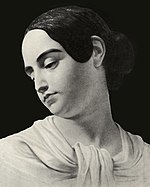
After leaving West Point, he dedicated himself to writing full time. As with many writers, he moved about the country, living variously in New York City, Baltimore, Philadelphia, and Richmond. While in Baltimore he stayed with family and fell in love with and married his 14-year-old cousin Virginia Clemm, who was the love of his life (or maybe he just didn't like saying good-bye).


Virginia Clemm Poe


By 1836 he had returned to Richmond where he worked as a literary critic of some notoriety.  In his professional life, he had worked on the editorial staff of the Southern Literary Messenger of Richmond,  the New York Quarterly Review, and  Graham's Magazine at Philadelphia. It enabled him in 1843 to have a magazine of his own, the Stylus. His dissolute ways estranged him to many and ruined his magazine's prospects.   After his young wife Virginia died in 1847, Poe maintained a pretty continuous downward spiral of drinking bouts, confrontations, and impecunity that overshadowed his inspired body of work.

His Work


In late 1830 Poe published Tales of the Grotesque and Arabesque, a collection of stories. It contained several of his most spine-tingling tales, including "The Fall of the House of Usher," "Ligeia" and "William Wilson." Poe launched the new genre of detective fiction with 1841's "The Murders in the Rue Morgue." A writer on the rise, he won a literary prize in 1843 for "The Gold Bug," a suspenseful tale of secret codes and hunting treasure.  Although best known for short stories steeped in mystery, Poe's most famous and profitable work was a poem, "The Raven." I believe a film by that name was Jack Nicolson's first feature role.  Poe also published a work of poems called, well, "Poems." He released it right after leaving the Academy and dedicated to his fellow cadets, who famously each gave him a dollar and twenty-five to fund the work.  For whatever reason, my favorite Poe short story is "The Cask of Amontillado."

More Edgar Connections


I lived many years in the Bronx and visited the Poe Cottage at Kingsbridge Road and The Grand Concourse. Here Poe lived for a time with his bride Virginia, who speculation credits as the inspiration for the poem Anabel Lee, a ballad of love and death. 

"It was many and many a year ago,
   In a kingdom by the sea,
That a maiden there lived whom you may know
   By the name of Annabel Lee;
And this maiden she lived with no other thought
   Than to love and be loved by me."

                                                                            
                                                                    Poe Cottage, Bronx, NY


While in the Army, I often went on temporary duty to Richmond, Virginia and several times stayed at Linden Row Inn, a street of row houses now turned into an upscale but small and elegant hotel. Returning from a five-year trip to England, the Allans (including Edgar) lived with Mr. Allan’s business partner, Charles Ellis in his house on Linden Row.  Edgar Allan Poe played with the Ellis children in the gardens that had the famous Linden trees. Local legend has it that the enchanted garden is the one that Poe mentions in his famous poem “To Helen.” Poe may have also  courted another life-long love, Elmira Royster, in the garden where the Linden Row Inn now stands.

                                                                            
                                                                The Linden Rowe Inn

His Death


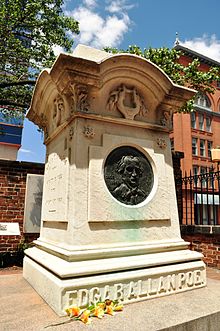
Poe was found lying in a gutter in Baltimore ranting incoherently.  Taken to Washington College Hospital he died on October 7th, 1849. Many legends have circulated as to the causes and situation involving his death but the truth is we will never know the full circumstances of Edgar's demise.  He lives on in his work and the many places that claim his presence during a life and death  punctuated by the simple word from his most famous work, the poem, The Raven:

 "Nevermore!"
Poe grave and monument in Baltimore