Followers

Showing posts with label The Patriot Spy. Show all posts

Saturday, October 14, 2017

Shallow Ford

A Humble Crossing


The Shallow Ford, about 15 miles west of Winston-Salem, North Carolina, is a shallow part of the Yadkin River that, during colonial times, provided a safe crossing for travelers. The ford is formed by a sand and gravel bar. Upstream, a stretch of hard rock crosses the river, and below this rock, the gradient lessens, which weakens the current and deposits sediment, creating the bar that makes up the crossing. It served as a natural game crossing and fish trap used by the Native Americans. 

By 1748, six families had settled near the ford. Within two years, a ferry and tavern operated there. Soon after, Moravians settled nearby and built the first road to the ford, with several others following over the years, making it a kind of transportation hub. By the time of the American Revolution, the Shallow Ford was an important crossing point for travelers. Although the Yadkin River could be crossed at other fords and ferries, heavier wagons could only cross at two places: the Trading Ford, near Salisbury (Rowan County), and the Shallow Ford (Surry County). Several roads converged on both sides of the river. This modest crossing played a small but significant role in shaping the outcome of the war.


Shallow Ford

A Southern Strategy


Gen Cornwallis


The year 1780 was to be a comeback year for the British in North America with their shift to a "southern strategy." And it initially proved to be a successful and effective plan. By the fall of 1780, the British commander in the south, General Charles Cornwallis, moved north into North Carolina after taking control of most of Georgia and South Carolina. The final phase of the grand strategy was to dominate the entire south before moving north into Virginia. He had established his headquarters in Charlotte, where bands of Loyalists gathered to support the crown.


Loyalist Militia gathered with the arrival of Cornwallis


The absence of local patriot militia groups that had gone to King's Mountain created a vacuum for Loyalists to rise and cause chaos in their counties. In Surry County, local Loyalist brothers Gideon and Hezekiah Wright gathered hundreds of Tories who started taking revenge on the properties of absent patriots and killing those who opposed them. On October 3rd and 8th, they attacked patriots in Richmond, the county seat, where they also killed the county sheriff.


Western NC and Surrey Co in 1780


When news spread of the Loyalist uprising, patriots from nearby areas began to mobilize to stop them. The news of the surprise defeat of the renowned Major Patrick Ferguson at King's Mountain helped energize the patriots, who had been subdued by Cornwallis's maneuver north. Now things were beginning to change. 

Patriot militia General William Lee Davidson now believed that the local Tories intended to join Lord Cornwallis's forces in Charlotte. He sent fifty men from Charlotte, along with two companies of patriot militia from Salisbury. They were joined by 160 men from Montgomery County, Virginia, under Major Joseph Cloyd (who had come to the Carolinas to fight the now-deceased Ferguson). All of the converging patriots came under the leadership of Cloyd.


A Place of Battle


Competing militias would clash in a small but pivotal battle
along the Yadkin River at Shallow Ford


All this activity reached a boiling point on October 14, when a group of 600 Loyalists led by Colonel Gideon Wright crossed the Yadkin River en route to join General Cornwallis in Charlotte. Early Saturday morning, October 14, Cloyd's force of 350 men waited on the west side of a small stream near the Shallow Ford crossing of the Yadkin River. Around 9:30, they spotted the Loyalist force that had terrorized the county for weeks. The Loyalists, numbering between 400 and 900, crossed the Yadkin and headed west along Mulberry Fields Road. A shout of "Tory! Tory!" went up among the patriots. From across the creek, they heard similar cries of "Rebel! Rebel!"


NC patriot militia


The patriots deployed and quickly formed battle lines. Volleys were exchanged. One Captain James Bryan, of the notorious Tory Bryan clan, who led the front of the Loyalist forces, was swiftly killed. Five rifle balls went through him and his horse. The patriots advanced toward the ford as the Loyalists retreated and regrouped. Captain Henry Francis of the Virginia militia was shot through the head and fell dead a few steps from his son, Henry. His other son, John, took careful aim and fired at the Loyalist who had killed his father. 

Despite being outnumbered, the patriots soon gained the advantage, and several more Loyalists fell. After another quick exchange of fire, the Loyalists retreated chaotically across the Yadkin, shouting, "We are whipped, we are whipped." Enraged patriots beat the wounded Loyalists to death after their comrades had fled. A black Loyalist named Ball Turner continued to fire at the patriots. An angry group of patriots found his position and riddled him with musket balls. The Loyalists soon made good their escape. Captain Henry Francis of the Whigs lost his life, and four others were wounded. The Loyalists suffered about fifteen killed. The engagement lasted less than an hour.


Shallow Ford Battle Marker

Aftermath


As the engagement ended, a relief party of three hundred militia under Colonel John Peasley arrived, along with Colonel Joseph Williams of Surrey County. Williams had heard the musket fire from his nearby home. The next day, Major General William Smallwood arrived at Salem with about 150 horsemen, thirty infantry, and three wagons. Smallwood, a Marylander, had been put in charge of all North Carolina militia. 

As a colonel in 1776, Smallwood had commanded the renowned Maryland Line on Long Island and is featured in my novel of that campaign, The Patriot Spy. Smallwood had left Guilford Courthouse the previous day. Seeing that the local force had defeated the Loyalists, he launched his men in pursuit of those who had fled. As a result of Shallow Ford, the Wright brothers' Loyalist forces in Surry County were effectively neutralized for the duration of the war. Hezekiah Wright himself was later shot and wounded in his own home. His brother Gideon fled to the safety of Charlestown, where he died on August 9, 1782.


General William Smallwood


The results of the double defeats at King's Mountain and Shallow Ford dealt a major blow to Cornwallis: patriot morale surged along with their numbers, while demoralized North Carolina Loyalists were never able to rally such a force again. Cornwallis had to retreat into South Carolina for the winter. His grand strategy was delayed by a year, with even more serious implications for any hope of a British victory.

Fittingly, the Shallow Ford played a minor role the following year when, on 7 & 8 February, Cornwallis's army crossed it in the legendary pursuit of General Nathanael Greene during the maneuvers that led to the Battle of Guilford Court House on 15 March 1781.


Saturday, February 28, 2015

The Knights Templar


Oh, What a Knight!


I am pleased to share that The Patriot Spy, the first book in the Yankee Doodle Spies series, has been submitted for an award in the Best History category by the Knights Templar! Although it is a historical novel, The Patriot Spy accurately depicts the events during the British invasion of Staten Island, Long Island, and New York Island in the summer of 1776. It accomplishes this by incorporating fictional plots and characters into the story of the campaign and the people involved. I am truly honored by this recognition.


Patriot Spy First Edition Cover


Who are these Knights?


For many years, when I heard Templar, I thought of Roger Moore’s old TV series, The Saint. Moore played a mysterious figure involved in crime, espionage, and other mayhem—like Jeremiah Creed. Like many religious orders from the Middle Ages, the Knights Templar are shrouded in mystery, myth, and misunderstanding. That makes them all the more fascinating. Or one could imagine the villainous Knight Templar Sir Brian de Bois-Guilbert in Sir Walter Scott’s grand historical novel, Ivanhoe. More recently, I got hooked on the Arn movie/mini-series, loosely based on a devout Swedish noble unfairly banished to serve as a Templar knight in the Latin Kingdom of Palestine.


Long ago, in a far-off Galaxy


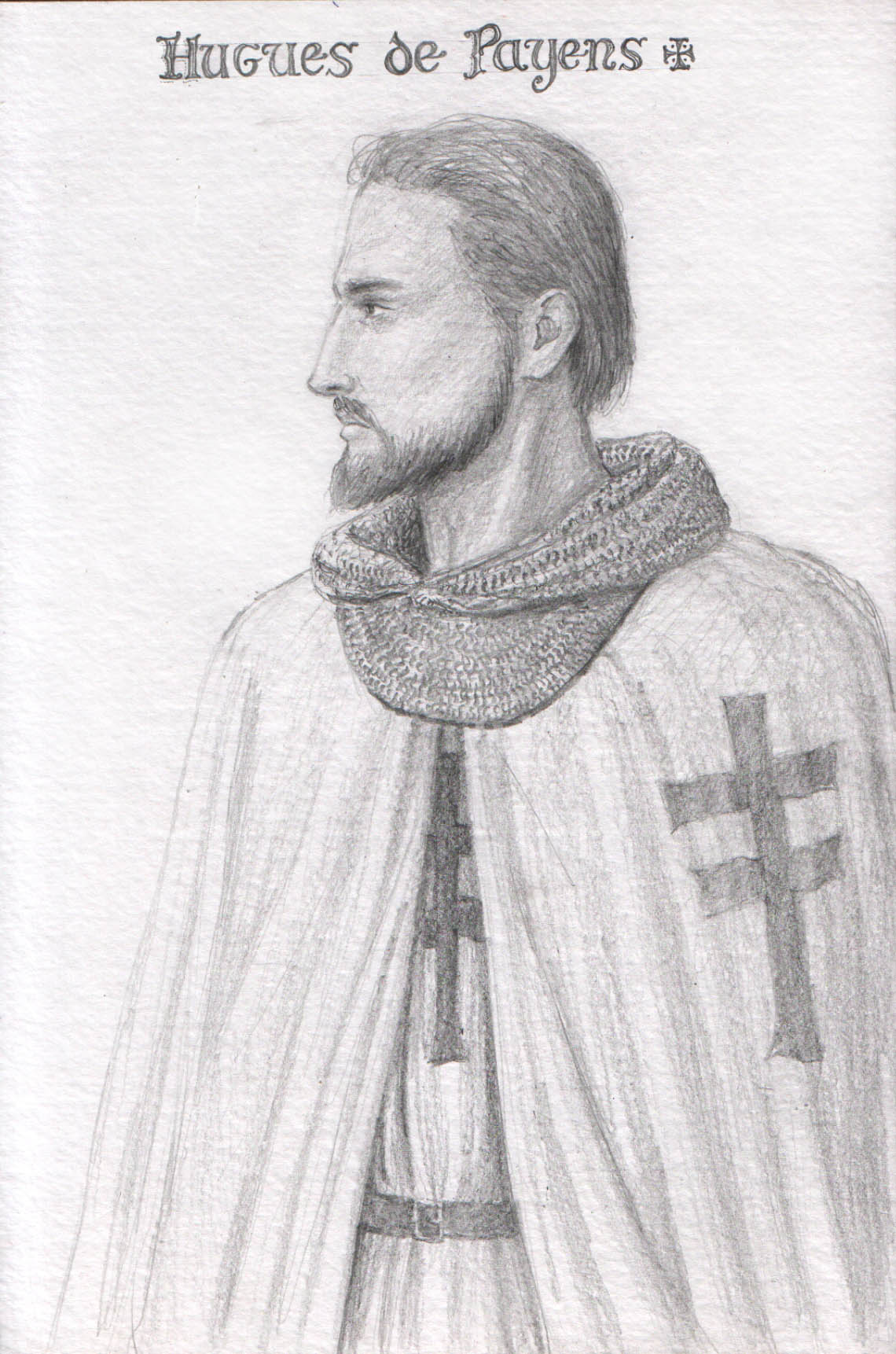
Hugues de Pavens
The Middle East might as well have been a distant galaxy for most Europeans in the twelfth century. Time and space had different meanings back then, when few peasants left the farm where they were born, and very few of the upper classes left the shire. Then, there was a call to action, and an entire continent seemed to turn east. 

The Templars were founded in the Holy Land in 1119. It began with a small, idealistic group of knights led by Hugues de Payens, who offered their services to protect pilgrims traveling to the Holy Places. They organized themselves into a religious community, sworn to protect Christian pilgrims visiting Jerusalem and the holy sites. They were called the Poor Knights of Christ of the Temple of Solomon, or simply the Knights of the Temple. 

The original purpose of the crusades was just that—protecting pilgrims and holy sites from the depredations of the Seljuk Turks, whose conquest of Palestine from the Arabs resulted in taxes and hostilities against Christians.


It then took a very different turn. After capturing Jerusalem in 1099, the Crusaders aimed to establish a permanent presence to protect their conquests. The original Templars played a small role initially, but they served as an inspiring symbol for Europe’s Christians. They used the al-Aqsa Mosque as their base of operations, which was believed to be the site of Solomon’s Temple. Important to their movement, they gained papal recognition as a military order in 1129 from Pope Honorius II. Hugues de Payens was appointed as the first Master of the Temple. 

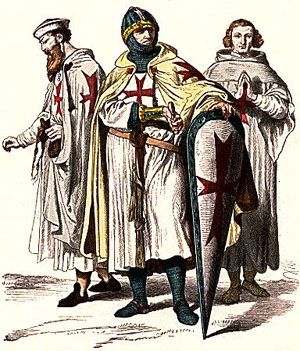
It was the great monk Bernard de Clairvaux who understood the historical importance when he wrote in "De laude novae militae" (“In Praise of a New Knighthood”) that a new kind of order had been formed, made up of laymen who combined knightly and monastic life. These soldier monks vowed to fight to protect Christian interests. They took the usual monastic vows of poverty, chastity, and obedience, but also made a fourth key promise—to defend the holy places from the infidel. Over time, the order expanded its reach and soon gained lands in Europe to recruit men and gather funds.


Follow the Money


And in the end, it mostly came down to money. Wars cost money, and the Templars went about raising it in ways that were unique for Christians of that era. Some of their European houses operated as financial hubs, loaning money and collecting fees. This served as an early form of international banking in medieval Europe, long before modern banks and finance systems. The Templars' military strength and extensive network offered a safe place for kings and nobles to store their wealth, with London and Paris becoming the primary centers. Over time, this created a dependence on the Order that, in the years that followed, would cause some in power to grow resentful.


Military, religious, and financial power became
hallmarks of the Order


Faith and Power


The Order reported only to the Pope. This, along with their increasing wealth, enabled the Templars to build an effective fighting force, a naval fleet, and a system of fortresses in Palestine and Syria. The Templars helped finance the Reconquista against the Saracens in Spain, supported by the secular Spanish and Portuguese. 

By the 13th century, the Order numbered 7000 members, including knights, sergeants-at-arms, non-military sergeants, brothers, and priests. Their network comprised around 870 castles, preceptories, and convents spread throughout most of Christian Europe, Palestine, and Syria. Due to their bravery, discipline, and resolve, they bore much of the burden in defending the Latin Kingdoms. In fact, they were called “lions in battle.”  

During the Crusades, thousands of Templars sacrificed their lives in battles like Cresson, Hattin, La Forbie, and Mansurah. However, Jerusalem was eventually lost to Saladin in 1187. When the Latin kingdoms fell again to the Arabs, the Order’s military importance declined as their retreat followed the retreat of Christendom, first to Cyprus and then even further west.


There is no denying the courage and devotion of the Templars in battle


A Rapid Descent


By the fourteenth century, the Crusading era and its spirit were nearly gone. With its decline, secular rulers in Europe started to assert their power against the growing influence of the Pope—at least in terms of authority for now. A transnational entity like the Order, one of the world’s earliest non-governmental organizations (NGOs), threatened this secular rise. 

More importantly, the Order held the wealth that secular kings needed to fund their armies and control their vassals. Philip IV of France was the first king to challenge the Order’s power. On Oct. 12, 1307, the order’s Grand Master, Jacques de Molay, was in Paris to attend the funeral of Catherine, wife of Charles of Valois, brother of King Philip IV, "the Fair," of France.

De Molay was surprised when Philip's agents arrested him on Friday, October 13, 1307. Meanwhile, Philip also launched nationwide raids on Templar properties and arrested hundreds of the Order’s members. The travesty of justice that would follow gives rise to the modern myth of bad luck on Friday the 13th. 

Philip charged that the Templars were no longer dedicated to defending the Holy Land but were apostates. He accused them of denying Christ, desecrating crucifixes, and engaging in indecent acts such as male kissing and compulsory sodomy. Furthermore, his agents accused them of worshiping idols. At first, people outside France disbelieved the charges against the Order. 

The Pope himself was outraged. After all, the Order operated under his authority, and he was unaware of the charges. Yet, at first glance, the allegations seemed justified. Under heinous torture and threats, many Templars confessed to some of the alleged misdeeds.


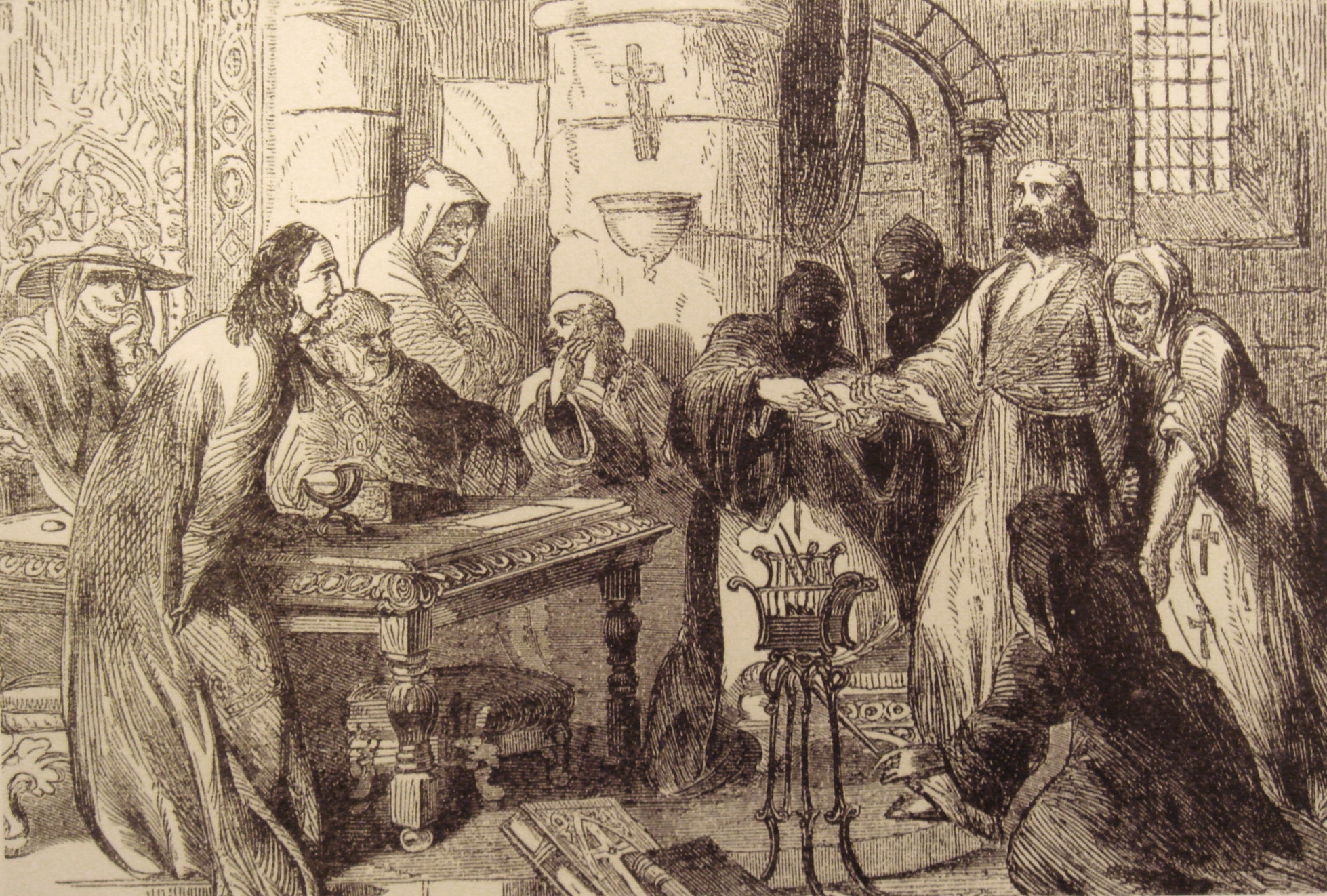
Trial? Or something else? de Molay under investigation... and worse


De Molay himself was compelled to make public admissions under the watchful eye of selected theologians. The Pope attempted to take control of the trial but was unsuccessful. A desperate defense of the Order by two of its priest-lawyers also failed. The Pope did not believe the accusations, especially regarding a “secret protocol” that called for many of the heinous acts listed in the charges. However, the forced confessions left him with little options to act. 

Notably, in those pre-waterboarding days, interrogations involved all kinds of brutal torture and mutilation. Predictably, most caved into their tormentors' demands. Under pressure, at the Council of Vienna in 1312, the pontiff suppressed the order but did not hold it criminally liable. 

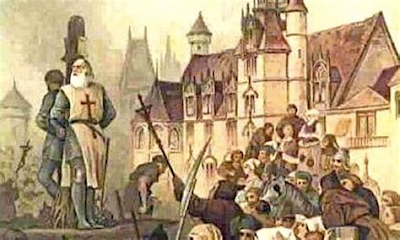
Nearly two centuries of service to the Christian faith were thrown to the wind in a swirl of hysteria and conspiracy. After recanting their confessions (asserting no crimes occurred), De Molay and Geoffrey of Charney, the preceptor of Normandy, were burned to death for heresy two years later in Paris. They were followed by about 50 other members who recanted but were condemned as “relapsed heretics” and executed. Few historians today dispute that the charges by Phillip were concocted and the confessions obtained by torture.


Execution of De Molay

Loss and legend: those Boogie Knights


The property and wealth of the order were seized by secular authorities or handed over to other orders, except for those members of the Order who resided in Portugal. The King of Portugal uniquely offered the knights his protection. Those knights not executed by Philip were merged into other orders. Philip’s outrageous acts might have ended the Order and relegated it to history, but… the Templars’ dramatic demise fueled the rumor mill. 

One legend claims that in 1314, Templar knowledge was secretly passed on to future generations. This led to the belief that the Order continued "underground" in the years that followed, with various theories and speculations. Some believed they had chapters in Scotland, America (before Columbus), aided in forming what is now known as Switzerland, and were responsible for the birth of Freemasonry, among other ideas. The Templars and the mystery surrounding them became perfect material for novelists, filmmakers, and even some historians. 

For example, Sir Walter Scott, an early English-language historical novelist, set the template for fiction and drama with his 1819 novel Ivanhoe. In his version of the myth, the villainous Templar Sir Brian de Bois-Guilbert and his order drifted away from their original purpose. Many other novels linked evil deeds and secret plots to the Templars. This was followed by numerous books, periodicals, films, and TV shows exploring the myth. Even computer games tapped into the legacy and mystery. 

Throughout it all, many conspiracy stories emerged, and even the Nazis became involved in some. Sadly, over time, many have accepted such embellishments as fact. Who doesn't love conspiracy theories wrapped in the mists of history? However, there’s no solid evidence that the Order survived in the form it once held at its peak.


The Modern Knights Templar


Today, the spirit of the Poor Knights of Christ of the Temple of Solomon is carried on by dedicated men of faith and action in the form of the Sovereign Military Order of the Temple of Jerusalem. This ecumenical Christian and chivalric charitable order does not claim a direct lineage to the original Knights of the Temple. However, they have adopted two of the original Templar missions: protecting Christians at risk, especially in the Holy Land and the Middle East, and ensuring the road to Jerusalem remains open to all. They show devotion to God by promoting love and respect. Their efforts include fostering understanding among all religions, helping pilgrims, and maintaining the Christian presence in the Holy Land.


They also work to protect the poor and sick, promote justice, and defend free speech. (The original order’s demise was based on a travesty of justice and suppression of free speech). They uphold the ideals of chivalry and preserve the monuments, archives, and history of the Knights Templar. In the United States, the order is organized into Priories, Preceptories, and Commanderies across many states and the District of Columbia. I am honored that the Priory of St. Patrick (Hudson Valley) in New York submitted The Patriot Spy for the 2015 History Book Award.


The US order is affiliated with the international order, the Ordo Supremus Militaris Templi Hierosolymitani (The Sovereign Military Order of the Temple of Jerusalem). It is the only international Templar order recognized by the United Nations as a non-governmental organization with special consultative status. From the way things look today, the order still has a lot of work ahead.


Saturday, November 17, 2012

Edgar? Is that you?

Apologies to Joan Rivers.  But I am pleased to report that The Patriot Spy has been submitted for a 2013 Edgar Award!

"What the heck is an Edgar?" 


 A reasonable question.  The Edgar Awards are presented each year by The Mystery Writers of America for achievement in mystery writing. The Edgars are the most prestigious awards in this very popular genre.  The Patriot Spy was submitted in the Best First Novel category.  Personally, I know it is my best first novel because it is my only first novel!  Now we just have to convince the judges.


Founded in 1945, Mystery Writers of America is a storied organization that strives to improve the genre of mystery writing by connecting authors and fans.  To do this, it works with libraries and vendors, and at the chapter level, it sponsors symposiums and events.  Authors, publishers, and fans come together to celebrate the power of the mystery and its special hold on the reading public.  There are eleven Mystery Writers of America chapters throughout the country.  It has its headquarters in New York.


                                                        Edgar Allen Poe was the dean of 
                                                    American mystery and thriller writers


Why "Edgar?" 


The name Edgar is in honor of the literary legend, Edgar Allen Poe.  Poe is among the most famous 19th Century American writers and is considered the father of mystery writing with his seminal work, "Murders in the Rue Morgue."  Poe was born in Boston in 1809.  His grandfather, David Poe, served with distinction in the Revolutionary War and is said to have been a friend of the Marquis De Lafayette and was known to George Washington himself.  There - I managed to make a Poe connection to the Yankee Doodle Spies!

West Point mid 19th Century

Edgar's Life


 Poe's parents were actors.  They died when he was a boy and Richmond tobacco merchant John Allan and his wife adopted him. They sent him to the University of Virginia but gambling debts and drinking led him to leave.  He enlisted in the US Army and served with some distinction in the Field Artillery where he rose to the rank of Sergeant Major.  The military life soon wore him down and strange as it may seem Poe sought a commission at the US Military Academy at West Point as a means of escape.  Poe did well there until he decided the Academy did not suit him.  He could not resign however without John Allan's approval (declined). So he broke numerous regulations, mostly absenting himself from classes (what we call "cutting") until he was, at last, he stood before a court-martial and dismissed in March 1831.

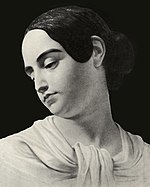
After leaving West Point, he dedicated himself to writing full time. As with many writers, he moved about the country, living variously in New York City, Baltimore, Philadelphia, and Richmond. While in Baltimore he stayed with family and fell in love with and married his 14-year-old cousin Virginia Clemm, who was the love of his life (or maybe he just didn't like saying good-bye).


Virginia Clemm Poe


By 1836 he had returned to Richmond where he worked as a literary critic of some notoriety.  In his professional life, he had worked on the editorial staff of the Southern Literary Messenger of Richmond,  the New York Quarterly Review, and  Graham's Magazine at Philadelphia. It enabled him in 1843 to have a magazine of his own, the Stylus. His dissolute ways estranged him to many and ruined his magazine's prospects.   After his young wife Virginia died in 1847, Poe maintained a pretty continuous downward spiral of drinking bouts, confrontations, and impecunity that overshadowed his inspired body of work.

His Work


In late 1830 Poe published Tales of the Grotesque and Arabesque, a collection of stories. It contained several of his most spine-tingling tales, including "The Fall of the House of Usher," "Ligeia" and "William Wilson." Poe launched the new genre of detective fiction with 1841's "The Murders in the Rue Morgue." A writer on the rise, he won a literary prize in 1843 for "The Gold Bug," a suspenseful tale of secret codes and hunting treasure.  Although best known for short stories steeped in mystery, Poe's most famous and profitable work was a poem, "The Raven." I believe a film by that name was Jack Nicolson's first feature role.  Poe also published a work of poems called, well, "Poems." He released it right after leaving the Academy and dedicated to his fellow cadets, who famously each gave him a dollar and twenty-five to fund the work.  For whatever reason, my favorite Poe short story is "The Cask of Amontillado."

More Edgar Connections


I lived many years in the Bronx and visited the Poe Cottage at Kingsbridge Road and The Grand Concourse. Here Poe lived for a time with his bride Virginia, who speculation credits as the inspiration for the poem Anabel Lee, a ballad of love and death. 

"It was many and many a year ago,
   In a kingdom by the sea,
That a maiden there lived whom you may know
   By the name of Annabel Lee;
And this maiden she lived with no other thought
   Than to love and be loved by me."

                                                                            
                                                                    Poe Cottage, Bronx, NY


While in the Army, I often went on temporary duty to Richmond, Virginia and several times stayed at Linden Row Inn, a street of row houses now turned into an upscale but small and elegant hotel. Returning from a five-year trip to England, the Allans (including Edgar) lived with Mr. Allan’s business partner, Charles Ellis in his house on Linden Row.  Edgar Allan Poe played with the Ellis children in the gardens that had the famous Linden trees. Local legend has it that the enchanted garden is the one that Poe mentions in his famous poem “To Helen.” Poe may have also  courted another life-long love, Elmira Royster, in the garden where the Linden Row Inn now stands.

                                                                            
                                                                The Linden Rowe Inn

His Death


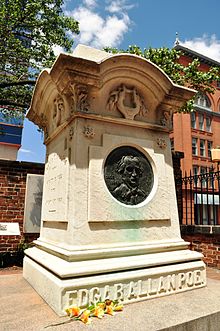
Poe was found lying in a gutter in Baltimore ranting incoherently.  Taken to Washington College Hospital he died on October 7th, 1849. Many legends have circulated as to the causes and situation involving his death but the truth is we will never know the full circumstances of Edgar's demise.  He lives on in his work and the many places that claim his presence during a life and death  punctuated by the simple word from his most famous work, the poem, The Raven:

 "Nevermore!"
Poe grave and monument in Baltimore