Followers

Showing posts with label Yankee Doodle Spies. Show all posts

Sunday, September 20, 2026

Freedom Under Another Flag

 Writing The South Spy was an engrossing experience. Sending my protagonist, Jeremiah Creed, into an entirely new theater of war, using more sophisticated intelligence and tradecraft, was a big part of it. In many ways, the American Revolution was won when the British strategy in the South failed. I also introduced some interesting fictional characters, although many represent real people or “types.” But of course, weaving in the historical figures is the most challenging and rewarding part, especially when you come across someone completely different.


Writing of the South also meant I had to deal with the experience of enslaved Africans, as they made up the larger part of that state’s population. One of those was John Kizell, whose life experience fascinated me to the point where I couldn’t resist inserting him into this tale of action and intrigue.

Son of Africa

 The young African we know as John Kizell was born around 1760 among the Sherbro people on Sherbro Island in what is now Sierra Leone. His early life was shaped by the rhythms of coastal West African communities. Around age 13, his father—a local chief—sent him to visit an uncle who was also a chief in a nearby village. That night, the village was attacked. A fight followed in which the uncle and most of his people were killed. Survivors who did not escape were taken prisoner. Kizell was among them. 

Village in Sierra Leone

His father offered slaves and land to ransom him. The captors refused and said they would rather kill the boy than release him. They marched him to the Gallinas River region (southeastern Sierra Leone, a major slaving area) and sold him to a European dealer. This pattern—African polities raiding rivals or using accusations (sometimes witchcraft) as a pretext, then selling captives at the coast—was the standard way people from the Sherbro/Gallinas hinterland entered the Atlantic trade. Europeans rarely captured people themselves that far inland; they bought from African intermediaries. 

Middle Passage to Market

 The British ship Blossom, Captain William Briggs left the Cape Mount/Gallinas area with 336 captives and arrived in Charleston on 24 May 1773 with 274 still alive—about one in five dead, worse than the typical rate for that route at the time. The survivors were quarantined on Sullivan’s Island, then consigned to the Charleston firm of Robert, John and James Smith. The firm advertised their sale the next day. Lowther presents this as the most likely vessel but notes it is not proven beyond doubt. 

The Middle Passage Proved Harsh and Deadly

Sold into Slavery

In Charleston, Kizell was sold to Esther Kysell (also spelled Kizell), a Swiss-German widow who operated a tavern. There, amid the bustling streets and waterfront, he performed domestic and labor tasks. Through observation, interaction with other enslaved Africans and free Blacks, and possibly informal instruction, he became literate in English—a rare and valuable skill that would serve him later. Charleston in the 1770s was tense, divided by growing colonial resistance to British rule. For the enslaved, the rhetoric of liberty from Patriot leaders rang hollow while they remained in bondage. 

Charleston Harbor and Slave Market

Revolutionary Change

As with many enslaved Africans, the American Revolution transformed Kizell’s life. In 1779, British General Henry Clinton issued the Philipsburg Proclamation, promising freedom to enslaved people owned by rebels who fled to British lines. During the 1780 Siege of Charleston, as British forces under Clinton surrounded and bombarded the city, Kizell seized the opportunity—escaping his owner and joining the British side. Assigned to support roles common for Black recruits—likely with pioneer or labor units—he contributed to the British effort that led to the city’s surrender on May 12, 1780, one of the worst American defeats of the war and a key event in The South Spy. 

British Siege of Charleston 1780


Chilling Great North Reception

His path to freedom was not straightforward. At one point, American forces captured him, but he escaped and made his way back to British-controlled areas. By the war’s end, he had adopted the surname Kizell. As the British evacuated, thousands of Black Loyalists—enslaved people who had sought liberty with the Crown—were recorded in the “Book of Negroes.” Kizell was among those who boarded ships from New York in 1783 bound for Nova Scotia, Canada, along with approximately 3,000 other Black Loyalists. There, he received a certificate of freedom. He married a woman named Phyllis and started a family, though life in the harsh northern climate proved difficult. Promised land grants were often delayed or denied, and white settlers commonly discriminated against them. 

Nova Scotia Period: An Interlude

Homeward Bound

In 1792, Kizell joined roughly 1,200 Black Loyalists on a voyage to Sierra Leone, sponsored by the Sierra Leone Company. They sought to establish a settlement for free Blacks in Freetown. Among the roughly 50 native-born Africans in the group, Kizell returned to his birthland after nearly two decades. The settlers faced immediate hardships. Broken promises from the company, poor soil, disease, and tensions with local populations. Kizell settled near his ancestral Sherbro territory and worked as a farmer, merchant, and community leader. 

Route from Halifax to Sierra Leone

Business, Political, and Spiritual Leader 

His literacy and firsthand knowledge of the slave trade made him a powerful voice. He documented the devastating effects of ongoing slave raiding on African societies and became a Baptist preacher and advocate for abolition. He served as a peacemaker between settler communities and indigenous groups. In 1794, unrest among the Nova Scotian settlers led to arrests. Kizell testified in the related trial in England, using the opportunity to advance his family’s prospects. Later, he joined discussions about resettling free Black Americans in Africa and contributed to early efforts connected to the founding of Liberia. 

Kizell served as a Black Volunteer with the British

Complex Choices

John Kizell’s life embodied the complex choices thousands of enslaved Africans faced during the American Revolution. While Patriot ideals promised liberty to some, many Black men and women calculated (correctly) that the British offered a more immediate path to freedom. An estimated 20,000 to 100,000 enslaved people sought refuge with British forces across the colonies. For Kizell, this decision led from the Carolina rice fields and tavern service to military service, hardship in Nova Scotia, and an eventual return to Sierra Leone as a respected leader fighting the very trade that had enslaved him. 

Legacy of Liberty

John Kizell’s story highlights the broader experiences of Black Loyalists—resilience amid broken promises, the pursuit of dignity despite all obstacles, and the creation of new communities in Africa. Kizell died in the 1830s, leaving a legacy as a survivor, veteran, missionary, and abolitionist whose journey circled the Atlantic. In the Lowcountry’s marshes and on Sierra Leone’s shores, his footsteps trace a remarkable arc of survival and agency during one of history’s great upheavals.


Thursday, September 30, 2021

Gentleman Johnny


This edition of the Yankee Doodle Spies begins a series that profiles key historical figures in the upcoming novel of the acclaimed series, The North Spy. As a minor spoiler, this part of Jeremiah Creed's adventures centers on the British invasion of New York from Canada in 1777. No one is more pivotal to that event than John Burgoyne.


The flamboyant and controversial figure at his best, Burgoyne embodies the classic noble-warrior-literati-celebrity archetype. As distinctive a personality as any archetype can be... His nickname, Gentleman Johnny, reflects how his soldiers see him—and how he perceives himself.

Military Brat or Bastard?

Burgoyne was born on February 24, 1722, in Sutton, to Captain John Burgoyne and his wife Anna Maria, the daughter of a wealthy merchant. Speculation suggests that young John might be a bastard—the illegitimate child of Lord Bingley. Bingley became John’s “godfather” and named him in his will as his heir if his daughters did not produce male heirs.

There was definitely money available to give John a head start in life. So at age 11, Burgoyne began attending Westminster School in London. There, he made some useful friends (always the goal), including Thomas Gage – a future General and the last Royal Governor of Massachusetts. Another close friend was James Smith-Stanley, also known as Lord Strange, who was the son of the wealthy and influential Lord Derby. At 15, Burgoyne joined the British Army by purchasing a commission in the Horse Guards.


John Burgoyne


Since the Guards were based in London and his duties were light, he had plenty of time and opportunities to socialize with high society. He soon earned the nickname, "Gentleman Johnny" for his stylish uniforms and fast lifestyle. However, he quickly accumulated large debts, and it is believed he sold his commission in 1741 to pay them off.

Return to the Colors

The War of the Austrian Succession gave the young dilettante a chance to reinvent himself or, better yet, to rebuild his military career. The British Army was expanding to counter the threat from France, and in April 1745, he was commissioned in the newly formed 1st Royal Dragoons. Unlike most “bought” commissions, as a new regiment, Burgoyne received his commission without any cost. 

Promoted to lieutenant later that year, he served with his regiment at the Battle of Fontenoy, leading troopers in several charges against the French. By 1747, Burgoyne had saved enough money to buy a captaincy—a rank that would give him the platform to get noticed, but the end of the war in 1748 ended any chances of further active service.


Battle of Fontenoy


Cupid’s Arrow

After the war, Burgoyne began courting Charlotte Stanley, the sister of his close friend at Westminster School, Lord Strange. When Charlotte's father, Lord Derby, disapproved of the match, John and Charlotte eloped, causing a scandal and leading his father to cut off her substantial allowance. Since officers on inactive duty received no pay, Burgoyne was forced to sell his commission for 2,500 dollars. 

The young lovers then traveled around Europe, mainly in France and Italy. But it wasn't just about love. During this period, Burgoyne became a dedicated fan of the arts and literature, and this journey helped inspire his creative side. He also began studying treatises on warfare and touring battlefields and fortresses. 


Cupid's Arrow


Return to England and the Army

When his wife gave birth to their only child, Charlotte Elizabeth, they moved back to Britain. Arriving in 1755, his former schoolmate Lord Strange helped the couple reconcile with Lord Derby, who then assisted Burgoyne in purchasing a captaincy in the 11th Dragoons. 

In 1758, Burgoyne joined the prestigious Coldstream Guards, where the ongoing Seven Years' War helped him rise to the rank of lieutenant colonel. In June 1758, he took part in a raid on St. Malo, France, where British forces burned French ships. This was followed by another raid on Cherbourg under then-Captain Richard Howe, who would later lead the Royal Navy in North America during the American War.


Richard Howe


A New Kind of Command

But John Burgoyne quickly developed new ambitions—to command one of the British Army's two new cavalry regiments, the 16th Light Dragoons. This new unit allowed John to apply some of his ideas about military science in practice. Burgoyne was no longer a dilettante. Unlike others who did not get directly involved in managing their regiments, he personally oversaw the formation of his unit and recruited officers from the landed gentry in Northamptonshire. 

He aimed to create a model unit built around his principles of military service: honorable officers, a strong sense of duty, and well-trained, well-equipped men treated with respect. He did not want his men to be the stereotypical dregs of society. To attract high-quality recruits, he worked to provide his men with the best horses, uniforms, and equipment.


Young Cavalry Commander


Unlike British Army traditions, Burgoyne encouraged his officers to get to know the “other ranks.” His concept of warfare emphasized that men should be independent thinkers in combat, not mindless robots like Frederick the Great’s. To facilitate this, he created and published a transformative regimental code of conduct. He also expected his officers to be better educated, urging them to spend time each day reading and learning French, since many of the top military texts were in French, such as the writings of Marechal Maurice de Saxe.


Marechal Maurice de Saxe


Politics, War & Arts

Somehow, Burgoyne found the time and money to get elected to Parliament for Midhurst in 1761. But the next year, he headed to Portugal as a new brigadier general. He gained recognition for capturing Valencia de Alcántara and then defeating the Spanish in the Battle of Vila Velha. During the battle, Burgoyne directed Lieutenant Colonel Charles Lee, future Deputy Commander of the Continental Army, to charge a Spanish artillery battery. 


Charles Lee


Burgoyne returned to Britain at the end of the war. In 1768, he was re-elected to Parliament and appointed governor of Fort William, Scotland. He was outspoken and somewhat “progressive” in Parliament—advocating for military and colonial reform, especially within the East India Company. By this time, he was a major general, but he also dedicated a significant amount of his time to the arts. He had enough free time to write plays and poetry. In 1774, his play The Maid of the Oaks was performed at the Drury Lane Theater.


Drury Lane Theater

Member of the Dream Team

When the American colonial resistance broke out into war in April 1775, Lord George Germain, Minister for the Colonies, sent three of the most promising officers willing to face the Americans (several others refused to serve against fellow Britons). So the dream team of John Burgoyne, William Howe, and Henry Clinton, all highly experienced and renowned veterans, sailed to Boston. With General Thomas Gage in command, there was a surplus of officers, so Burgoyne did not take on field command. However, the debacle at Bunker Hill and the siege gave him plenty of opportunities to learn from others’ mistakes.  


General Thomas Gage

Home and Back and Home

Frustrated, Burgoyne returned to England in November 1775. His wife Charlotte died in February 1776, which deepened his sorrow. Although Burgoyne never remarried, he started a long affair with a married actress, Susan Caulfield, with whom he had four children between 1782 and 1788. The children were raised in Lord Derby's household, and the oldest became Field Marshal Sir John Fox Burgoyne.


General Sir Guy Carleton

His wife gone and eager to prove himself, Burgoyne returned to North America in the spring. This time, arriving at Quebec, where he served under Governor Sir Guy Carleton, who had just stopped the American invasion. Although Carleton managed to push American forces out of Canada, he failed to follow up with a drive on Albany, NY. Burgoyne became critical of Sir Guy’s caution and once again sailed for Britain.

A Brilliant Scheme

Among his other traits, Burgoyne was a smooth talker. Once back in London, he began pressing the Minister for the Colonies, Lord Germain, who was the key figure for defeating the rebellion, about his plan to win the war in 1777. 

The plan involved a three-pronged attack: a thrust south from Lake Champlain aimed at seizing Albany, supported by a detachment led by Lt. Colonel Barry St. Leger approaching from the west through the Mohawk Valley, and a northward advance up the Hudson River from New York led by Sir William Howe to seal the Americans' fate. 

The goal was to cut off New England from the rest of the American Colonies—a classic divide and conquer strategy. Burgoyne’s plan was brilliant but ultimately impractical due to political and geographical challenges.


Lord George Germain


What we have here is Failure to Communicate

Confusion between Germain and Lord Howe, commander-in-chief in North America, would be their undoing. Howe planned to move south toward Philadelphia that year. It is unclear when Germain informed Burgoyne that his support from New York City would be limited. Still, Burgoyne landed in Canada and assembled more than 7,000 men – British regulars, German auxiliaries, as well as some Canadians and Indians.


Burgoyne devised a brilliant but complex plan

Howe (sic) He Lost

I will not delve deeply into this complicated and crucial military event. My future novel, The North Spy, will cover most of the major and some of the minor activities. Burgoyne’s plan was thwarted by several factors. 

Time was not on his side, as the campaign season in the north was short, and he started late and slowly. The terrain was some of the most difficult in North America, with dense forests, numerous bodies of water, and mountains to navigate. Additionally, the Americans rallied most fervently against the incursion, spurred on by atrocities committed by Burgoyne’s Indian allies – both rumored and real. 

Delays & False Assumptions

The initial delay was gathering enough vessels to exploit the excellent waterways—a virtual superhighway leading straight into the heart of the colonies. It was already late June when they arrived on Lake Champlain. Burgoyne’s assumption that widespread Loyalist and Indian support would rally around him was immediately shattered. 

This was a consistent misjudgment in British thinking throughout the war. There was never a large number of Loyal Americans eager to fight, and only a few Native Americans and Loyalists joined his forces. Although Burgoyne captured the northern stronghold, Fort Ticonderoga, by early July, he made a critical mistake by pursuing the Americans. He started diverging from his supply line as his men were lured further away from the waterways. 


Fort Ticonderoga


A Small Win & A Big Loss

A minor victory at Hubbardton on July 7 only gave him false confidence. Burgoyne’s advance south toward Forts Anne and Edward was delayed by the retreating Americans, who blocked roads and trails with trees and destroyed any bridges. Around this time, he learned Howe was sailing to Philadelphia – the crucial push from the south would not happen. Meanwhile, the supply situation worsened as the army lacked enough transport to cross the region's primitive roads.


Battle of Hubbardton


The need for supplies led him to send a force of Germans foraging to the east, where they stumbled into a hornet’s nest of American militia at Bennington on August 16. The New England militia under John Stark defeated the British, inspiring more men to join the cause. 

Many of Burgoyne’s Indian allies began to sense the changing situation and started to drift off to plunder and return home. To make matters worse, Barry St. Leger was turned back at Fort Stanwix. The other part of the triad was gone. Burgoyne had two options: consolidate at Fort Ticonderoga and continue the fight next year – or take a gamble and push farther south.


Battle of Bennington 

The Die is Cast

He took the plunge. Burgoyne decided to abandon his supply lines and attempt a “brute squad” push on Albany in time for winter quarters. He crossed to the west bank of the Hudson on September 13. But just south of Saratoga, a rapidly growing American army, fortified with defense works designed by famed Polish engineer Thadeuz Kozciusko at a place called Bemis Heights, waited. 

The weak Major General Horatio Gates commanded the force, composed mainly of New England and New York militia, but he also had some elite continental troops sent north by George Washington. Gates may have been called "Granny" (his nickname), but the next line of command included some of the war's best leaders, such as Brigadier General Benedict Arnold, Colonel Dan Morgan, Enoch Poor, Ebenezer Learned, and Benjamin Lincoln.


General Horatio Gates


Freeman's Farm

Burgoyne hesitated. His army was weakened and morale was dropping. Although Gates was happy to stay behind his defenses and wait (which wasn't a bad idea), he let Arnold try a strategy. On September 19, Arnold and Morgan attacked Burgoyne's troops at Freeman's Farm. Intense fighting broke out. Both sides suffered heavy losses, but the British retreated to regroup.  


Battle of Freeman's Farm

Bemis Heights

With their supply situation critical, many British commanders recommended a retreat. Burgoyne anxiously hoped that a small diversion from NYC launched by former dream team member Henry Clinton would draw some of the Americans south of Albany. But Clinton’s move was too little, too late. Yet unwilling to fall back to Fort Ticonderoga, Burgoyne tried a last desperate move at Bemis Heights on October 7. 

A strong column under General Simon Fraser was smashed, and Fraser, his best subordinate, was killed by a sniper. So were precious regulars and Germans who would never be replaced. Burgoyne showed personal bravery and was nearly shot several times by American marksmen. When Fraser's column was repulsed, the Americans launched their own attack and punished the British, although they failed to take and hold the British defenses. But Burgoyne had been beaten.


Battle of Bemis Heights

An “Unconventional” Surrender

The British retreated to their camp near Saratoga. Meanwhile, the Americans had cut off his retreat to the north and were daily harassing his lines with sniper fire. Stuck in two pitched battles and now unable to fall back on supply lines or break southward, Burgoyne surrendered on October 17 at Saratoga. 

Yet “Gentleman Johnny” tried to make the best of a bad situation through a technical protocol. He managed to persuade Gates (a former British officer) to allow him to sign a “convention” instead of an unconditional surrender. Also, he and his men were to be returned promptly to Britain. 

Congress later annulled the deal. While British and German officers were sent home on parole, the “other ranks" laid down their arms under the watch of American militia and Continentals, and roughly 5,800 soldiers marched off to captivity in Boston and eventually Charlottesville, Virginia.


Burgoyne Surrenders at Saratoga


Home in Disgrace

Saying Burgoyne returned to Britain in disgrace is an understatement. This was one of the worst defeats in British history – surpassing Malplaquet, Fontenoy, or Carillon. The American militia had routed a British army in the field – convincing France to openly ally with the emerging American nation, later joined by Spain. The impact on world history would be profound.


Burgoyne's demand for a court-martial
was denied

Attacked by the government for his failures, Burgoyne tried to clear his name by blaming Germain for not ordering Howe to support his campaign. He demanded, but did not receive, a court-martial to clear his disgrace. Instead, King George III stripped him of all titles. Once again, Burgoyne was out of the army. But not for long.

Political Winds

Frustrated by the lack of support from Lord North’s administration, whom he had strongly backed, Burgoyne switched his political allegiance from the Tories to the Whigs. Soon, things turned around for Burgoyne. 


Things went south for Lord North -
to Burgoyne's advantage


When Lord North’s cabinet fell in 1782, Burgoyne gained the favor of the Whigs, and his rank of major general was restored along with a colonelcy in the King’s Own Royal Regiment. Burgoyne maneuvered to secure a top military appointment—commander in chief in Ireland—and also became a privy councilor. 

However, he left the government when Lord Rockingham’s administration collapsed a year later. Still, this allowed him time to focus on his literary projects, which had become his main passions besides his mistress.

Burgoyne Reinstated

Acclaimed Playwright

Burgoyne wrote two romantic comedy plays: Maid of the Oaks, completed by 1774, and The Heiress, written in 1786, which is arguably his best work. He also collaborated with Richard Brinsley Sheridan on the production of The Camp in 1778. In 1780, he wrote the libretto for William Jackson’s The Lord of the Manor. Burgoyne translated Michel-Jean Sediane’s Richard Coeur de Lion for a semi-opera at the Drury Lane Theatre in 1788.


Actress Frances Abington 
in Maid of the Oaks


Legacy

Despite his failed strategy and campaign at Saratoga, John Burgoyne is best remembered for his literary achievements among contemporary and post-Revolutionary War Britons. He was most admired for The Heiress, which was a great success and beloved by many both before and after his death. Gentleman John Burgoyne died suddenly at his Mayfair home on June 3, 1792. He was buried at Westminster Abbey.


Burgoyne's Legacy was his plays


Sunday, May 20, 2018

Why Spy?


During my years in US Army intelligence, I had the bright idea of writing a spy novel. Half the people I worked with thought of the same idea. Some even tried to write drafts. But very few finished, and to my knowledge, even fewer got published. As a long-time student of history, I wanted to create a historical portrait, not just craft a spy story. 

Until recently, few Americans knew that, besides being the top soldier during the Glorious Cause, George Washington was also the country's leading spymaster. However, we in Army Intelligence were aware of his secret role. So, when I decided to start writing my spy novel(s), I chose to blend spy themes with fictional versions of James Bond set against the American Revolution. 

The Yankee Doodle Spies series celebrates—tales of men and women who fought the secret war—gathering intelligence to give Washington an edge over the mighty British land and sea forces.


George Washington was the great case officer
of his day


Origins of the Term, Spy


Words have meaning. So let’s examine the word, Spy – the key term in this series. Where does it originate from, and what does it mean? According to one source, the word comes from Old French and other European languages.


Benjamin Tallmadge coordinated
Washington's spies

A Noun


The word 'Spy,' as a noun, dates back to the mid-13th century and originally meant "one who spies on another." This comes from the Old French word 'Espie,' meaning a "spy, look-out, or scout." In Middle English, 'spy' derived from the shortening of the Old French word 'Espie,' which included 'espying,' 'espier,' and 'espy.' The Old French term itself has Germanic roots, originating from an Indo-European root shared by the Latin word 'specere,' which means to behold or look.


Old French was connected to Latin


A Verb


To spy, the verb has the same mid-13th century origin and meant to watch secretly. This originated from the Old French verb espier, which meant "observe, watch closely, spy on, or find out," likely from the Frankish spehon or another Germanic source. The term spehon appears in Proto-Germanic and Old High German, where it also meant "to look out for or scout." Old English had the verb spyrian, meaning "to make a track, go, pursue; ask about, investigate." The related noun was spyrigend, meaning "investigator, inquirer."


Old High German was connected to Frankish and Old French


The Italian verb, spiare, and Spanish espiar also derive from the Germanic root from around 1300 and similarly mean "to catch sight of.” The term evolved into the modern German verb, spähen, meaning "to spy." The word further developed in Middle Dutch to become Spien.


One of many iterations of the Army
Special Agent's Badge 


Interestingly, as I worked with German counterintelligence during the Cold War, I noted that their modern term for a spy is 'Spion,' and espionage is 'Spionage.' The root of the words and their basic sounds remain unchanged. However, pay attention to some other action descriptors in the etymology, such as observe, watch closely, find out, look out, ask about, and so on.

A Curious 18th Century Use


We can see that the term, “to spy,” means learning through observation and, of course, reporting. Now, done clandestinely during wartime, it aligns more closely with the modern definition. However, the term spy once had another use - related to observing and gathering information to report on it. So, it’s not a big leap to connect this terminology to another meaning for the word, “Spy."


"Spy" used a journal


In the 18th century, the term “Spy” was used as the name for major periodicals in colonial and post-colonial America. These publications played a significant role in shaping colonial thought during the struggle for independence before the actual war. We will discuss this in more detail in an upcoming post.


Saturday, January 19, 2013

Blast from the Past


Several "open sources" reported a dangerous and historic discovery made in Central Park the week before last.

New York City Parks workers found a live cannonball loaded in a cannon. The artillery piece, dating back to the Revolutionary War, was one of two cannons stored at the park’s Ramble shed near the 79th Street transverse, a road that crosses the park from east to west. Preservation workers from the Central Park Conservancy called the police after opening the capped cannon for cleaning. The police discovered over 800 grams of black powder, along with cotton wadding and a cannonball. More importantly, the powder was still capable of firing!

                                                                                       
                                             Revolutionary War cannon found in Central Park

The cannon, donated to the park around the time of the Civil War, was on public display for over 125 years until 1996, when the Conservancy decided to bring it inside to protect it from vandalism. So, a loaded cannon sat amidst joggers, school kids, picnickers, and lovers (not to mention assorted hookers, pimps, junkies, and muggers). It’s amazing that loaded ordnance could have gone unnoticed for so long. However, the gun posed little real threat, as it was already over 90 years old and is believed to have come from a sunken British vessel in the East River. Additionally, it was capped with concrete.


The Patriot Spy recounts the British invasion of Long Island (modern-day Brooklyn) and then the Island of New York (modern-day Manhattan)... The gun appears to be a small-caliber (6 or 12-pound) carronade. During the Revolutionary War, guns like these would have mostly been used to arm British merchant ships, not frigates as the New York papers speculate.

Carronades (named after the British Carron ironworks that developed them) were short-barreled guns used on merchant ships for defense. More economical and easier to operate than high-velocity "long guns," the carronade's lower muzzle velocity gave it a better "smashing" ability. The carronade's shot could devastate its target, tearing the ship's gunwale and masts into much larger chunks and splinters that were as deadly to the enemy as the munition itself. Additionally, because they required less run-out space, they needed a smaller crew, and more carronades could be mounted in the same space as long guns. They could also be brought back into battery for the next shot more quickly than traditional guns, giving carronades a faster rate of fire.


Carronades had a higher trajectory than long guns
Why merchant ships? The carronade sat high in its gun carriage, making it more difficult to smash the hull at the waterline. However, the deck line and the masts were easy targets. Merchant vessels typically only needed to smash masts, yardarms, and rigging to reduce the sail power of their pursuer—usually an American privateer—and then make their escape. It wasn't until 1791 that the Royal Navy started mounting these devastating little weapons on the men o' war. And not just on frigates: schooners, brigs, and even ships of the line (large sailing battleships with 60 or more guns). The concentrated close-range fire of the carronade proved deadly to French, Spanish—and sometimes American—ships during the numerous naval battles and duels that took place from 1792 until 1814.


Merchant vessel fleeing privateers


However, during the time of Yankee Doodle Spies, the carronade was viewed as a defensive weapon suitable for merchant ships. One can wonder whether any of the American privateers mounted these guns. They probably did once they captured a British merchant prize. The importance of merchant shipping and privateers during the Yankee Doodle Spies era is often overlooked in popular histories, but I will discuss in a future blog how vital, even decisive, that aspect of the War for Independence truly was.


Heading east from Mc Gowans Pass - today

With this recent discovery, Central Park once again links itself to the War for Independence and the Yankee Doodle Spies. Not far from where the mysterious gun was found near McGowan's Pass—a crucial approach to the Heights of Harlem that played a significant role during the British invasion of Manhattan. And a key setting in...The Patriot Spy.


Saturday, November 17, 2012

Edgar? Is that you?

Apologies to Joan Rivers.  But I am pleased to report that The Patriot Spy has been submitted for a 2013 Edgar Award!

"What the heck is an Edgar?" 


 A reasonable question.  The Edgar Awards are presented each year by The Mystery Writers of America for achievement in mystery writing. The Edgars are the most prestigious awards in this very popular genre.  The Patriot Spy was submitted in the Best First Novel category.  Personally, I know it is my best first novel because it is my only first novel!  Now we just have to convince the judges.


Founded in 1945, Mystery Writers of America is a storied organization that strives to improve the genre of mystery writing by connecting authors and fans.  To do this, it works with libraries and vendors, and at the chapter level, it sponsors symposiums and events.  Authors, publishers, and fans come together to celebrate the power of the mystery and its special hold on the reading public.  There are eleven Mystery Writers of America chapters throughout the country.  It has its headquarters in New York.


                                                        Edgar Allen Poe was the dean of 
                                                    American mystery and thriller writers


Why "Edgar?" 


The name Edgar is in honor of the literary legend, Edgar Allen Poe.  Poe is among the most famous 19th Century American writers and is considered the father of mystery writing with his seminal work, "Murders in the Rue Morgue."  Poe was born in Boston in 1809.  His grandfather, David Poe, served with distinction in the Revolutionary War and is said to have been a friend of the Marquis De Lafayette and was known to George Washington himself.  There - I managed to make a Poe connection to the Yankee Doodle Spies!

West Point mid 19th Century

Edgar's Life


 Poe's parents were actors.  They died when he was a boy and Richmond tobacco merchant John Allan and his wife adopted him. They sent him to the University of Virginia but gambling debts and drinking led him to leave.  He enlisted in the US Army and served with some distinction in the Field Artillery where he rose to the rank of Sergeant Major.  The military life soon wore him down and strange as it may seem Poe sought a commission at the US Military Academy at West Point as a means of escape.  Poe did well there until he decided the Academy did not suit him.  He could not resign however without John Allan's approval (declined). So he broke numerous regulations, mostly absenting himself from classes (what we call "cutting") until he was, at last, he stood before a court-martial and dismissed in March 1831.

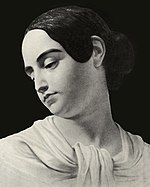
After leaving West Point, he dedicated himself to writing full time. As with many writers, he moved about the country, living variously in New York City, Baltimore, Philadelphia, and Richmond. While in Baltimore he stayed with family and fell in love with and married his 14-year-old cousin Virginia Clemm, who was the love of his life (or maybe he just didn't like saying good-bye).


Virginia Clemm Poe


By 1836 he had returned to Richmond where he worked as a literary critic of some notoriety.  In his professional life, he had worked on the editorial staff of the Southern Literary Messenger of Richmond,  the New York Quarterly Review, and  Graham's Magazine at Philadelphia. It enabled him in 1843 to have a magazine of his own, the Stylus. His dissolute ways estranged him to many and ruined his magazine's prospects.   After his young wife Virginia died in 1847, Poe maintained a pretty continuous downward spiral of drinking bouts, confrontations, and impecunity that overshadowed his inspired body of work.

His Work


In late 1830 Poe published Tales of the Grotesque and Arabesque, a collection of stories. It contained several of his most spine-tingling tales, including "The Fall of the House of Usher," "Ligeia" and "William Wilson." Poe launched the new genre of detective fiction with 1841's "The Murders in the Rue Morgue." A writer on the rise, he won a literary prize in 1843 for "The Gold Bug," a suspenseful tale of secret codes and hunting treasure.  Although best known for short stories steeped in mystery, Poe's most famous and profitable work was a poem, "The Raven." I believe a film by that name was Jack Nicolson's first feature role.  Poe also published a work of poems called, well, "Poems." He released it right after leaving the Academy and dedicated to his fellow cadets, who famously each gave him a dollar and twenty-five to fund the work.  For whatever reason, my favorite Poe short story is "The Cask of Amontillado."

More Edgar Connections


I lived many years in the Bronx and visited the Poe Cottage at Kingsbridge Road and The Grand Concourse. Here Poe lived for a time with his bride Virginia, who speculation credits as the inspiration for the poem Anabel Lee, a ballad of love and death. 

"It was many and many a year ago,
   In a kingdom by the sea,
That a maiden there lived whom you may know
   By the name of Annabel Lee;
And this maiden she lived with no other thought
   Than to love and be loved by me."

                                                                            
                                                                    Poe Cottage, Bronx, NY


While in the Army, I often went on temporary duty to Richmond, Virginia and several times stayed at Linden Row Inn, a street of row houses now turned into an upscale but small and elegant hotel. Returning from a five-year trip to England, the Allans (including Edgar) lived with Mr. Allan’s business partner, Charles Ellis in his house on Linden Row.  Edgar Allan Poe played with the Ellis children in the gardens that had the famous Linden trees. Local legend has it that the enchanted garden is the one that Poe mentions in his famous poem “To Helen.” Poe may have also  courted another life-long love, Elmira Royster, in the garden where the Linden Row Inn now stands.

                                                                            
                                                                The Linden Rowe Inn

His Death


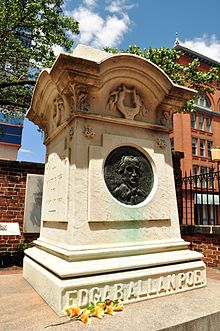
Poe was found lying in a gutter in Baltimore ranting incoherently.  Taken to Washington College Hospital he died on October 7th, 1849. Many legends have circulated as to the causes and situation involving his death but the truth is we will never know the full circumstances of Edgar's demise.  He lives on in his work and the many places that claim his presence during a life and death  punctuated by the simple word from his most famous work, the poem, The Raven:

 "Nevermore!"
Poe grave and monument in Baltimore