Followers

Saturday, August 27, 2022

The Saint


Not the infamous TV character Simon Templar played by Roger Moore, but a son of County Kildare, a professional British officer, and a key contributor to the Saratoga Campaign. In fact, Lieutenant Colonel Barry St. Leger’s push from the west was the third prong of the triple pincer against Albany in a grand plan to defeat the Americans once and for all. Often seen as an afterthought, St. Leger's role was a vital part of a strategy designed to overwhelm the rebels in New York.


Roger Moore as Simon Templar

Born in the Land of Saints and Scholars

Barrimore Matthew St. Leger was born in May 1737 in County Kildare, Ireland, and was a nephew of the Fourth Viscount Doneraille. This date is actually his baptism date, as Irish tradition was to record baptisms more carefully than births during a time when infant mortality was common. Barry’s father, Sir John St. Leger, was a prominent Irish judge. His brother, Anthony St. Leger, served in Parliament and the military, reaching the rank of major general.


Anthony St. Leger

Saint to Scholar to Soldier

The high-born St. Leger attended the esteemed halls of Eton and Cambridge before joining as an ensign with the 28th Regiment in April 1756. His regiment immediately sailed to North America for the French and Indian War. St. Leger served with some distinction under British General James Abercromby. 


James Abercromby


By 1758, the young Irishman was a captain in the 48th Regiment and participated in General Jeffery Amherst’s Siege of Louisbourg. St. Leger was appointed brigade major (a staff position, not a rank) during General James Murray’s advance on Montreal in 1760, and in September 1762, he was promoted to major in the 95th Regiment. The French and Indian War had been beneficial for the Viscount’s nephew. The Revolutionary War, however, would be a mixed experience. 


Jeffery Amherst


Defending Canada

When resistance erupted into rebellion and war in 1775, St. Leger served as lieutenant colonel of the 34th Regiment. Barry arrived in Canada in the spring of 1776. He and his regiment helped Governor-General Guy Carleton repel the invading American forces throughout the summer and fall of that year. St. Leger and the 34th recaptured Fort Ticonderoga during the southward drive but withdrew when Carleton decided to end the campaign and return north into winter quarters. 


Guy Carleton


A Grand Strategy

The irrepresible General John Burgoyne arrived from England in early 1777 with reinforcements from Lord Germain, the Minister for Colonies. “Gentleman Johnny” also brought his bold plan of a three-pronged attack to capture Albany, New York. His aim was to sever the stubborn New England colonies from the rest of the colonies. What would happen after that was unclear.


Western Approach

A lesser-known but essential part of Burgoyne’s plan was a supporting move along the Mohawk River to draw away rebel forces, punish rebel farmers, and link up with his main force near Albany. Burgoyne chose St. Leger to lead the western branch because of his experience and skill in navigating the northern wilderness. 


John Burgoyne


Brevet Brigadier General

On June 23, 1777, St. Leger’s combined force of about 800 British regulars, Hessians, Loyalists, and Canadians set out from Montreal. They included Loyalists under Colonel John Johnson and Major Walter Butler, along with some British and Hessian troops. St. Leger, who had been breveted a brigadier general for the campaign, prioritized speed over firepower, so he decided to leave behind heavier artillery to avoid slowing the wilderness march. He did bring along a few light guns, but these would prove inadequate for the task.


Barry St. Leger


Drums Along the Mohawk

On 25 July, a flotilla of British ships and barges landed St. Leger’s forces at Oswego, New York. They were quickly joined by 800 Native warriors led by Iroquois War Chief Joseph Brant and Seneca War Chief Cornplanter. 


Chief Joseph Brant


They quickly moved up the Mohawk River valley following Burgoyne’s plan, passing friendly Iroquois villages and undefended farmland. 


Iroquois village on the Mohawk River

But St. Leger soon faced his first obstacle—rebel-controlled Fort Stanwix (present-day Rome, NY), which was fiercely defending the upper valley against his advance. To St. Leger’s dismay—reports from Indian scouts and spies proved accurate. 


Fort Stanwix


The Continental Army’s Northern Department commander, General Philip Schuyler, recently repaired the fortification and garrisoned it with 750 men of the 3rd New York Regiment under Colonel Peter Gansevoort, with Lieutenant Colonel Marinus Willet as his deputy.


Peter Gansevoort

Fort Stanwix Besieged

When St. Leger arrived outside Fort Stanwix, he sprang into action, conducting a “leader’s reconnaissance" of the post. He quickly realized he had underestimated the size and strength of the place. Lacking the heavy guns to pound the fort into submission, St. Leger ordered his Indian allies to encircle it in what was a very soft siege. 


Iroquois Braves surround Fort Stanwix


He then tried to bluff the defenders into surrender by showcasing his entire force. Ironically, the many native warriors convinced the Americans they would be slaughtered if they surrendered. St. Leger’s surrender summons fell flat. Frustrated, he ordered a bombardment of the fort, but his small-caliber guns proved ineffective.

Oriskany Ambush

Farther up the valley to the east, the Tryon County militia gathered when word of the British invasion reached them. A column of 800 men under Colonel Nicholas Herkimer marched out of Fort Dayton, aiming to relieve Stanwix. But Molly Brant, sister of Chief Joseph Brant, warned St. Leger of the new threat. He responded by sending a force of Loyalists and Indians into the dense forest near the village of Oriskany, to the east. 


Molly Brant

On 6 August, beneath a dense canopy of ancient woods, they launched a devastating ambush on the militia, which was halfway across a deep gulley. A fierce firefight broke out. Curtains of gunfire tore through the hardwood and scythed down brush and branches. Men fell on both sides, but with many dead and wounded, including Herkimer, the Tryon County militia retreated behind the cover of thick gun smoke.


Oriskany Ambush & Firefight


Stubborn Resistance

Back at Fort Stanwix, the Americans had a few tricks of their own. With the besiegers reduced to sending forces to Oriskany, Lieutenant Colonel Marinus Willet successfully launched a sortie from the defenses and captured St. Leger’s camp, thoroughly looting it. The loss of supplies discouraged the tribesmen, and they began abandoning St. Leger’s column.


Marinus Willet


Desperate, St. Leger once again threatened the defenders with massacre unless they surrendered. Gansevoort agreed to a truce but was determined to defend the fort. He sent Willett to ride through British lines to Stillwater, report the situation to General Philip Schuyler, and ask for reinforcements. 

Arnold’s Deception

And so, it was. General Benedict Arnold assembled a force to drive the British from Stanwix. But Arnold was as clever as he was brave and bold. He sent a unhinged man named Hon Yost to “desert” the British. His rantings of a relief force “more numerous than the leaves on trees” frightened the remaining warriors, who fled west. 


Benedict Arnold


Seeing his hopeless situation, St. Leger was forced to abandon his siege of Fort Stanwix. On August 25, his regulars, Hessians, Loyalists, and a few loyal Indian allies, traveled west along the Mohawk River and headed for Canada. St. Leger’s failure to reach Albany and support Burgoyne directly helped lead to the surrender at Saratoga in October 1777.

Return to Ticonderoga

St. Leger did not dwell on his failed campaign. Instead, he quickly took action after returning to Montreal, persuading limited forces from Governor Guy Carleton. He led his troops south to directly reinforce Burgoyne. However, they had just reached Fort Ticonderoga when news of the Saratoga surrender arrived in October 1777. 


Fort Ticonderoga


Guerrilla Warrior

For the rest of the war, St. Leger remained in active command and established himself as a specialist in irregular warfare. He led multiple raids against the Americans in upper New York, which became a battleground of brutal partisan and guerrilla fighting throughout the conflict. Spying, betrayal, raids, ambushes, assassinations, and burning would ravage upper and central New York.


Loyalist raiders


St. Leger was involved in a failed attempt to kidnap General Philip Schuyler. In 1781, the new commander in Canada, General Frederick Haldimand, sent him back to Ticonderoga to meet with discontented rebel leader Ethan Allen. However, the plan to separate Vermont from the rebels did not succeed.


Philip Schuyler


Canadian Service

Unlike most of his fellow officers, St. Leger did not return to England or sail to another theater after the 1783 Treaty of Paris. Instead, he stayed in Canada. In 1784, he was promoted to brigadier general and took over as commander from Haldimand. But by 1785, poor health caused by the hardships of campaigning forced him to step down and retire from active service. St. Leger died in Worksop, Nottinghamshire, England, on December 23, 1793. 


Frederick Haldimand

Legacy

St. Leger's legacy is mixed. He was a talented tactical leader capable of planning and organizing complex operations across large wilderness areas. However, his only major independent command ended in failure due to a combination of poor decision-making (remember the heavy guns?), failure to keep his native allies in line, and unforeseen resistance from American forces that were more formidable than expected. 

But unlike his commander Burgoyne, "The Saint" knew when to quit and pulled his troops out of a dangerous situation. Facing the defenders at Fort Stanwix combined with General Benedict Arnold's relief force would have likely led to the destruction of his force. Instead, his troops would live to fight another day and continue to harass and threaten upper New York for the rest of the war, while Burgoyne’s stubborn refusal to consolidate caused his larger army to march off to rebel prisons.


Sunday, July 31, 2022

The Old Patroon


The Dutch settlers of New York and East Jersey were among the hardest-working Europeans to settle in North America. Thrifty, ambitious, and organized, they expanded their foothold on Manhattan into a collection of settlements that far surpassed the small homeland they left behind. They named the colony New Netherlands. It was governed by a network of extremely wealthy landowners, called patroons, who had been granted large plots of land to cultivate and oversee. 

The Dutch Way

Originally, these patroons had the right to establish courts and levy taxes. Changes occurred when the British arrived in the late 17th century, and by 1775, the patroonships were abolished and renamed estates. By then, a sizable middle class had grown from Long Island and Manhattan, along the Hudson and Mohawk Rivers. Many had crossed the Hudson and settled along the Hackensack River in East Jersey. The cultural and economic influence of the Dutch still affected the renamed colony of New York, and they played an important role in the War for Independence.


Roots Deep and Wide

Philip Schuyler was born into a wealthy Dutch patroon family on November 20, 1733, in Albany, New York. His parents, Cornelia Van Cortlandt and Johannes Schuyler Jr., had extensive connections to the most prosperous patroon families. His maternal grandfather was Stephanus Van Cortlandt, the 17th Mayor of New York City. Educated by tutors at the Van Cortlandt family estate in New Rochelle, he mastered Mathematics and French, in addition to his native fluency in Dutch and English. Young Schuyler actively traded with the Indians and built strong bonds with the leaders of the nearby Iroquois of the Mohawk nation. He became fluent in their language.


First Fight

Like many of his generation, he gained military experience during the French and Indian War, where Schuyler served as a captain in the New York militia. His cousin, Lieutenant Governor James Delancey, had appointed him. His connections were extensive. The wealthy young Schuyler raised a local company. He participated in some of the key battles in upper New York, including Lake George, Oswego River, Carillon, and Fort Frontenac. At Oswego, he served as a quartermaster until the fort fell to the French.


Prosperous Patroon

Post-war, he built on his wealth as a patroon until he became one of the wealthiest and most prominent men in New York. In 1768, he parlayed his wealth and influence into a political career and secured a seat in the New York legislature. Although not a radical Son of Liberty, Schuyler spoke out against British policy. He managed to get himself on a commission to settle a boundary dispute with New Hampshire. This would earn him enemies among the New Hampshire and Massachusetts elites—enemies who would pursue him in years to come.


Philip Schuyler


Continental Congress

At the start of hostilities with Britain in April 1775, Schuyler served as a delegate to the Second Continental Congress in Philadelphia. His experience in the French and Indian War helped him on a committee that developed rules and regulations for the new United Colonies Army. This led to a friendship with General George Washington, who later asked Congress to appoint him as one of the Army's major generals. 


Continental Congress


All In

Despite his wartime experience, his appointment was more about securing New York's support for the Cause than leveraging his military skills. This kind of regional quid pro quo was common and used to ensure that the different colonies were "all in." Virginia's Colonel George Washington had edged out Massachusetts' John Hancock as commander-in-chief of the Army for the same reason.


John Hancock


First  Command

Schuyler's background and experience with upper New York made him a natural choice to command the Northern Department, headquartered in Albany, his old stomping grounds. However, the mission was daunting – assemble an army and invade Quebec (Canada), where it was expected that the local "Habitants" (French settlers) would rally to the Cause. His first move, however, was political. Schuyler managed to secure the neutrality of the powerful Iroquois Confederation – or at least delay their involvement.


Schuyler leveraged strong Iroquois connections


Quebec Disaster

While thus engaged, Brigadier General Richard Montgomery gathered the forces and began his advance without awaiting Schuyler's approval. Faced with a fait accompli and debilitated by a gout attack, Schuyler approved Montgomery's plans and set to work on the logistics support the fiery Irishman would need. The campaign started late in the season, so although initially successful, it collapsed in the depths of December when Montgomery and Benedict Arnold were cut down while storming Quebec City. Montgomery died, but Arnold recovered. Schuyler's New England foes quickly cast blame on the old Dutchman.

Night Assault of Quebec


Defending the North

The British, properly reinforced, launched an offensive in the spring. While Schuyler once again managed political interference, gathered men and supplies, and coordinated the overall effort, General John Sullivan, who fought a desperate retreat from Canada, attempted to garrison the mighty Fort Ticonderoga – The Gibraltar of the North.


John Sullivan


A British fleet gathered at the mouth of the Richelieu River, so Schuyler instructed Benedict Arnold (who had recovered from his wounds at Quebec) to take command of the forward defenses on Lake Champlain. The next phase of America's struggle would be fought on that long, icy body of water. Schuyler instructed Arnold to assemble a fleet to stop the armada of men and boats coming from the north under General Guy Carleton, Governor-General of Canada.


Lake Champlain Basin


Arnold performed a "rock soup" miracle, gathering a small flotilla of gunboats and, using his unique and aggressive cunning, surprised the fleet at Valcour Island. He fought the larger British ships bravely, but the Americans were torn apart by the heavier guns and ships. Still, the stubborn resistance slowed Carleton's advance, and since it was now October, he withdrew to winter quarters, planning to finish the campaign in spring 1777. The Americans had bought some time.


American defeat at Valcour Island 


Winter of Discontent

Schuyler was distracted from his preparations by a winter of bitter political infighting as his New England detractors blamed him for the northern failures. General Horatio Gates replaced him in March 1777, but the New York delegation in Congress raised a ruckus, and Schuyler was reinstated shortly afterward. However, the bitter infighting continued even as Schuyler worked to bolster Ticonderoga and begged his New England foes for more regiments to face the British onslaught forming in Canada.


Gibraltar of the North


By Land and Sea

Despite Schuyler's efforts to prevent another British advance, General John Burgoyne's 8,000-strong force sailed down Lake Champlain and moved uncontested into Fort Ticonderoga. Its commander, General Arthur St. Clair, realizing his forces were too weak to fight and would only be captured by the British, evacuated hours before the British arrived – a crucial decision. Schuyler approved St. Clair's withdrawal and ordered a "Fabian Defense." The garrison vanished into the thick woods, cutting down trees and constructing abatis and other obstacles in an effort to slow Burgoyne's troops, who were hot on their heels. The British were drawn deeper into the wilderness and away from the waterways that supplied their route south and their supplies.


Arthur St. Clair


Rallying the Militia

The Americans distracted the British, causing Burgoyne's advance to slow down and giving time for the militias to finally respond to Schuyler's call for men. British efforts toward New England and reports of Iroquois raids helped fuel this. From his headquarters in Albany, Schuyler made urgent pleas for powder, lead, guns, and supplies. But mainly, he needed men. His plans included establishing another line of defense about 30 miles north of Albany. 


Major General Schuyler


But the blame for Ticonderoga fell on Schuyler, and General Horatio Gates was once again put in charge. Gates halted the British in two decisive battles near Saratoga, where he accepted their surrender in October 1777.


Horatio Gates


Court Martial and Politics

Schuyler demanded and received a court-martial in 1778, which cleared him of wrongdoing, but he resigned his commission and returned to Congress in 1779. Philip Schuyler's legacy was that he was the only major general in the Continental Army never to fight a pitched battle. He continued to offer advice to his friend, General Washington, as his understanding of strategy and logistics was well recognized. His knowledge of Indian affairs also benefited Washington, who sought his counsel during the 1779 campaign against the Iroquois.


General Washington valued Schuyler's counsel


Enemy of the British?

Despite rumors in New England labeling him a Tory, Schuyler was targeted by the British. He faced the threat of personal attack. In October 1777, General John Burgoyne's retreating forces burned down Schuyler's country home. He later rebuilt it, and now it is open to the public. 


Schuyler's Estate Home rebuilt 


In another incident in 1780, British agents attacked Schuyler's Albany mansion under cover of darkness. The attempt, whether kidnapping or murder, was thwarted. Following the incident, Schuyler was under the protection of a bodyguard of Continental Army soldiers. However, he remained a target. On 7 August 1781, Schuyler foiled a kidnapping plot led by John Walden Meyers. It failed when Schuyler managed to escape from his Albany mansion. The Albany mansion served variously as his home, Northern Army headquarters, political center, and business office.


Schuyler Mansion in Albany


Post-War and Politics

The old patroon had powerful New York connections, and after the war, he focused on local politics by serving in the New York State Senate. He also served as a delegate to the state Constitutional Convention in 1789 and worked hard to support the new American Constitution. Schuyler was both a businessman and a soldier plus a politician. He expanded his estate near Saratoga after the war, growing to tens of thousands of acres, with a dozen slaves and tenant farmers, as well as a store and mills for flour, flax, and lumber. To get his goods down the Hudson River to market, he built schooners, naming the first Saratoga.


Schuyler had his own fleet

Federalist

Unsurprisingly, Schuyler was among the first two U.S. Senators appointed to represent the state in the new Congress. Naturally, the longtime ally of George Washington now supported his president as a steadfast Federalist. He especially backed the solid economic policies proposed by Secretary of Treasury Alexander Hamilton, who had married Schuyler's daughter, Elizabeth (more about her below). The whirlwind of New York politics caused him to lose his seat in 1792 but regain it in 1797. At the time, state legislatures, not the voters, elected senators — connections often determined who stayed or went. Schuyler was the first New Yorker to join the controversial Society of Cincinnati, a fraternity of Revolutionary War officers seen by some as a rising aristocracy. Yet most senior officers, including George Washington, had joined the organization.


President George Washington


Domestic Life

Schuyler married into the highly wealthy and influential Van Rensselaer family when he took Catherine Van Rensselaer's hand on September 7, 1755, in Albany. They had a large family of 15 children, eight of whom survived to adulthood. His second child, Elizabeth, later married young Continental Army officer Alexander Hamilton. She gained modern fame through the musical Hamilton. During her life, she used his legacy and family connections to participate in philanthropic efforts, including establishing the first orphanage in New York City.


The Hamiltons

Old Patroon

Schuyler's poor health led him to resign from political life in 1798. He died at his home in Albany in 1804, leaving a complex legacy of both success and failure. His critics saw him as too cautious or reserved to fight. Some accused him of treason—especially his enemies in New England—who were constantly suspicious of his aristocratic Dutch background. Regional conflicts also influenced perceptions. They believed Schuyler supported his own New York land claims over those of Vermont. Ironically, Schuyler later backed the Vermonters, which angered influential New York Governor George Clinton. Fame, wealth, and power drew powerful enemies to the Old Patroon.


Schuyler Grave and Memorial
Albany Rural Cemetery


Thursday, June 30, 2022

Forts of the North


Glacial Expanse

Although much of North America was heavily forested in the 18th century, the expansive region of mountain woodlands stretching from New England to the Great Lakes along the northern part of New York made travel slow, difficult, and often dangerous. For centuries, however, the native tribes of the area, including the Iroquois, Abenaki, and Huron, moved through it with relative ease. Passes of knowledge passed down through generations of the tribes turned even the smallest crack in the woods, footpath, or deer trail into their main routes.


However, modern (18th-century) travelers like explorers, hunters, trappers, and armies needed a better way to navigate the often overwhelming wilderness. To do this, they also looked to nature. In this case, the excellent network of waterways was created by glaciers that receded at the end of the last great ice age.


Waterways of War

The resulting waterway extended, with minimal interruption, from the Saint Lawrence River to Lower New York Harbor and the Atlantic Ocean. This narration will focus on the northernmost waters of Lake Champlain and Lake George. Several forts built to defend the waterways played a significant role in the many clashes between the French, Indians, and the British in the 18th century. 


Crown Point

This is the story of two forts as Britain and France clashed to control Lake Champlain, the largest body of water south of the Great Lakes and west of the Atlantic Ocean. Like an opposing left thumb, a small peninsula extending into the lake from Champlain's western shore dominates the approach from either side. As the first "battlespace" between Canada and the colonies, it played a crucial role in the many 18th-century conflicts over a North American Empire. 


Crown Point and Other Forts of the North


The French were the first to recognize the strategic importance of the location. In 1734, they started building a base called Fort St. Frederic, which they used to launch raids against British settlers in central New York and New England (the hated Bostonnais). During the French and Indian War, the British aimed to neutralize the base and eventually succeeded in capturing it in 1759. They quickly constructed new defensive structures on the site, which they named "His Majesty's Fort of Crown Point." The new fortifications at Crown Point covered more than seven acres, making it one of the largest in North America.


Between the French and Indian War and the start of the American Revolution, Crown Point (like all other spots along the waterway) became less important and was basically put on hold. However, in 1775, the Americans saw the value in capturing the unmanned cannons and weapons for the new Continental Army. It served as a base for American forces invading Canada in 1775 and defending New York in 1776. Crown Point returned to British control when General John Burgoyne launched his 1777 campaign to split up the colonies. It stayed under British control even after Burgoyne surrendered in October of that year.


Ruins of the fort at Crown Point


Fort Ticonderoga

Fort Ti is the big daddy of forts, the big kahuna, the Gibraltar of the North, and plays a major role in my novel, The North Spy. The name "Ticonderoga" comes from the Iroquois word tekontaró:ken, meaning "it is at the junction of two waterways." Situated between Lake Champlain and Lake George, the site controlled the transit route between Canada and the American colonies, making it one of the most strategic locations in North America. I visited once when I was very young and twice as an adult and have not even begun to explore its full historical and geographic significance. 


The Gibraltar of the North


French Carillon

Recognizing its strategic importance, the French first fortified the site in 1755 and named it Fort Carillon. It would play a key role in the upcoming campaigns of the French and Indian War. The strength of the location was demonstrated in 1758 when 4,000 French troops defeated 16,000 British soldiers in a fierce battle called The Battle of Carillon. However, all forts are meant to be taken, and in 1759, the British returned. This time, they drove out the small French garrison. 


Fighting at Fort Carillon


Rebel Pickings

At the start of the Revolutionary War, local leaders recognized the importance of the fort and its weapons. In 1775, the American siege of Boston surrounded the British but lacked the necessary guns to carry out a proper siege and the gunpowder to risk a full-scale attack. 


Taking Ticonderoga by surprise


On May 10, 1775, Colonel Benedict Arnold and Ethan Allen led a surprise attack with a group of Green Mountain Boys and other local militia, catching the garrison off guard and capturing it. General George Washington, the new commander-in-chief of the Continental Army, sent Colonel Henry Knox to Ticonderoga to move the heavy cannons and powder back to Boston. When these captured guns were installed in the battery overlooking the city in March 1776, General William Howe ordered the evacuation of Boston.


Knox dragged Ticonderoga's guns to Boston


Red Deluge

During the summer campaign of 1777 led by British General John Burgoyne, Ticonderoga was a focal point. The large fort was crucial to Burgoyne's plans, serving as his logistics hub and starting point for his final push to Albany and a connection with General Henry Clinton's army in New York City.


General John Burgoyne


Without a Shot

The Americans acknowledged the threat and the importance of defending the fort, but the defenses had been neglected, and the garrison lacked enough troops, munitions, and supplies. Ironically, large fortresses use a lot of resources and are vulnerable if not fully staffed. This was the situation facing the new American commander of the garrison, General Arthur St. Clair. Ticonderoga was surrounded by mountains that, if taken, would put the fort and garrison in danger. St. Clair did not secure those hills, but the resourceful British did – dragging a gun battery to the top of Mount Defiance. Recognizing the danger, St. Clair ordered a night withdrawal, leaving the Gibraltar of the North without firing a shot.

St. Clair ordered the surrounded and undermanned fort abandoned


Fort Ann

Nestled in the rugged woods east of Lake George's southern tip, Fort Ann sits at the edge of the rough terrain and marks the start of the lowland routes to Fort Edward and the Upper Hudson Valley. 


Fort Ann protected the approach to the Hudson


French and Indian War

Recognizing its strategic position, the British built a small fort there in 1757. It was in 1758 that renowned French and Indian War leaders Israel Putnam and Robert Rogers led a force of 500 men to scout and screen the French at Fort Ticonderoga. On their return, they were ambushed, and Israel Putnam was wounded and captured.


Rogers's Rangers


Revolutionary War

Following the fall of Fort Ticonderoga in the summer of 1777, British General John Burgoyne forced the Continental troops to retreat. They pursued them through the dense, rugged woods east of the lakes. The Americans conducted a fighting withdrawal by felling trees and setting up ambush points, then regrouped in a defensive perimeter near the last stronghold before the pass leading to the lowlands – Fort Ann. The British advance guard was on the move, determined to capture the fort.


British Advance Guard


Impromptu Battlefield

The Battle of Fort Ann took place here on July 9, 1777. This was another delaying action, one of many large and small, that marked the middle phase of the Saratoga Campaign. 


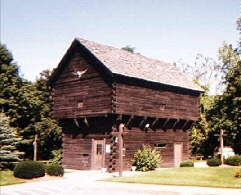
Fort Ann Block House


The British advance guard, consisting of around 200 men, was confronted at the gorge about a mile north of Fort Ann by Colonel Pierce Long's rear guard, which included 150 men reinforced by 400 New York militia under Colonel Henry van Rensselaer. Long and van Rensselaer launched an attack in two columns when the British paused to wait for reinforcements. One column swung east, threatening the British flank and rear, while the other pushed into the defile.

Gunpowder and War Whoops

The British withdrew to higher ground, and after two hours of intense fighting, the Americans broke contact due to a lack of ammunition and the sound of approaching British reinforcements. However, those reinforcements turned out to be a ruse—a single British officer imitating Iroquois war whoops. While a British victory, the action at Fort Ann delayed the progress of the British Saratoga Campaign. 


While the Patriots successfully outnumbered and surrounded the British, they ultimately retreated to Fort Ann and then to Fort Edward after being deceived into thinking that enemy reinforcements were about to encircle them. Nevertheless, the Patriots effectively delayed British movements toward Saratoga and secured an American victory there. 


Fort Edward

A series of forts was built at the "Great Carrying Place," a portage around the falls on the Hudson once used by local Indians before colonial times. Located on the "Great War Path," which was later used by the Iroquois and other tribes, both French and English colonists saw its importance and used it during many wars in the eighteenth century.


Fort Edward and Rogers Island


A French and Indian Fort

During the French and Indian War, General Phineas Lyman built Fort Lyman here in 1755. Sir William Johnson, the British Superintendent for Indian Affairs, renamed it Fort Edward in 1756 to honor Prince Edward, the younger brother of the future King George III. After Fort William Henry was captured by the French, the well-known Major Robert Rogers used it as a base for his Rangers' operations. In 1759, General Jeffrey Amherst's army gathered at Fort Edward for their attack on Fort Carillon and Fort St. Frederic. After the British took the forts, Fort Edward was greatly reduced as the war moved north.


Sir William Johnson


Revolutionary Days

Fort Edward was destroyed by the rebels shortly after the Revolutionary War started. Although it was never used as a defensive structure, its strategic location made it a base for many military officers passing through. The commander of the Continental Army's Northern Department, General Philip Schuyler, used it as his headquarters until the British forced him south on their way to Saratoga in the summer of 1777.


General Phillip Schuyler


Place of Infamy

The most infamous event of the 1777 Saratoga campaign, the case of Jane McCrae, happened near the fort. Jane, the fiancée (or lover) of a Loyalist officer, was captured by an Indian war party while visiting a house close to the fort. Her fiancée sent another Indian war party to negotiate for her release. When it became clear that the fiancée's envoy would not pay a ransom, her captor, a Huron named Wyandott Panther, became enraged. During the argument, he allegedly shot her. Jane's bloody scalp was brought to the British camp, where her fiancée identified it by its bright red hair. The rest of her remains were buried near the fort.


Jane McCrae's tragic death rallied the North


Patriotic Outrage

The Americans exploited the incident to stir up deep-rooted colonial fear and hatred of the Indians. Given the long history of conflict between the tribes, especially the Mohawks, this was fairly easy to do. Soon, hesitant farmers and settlers began to rally to the cause in large numbers. By the time General Burgoyne's Army was north of Albany, the angry rebels outnumbered him two to one.


McCrae's death and fear of the Indians rallied the complacent


Forts of Futility?

It is an axiom that forts are built to fall. A determined and sometimes lucky attacker will always succeed despite the earth, stone, wood, mortar, and sweat invested. The forts of the north were no exception. Despite their strategic positioning, excellent defensive terrain, and large land areas for an attacker to control, they all fell. But does that mean they were a failure? Like minefields, forts are not meant to stop an enemy but to influence his actions by channeling his forces, slowing his advance, and forcing a confrontation. And despite their flaws, the forts of the north, over decades of war and strife, served as formidable targets.

Guns of Ticonderoga


I suggest that anyone interested in the captivating history of the region visit these sites. They are set amidst some of the most stunning scenery in the United States. Today, the mountains and waterways host charming villages, scenic farms, and a variety of activities to enjoy while reflecting on the courage and sacrifice of early Americans, including both Native Americans and colonists.