Followers

Saturday, September 30, 2023

The Last Cantonment

 Travels through History

Earlier this month, I traveled to Kennebunkport, Maine, where I delivered a presentation on intelligence activities during the American War of Independence to the Maine Chapter of the Association of Former Intelligence Officers. On the way back, I visited the Continental Army’s last cantonment site and General Washington’s Headquarters, located in the central Hudson Valley. These modest and scenic locations were the focus of some exciting developments as the eight-year fight for independence entered its final stages.


Army at Dusk

Although British General Charles Cornwallis’s surrender at Yorktown, Virginia, in October 1781 marked the final major battle of the eight-year war, small fights continued as both sides looked for advantages in the peace talks. General George Washington sent part of his army south to support Major General Nathanael Greene’s effort to take back the Carolinas from the British, who stubbornly held onto their coastal forts. Meanwhile, Loyalist groups kept fighting wherever they could.


Yorktown Surrender


The rest of Washington’s Army, about 7,500 men, retreated to New York, where Washington hoped to join forces with the French under General comte de Rochambeau and execute his long-planned attack on New York City. However, like the British, the French now saw their main priority as competing for the islands of the West Indies and soon headed south. Washington set up his Army in the mid-Hudson Valley area, close enough to threaten the British garrison, which controlled New York City, Long Island, and parts of Westchester.


comte de Rochambeau

Without support from the French Army or Navy, his main job was to keep an army as a believable threat to the city — making it just another part of the complex diplomatic struggle happening in Paris. This was easier said than done. The only thing harder to manage than an army at dawn is an army at dusk. Still, if negotiations failed, Washington understood that a credible army would be essential to the country’s survival.

Newburg Headquarters

The central Hudson Valley offered a stunning setting for the Army at dusk. The mighty Hudson (then called The North) River was bordered by steep slopes covered with lush forests, green farmland, and neat orchards. Once the land of native tribes and early Dutch settlers, the area had become Anglicized but still retained much of its original Dutch character. 


The Hasbrouck House

Washington’s headquarters was in the town of Newburgh, about four miles north of the main Army encampment. From April 1782 to August 1783, he established the Continental Army headquarters and his residence in a brown fieldstone mansion owned by the Hasbrouck family. He stayed at the Hasbrouck House longer than at any other of his many homes during the eight-year war. Washington was joined by his staff, personal Life Guard, servants, and occasionally, Martha Washington.


Map of Newburgh and New Windsor


He would oversee the final stages of his war from this spacious home overlooking the Hudson from its western bluffs.

New Windsor Cantonment

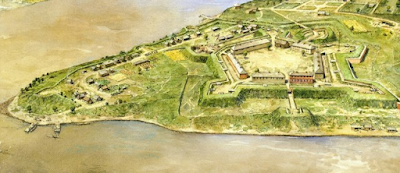
A few miles south, the remaining brigades of the Continental Army gathered in log huts cut from the nearby Catskill Mountains. He had marched them there in October, and by December, the Army’s engineers and carpenters, helped by the infantrymen, built nearly 600 huts, forming a military community — a cantonment. This cantonment, housing 7,500 soldiers along with 500 women and children, was the most densely populated “town” in the colonies and the second largest “city” in New York State.


Cabins served as barracks and unit headquarters


Although not as harsh as the winter at Valley Forge or the Morristown cantonment, the winter quarters still proved difficult. Officers and soldiers spent much of their time gathering enough wood for camp and stove fires, and, as was common during the war, quartermasters struggled to get enough food, blankets, clothing, and other vital supplies. Some senior officers argued over finding suitable quarters.


Most of the Continental Artillery was at West Point

In addition to forces stationed at New Windsor, Washington, mainly his artillery and the Corps of Invalids, further down the Hudson at West Point. A “duty regiment” was also rotated into lower Westchester, where they monitored the British defenses at Kingsbridge (today’s Bronx). The shortage of forage for horses also forced him to disperse most of his cavalry.

The Man Who Would Not Be King

By 1782, years of poor treatment of the Army by the Continental Congress and, more specifically, the states, had led to widespread discontent. One of Washington’s commanders, Colonel Lewis Nicola, decided that action was necessary. Nicola, a Dublin-born French Huguenot, commanded the Corps of Invalids, wounded soldiers who were limited in capability but kept for guard, garrison, and sentry duties.


Washington rejected monarchy


 In a May 1782 letter to the commander-in-chief, Nicola proposed establishing a monarchy similar to Britain’s, suggesting that Washington could be king. He pointed to the grievances of the Army and its officers, indicating that this idea reflected a widely held belief. Washington's response was immediate and stern; he sharply rebuked Nicola in writing for the proposal and for the suggestion that he would abandon a republic to become a king.

Spring of Discontent

At New Windsor, General George Washington put a stop to a conspiracy among his officers. The issue was, once again, pay. The officers were concerned that the half-pay pensions long promised by the Confederation Congress would not materialize. Many understood that once the treaty with Britain was signed, there would be no incentive for the government to keep its promises. 


Officers who led the troops were promised pensions for service


In fact, the Articles of Confederation Congress had no authority to allocate funds for this—it was the responsibility of the states. Alexander Hamilton, now serving in Congress, and his allies were working to resolve the issue. However, many officers had lost patience, and a movement was forming to take action against Congress itself—the so-called Newburgh Conspiracy.


New Windsor cabins and Temple Hill in the background

Informed of this, Washington composed a stirring paean to duty and country over interest and planned to attend a meeting of the officers scheduled at Temple Hill, a long wooden structure used as a meeting hall and community center for the cantonment. 

Temple Hill Gathering

On March 15, 1783, the officers gathered, and Major General Horatio Gates, who was now the camp commandant, began the session. About three hundred officers had planned to attend, which was too many for the building, so they sent representatives who sat in an angry mood. However, Washington entered the room unexpectedly and expressed his desire to speak to the meeting. Gates was forced to yield the chair to the commander-in-chief.


Site of the gathering

As he addressed them, Washington observed their body language. He was not getting through. Too many promises had been made and broken. He decided to read a letter he had received from a Congressman sympathetic to the officers, which explained what was being done. But as Washington fumbled to put on his reading glasses, he paused and apologized, "Gentleman, you must pardon me, for I have not only grown gray but almost blind in service to my country."


Washington addresses the officers

A hush spread through the room as grown men, all seasoned warriors, started to cry. The towering general was like a war god to them—someone who rode across battlefields on his steed and embodied patriotism, sacrifice, and bravery. The atmosphere cleared, and the rebellion and any chance of military dictatorship were stopped before they could grow.

New Governance

When he wasn't busy managing his Army or corresponding with Congress and thirteen stubborn state governments, Washington had time to think about the nation’s future. He wrote letters to the state governors explaining the principles of republican government he would later put into action. 


Corresponding with Congress & the States


New Award

He also took time to reflect on the sacrifice and courage his troops showed during many years of trials and combat. He ordered the creation of what was called the “Badge of Military Merit.” Awarded to three sergeants for their bravery in storming the British redoubt at Yorktown, it was the precursor to what later became the Purple Heart.


Badge of Military Merit


Evening Parade

At the New Windsor Cantonment, Washington issued the cease-fire orders, ending the eight-year War of Independence. 

Head Quarters Newburgh 18 April 1783

The Commander in Chief orders the cessation of Hostilities, between the United States of America, and the King of Great Britain, to be publickly proclaimed, to morrow at the Newbuilding and that the proclamation, which will be communicated therewith, be read tomorrow evening at the Head of every Regiment and Corps of the Army—After which the Chaplains with the several Brigades will render thanks to the Almighty God, for all his mercies, particularly, for his over-ruling the wra[th] of man, to his own glory, and causing the rage of War, to cease amongst the Nations.

With the official end of hostilities, the cantonment became the site for the Continental Army’s “evening parade.” As regiment after regiment began to demobilize while keeping enough force to ensure that the British commander-in-chief, General Guy Carleton, would evacuate New York City at the scheduled time, the shrinking forces eventually moved downriver to near West Point and Verplank's Point. Communication with the British in New York City became vital as the officers who once managed war now had to oversee a return to peace.


Final task - Mustering out the troops


Thursday, August 31, 2023

The White Savage


Frontier Savagery

The sound of frenzied whooping mixed with shrill screams filled the ears of the three frightened boys huddled together for safety. Their hands and feet were bound, leaving them helpless to do anything but stare with eyes stinging from tears. Soon, the crackling of flames began to compete with the savage whoops of the Delaware braves, who grew more excited as the burning fires crept up the figure tied firmly to a pole. Some of the braves shouted what could only be taunts and insults, primarily because the old man remained stiff-lipped as his flesh began to sear and burn, emitting a putrid stench that made the three youths nauseous while exciting the bloodlust of their tormentors. Finally, the fire completely engulfed the old man, whose head slumped as the dark smoke swallowed him.


War parties tortured enemies 
of both  races

One of the boys shouted when the smoke cleared and the fires subsided, revealing a pile of charred wood and bone, "Grandpa!"

"Don't let 'em know you're scared," hissed Simon, the oldest. "Never!"

After this, fourteen-year-old Simon Girty and his two brothers were soon parceled out to different tribes as hostages. This was a typical sequence of events for families who settled along the American frontier, which was Indian territory.


Frontier Family

Simon Girty was born in 1741 in Chambers Mill, Pennsylvania, a small hamlet near Harrisburg in the heart of the colony. His Scots-Irish family later moved to Sherman's Creek, about thirty-five miles to the northwest. In 1751, Girty lost his father, who was killed in a liquor-fueled duel. Girty's grandfather raised the boys. Girty and his brothers grew up illiterate but tough, as the family lived on the edge of civilization.


Backwoods Homestead

The West Aflame

In 1754, war reached Pennsylvania as France and England fought one last time to control North America. Along the frontier, groups of Indians and their French allies raided farms and settlements, causing a wave of terror.


French and Indians Attack

In 1756, the Girty family and many others, afraid of falling prey to the tomahawk, fled to the safety of Fort Granville, a small stockade about fifty miles northwest of Harrisburg. A mixed force of French troops and Native Americans, mainly Lenape warriors, attacked on August 2. The garrison quickly surrendered; the fort was destroyed, and the Girtys and other settlers were taken captive. But before they were forced to move off to live with new masters, they had to watch as their grandfather was burned at the stake.

Indian Life

Simon was captured by the Delaware tribe but was later handed over to a band of Seneca, who marched him to the Ohio Territory, where they "adopted" the young man into the Seneca nation. As was often the case with white captives, Girty quickly adjusted to life among the native tribes, learning their language and customs. He soon began to learn Iroquois and the subtleties of tribal life and warfare.


Braves preparing for a hunt


Frontier Freedom

Girty was finally released at Fort Pitt in 1759. By then, he had become fluent in the Seneca and Iroquois languages and was well-versed in all aspects of tribal life. And, most importantly, Indian warfare — a Seneca in all but skin color.


Simon Girty as Scout

Girty returned to live with his mother and worked as a struggling farmer. He also served as an interpreter for fur traders dealing with the Delaware Indians in western Pennsylvania. The British authorities valued his skills and enlisted him to negotiate treaties with various tribes along the frontier.


Girty served in Lord Dunmore's War

During Lord Dunmore's War against the Shawnee Nation in 1774, Girty became a skilled frontier scout. There, he befriended Simon Kenton, a well-known frontiersman.


War for Independence

When war broke out between Britain and her American colonies in 1775, Simon supported the patriot cause. General James Wood sent him back to the Ohio Territory, where he helped with American negotiations with the Shawnee, Seneca, the Delaware, and the Wyandot.


Girty Armed for War

Troublemaker

Girty struggled with military discipline, often finding himself in trouble with the officers in charge. This issue reached a peak in September 1777, when he was arrested and accused of treason, as he was suspected of helping to plot the seizure of Fort Pitt. 


Fort Pitt

Local Loyalists plotted to kill the occupants of Fort Pitt before surrendering it to the British. Girty was acquitted, but the experience left him bitter, and he switched his allegiance back to the crown. In March 1778, the frontiersman Girty, along with his brothers James and George, quietly slipped out of the fort and traveled to Detroit, the main British base in the northwest.


Indian Department

There, British Lieutenant Governor Henry Hamilton recognized the need for Girty's skills as a linguist and frontiersman and ordered him to join the Indian Department, where he quickly gained notoriety across the northwest frontier.


Lieutenant Governor Henry Hamilton


Backwoods Pirate

From that time until the war ended in 1783, Simon Girty attacked the Americans. His cultural and language skills helped him recruit many native tribes to the British side and also kept them from supporting the Americans. He led or directed raids, ambushes, robberies, and outright massacres, becoming the terror of the West. Frightened settlers started calling him The White Savage or The Great Renegade.


Frontier Terror


First Blood

His true entry into chaos began in 1779 when Girty, leading mixed groups of Loyalists and Indians, carried out several attacks that left the patriots shaken. He unleashed Indian war bands around Fort Laurens, Ohio, where they massacred multiple patriot units. His October 4, 1779, ambush of an American column led by Colonel David Rogers was a brilliant strike against the cause, resulting in fifty-seven militiamen dead and the capture of 600,000 Spanish dollars.


Ambush

In 1780, Girty helped British Captain Henry Bird lead a major attack against American settlements in Kentucky. The mission led to the capture of two forts and over 300 hostages, including his former friend Simon Kenton, whose release he arranged.


Taking Hostages

He also arranged to move the pre-patriot Moravian missionaries, David Zeisberger and John Heckewelder, along with their native parishioners, to the distant reaches of the Upper Sandusky River. This allowed the British to better monitor their activities. It's not the last time the British would relocate civilians for tighter control — the Boer War comes to mind.


The Great Renegade

By this point, the Americans had branded Girty a turncoat — offering a reward of 800 dollars for him, dead or alive. The incendiary Girty even succeeded in angering arguably the most prominent Loyalist, Iroquois war chief Joseph Brant, by confronting him when Brant was bragging. The equally fiery Brant slashed Girty across the face with his saber, leaving a wicked Al Capone-like scar. Ironically, the mutilation gave Girty much prestige among the braves.


Chief Joseph Brant

Campaign of Infamy

In June 1782, Captain William Caldwell and Simon Girty led a force of 400 warriors from the Wyandot, Lenape, and Shawnee tribes, along with a detachment of Butler's Rangers, against a group of 500 volunteers commanded by Colonel William Crawford. They stopped the American push aimed at destroying Indian settlements on the Sandusky River. Then they surrounded Crawford's force, which retreated in a disorganized panic. 


Torture and Death of Colonel Crawford

They captured many prisoners, including Crawford, who endured brutal torture for days before being burned at the stake. Like his grandfather, Girty was said to have stood by without intervening, gaining lasting infamy among Americans on the frontier. However, some accounts say he was threatened with his own scalping if he interfered.

Kentucky Killing

Caldwell, Girty, and the mixed band brought chaos into Kentucky, launching brutal attacks on many defenseless farms and small villages. This campaign of terror reached its peak after their failed siege of Bryan's Station on August 15. When he learned of an approaching relief force, Girty and his band decided to use a trick. As the column drew near, they pretended to retreat.


Siege of Bryan's Station

Girty positioned several of his braves along the bluffs overlooking the Blue Licks River. He kept them in plain sight, aiming to lure the Kentuckians into a kill zone. Caldwell placed most of the rangers and warriors in ravines and behind boulders. The trap was set.


Battle of Blue Licks

One of the column's leaders, renowned frontiersman Daniel Boone, suspected a trap and warned for caution, but the column's commander, Major Hugh McGary, hurried his men straight across the stream. Boone said, "They'd all be slaughtered," but took his command to the right of McGary's line, which then moved right into a deadly ambush.


Blue Licks marker


The Kentuckians moved up the bluffs in a skirmish line, but once they reached the heights, Girty's men opened fire at close range with devastating effect. The relief force was sent reeling back, leaving seventy dead on the field, including Daniel Boone's son. Caldwell and Girty's party then withdrew to Detroit. These hit-and-run tactics kept the northwest frontier ablaze throughout the Revolutionary War and beyond.

No Post-War Pause

The Treaty of Paris did not reduce the tension between the northwest tribes and the ever-expanding American settlements that started to cross the frontier. Girty also played a part. For the next ten years, he was a relentless supporter of war against the Americans at tribal councils. Was it driven by his deep hatred for his former countrymen, revenge for past wrongs, or simply because he was an agent of British policy? We may never know. But it was probably all of those things.


Girty took part in tribal councils

War Drums Along the Miami

By 1791, the tribes of the Ohio country had unified into a federation that vowed to fight the American threat to their lands or die trying. The gathered warriors had all the traditional cunning, skill, and bravery of their ancestors but also had British training and weapons that made them a much stronger force than any of the Western tribes that gained fame in the next century. Still, many leaders decided to settle with the new government, but American raids and the killing of Chief Little Turtle's daughter pushed the tribes into war.


An Army's Destruction

Simon Girty was with Chief Little Turtle of the Miami and his war party when they defeated an American Army led by Revolutionary War heroes General Arthur St. Clair and Richard Butler at the Battle of the Wabash. The northwest was vulnerable to the war bands. Enraged, President Washington ordered the formation of a new army, called the American Legion, and placed it under the command of a war hero from eastern Pennsylvania, General Anthony Wayne.


Battle of the Wabash

Fallen Timbers

Simon Girty marched to confront this new army alongside War Chief Blue Jacket and his Shawnee, Ottawa, and various other tribes. In August 1794, Blue Jacket and Girty faced off against Wayne's American Legion and General Charles Scott's Kentucky Militia at Fallen Timbers. In the brief but decisive battle of Fallen Timbers, Anthony Wayne defeated Blue Jacket's coalition, and the tribes ultimately sued for peace — a bitter pill for a noble people.


Anthony Wayne at Fallen Timbers

Escape North

The British finally evacuated Detroit in 1795. The long-standing Great Lakes bases used for operations against the new American government were handed over to the Americans by the Jay Treaty. Still a wanted man, Girty had to move north to safety in Canada and worked for the British Indian Department in Amherstburg, Ontario. The elderly Girty, now nearing depression and struggling with alcoholism, had to flee the town when the Americans invaded in 1813. He returned after the Americans withdrew and lived there until his death on February 18, 1818.


Pantheon of Savagery

What can we understand from this controversial frontiersman? For one, he had many companions in the pantheon of savagery, from all backgrounds and sides. Besides the well-known battles on the Atlantic coast, the American War for Independence was both a civil war and a clash of cultures. The hundreds of raids, ambushes, and small skirmishes were much more brutal than the European-style battles in the east. Simon Girty represents the many men on both sides who used savagery as a weapon of war. Sadly, this pantheon continues to grow with new members to this day.


The Pantheon in 1836 by Jakob Alt


Saturday, July 29, 2023

Clan Mother

The Clandestine Challenge

The difficulty with any espionage study is the lack of unclassified sources — since clandestine work must remain secret by nature. This is especially true when looking back to the time of the Yankee Doodle spies, when nearly all espionage activity was "off the books," with few reports or records kept. Spies operated in all theaters throughout the war, but identifying who they were and what they did is difficult, requiring lots of "fill in the blank" and connect-the-dots analysis.


Spying on the Spies

Savage War of Peace

The American Revolution in the Mohawk Valley involved years of internecine conflict and small-scale combat that often reached a fever pitch. Patriot Whigs and Loyalist Tories went head to head in battles ranging from a few dozen to a few hundred fighters, rarely involving large-scale clashes with thousands. Add six Iroquois tribes, Canadians, Continentals, and British regulars into the mix, and you get a stew of conflict and chaos. But unlike many other areas of the war, the central New York region was never quiet. Instead, a relentless savage war of peace raged on. 


The Mohawk Valley


The role of the native tribes added an objective layer of complexity to the struggle in New York. The powerful Iroquois Confederacy was mostly aligned with the British, thanks to the outstanding efforts of the Crown's Indian Agent, Sir William Johnson, and his son. 


Sir William Johnson

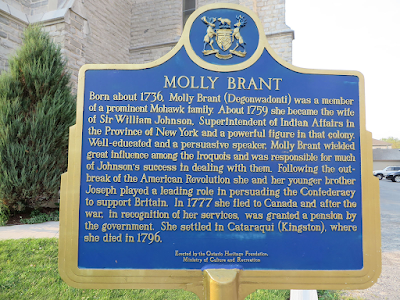
Of the Iroquois nations, the most powerful, warlike, and pro-British were the Mohawks, who controlled the easternmost part of the territory. Our subject is one of those Mohawks, a woman born Konwatsi'tsiaiénni, but now known as Mary or Molly Brant, older sister to Joseph Brant, who became a Mohawk War Chief and British officer during the war for independence. 

Youth in Two Worlds

Molly Brant was born around 1736 in the Ohio Valley, although her family's ancestral home was the village of Canajoharie, on the upper Mohawk near Little Falls, New York. Her parents were Margaret (Onagsakearat) and Peter (Tehowaghwengaraghkwin), who were Anglicans. When Peter died while the family lived on the Ohio River, Molly's mother returned to Canajoharie with her and her brother Joseph.


Iroquois Village

Both Brant children grew up in two worlds, becoming fluent in English and comfortable with English culture. Molly was educated in the Mohawk Valley, and because she spoke English well, she accompanied twelve Mohawk tribal elders on a delegation to Philadelphia in 1755. After that trip, Molly met the most powerful man in these two worlds, the renowned British Indian Agent Sir William Johnson — her beauty and grace deeply affected him. Johnson handled all the deals involving the tribes and was known to be an honest broker who cared for both the Iroquois and the white settlers in central New York. He was also quite wealthy.

Lady of the Manor

By 1759, the twenty-three-year-old Molly was officially listed in Johnson's records as his "housekeeper," but she was, in fact, his common-law wife—possibly married under Iroquois customs. She would have seven children with him and served in all respects as the powerful Johnson's partner. 


Molly Brant was the Lady of Johnson Hall

Anglo visitors who visited Johnson's estate, Johnson Hall, remarked on her beauty, delicate features, olive skin, excellent manners, and understated but commanding presence. In all but name, Brant was the Lady of the  Johnson Hall estate.

The Clan Mother

During her time with Johnson, she also rose to become a Clan Mother, receiving the Mohawk name Tekonwatonti (Many Opposed to One). Molly led a society of Six Nations (Iroquois Confederacy) matrons. In the matriarchal hierarchy of the Iroquois, Clan Mothers held great power and influence, traditionally choosing and dismissing leaders. They also had the authority to veto their decisions.


Clan Mothers wielded significant influence

Sir William died the year before Lexington and Concord erupted and plunged the colonies into open war with the Crown. 

Loyal to the Crown

Molly Brant and her brother Joseph remained loyalists, dedicated to the British cause. Joseph became a well-known Loyalist commander and Mohawk War Chief whose actions frustrated the patriots. 


Chief Joseph Brant

His sister's role was more ambiguous but equally important. She provided food and ammunition to nearby Loyalist units. Most importantly, she passed valuable intelligence to her brother and other Loyalist and British leaders in central New York. 

Spymaster

Although there's little recorded about this (for reasons mentioned above), she probably heard reports on American movements in the Mohawk Valley from travelers, hunters, and traders passing through her village.


Molly Brant: Mother Clan, Mother.Spy

The best example of this occurred in August 1777. British Lieutenant-Colonel Barry St. Leger's force, composed of British troops, Loyalists, Canadians, and Indians, had besieged the American garrison at Fort Stanwix (located in today5s Rome, NY). When the Tryon County militia learned of the siege, a brigade-sized force marched west along the river to relieve the post.


Battle of Oriskany

When Molly learned of their movement, she sent word to St. Leger, who dispatched a force of Loyalists and Indian allies that set a well-planned ambush in the dense cypress forests near Oriskany. The relief column was pushed back with heavy losses, and its commander, Colonel Nikolas Herkimer, was mortally wounded.


Fort Stanwix

In retaliation, the American-Allied Oneidas attacked her village of Canajoharie, destroying it and nearby Fort Hunter. 

On the Road

Molly moved her family through various Loyal Iroquois villages. Brant and her family lost most of their belongings. They sought refuge at Onondaga near Syracuse, New York, the capital of the Six Nations Confederacy, first going to Syracuse, then Cayuga, and finally Niagara.


Iroquois Village along the Mohawk River

At each of these, she proved to be a strong and effective supporter of the Loyalist cause, helping to keep most of the Iroquois aligned with the British. As a result, the British were able to use the Iroquois war bands to strengthen their diminishing Loyalist and British forces in New York.


Iroquois War Band

Resilient Leader

As the war continued in New York, the British and their Indian allies were gradually pushed westward. The British asked Molly Brant to help lead the thousands of starving refugees fleeing the Americans to the safety of Fort Niagara — the last stronghold in the area. She proved to be a capable leader, organizer, and spokesperson for the tribes. Her influence and power grew among both the tribes and the British authorities.


Fort Niagra: last bastion of British 
power in New York

One British officer remarked that her influence on the tribes was such that "their uncommon good behaviour in great measure to be ascribed to Miss Molly Brant's influence over them, which [was] far superior to that of all their Chiefs put together."

A Separate Peace

But when the Treaty of Paris was signed, the rug was pulled out from under the Iroquois and Loyalists in New York. The British made little effort to protect their ancestral lands, leaving the Iroquois to face their enemies alone — and it did not go well. Many of the Iroquois and all the Loyalists fled to Canada. 


Treaty of Paris signing

A Bitter Nation

The Iroquois who stayed behind became bitter toward Molly and her British masters. Molly left the home the British built for her on Carleton Island, as it was now on the American side of the border. The Clan Mother moved to a village called Cataraqui and, with other Loyalists, founded what later became Kingston, Ontario.

A Grateful Crown

The grateful British awarded her land and a pension large enough to turn down the Americans' offers to return to New York. They recognized her leadership's importance. But she was dismissive of the people who had destroyed the Iroquois lands during eight years of bloody warfare.

Founding Canadian

Molly Brant's family became well-known in Upper Canada. Five of her six daughters married Canadian men. George, her surviving son, got a position in the Indian department. Her older son died fighting for the British. 


At age sixty, the Clan Mother died in Brantford, Ontario, in 1796. Her exact burial site is unknown, but many believe the good, lifelong Anglican rests somewhere beneath St. Paul's Church in today's Kingston, Ontario, Canada. Her legacy is that of a remarkable woman who cared for her family, clan, tribe, and nation in both peace and war.


St. Paul's Church and Burial Ground