Followers

Showing posts with label Newburgh. Show all posts

Saturday, September 30, 2023

The Last Cantonment

 Travels through History

Earlier this month, I traveled to Kennebunkport, Maine, where I delivered a presentation on intelligence activities during the American War of Independence to the Maine Chapter of the Association of Former Intelligence Officers. On the way back, I visited the Continental Army’s last cantonment site and General Washington’s Headquarters, located in the central Hudson Valley. These modest and scenic locations were the focus of some exciting developments as the eight-year fight for independence entered its final stages.


Army at Dusk

Although British General Charles Cornwallis’s surrender at Yorktown, Virginia, in October 1781 marked the final major battle of the eight-year war, small fights continued as both sides looked for advantages in the peace talks. General George Washington sent part of his army south to support Major General Nathanael Greene’s effort to take back the Carolinas from the British, who stubbornly held onto their coastal forts. Meanwhile, Loyalist groups kept fighting wherever they could.


Yorktown Surrender


The rest of Washington’s Army, about 7,500 men, retreated to New York, where Washington hoped to join forces with the French under General comte de Rochambeau and execute his long-planned attack on New York City. However, like the British, the French now saw their main priority as competing for the islands of the West Indies and soon headed south. Washington set up his Army in the mid-Hudson Valley area, close enough to threaten the British garrison, which controlled New York City, Long Island, and parts of Westchester.


comte de Rochambeau

Without support from the French Army or Navy, his main job was to keep an army as a believable threat to the city — making it just another part of the complex diplomatic struggle happening in Paris. This was easier said than done. The only thing harder to manage than an army at dawn is an army at dusk. Still, if negotiations failed, Washington understood that a credible army would be essential to the country’s survival.

Newburg Headquarters

The central Hudson Valley offered a stunning setting for the Army at dusk. The mighty Hudson (then called The North) River was bordered by steep slopes covered with lush forests, green farmland, and neat orchards. Once the land of native tribes and early Dutch settlers, the area had become Anglicized but still retained much of its original Dutch character. 


The Hasbrouck House

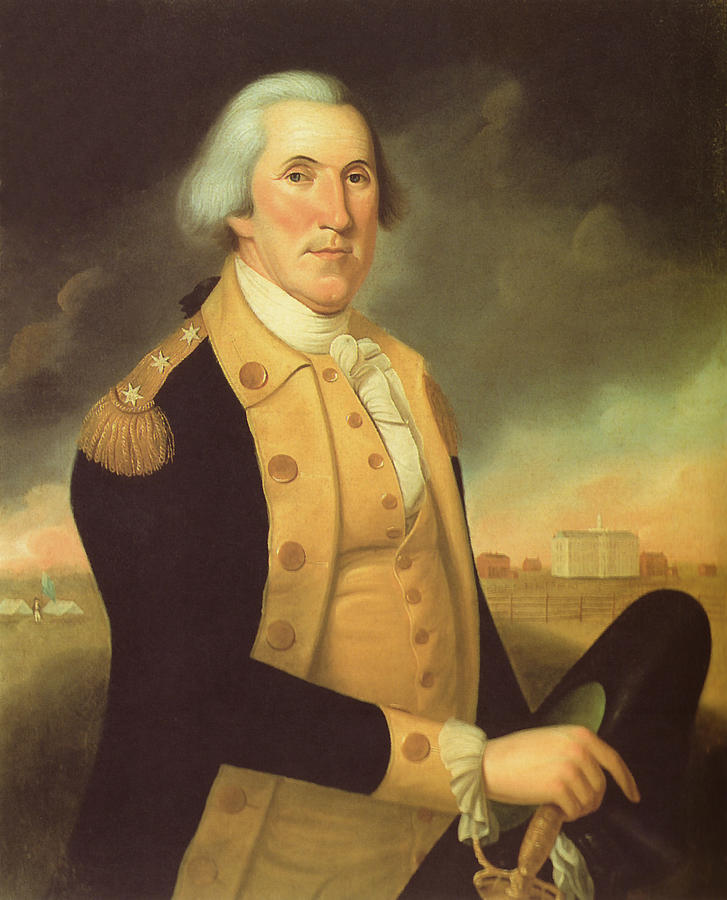
Washington’s headquarters was in the town of Newburgh, about four miles north of the main Army encampment. From April 1782 to August 1783, he established the Continental Army headquarters and his residence in a brown fieldstone mansion owned by the Hasbrouck family. He stayed at the Hasbrouck House longer than at any other of his many homes during the eight-year war. Washington was joined by his staff, personal Life Guard, servants, and occasionally, Martha Washington.


Map of Newburgh and New Windsor


He would oversee the final stages of his war from this spacious home overlooking the Hudson from its western bluffs.

New Windsor Cantonment

A few miles south, the remaining brigades of the Continental Army gathered in log huts cut from the nearby Catskill Mountains. He had marched them there in October, and by December, the Army’s engineers and carpenters, helped by the infantrymen, built nearly 600 huts, forming a military community — a cantonment. This cantonment, housing 7,500 soldiers along with 500 women and children, was the most densely populated “town” in the colonies and the second largest “city” in New York State.


Cabins served as barracks and unit headquarters


Although not as harsh as the winter at Valley Forge or the Morristown cantonment, the winter quarters still proved difficult. Officers and soldiers spent much of their time gathering enough wood for camp and stove fires, and, as was common during the war, quartermasters struggled to get enough food, blankets, clothing, and other vital supplies. Some senior officers argued over finding suitable quarters.


Most of the Continental Artillery was at West Point

In addition to forces stationed at New Windsor, Washington, mainly his artillery and the Corps of Invalids, further down the Hudson at West Point. A “duty regiment” was also rotated into lower Westchester, where they monitored the British defenses at Kingsbridge (today’s Bronx). The shortage of forage for horses also forced him to disperse most of his cavalry.

The Man Who Would Not Be King

By 1782, years of poor treatment of the Army by the Continental Congress and, more specifically, the states, had led to widespread discontent. One of Washington’s commanders, Colonel Lewis Nicola, decided that action was necessary. Nicola, a Dublin-born French Huguenot, commanded the Corps of Invalids, wounded soldiers who were limited in capability but kept for guard, garrison, and sentry duties.


Washington rejected monarchy


 In a May 1782 letter to the commander-in-chief, Nicola proposed establishing a monarchy similar to Britain’s, suggesting that Washington could be king. He pointed to the grievances of the Army and its officers, indicating that this idea reflected a widely held belief. Washington's response was immediate and stern; he sharply rebuked Nicola in writing for the proposal and for the suggestion that he would abandon a republic to become a king.

Spring of Discontent

At New Windsor, General George Washington put a stop to a conspiracy among his officers. The issue was, once again, pay. The officers were concerned that the half-pay pensions long promised by the Confederation Congress would not materialize. Many understood that once the treaty with Britain was signed, there would be no incentive for the government to keep its promises. 


Officers who led the troops were promised pensions for service


In fact, the Articles of Confederation Congress had no authority to allocate funds for this—it was the responsibility of the states. Alexander Hamilton, now serving in Congress, and his allies were working to resolve the issue. However, many officers had lost patience, and a movement was forming to take action against Congress itself—the so-called Newburgh Conspiracy.


New Windsor cabins and Temple Hill in the background

Informed of this, Washington composed a stirring paean to duty and country over interest and planned to attend a meeting of the officers scheduled at Temple Hill, a long wooden structure used as a meeting hall and community center for the cantonment. 

Temple Hill Gathering

On March 15, 1783, the officers gathered, and Major General Horatio Gates, who was now the camp commandant, began the session. About three hundred officers had planned to attend, which was too many for the building, so they sent representatives who sat in an angry mood. However, Washington entered the room unexpectedly and expressed his desire to speak to the meeting. Gates was forced to yield the chair to the commander-in-chief.


Site of the gathering

As he addressed them, Washington observed their body language. He was not getting through. Too many promises had been made and broken. He decided to read a letter he had received from a Congressman sympathetic to the officers, which explained what was being done. But as Washington fumbled to put on his reading glasses, he paused and apologized, "Gentleman, you must pardon me, for I have not only grown gray but almost blind in service to my country."


Washington addresses the officers

A hush spread through the room as grown men, all seasoned warriors, started to cry. The towering general was like a war god to them—someone who rode across battlefields on his steed and embodied patriotism, sacrifice, and bravery. The atmosphere cleared, and the rebellion and any chance of military dictatorship were stopped before they could grow.

New Governance

When he wasn't busy managing his Army or corresponding with Congress and thirteen stubborn state governments, Washington had time to think about the nation’s future. He wrote letters to the state governors explaining the principles of republican government he would later put into action. 


Corresponding with Congress & the States


New Award

He also took time to reflect on the sacrifice and courage his troops showed during many years of trials and combat. He ordered the creation of what was called the “Badge of Military Merit.” Awarded to three sergeants for their bravery in storming the British redoubt at Yorktown, it was the precursor to what later became the Purple Heart.


Badge of Military Merit


Evening Parade

At the New Windsor Cantonment, Washington issued the cease-fire orders, ending the eight-year War of Independence. 

Head Quarters Newburgh 18 April 1783

The Commander in Chief orders the cessation of Hostilities, between the United States of America, and the King of Great Britain, to be publickly proclaimed, to morrow at the Newbuilding and that the proclamation, which will be communicated therewith, be read tomorrow evening at the Head of every Regiment and Corps of the Army—After which the Chaplains with the several Brigades will render thanks to the Almighty God, for all his mercies, particularly, for his over-ruling the wra[th] of man, to his own glory, and causing the rage of War, to cease amongst the Nations.

With the official end of hostilities, the cantonment became the site for the Continental Army’s “evening parade.” As regiment after regiment began to demobilize while keeping enough force to ensure that the British commander-in-chief, General Guy Carleton, would evacuate New York City at the scheduled time, the shrinking forces eventually moved downriver to near West Point and Verplank's Point. Communication with the British in New York City became vital as the officers who once managed war now had to oversee a return to peace.


Final task - Mustering out the troops


Sunday, May 21, 2017

Rev War Talk: Veterans & Leaders


Dick Winter's Memorial at Veteran's Plaza in Ephrata. Pennsylvania


The Lecture


As part of their ongoing Veteran's Lecture Series, the Winters Leadership Memorial Committee invited me to speak on the American Revolution, the Yankee Doodle Spies, and related topics. The committee sponsors one such talk each month, typically the last Tuesday. The talk will encompass an overview of the eight-year struggle for independence plus a series of cameos on various aspects of the war such as intelligence, maritime, geography, etc. It will take place in the library at Ephrata, Pennsylvania. The Lecture Series itself began back in 2014 as a way to continue the effort we started with the construction of Ephrata’s Veterans Plaza & installation of the Winters Leadership Memorial. The driving purpose behind building the Veterans Plaza was to honor all veterans from all wars. One of the plaques in the plaza says it best, “They are not dead who live in the hearts they leave behind.”


The Man


The Winters Leadership Memorial is named after Major Dick Winters, legendary WWII commander of Easy Company of the 101st Airborne (Screaming Eagles) commemorated in the book and television mini-series: Band of Brothers. Winters grew up in and around Ephrata, in central Pennsylvania, where he eventually returned.

Winters was immortalized in the book and HBO series, "Band of Brothers"

The Memorials


In June of 2012,  a statue was installed at Utah Beach in Normandy.  It was created in Richard D. Winters' likeness, designed to honor all leaders, especially those of the Junior Officer’s.  Winters felt that the leadership and decision making of these young and inexperienced men was critical to the success of the D-Day invasion and other critical WWII battles. The artist who created the Winters Statue also offered the community of Ephrata the opportunity to erect a reproduction of the Normandy statue.  A committee was formed,  and the group set out to raise the funds required to acquire the statue, build the Veterans’ Plaza it would rest in, and maintain the site. In May 2015  the statue was dedicated at the plaza.


Actor Damian Lewis, who portrayed Dick Winters in the HBO series,
speaks with 101st vet during the commemoration of the Winters Memorial
  in Normandy, France


America's Veterans Issues & the Revolutionary War


So what does all of this have to do with the Rev War? Well, everything as it turns out. Issues regarding veterans commenced even as the American War for Independence was in its waning years. Soldiers released from services often failed to receive compensation promised by the states and Congress, little as that was. There were several "affairs" sometimes even mutinies over lack of compensation, food and clothing.


Newburgh Conspiracy


One of the most famous was the Newburgh Conspiracy, a rebellion of Continental Army officers in March 1783 that was nipped in the bud by George Washington himself. Washington personally confronted the conspirators, who planned to march on Congress and overthrow the fledgling confederation government. In 1780, Congress had passed a resolution providing half-pay for retired soldiers. But as late as  1783 the states (who had the power of the purse) had yet to comply with Congress’s request for money. The British Army was still quite ensconced in North America - the last troops would not leave until very late in the year. So the action of these conspirators could have resulted in stamping out the new nation before it could be established.


Continental Army at New Windsor Cantonment


How did it happen? As the conspirators gathered at an assembly hall/chapel  (the Temple Building) at Newburgh's  New Windsor Cantonment, to the surprise of all, Washington suddenly appeared before the assembly. The group had an inflammatory ultimatum penned by Major Armstrong, a former aide to cashiered General Horatio Gates (no friend of Washington). Washington denounced Armstrong and the ultimatum in very strong (for the 18th Century) terms.


The Temple Building - chapel where the officers gathered and Washington
confronted the conspiracy

The commander in chief remarked of the ultimatum, "...something so shocking in it, that humanity revolts at the idea." Taking the pulse of the audience he went on, "My God! What can this writer have in view, by recommending such measures! Can he be a friend to the army? Can he be a friend to this country? Rather is he not an insidious foe?" He also asked that they, "Give one more distinguished proof of unexampled patriotism and patient virtue." He asked for their, "full confidence in the purity of the intentions of Congress."


Washington's Headquarters at Newburgh


In closing, Washington attempted to read a letter he recently received from Joseph Jones, a Congressman from Virginia. The letter was to assure the commander in chief of (some in) Congress's assurance that the needs of the soldiers would receive a full measure of support. But Washington’s vision had recently begun to fail. He struggled with the opening paragraph. Frustrated Washington retrieved a pair of glasses from his pocket.  Then, the usually formal and stiff Washington made a rare casual remark. "Gentleman, you must pardon me, for I have not only grown gray but almost blind in service to my country."

This spontaneous act of demonstrating his humanity, from a man almost all held as next to God, had the immediate effect of taking the air out of the sails of mutiny and rebellion. Many officers began to weep. Possibly the greatest threat to the American Revolution and the new nation had evaporated due to the heartfelt and humble words of Washington. Sadly, veterans have had to fight for their rights from that day forward. Sometimes things did not end as peacefully and quickly as that March day in the Hudson Valley.


Washington did as much in saving The Cause with
his talk as in all the battles he fought


Saturday, April 16, 2016

The Nicola Affair

One of the little-known but crucial events of the American War for Independence happened as the conflict seemed to be coming to an end. This post discusses the man who would fight a king but also make a king - Louis Nicola.


Early Life - Soldier and Civil Servant of the King


Lewis Nicola was born in Dublin, Ireland, in 1717, as the son of a British army officer and the grandson of Huguenot refugees. Although little is known about his upbringing, Nicola’s family apparently gave him a solid secondary education. Like many Irish, he joined the British army and spent nearly thirty years fighting for his king. His family purchased him a commission as an ensign in the British army in January 1740. He married his first wife, Christiana Doyle, on September 19 of that year. During the early 1740s, Nicola was stationed in various Irish cities, including Galway, MannorHamilton, Londonderry, Dublin, and Cork. After a brief tour of duty in Flanders during the intense fighting in the spring and summer of 1745, Nicola returned to Ireland, joining the garrison at Charles Fort near Kinsale, and eventually earning a promotion to the rank of fort major in early September 1755. For the twenty-one years following his return to Ireland in 1745, Kinsale was his home. He became involved in civic service and developed an interest in scientific inquiry. Nicola married his second wife, Jane Bishop, on April 18, 1760, eight months after the death of Christiana Nicola.


Nicola served in Flanders in 1745 


An Immigrant to the New World


When he did not receive a expected inheritance, Nicola moved to America in 1766, settling in Philadelphia and opening a dry goods store on Second Street. Not content to be just a shopkeeper, Nicola became a prominent figure in the growing world of publishing. In 1767, he established a library, and by December 1769, he moved it to Spruce Street in the more fashionable Society Hill. He renamed his establishment the “General Circulating Library.” A believer in the broad enlightenment of the people, Nicola continued to publish several magazines focused on scientific information and inquiry. Nicola also helped establish the American Philosophical Society in 1769 and became the publisher of its annual report, Transactions.


Nicola temporarily relocated his family to Easton, where he also held public roles, and in 1774, he was appointed Justice of the Peace in Northampton County (essentially the county judge). As tensions with Great Britain increased and conflict appeared unavoidable, he returned to Philadelphia and resumed his focus on military affairs. Leveraging his experience in the British Army, he published A Treatise of Military Exerciser, Calculated for the Use of the Americans, in 1776, which was a very timely publication. This work, created at the request of the colonels of the five battalions of Pennsylvania militia from Philadelphia, aimed to include “every Thing that is supposed can be of Use to” the colonists and exclude “such Manoevres, as are only for Shew and Parade.”


Nicola's Invalid Corps garrisoned Trenton
Nicola was fluent in French and translated several French military texts. In 1776, Nicola was appointed Barracks Master of Philadelphia and commander of the city guards. During the British occupation of Philadelphia, Nicola published a map for use if the Americans moved against his adopted town. His experience leading old men and boys as commander in Philadelphia led him to ask Congress to consider an idea he had for better garrisoning—using wounded veterans. 

On June 20, 1777, the Continental Congress, recognizing the validity of Nicola’s arguments, established an Invalid Corps consisting of eight companies and nearly one thousand men, “to be employed in garrisons, and for guards in cities and other places, where magazines or arsenals, or hospitals are placed; as also to serve as a military school for young gentlemen, prior to their being appointed to marching and other military arts." Essentially, this marked the beginning of a rudimentary military academy. 

Nicola was appointed Colonel in the Continental Army and commander of the Invalid Corps. Nicola and the Invalid Corps performed many valuable services during the American Revolution. For most of the war, the corps was stationed in Philadelphia. When General William Howe’s British army advanced toward the American capital in the fall of 1777, Nicola moved his family and the Invalid Corps elsewhere. They relocated to Bristol, then Fort Mifflin, and finally to Trenton. Nicola planned several operations against British outposts, but once both sides settled into winter quarters, the corps was redeployed to Easton and Bethlehem, Pennsylvania, to guard hospitals and military stores in those towns. 

Like the rest of the Continental Army, the Invalid Corps faced great hardships during the winter of 1777–78. After a brief stay at Valley Forge in spring 1778, the Invalid Corps returned to Philadelphia on June 19, just after the British withdrew from the city. Over the next three years, the corps was mainly stationed in Philadelphia, with a period in Boston. Besides garrison duties, Nicola directed the corps to interrogate prisoners and deserters and sent intelligence reports to Washington. The intellectually active Nicola also proposed several schemes to Congress, including forming a partisan force, implementing new army regulations, and using the Invalids in recruiting.


The Invalid Corps garrisoned Fort Mifflin


The Nicola Letter


On June 13, 1781, in response to Washington’s request of May 27, Congress authorized the concentration of the corps at West Point, New York. The Invalids spent much of their time at West Point's outposts, such as Fishkill. Nicola faced many challenges regarding pay and feeding his men. He successfully defended himself against a court-martial based on charges from a discontented captain. The poor quality of the invalids and a shortage of officers and men only worsened his situation. He had to deal with numerous cases of misconduct.

Nicola himself faced financial difficulties throughout the war and, like many other officers, was unhappy with Congress's treatment of officers and men concerning supply, rations, and pay. Widespread disgruntlement simmered even as the new nation approached independence. With all of his experiences—both good and bad—since joining the Continental Army, Nicola, ever a man of letters and ideas, wrote a letter to Washington on May 22, 1782, from Fishkill, New York, outlining his grievances over the army’s poor treatment by Congress.

Nicola wrote:

                    "...From several conversations, I have had with officers, & some I have
                    overheard among soldiers, I believe it is generally intended not to separate
                    after the peace ’till all grievances are redressed, engagements &
                    promises fulfilled . . . God forbid we should ever think of involving
                    that country we have, under your conduct & auspices, rescued from
                    oppression, into a new scene of blood & confusion; but it cannot be
                    expected we should forego claims on which our future subsistence &
                    that of our families depend." 

Washington was well aware of all this, but Nicola's second theme stunned and angered him. Nicola stated bluntly that, unlike many of his American contemporaries, he was not a “violent admirer of a republican form of government.” He then discussed the histories of earlier republics like Venice, Genoa, and Holland, explaining why “their lustre” had “been of short duration.” This, in Nicola’s view, also applied to the United States. None of these had been able to govern themselves effectively. Regarding the Continental Congress, Nicola asked, “has it not evidently appeared that during the course of this war we have never been able to draw forth all the internal resources we are possessed of, and oppose or attack the enemy with our real vigour?”


Mount Guillian - near Fishkill


Nicola went on to argue for a limited constitutional monarchy similar to Britain's. That caused a strong reaction from Washington. The tone of Washington's reply to Nicola that same day shows he not only disapproved of Nicola’s “scheme” but was also deeply offended by it. 

After expressing his “great surprise & astonishment,” Washington wrote that “no occurrence in the course of the war, has given me more painful sensations than your information of there being such ideas existing in the Army as you have expressed.” Furthermore, Washington was “at a loss to conceive what part of my conduct could have given encouragement to an address which to me seems big with
the greatest mischiefs that can befall my Country. If I am not deceived in the knowledge of myself,” Washington continued, “you could not have found a person to whom your schemes are more disagreeable.”


The Continental Army encampments around West Point - 1782


While he admitted to the problems facing the army and promised to do everything in his power “in a constitutional way” to address them, Washington urged Nicola that if he had “any regard for your Country, concern for yourself or posterity—or respect for me, to banish these thoughts from your Mind & never communicate, as from yourself, or anyone else, a sentiment of the like nature.”

Finally, as an obvious but rarely used safety precaution, Washington had two of his aides-de-camp, David Humphreys and Jonathan Trumbull, attest that the copy of the letter he kept for his files was an exact duplicate of the one he had sent to Nicola. Nicola was hurt by the rebuff and immediately apologized at great length, writing that he was “extremely unhappy that the liberty I have taken should be so highly disagreeable to your Excellency . . . nothing has ever affected me so much as your reproof.”

Several letters followed as Nicola tried to justify his actions. No written response from Washington ever arrived, or if it did, no record exists.


Apres l' Affaire


And curiously, Nicola's relationship with the commander in chief remained as it was before the letters. He continued to command the Invalid Corps and played the normal role of a Continental officer. Washington never shunned or further censured him. In fact, Washington supported Nicola's objections when Congress moved to disband the Invalid Corps in the spring of 1783. Nicola returned to Philadelphia and provided administrative service through the end of the war, retiring as a Brevetted Brigadier General. After the war, he held a position as manager of the city's workhouse and became active in the Society of the Cincinnati.

Nicola remained involved in military affairs as the inspector of the city's militia through the 1790s, when he retired and moved to Alexandria, Virginia, where he died in 1807. Although Nicola's proposal to Washington was controversial, it should not overshadow a life of distinguished service in both peace and war. Many desired a monarch, and many believed that monarch should be George Washington.

Nicola's letters and the responses (and lack thereof) ironically strengthened the case for Washington as one of the few men in history to reject a chance at monarchy—a move that led none other than George the Third to call him the man of the century. We prefer to call him the essential man. In a way, Washington and the new nation may owe a debt to Nicola for his "modest proposal." Instead of a king, the Nicola Affair helped to reinforce George Washington's commitment to a government of men, not monarchs.


Washington's response to Nicola sealed his reputation as
the indispensable man of the republic


Sunday, September 6, 2015

The Life Guard


With Labor Day weekend upon us, I am officially concluding the Yankee Doodle Spies summer vacation. But in the spirit of those sun-drenched beach protectors, I’ve decided to blog about the lifeguards. This post isn’t about Baywatch, so you can put away your sunscreen and towels. And don't bother searching for a happy snap of Pamela Anderson and her crew. Even before America had recreational beaches, it had lifeguards, or in this case, The Life Guard. This is about George Washington's Life Guard, to be precise. Readers of The Patriot Spy and its just-released sequel, The Cavalier Spy, have probably noticed that wherever George Washington was, a Life Guard was likely nearby.


Despite fighting a war for independence and liberty, the founders' generation still believed in titles. And just like today, those titles often came with perks. Lieutenant General George Washington was more than just the commander in chief of the Continental Army. He was also the unifying force of the eight-year struggle we call the American Revolution. This wasn’t so much planned as a natural result of his leadership qualities, integrity, and stature. He brought together different classes and sections. He was a symbol. And as a symbol of his acknowledged position as the highest executive in the land, he received the title: "His Excellency." It’s a tribute to Washington’s unique presence and importance that this honorific didn’t disappear when he resigned from military service, at least officially.


The British were well aware of Washington's significance to the cause they aimed to crush. And the Americans knew that the British were aware. Throughout the war, the fear that the enemy might assassinate or capture the "essential man" lingered. But it wasn't long into Washington's command at Cambridge, Massachusetts, that the need for military bodyguards was recognized. On March 11th, 1776, Washington issued the following orders,


The General wishes to select a specific number of men to serve as his guard for himself and his baggage. The Colonel or Commanding Officer of each of the established regiments, except for the artillery and riflemen, will provide four men, from which the required number will be chosen. His Excellency relies on the Colonels to recommend good men based on their sobriety, honesty, and good conduct. He prefers them to be between five feet eight inches and five feet ten inches tall, well-built, and, above all, he emphasizes the importance of cleanliness in a soldier. Consequently, he requests careful selection of men who are clean and tidy. These men are to assemble at headquarters precisely at 12 o'clock noon tomorrow, when the final selection will be made. The General does not require them to be in uniform or armed, nor does he want anyone sent to him who is not fully willing or eager to be part of this Guard. They should be trained men."


Ever conscious of the need to avoid sectional preference, Washington chose a A New England man to lead the special unit: Captain Caleb Gibbs of the 14th Massachusetts Continental Regiment commanded the Guard, but George Lewis, a nephew of Washington, was named the Lieutenant. The explicit mission of the new group was "to protect General Washington, the army's cash, and official papers." Gibbs began reorganizing the unit. He created the motto, "Conquer or Die." The unit had several names. The official name was "His Excellency's Guard" or the "General's Guard." Many enlistees called it "The Life Guards," "The Washington Life Guards," or "Washington's Body Guard." Washington himself usually referred to them as "My Guards." In dispatches and correspondence, Gibbs called himself "Commandant C-in-C, Guards." The force was specially uniformed and outfitted, making it the best-dressed and equipped among all the Continentals. The uniform consisted of a blue coat with white facings, white waistcoat and breeches, black half-gaiters, and a cocked hat with a blue and white feather. The Guard's size varied during the war but generally settled around 180 men, about the strength of three regular infantry companies. It temporarily grew to 250 men during the winter of 1779–80, when the Continental Army was encamped at Morristown, New Jersey, near the British Army.


Life Guard and Traitor
It did not take long for the elite new unit to prove its worth—and its danger. By May 1776, the British evacuated Boston, and, anticipating an attack on New York, Washington began moving the Continental Army south. On May 24th, 1776, an element of the C-in-C Guards set up camp near Richmond Hill on Manhattan Island. Spies recognized the elite unit and understood what it meant. Anticipating Washington's arrival, a group of New York Tories had secretly plotted earlier that month. Their goal was to assassinate George Washington. Luckily for the Americans, the plot was uncovered. The New York Provincial Congress ordered several Tories, including the city's Mayor, David Matthews, arrested. Meanwhile, Washington sent Gibbs and a hand-picked team to arrest another forty conspirators. Disturbingly, some of these were Continental Army soldiers, including members of Washington's Life Guards: Sergeant Thomas Hickey, Drummer William Green, Fifer James Johnson, and Privates John Barnes and Michael Lynch. Hickey, who had previously been jailed for passing a counterfeit note, was entangled in this conspiracy. As often happens, foolishness and ego led to his downfall—he revealed the plot to another inmate, who used the information to improve his own situation. (I believe this is where plot lines for shows like Law and Order or NYPD come from.) Hickey faced a court-martial alone among the conspirators and was found guilty of mutiny and sedition. He was executed in New York before a crowd of 20,000 spectators on June 28, 1776.


Escorting His Excellency


After that fiasco, the Guard went on to serve with distinction for the rest of the war. The Guard's strength at that time was about 50 men. They accompanied Washington to White Plains and took part in the battle there on October 28th, occupying their position on Chatterton Hill. The next day, the entire Army retreated to New Jersey. When their enlistment terms expired, Washington discharged twenty of the Guard on the condition that they would reenlist in the cavalry unit being raised by Lieutenant Lewis, who had been detached from the Guard for that purpose. A small group fought alongside Washington at Trenton during the darkest hours of the revolution. Others were assigned to different regiments to bolster their numbers and morale.


The Life Guard (in helmets) also honored
distinguished visitors to HQ: here Lafayette


During the spring of 1777, as the army emerged from its first winter encampment at Morristown, NJ, Washington ordered Gibbs to procure new uniforms for the unit. Blue jackets and buff facings with leather helmets adorned with medium blue cloth binding and a white plume tipped in blue on the left side of the helmet. However, Gibbs, possibly due to limited supplies, outfitted them with red vests instead of buff. The Life Guards proved their worth the following winter. At Valley Forge, Von Steuben used members of the Guard as his demonstration company for the new American Drill. Von Steuben personally trained them and then sent them to other Continental Army regiments until the entire force was drilled in the new tactics. This transformed the often hapless Continental units into a force capable of facing the British regulars. It also established the Commander-in-Chief's Life Guards as the Continental Army's truly elite unit, not just a group of dandies in the general’s circle.


It is often overlooked that a key mission of the Life Guard was to protect the commander-in-chief's immediate supplies and equipment. Tents, office equipment, and especially correspondence needed safeguarding during the numerous marches made by Washington.
The Life Guards marched with Washington throughout the war. They were at his side during the campaigns in New York, New Jersey, and into Virginia. In 1779, Caleb Gibbs, now a major, was replaced by another New Englander, Connecticut-born William Colfax. Washington promoted the young officer to Captain. Colfax was present at the Surrender of Lord Cornwallis at Yorktown and was allowed by Washington to occupy a prominent position on horseback near him. As the long struggle drew to a close, Washington's Life Guard, now reduced to about fifty men, was furloughed from duty in June 1783 at army headquarters in Newburgh, New York. With the British about to evacuate New York City, the Life Guard was ordered disbanded on November 15th, 1783.


The Life Guard Flag


Sunday, January 26, 2014

The Birthday Present

Celebrating Washington's Birthday


Birthday Boy and Commander-in-Chief


King George III

Believe it or not, there was a time when George Washington's birthday was not a celebrated federal holiday. Wait a minute, that time would be... now! In this blogger's humble opinion, His Excellency is more than worthy of a day for him alone and not shared with 40-something other chief executives. He was the first.  And the first is always (OK, usually) special. But Washington was more than special. He was the essential man of his age. With the exception perhaps of King George III and his inner circle, that was the considered opinion of most of the world (America and Europe). Later, even George III had some lauding comments on Washington eschewing absolute power and kingship. In 1879, the US Congress honored our first president by closing government offices in Washington, DC, on  February 22nd. Curiously, this had nothing to do with the budget. It was the first holiday honoring a particular American citizen, and it was celebrated on his actual birthday, not the Monday of. Back then, the holidays were about commemorating something meaningful, not just another 3 day weekend. In 1885, Congress expanded the holiday to include all federal offices and activities.


A Special Birthday Present


In 1931, the Chief of Staff of the Army, Douglas MacArthur, submitted a recommendation to Congress intended to present the first commander-in-chief with a very special 200th birthday present: the awarding of a "new" medal to recognize soldiers injured in combat. On February 22, 1932, Washington's 200th birthday, the U.S. War Department announced the creation of the "Order of the Purple Heart." 

General Order No.3 announced the establishment of the award, which would have a likeness of Washington:

"...By order of the President of the United States, the Purple Heart, established by General George Washington at Newburgh, August 7, 1782, during the War of the Revolution, is hereby revived out of respect to his memory and military achievements."

By order of the Secretary of War:

Douglas MacArthur

General, Chief of Staff


But why was this so special after all? 


 The First Award


Biographers and students of George Washington know that he is the author of many firsts, both in the military and later in the presidential and political arena. The sobriquet, First in War, First in Peace, First in the hearts... was literally true. This was the logical result of Washington's place and time in our nation's founding and the leadership he showed through eight years of war, the establishment of the US Constitution, and eight years of the world's first presidency. The list of things established by him in the military, civil and governmental spheres is impressive. One of these firsts is the nation's first military award. The award, originally called the Badge of
Washington's Headquarters, Newburgh, NY
Military Merit was established by Washington when he served as the commander-in-chief of the Continental Army as the long war for independence was coming to a close. That order, issued from his headquarters at Newburgh, New York, stated it would be a decoration consisting of a purple, heart-shaped piece of silk, edged with a narrow binding of silver, with the word Merit stitched across the face in silver. The badge was to be presented to soldiers for "any singularly meritorious action" and permitted its wearer to pass guards and sentinels without challenge! I like that last perk. Does cutting the line at TSA count?


On August 7, 1782, this general order established the Badge of Military Merit:

"... The General ever desirous to cherish virtuous ambition in his soldiers, as well as to foster and encourage every species of military merit directs whenever any singularly meritorious action is performed, the author of it shall be permitted to wear on his facings, over his left breast, the figure of a heart in purple cloth or silk edged with narrow lace or binding."

Original Badge of Merit Replica


The honoree's name and regiment were also to be inscribed in a "Book of Merit." As it turns out, only three Revolutionary War soldiers are known to have received the Badge of Military Merit: Sergeant Elijah Churchill, 2nd Continental Dragoons; Sergeant William Brown, 5th and Sergeant Daniel Bissel, 2nd Connecticut Continental Line Infantry. Possible Yankee Doodle Spies connection: 2nd Continental Dragoons included Lieutenant Colonel Benjamin Tallmadge's unit - Washington's spies. Unknown if Sergeant Churchill was a member of that element, but it is likely.


The Legacy


It did not take long for the Purple Heart to evolve in scope and purpose. On May 28, 1932, 138 World War I veterans were conferred their Purple Hearts at Temple Hill in New Windsor, NY. Temple Hill was the site of the New Windsor Cantonment, which was the final encampment of the Continental Army in the winter of 1782-1783. At first, the Purple Heart was exclusively awarded to Army and Army Air Corps personnel. Still, in 1942, President Franklin Roosevelt allowed the Navy to award the Purple Heart to Sailors, Marines, and Coast Guard personnel. Later that year, the Purple Heart was made available for posthumous award to any member of the military killed on or after December 7, 1941. The original Purple Heart was awarded for meritorious service. But with the creation of the Legion of Merit in 1942, the award of the Purple Heart for meritorious service was discontinued and is now awarded to any member of the Armed Forces who has been wounded or killed in designated combat activities.

Today's Purple Heart