This edition of the Yankee Doodle Spies shifts focus from the Loyalists to an Englishman. However, this Englishman, a professional officer by training, came to America after his British military career stalled. Settling in Winchester, Virginia, in 1773, Lieutenant Colonel Charles Lee adopted Whig and patriot politics, and thanks to his experience in the regular army, was appointed second in command to General George Washington. It is more than an understatement to say Lee was controversial, odd, ambitious, and morally uncertain. But I digress. Instead of detailing his entire career – which is too rich to fit into one post — I thought we’d examine his “evening parade.”
Early Career at a Glance
Lee was a well-educated son of a (not so modern) major general. After attending school in Switzerland, he entered the Royal Army as an ensign in 1747. Like others of his generation of soldiers and sailors, he saw a lot of action, as Britain had no shortage of wars in the mid-eighteenth century.
 |
| Major General Charles Lee |
His exploits in the Seven Years War, actually the French and Indian War, took him from Braddock’s defeat on the Monongahela to the final victory on the Plains of Abraham. He ended the war as a major and returned to Europe, where he served briefly as a lieutenant colonel in the Portuguese Army and later in the Polish service. In the latter, he managed to lose two fingers in a duel in which his opponent died. Lee was no snowflake.
 |
| Lee was a Seven-Year War and French and Indian War Veteran |
With his career in the Royal Army at its lowest point, he moved to North America to pursue farming and politics. When the American Revolution erupted, he was among those considered to lead the new American army. He lost to George Washington but was awarded the second-in-command position as a consolation. Major General Lee displayed talent but was also cantankerous and involved in many intrigues along with military engagements. He was known as a seducer of women but was quirky, disheveled, and always accompanied by his pack of dogs. Captured under mysterious circumstances as America’s fortunes declined in late 1776, many suspected Lee of aiding his British captors, who used him for their advantage.
 |
| Lee was captured at Basking Ridge, NJ while away from his army |
Renewal and Redemption
Lee was paroled as part of a prisoner exchange in April 1778, being swapped for British General Richard Prescott. Despite suspicions of duplicity and back-stabbing by Lee, George Washington welcomed him home to the Continental Army like a prodigal son. Circumstances placed the quirky but still considered a professional officer in a position to make up for any past quirks, obfuscations, and manipulations. The Continental Army emerged from Valley Forge as a revitalized force, professionally trained and equipped. British actions would give Charles Lee a chance to use that new force and prove once and for all that he was the best officer in the army, a view long held by Lee and his supporters.
 |
| The Continental Army emerged from Valley Forge as well-trained professionals |
General Clinton’s Gift
By spring 1778, the British had decided to abandon the American capital and concentrate their forces in the major stronghold of New York. This would allow London to redirect land and naval forces to the new active theater in the West Indies. Clinton sent part of his forces north by sea, but a significant force would have to march north across the hot fields of the Jerseys before they could be transported to New York. Washington’s spies warned him of this, and he positioned the Continental Army to take advantage of Clinton’s predicament. A slow-moving land force, reduced in numbers, became an easy target for the commander in chief. Clinton had given the long-suffering Continentals a gift.
 |
| Sir Henry Clinton |
Councils of War
During a series of war councils, Washington sought to decide the best course of action. Should they risk an all-out attack? Shadow the British and harass their movements? Or try to block them and force a British assault?
The final meeting took place on June 24. Many wanted to take decisive action against the British, but the generals were divided on how to proceed. Marquis de Lafayette considered it a matter of honor to strike at the enemy. Nathanael Greene advocated for a partial effort as a way to boost morale. The aggressive “Mad” Anthony Wayne preferred an all-out fight. However, Lee clarified that his only goal was to observe the British army as it retreated.
 |
| Mad Anthony Wayne |
The quirky, self-important Lee offered surprisingly cautious advice and had a good understanding of the risks involved. Lee thought an all-out attack on the British was absurd and believed that a defeat for the Americans would be disastrous. To be fair, he probably didn’t realize that this army was unlike any previous command—the American army of the past. Washington decided to keep harassing the British. His combative, young aide Alexander Hamilton dryly remarked that the results of this meeting "would have done honor to the most honorable body of midwives and to them only."
To Lead or Not to Lead
Events gave Washington pause. The New Jersey militia under General Philemon Dickinson (see the Yankee Doodle Spies post on the Militia General) slowed and harassed the British column, which was already being troubled by New Jersey militia blocking roads and launching nuisance attacks.
 |
| Major General Philemon Dickinson |
Seeking to capitalize on this, Washington dispatched an advance guard of six hundred riflemen under famed Colonel Dan Morgan, then added a second detachment of 1,440 selected Continentals. He followed with a third wave of a thousand chosen men led by Wayne. Washington asked his recently returned second in command, Charles Lee, to lead this strike force, but Lee declined. Did he feel that taking on the British in this manner was too risky or that the command was beneath him?
 |
| Dan Morgan |
Lafayette, I am Here
So Washington turned to one of his favorites – the Marquis de Lafayette, the young French aristocrat who accepted the command. But Lee then had second thoughts and demanded command of the force. Washington felt he had no choice but to agree. However, he increased the force by another six hundred men as a reason for replacing Lafayette. Now, a force of about 5,000 was closing in on the British rear.
 |
| Marquis de Lafayette |
A final war council on June 27 offered little clarity on how severely to attack the British, who were nearing Monmouth Court House on their way to a Sandy Hook rendezvous with the fleet. Lee and the strike force slowly positioned themselves near the British rear guard. Several messages from Washington did not provide clear guidance on what actions to take. Therefore, Lee decided to proceed with a watchful waiting approach.
His placement of forces was uneven, making mutual support difficult. On June 28th, he advanced carefully with Anthony Wayne's brigade leading. The day was hot and humid, soaking coats in both red and blue. When the initial contact on June 28th caught the British rear guard off guard, Anthony Wayne pressed for a more aggressive stance, as was his style. (See the Yankee Doodle Spies post on The Mad Man) But without clear orders, Lee hesitated. The chance to outflank the British rearguard was lost.
Baptism by Fire
But upon learning of the contact, General Clinton, meanwhile, decided to give the rebels one last lesson. He reinforced his rearguard and sent them south after their pursuers. Lee’s situational awareness was confused. He received conflicting reports on British strength and activities. But he decided to fix the British rearguard in front of him — if he could find it. He sent forward Wayne’s force, but Wayne circled around the British left to attempt an ambush. Wayne was surprised by a detachment of dragoons, and firing erupted. Lee had to change plans. He pushed Lafayette forward and maneuvered to take advantage of Wayne’s situation.
 |
| Old Monmouth Courthouse |
Run Away, Run Away Run
Then Clinton unexpectedly attacked the rebels and sent the grenadiers against Lee’s right. Chaos broke out. A series of firefights erupted. Volleys of lead shot across the steamy farm fields. Guns began spewing heavy iron balls across meadows and fields. Lee’s situational awareness quickly worsened. He didn't know what was facing him, and he didn't have his forces well controlled. Without clear orders from Lee, his brigades moved on their own in response to the situation as they understood it. Normally, this isn’t entirely bad. Initiative in battle is a good thing. But this situation was heading toward disaster because the formations weren’t working together—they were acting independently.
 |
| Lee's units operated independently against the British |
Fearing the worst—a potential engagement he wanted to avoid—Lee retreated three times. His aim was to extract his forces from a dire situation and steer clear of the grasp of the British regulars with the army's most elite infantry and cavalry. Puzzled by the withdrawals, soldiers and commanders started to lose morale. Was something going wrong that they did not understand? The fog of battle made the retreat look and feel like a rout. These were perhaps understandable actions given the circumstances he faced. But he made one crucial mistake. He did not keep the commander in chief informed.
You May Leave the Army
In the rear, Washington was advancing with his staff through a stand of woods. Suddenly he saw a civilian and a fifer coming down the road. He disbelieved them when told the army was in retreat. Then stragglers bereft of gear and weapons staggered past. Soon, an entire unit was seen running away from the front. Washington, now enraged, rallied the men and pushed forward. Soon, he spotted an officer on horseback ostensibly fleeing the battle. It turned out to be Charles Lee.
 |
| Washington confronts Lee |
“What is all this?” Washington demanded. Lee hesitated at first. Then Lee blurted out a series of incoherent defensive statements about intelligence and the power of the British. That did not go over well. Washington insisted they were facing only a strong covering party of the enemy. Lee replied that the British had greater numbers than previously thought and did not believe it was proper to risk the army. Washington erupted into a tirade unlike anything anyone had seen before, questioning Lee’s bravery. Washington ended the exchange when he saw some units retreating and hurried over to rally them. Lee seemed to have remained in stunned silence for a few minutes.
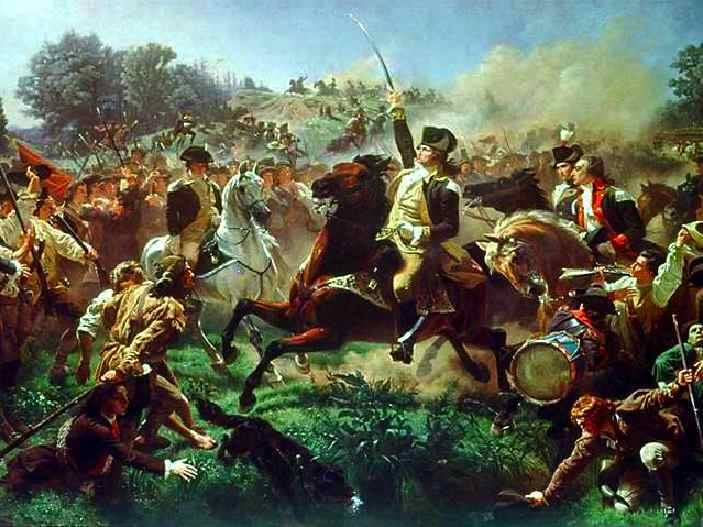 |
| Washington managed to rally the army |
Washington meanwhile rallied the retreating troops, regrouped his forces, and fought Clinton’s regulars to a standstill. The fighting went back and forth as neither side would concede. Despite the burning summer heat, both sides unleashed musket volleys and thunderous artillery. The savage day's fighting ebbed with the dark of night, and both armies collapsed where they fought and slept on their arms. But when the Americans stood at dawn, they found the entire British had beat feet to Sandy Hook and the safety of the fleet. Although a sort of moral victory, Washington was vexed at losing a chance to crush the enemy.
 |
| The Americans stood their own against British assaults |
The End of the Affair
By the 29th, Washington revisited the issue of Lee and his behavior. In a series of letters, Lee became petulant and unremorseful. When Washington questioned his reason for the withdrawal, the two men exchanged words. Demanding a hearing, Lee was charged with insubordination. A court-martial was convened over several weeks. Lee was found guilty of dereliction and cowardice. His punishment: removal from command in the army for one year. Unsatisfied with the outcome, Lee became involved in several affairs of honor and frequently criticized the Continental Congress for enforcing the sentence. These actions resulted in his permanent dismissal from the Continental Army in January 1780.
 |
| Lee once advised that he liked his dogs better than people |
Retrospective
Charles Lee’s quirky personality, arrogance, and narcissism made him very controversial. Yet, for most of the war, he was admired by many in the army and Congress for his experience and professionalism. He has a mixed record, though, and there were times when his loyalty was suspect. But his actions at Monmouth were the result of his awe of the British professionals, fear of getting decisively engaged, and confusion in the fog of battle. I also suspect he was undermined by a lack of respect for Washington, poor chemistry with his subordinate commanders, and lack of confidence in the American soldiers under him. Of these, the third was his greatest failure.


