Followers

Showing posts with label Henry Clinton. Show all posts

Friday, January 30, 2026

Commander in the Crucible

The first edition of the Yankee Doodle Spies Blog continues to highlight historical characters featured in the series. In this case, we begin looking at the characters in my upcoming novel, The South Spy, book six in the series. We'll start with the man who was there at the start, but was given overall command of British forces in North America midstream.

New World Origin

Henry Clinton, born April 16, 1730, in Newfoundland, was the son of Admiral George Clinton, a Royal Navy officer and colonial governor of New York (1741–1751). This early exposure to America shaped his career, though he chose the army over the navy. 

Admiral George Clinton

Gone to Soldier

At age 15, he joined the New York militia as a lieutenant in 1745, gaining initial experience before returning to England in 1749. In 1751, he was commissioned in the Coldstream Guards, advancing through merit and patronage to become aide-de-camp to Sir John Ligonier in 1756. 

During the Seven Years' War (1756–1763), he rose to lieutenant colonel in the 1st Foot Guards by 1758. He served in Germany from 1760, fighting at Villinghausen (1761), Wilhelmsthal (1762), and Nauheim (1762), where a severe wound as an aide-de-camp to Prince Ferdinand ended his active campaigning. These experiences sharpened his tactical skills and forged ties with future Revolutionary figures such as Charles Lee, Lord Stirling, and Charles Cornwallis. 

Battle of Villinghausen

Marital Interlude Disrupted

After the war, Clinton married Harriet Carter in 1767; they had five children, but her death in 1772 from childbirth complications plunged him into prolonged grief. Promoted to major general in 1772, he entered Parliament (Boroughbridge 1772–1774, Newark-on-Trent 1774 onward) through the Duke of Newcastle's influence and briefly toured Russian forces in 1774 during the Russo-Turkish War. The American crisis called him back to service. 

Joining the Dream Team

In February 1775, Clinton sailed to Boston as third-in-command under Thomas Gage (along with William Howe and John Burgoyne, a sort of DreamTeam of military leaders), arriving on May 25. As second-in-command under Howe after Gage's recall, he urged aggressive action. At Bunker Hill (June 17, 1775), he rallied reserves amid heavy losses and later deemed it a "dear-bought victory." 

Bunker Hill

The Boston siege ended with an evacuation to Halifax in March 1776. In 1776, Clinton led a southern expedition to the Carolinas but failed at Sullivan's Island (June 28) against strong defenses. Rejoining Howe, he supported a flanking plan that secured victory at Long Island (August 27), though Howe's caution prevented annihilation. Clinton conducted landings on Manhattan and in Westchester, but growing friction with Howe over tactics soured their relationship. He occupied Rhode Island in December 1776 with ease. 

Frustration and Knighthood

Frustrated, Clinton sought resignation in early 1777 and returned to England briefly. Knighted (Knight of the Bath, April 1777) to retain him, he resumed as Howe's deputy in New York that July. Denied the northern command (which was given to Burgoyne), he criticized isolating Burgoyne and warned of disaster. In October, his diversionary Hudson River attack captured Forts Clinton and Montgomery but came too late to relieve Burgoyne at Saratoga. 

Sir Henry Clinton


Commander in Chief

Appointed Commander-in-Chief in America (February 1778, assumed in May after General William Howe's resignation), Clinton faced France's alliance with America, prompting troop transfers to the Caribbean and a defensive posture in the north. He withdrew from Philadelphia to New York (June 1778), clashing indecisively at Monmouth. Repelling a French threat at Newport (August), he shifted to a Southern Strategy to exploit Loyalist support, disrupt rebel economies, and rally sympathizers in Georgia and the Carolinas. 

Monmouth: First Battle as Commander in Chief


By spring 1778, the American War for Independence had entered its final phase—a global war that would make the Caribbean and its valuable spice islands a major theater. This was precipitated by France’s formal entry into the war and its open alliance with America in 1778, and was further complicated by Spain’s declaration of war against Britain in June 1779.  

Southern Strategy

Lord George Germain and the British commander-in-chief, Sir Henry Clinton, devised the so-called Southern Strategy amid mounting frustration. Stymied by inconclusive northern campaigns and the transfer of several crack British regiments to the islands after the French alliance in 1778, Clinton advocated shifting the focus to Georgia and the Carolinas to rejuvenate British fortunes and form a secure flank for the valuable British possessions in the West Indies.

George Germain


Clinton hoped to capitalize on perceived Loyalist sympathy, seize coastal strongholds to rally supporters, disrupt rebel economies, and threaten the Continental Army. A sound strategy, but one fraught with logistical nightmares, including overextended supply lines and unreliable intelligence on Loyalist numbers.

Savannah Success

In late 1778, Clinton dispatched Archibald Campbell with 3,000 troops; Savannah fell swiftly (December 29) with minimal losses, restoring royal control in Georgia. A Franco-American siege of Savannah (September–October 1779) under d'Estaing and Benjamin Lincoln failed disastrously on October 9, with allied losses exceeding 800, while the British suffered fewer than 150. Clinton hailed it as the war's greatest event, though subordinates such as Augustine Prévost acted semi-independently. 

Success at Savannah


Clinton in Charge

Clinton personally led the decisive Charleston campaign, departing New York in December 1779 with 8,500 troops and Admiral Marriot Arbuthnot's fleet. Storms delayed the arrival until February 1780; Clinton suffered from seasickness and fretted over losses. Landing south of Charleston, he methodically encircled the city, crossing the Ashley River by late March and digging siege lines against Lincoln's 5,000 defenders. 

Charleston


Cavalry raids, including Banastre Tarleton's at Monck's Corner (April 14), seized supplies. Arbuthnot's delays in blockading the harbor intensified Clinton's impatience. Artillery bombardment, including heated shot, devastated Charleston. Clinton rejected Lincoln's "honors of war" plea and demanded unconditional surrender on May 8. 

Charleston Victory

On May 12, Lincoln capitulated, surrendering over 5,000 prisoners—the war's largest American surrender—and vast munitions. This triumph vindicated Clinton's southern pivot. After occupying South Carolina, Clinton initially paroled militia members who pledged neutrality to win support. But in June 1780, he revoked the paroles, requiring active loyalty or imprisonment—a decision driven by fears of resurgence that alienated civilians and ignited guerrilla resistance. 

The Fall of Charleston


War on Remote

Leaving 8,000 troops under Cornwallis, Clinton sailed north in June, intending to oversee operations from New York. Cornwallis advanced inland, winning at Camden (August 1780), but defeats at King's Mountain (October) and Cowpens (January 1781) eroded those gains. Clinton's micromanagement, via delayed dispatches, rigid policies toward the Carolinians, poor relations with Admiral Arbuthnot and the theater commander, Lord Cornwallis, and underestimating partisan tenacity undermined the strategy. 

Lord Cornwallis


Legacy of Failure

This confusion led to Cornwallis’s surrender at Yorktown, effectively ending major combat and prompting serious negotiations. Clinton was replaced as commander-in-chief in early 1782, and General Guy Carleton (Governor General of Canada) took his place in May. Clinton returned to England, serving in Parliament and rising to the rank of full general. His post-war years were marked by ongoing controversy over his conduct of the war rather than by further major commands.


Monday, November 28, 2022

The North Spy Retrospective

One of my "stretch" books in the Yankee Doodle Spies series is The North Spy, which takes my protagonist on a harrowing mission in a venue both exotic and remote. And me along with him! 


General Washington's Dilemma

As the winter snows of 1777 melt into spring blossoms, General George Washington faces a tough choice. He knows the British Army, hunkered down in their winter quarters, will strike like a snake at the first chance to take the American capital, Philadelphia. But where and how? Rumors are flying: across the Jerseys by land? Up the Delaware River by sea? Or maybe a mix of both? Yet another option proves to be the toughest puzzle: a move north to link up with a British Army gathering in Canada.


General George Washington


Diverse Approaches

General Washington did not realize that the British armies in New York and Canada would soon be working against each other. Washington has the Yankee Doodle Spies, in the form of Major Benjamin Tallmadge's troop of the 2nd Continental Line Dragoons, patrolling, scouting, and spying in hopes of understanding what the British commander in New York, Major General Sir William Howe, is planning. Despite the soundness of Major General John Burgoyne's "three-pronged" plan to join with Howe at Albany and split the colonies in two, Howe hesitates.

General William Howe


Northern Storm Clouds, Southern Squalls

The capable yet often slow-moving Howe faces significant criticism for failing to capture the rebel capital in 1776 but remains resolute in his mission to complete the task and defeat Washington. As Burgoyne gathers his forces, totaling over 8,000 men south of Montreal to make a move across Lake Champlain and down the Hudson River, he remains unaware that Howe has shifted his focus southward. Howe does instruct his second in command to stay in New York City with a few thousand men to help Burgoyne if possible. We will see how that plays out.


General John Burgoyne


Hopeless Mission

Enter Lieutenant Jeremiah Creed, whom Washington sends on a daunting, if not hopeless, mission to penetrate Burgoyne's Army, ostensibly to report back on its strength and objectives. Washington's "Intelligence Advisor" and senior intelligence officer, Colonel Robert Fitzgerald, provides Creed with secret orders that will connect him with an agent in Canada. Now all Creed has to do is figure out a plan to get there, find the agent, and work his way into the British Army!


Jeremiah Creed must cover a vast wilderness for his mission


To the North

As Creed continues his journey, he reconnects with old friends and faces new enemies. He will confront ruthless Canadian backwoodsmen, fierce Iroquois (Mohawk) warriors, and an army of British regulars and German auxiliaries eager to impose the war on the Americans by any means necessary. Throughout his journey, Creed must use deception and cunning at every turn. He also struggles with a crisis of conscience, as he is compelled to deceive and manipulate people in new and challenging ways.


Creed must face Iroquois warriors


This is a story of skill and bravery as much as of action – and there is enough action to fill Lake Champlain with blood!

TurningPoint

Americans rally to the cause as General Horatio Gates assumes command of the Northern Department. The armies engage in a series of battles, and Jeremiah Creed becomes involved. The Saratoga campaign is arguably the most important turning point of the American Revolutionary War. The North Spy offers my perspective on it, closely following the actions of British and American commanders and soldiers as they clash in deep forests, shimmering lakes, and flowing rivers of the great north. Spoiler alert: Burgoyne's army surrendered to the American rebels at Saratoga in October 1777, bringing France openly into the conflict.


Saratoga  surrender: the Turning Point


The North Spy was released by Lanyard Press. Available at Amazon via https://www.amazon.com/North-Spy-Yankee-Doodle-Spies/dp/1737663678

And at other purveyors of fine books!


Friday, July 19, 2019

General Disaster

This edition of the Yankee Doodle Spies shifts focus from the Loyalists to an Englishman. However, this Englishman, a professional officer by training, came to America after his British military career stalled. Settling in Winchester, Virginia, in 1773, Lieutenant Colonel Charles Lee adopted Whig and patriot politics, and thanks to his experience in the regular army, was appointed second in command to General George Washington. It is more than an understatement to say Lee was controversial, odd, ambitious, and morally uncertain. But I digress. Instead of detailing his entire career – which is too rich to fit into one post — I thought we’d examine his “evening parade.”

Early Career at a Glance


Lee was a well-educated son of a (not so modern) major general. After attending school in Switzerland, he entered the Royal Army as an ensign in 1747. Like others of his generation of soldiers and sailors, he saw a lot of action, as Britain had no shortage of wars in the mid-eighteenth century.


Major General Charles Lee


His exploits in the Seven Years War, actually the French and Indian War, took him from Braddock’s defeat on the Monongahela to the final victory on the Plains of Abraham. He ended the war as a major and returned to Europe, where he served briefly as a lieutenant colonel in the Portuguese Army and later in the Polish service. In the latter, he managed to lose two fingers in a duel in which his opponent died. Lee was no snowflake.


Lee was a Seven-Year War
and French and Indian War Veteran


With his career in the Royal Army at its lowest point, he moved to North America to pursue farming and politics. When the American Revolution erupted, he was among those considered to lead the new American army. He lost to George Washington but was awarded the second-in-command position as a consolation. Major General Lee displayed talent but was also cantankerous and involved in many intrigues along with military engagements. He was known as a seducer of women but was quirky, disheveled, and always accompanied by his pack of dogs. Captured under mysterious circumstances as America’s fortunes declined in late 1776, many suspected Lee of aiding his British captors, who used him for their advantage.


Lee was captured at Basking Ridge, NJ
while away from his army


Renewal and Redemption


Lee was paroled as part of a prisoner exchange in April 1778, being swapped for British General Richard Prescott. Despite suspicions of duplicity and back-stabbing by Lee, George Washington welcomed him home to the Continental Army like a prodigal son. Circumstances placed the quirky but still considered a professional officer in a position to make up for any past quirks, obfuscations, and manipulations. The Continental Army emerged from Valley Forge as a revitalized force, professionally trained and equipped. British actions would give Charles Lee a chance to use that new force and prove once and for all that he was the best officer in the army, a view long held by Lee and his supporters.


The Continental Army emerged from Valley Forge
as well-trained professionals


General Clinton’s Gift


By spring 1778, the British had decided to abandon the American capital and concentrate their forces in the major stronghold of New York. This would allow London to redirect land and naval forces to the new active theater in the West Indies. Clinton sent part of his forces north by sea, but a significant force would have to march north across the hot fields of the Jerseys before they could be transported to New York. Washington’s spies warned him of this, and he positioned the Continental Army to take advantage of Clinton’s predicament. A slow-moving land force, reduced in numbers, became an easy target for the commander in chief. Clinton had given the long-suffering Continentals a gift.


Sir Henry Clinton


Councils of War


During a series of war councils, Washington sought to decide the best course of action. Should they risk an all-out attack? Shadow the British and harass their movements? Or try to block them and force a British assault?

The final meeting took place on June 24. Many wanted to take decisive action against the British, but the generals were divided on how to proceed. Marquis de Lafayette considered it a matter of honor to strike at the enemy. Nathanael Greene advocated for a partial effort as a way to boost morale. The aggressive “Mad” Anthony Wayne preferred an all-out fight. However, Lee clarified that his only goal was to observe the British army as it retreated.


Mad Anthony Wayne


The quirky, self-important Lee offered surprisingly cautious advice and had a good understanding of the risks involved. Lee thought an all-out attack on the British was absurd and believed that a defeat for the Americans would be disastrous. To be fair, he probably didn’t realize that this army was unlike any previous command—the American army of the past. Washington decided to keep harassing the British. His combative, young aide Alexander Hamilton dryly remarked that the results of this meeting "would have done honor to the most honorable body of midwives and to them only."

To Lead or Not to Lead


Events gave Washington pause. The New Jersey militia under General Philemon Dickinson (see the Yankee Doodle Spies post on the Militia General) slowed and harassed the British column, which was already being troubled by New Jersey militia blocking roads and launching nuisance attacks.


Major General Philemon Dickinson


Seeking to capitalize on this, Washington dispatched an advance guard of six hundred riflemen under famed Colonel Dan Morgan, then added a second detachment of 1,440 selected Continentals. He followed with a third wave of a thousand chosen men led by Wayne. Washington asked his recently returned second in command, Charles Lee, to lead this strike force, but Lee declined. Did he feel that taking on the British in this manner was too risky or that the command was beneath him?


Dan Morgan


Lafayette, I am Here


So Washington turned to one of his favorites – the Marquis de Lafayette, the young French aristocrat who accepted the command. But Lee then had second thoughts and demanded command of the force. Washington felt he had no choice but to agree. However, he increased the force by another six hundred men as a reason for replacing Lafayette. Now, a force of about 5,000 was closing in on the British rear.


Marquis de Lafayette


A final war council on June 27 offered little clarity on how severely to attack the British, who were nearing Monmouth Court House on their way to a Sandy Hook rendezvous with the fleet. Lee and the strike force slowly positioned themselves near the British rear guard. Several messages from Washington did not provide clear guidance on what actions to take. Therefore, Lee decided to proceed with a watchful waiting approach.


His placement of forces was uneven, making mutual support difficult. On June 28th, he advanced carefully with Anthony Wayne's brigade leading. The day was hot and humid, soaking coats in both red and blue. When the initial contact on June 28th caught the British rear guard off guard, Anthony Wayne pressed for a more aggressive stance, as was his style. (See the Yankee Doodle Spies post on The Mad Man) But without clear orders, Lee hesitated. The chance to outflank the British rearguard was lost.

Baptism by Fire


But upon learning of the contact, General Clinton, meanwhile, decided to give the rebels one last lesson. He reinforced his rearguard and sent them south after their pursuers. Lee’s situational awareness was confused. He received conflicting reports on British strength and activities. But he decided to fix the British rearguard in front of him — if he could find it. He sent forward Wayne’s force, but Wayne circled around the British left to attempt an ambush. Wayne was surprised by a detachment of dragoons, and firing erupted. Lee had to change plans. He pushed Lafayette forward and maneuvered to take advantage of Wayne’s situation.


Old Monmouth Courthouse 

Run Away, Run Away Run 


Then Clinton unexpectedly attacked the rebels and sent the grenadiers against Lee’s right. Chaos broke out. A series of firefights erupted. Volleys of lead shot across the steamy farm fields. Guns began spewing heavy iron balls across meadows and fields. Lee’s situational awareness quickly worsened. He didn't know what was facing him, and he didn't have his forces well controlled. Without clear orders from Lee, his brigades moved on their own in response to the situation as they understood it. Normally, this isn’t entirely bad. Initiative in battle is a good thing. But this situation was heading toward disaster because the formations weren’t working together—they were acting independently.


Lee's units operated independently against
the British

Fearing the worst—a potential engagement he wanted to avoid—Lee retreated three times. His aim was to extract his forces from a dire situation and steer clear of the grasp of the British regulars with the army's most elite infantry and cavalry. Puzzled by the withdrawals, soldiers and commanders started to lose morale. Was something going wrong that they did not understand? The fog of battle made the retreat look and feel like a rout. These were perhaps understandable actions given the circumstances he faced. But he made one crucial mistake. He did not keep the commander in chief informed.

You May Leave the Army


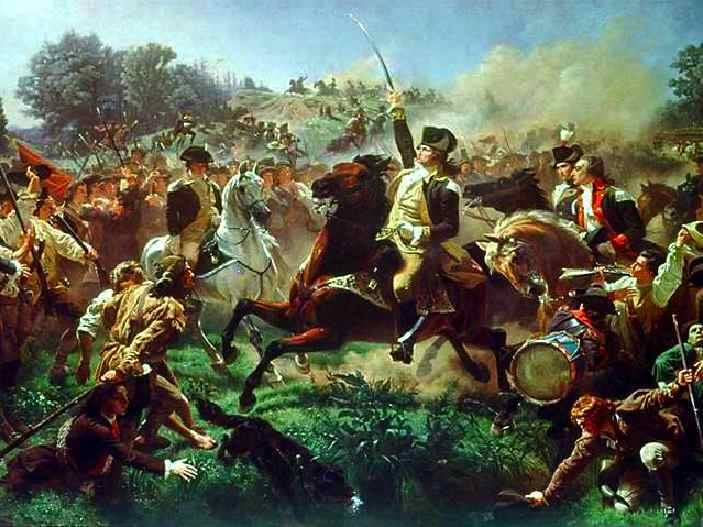
In the rear, Washington was advancing with his staff through a stand of woods. Suddenly he saw a civilian and a fifer coming down the road. He disbelieved them when told the army was in retreat. Then stragglers bereft of gear and weapons staggered past. Soon, an entire unit was seen running away from the front. Washington, now enraged, rallied the men and pushed forward. Soon, he spotted an officer on horseback ostensibly fleeing the battle. It turned out to be Charles Lee.


Washington confronts Lee


“What is all this?” Washington demanded. Lee hesitated at first. Then Lee blurted out a series of incoherent defensive statements about intelligence and the power of the British. That did not go over well. Washington insisted they were facing only a strong covering party of the enemy. Lee replied that the British had greater numbers than previously thought and did not believe it was proper to risk the army. Washington erupted into a tirade unlike anything anyone had seen before, questioning Lee’s bravery. Washington ended the exchange when he saw some units retreating and hurried over to rally them. Lee seemed to have remained in stunned silence for a few minutes.


Washington managed to rally the army


Washington meanwhile rallied the retreating troops, regrouped his forces, and fought Clinton’s regulars to a standstill. The fighting went back and forth as neither side would concede. Despite the burning summer heat, both sides unleashed musket volleys and thunderous artillery. The savage day's fighting ebbed with the dark of night, and both armies collapsed where they fought and slept on their arms. But when the Americans stood at dawn, they found the entire British had beat feet to Sandy Hook and the safety of the fleet. Although a sort of moral victory, Washington was vexed at losing a chance to crush the enemy.


The Americans stood their own against British assaults


The End of the Affair


By the 29th, Washington revisited the issue of Lee and his behavior. In a series of letters, Lee became petulant and unremorseful. When Washington questioned his reason for the withdrawal, the two men exchanged words. Demanding a hearing, Lee was charged with insubordination. A court-martial was convened over several weeks. Lee was found guilty of dereliction and cowardice. His punishment: removal from command in the army for one year. Unsatisfied with the outcome, Lee became involved in several affairs of honor and frequently criticized the Continental Congress for enforcing the sentence. These actions resulted in his permanent dismissal from the Continental Army in January 1780.


Lee once advised that he liked his
dogs better than people


Retrospective


Charles Lee’s quirky personality, arrogance, and narcissism made him very controversial. Yet, for most of the war, he was admired by many in the army and Congress for his experience and professionalism. He has a mixed record, though, and there were times when his loyalty was suspect. But his actions at Monmouth were the result of his awe of the British professionals, fear of getting decisively engaged, and confusion in the fog of battle. I also suspect he was undermined by a lack of respect for Washington, poor chemistry with his subordinate commanders, and lack of confidence in the American soldiers under him. Of these, the third was his greatest failure.


Sunday, August 5, 2018

The King's Rake


Beauing, belling, dancing, drinking,

Breaking windows, cursing, sinking

Every raking, never thinking,

Live the Rakes of Mallow,


Spending faster than it comes,

Beating waiter's bailiffs, duns,

Bacchus' true begotten sons,

Live the Rakes of Mallow.


And so begin the lyrics of the mid-18th-century song that remains in today's culture as an international classic, "The Rakes of Mallow." This song tells of the rakes from the farming town of Mallow, about 20 miles north of the city of Cork. What exactly is a rake? Although Mallow is a farming town, we aren't talking about the gardening tool. The other rake is an old-fashioned term for a person who indulges in drinking, gambling, womanizing, and rowdy behavior — traits both celebrated and condemned in Georgian England. This brings us to the rake in this story—the complex and never uninteresting George Hanger...


The Rake at Dawn


George Hanger was born near Berkshire, England, around 1751. His father was Gabriel, the 3rd Baron Coleraine, an Irish peer. As the third son of an upper-class noble, it was almost destined that he would pursue a military career. Hanger was educated at Eton and then spent a year at the University of Göttingen in Hannover, Germany. 

A bright student, Hanger had a rakish appearance and enjoyed the proverbial wine, women, and gambling—not necessarily in that order. He allegedly fought three duels by the age of 20 and was reputed to be an excellent shot. While in Germany, Hanger observed the legendary Prussian Army of Frederick the Great during maneuvers and decided then and there to follow a military path. 

In January 1771, he was appointed an ensign in the 1st Foot Guards, a prestigious regiment of the household troops. Hanger performed well but resigned after being passed over for a promotion just four years later. Early signs of his lifestyle began to surface.


George Hanger

Soldier for Hire


Hanger's German contacts served him well, and he soon received a captain's commission in the Feldjäger Korps of the forces of the Landgrave (Elector) of Hesse-Kassel, another elite unit. I think we know where this is going... It was as part of this group of young Teutonic aristocrats that Hanger sailed for America when the Landgrave "rented" his troops to King George III. 

Leaving Portsmouth in March 1776, young Hanger arrived just in time for some of the most "fun" episodes for crown forces during the entire eight-year struggle. He played a role in the relentless campaigns that swept the rebels from New York and the Jerseys in 1776, as well as in the less glamorous but equally brutal skirmishes of 1777. His performance was so impressive that he took command of an elite Hessian Jaeger (light infantry) company recruited from all the Hessian regiments in the army. 

According to reports, Hanger distinguished himself in the months that followed. His unit undertook much of the screening, patrolling, and small-scale fighting around Kingsbridge, Spuyten Duyvil, and Westchester. Around this time, he learned that his estate back in Britain had gone into foreclosure, and through a series of misfortunes, he found himself in dire financial straits. Our young hero had become a self-proclaimed "soldier of fortune,"


Hanger became a master of light infantry


An Unlikely Spy


When the British occupation of Newport, Rhode Island, ended in 1779, Hanger was chosen by the British commander in chief, General Henry Clinton, to undertake a daring reconnaissance mission to see if the American occupiers had left their defenses vulnerable for reconquest. He sailed 150 miles north from the mouth of New York Harbor on a frigate and led a twelve-man longboat into dangerous waters during a bold night raid. He captured a prisoner and returned to New York with him. Hanger was later criticized in American papers when the prisoner unexpectedly fell ill and died.


An unlikely Hanger sails on a secret mission
 to Rhode Island: espionage


Moving South


Patrick Ferguson
 - a badass
Later, Hanger took command of a mix of rifle and musket units and was seconded to the renowned "counter-guerrilla" Major Patrick Ferguson, one of the tough British officers of the war whose death at King's Mountain signaled the beginning of the end in the South. But I digress. With Ferguson, Hanger sailed to the Carolinas under General Henry Clinton in the spring of 1780, marking the start of the "southern strategy." After a brief stint as Clinton's aide-de-camp and then inspector of militia under Ferguson, the ever-adaptable Hanger managed to transfer to Banastre Tarleton's British Legion. The two hard-drinking, rough-and-tumble aristocrats hit it off, and Tarleton made Hanger his deputy. Hanger joined the green-jacketed band of Loyalist regulars that would become infamous under Tarleton.


Infamous Banastre Tarleton
Hanger's mentor and commander


The Legion


Lord Charles Cornwallis
The Legion led Major General Charles Cornwallis's invasion of North Carolina. When Tarleton was struck down by yellow fever, Hanger took command. Although an accomplished infantry fighter and dependable deputy, Hanger struggled with the cavalry, which was the vital strike force of Tarleton's Legion. 

He allowed himself to be ambushed at Wahab Plantation on September 21, 1780, where a partisan force under American Colonel William Davie attacked early in the evening. Surprised and overwhelmed, Hanger suffered 12 killed, 47 wounded, and almost 100 valuable horses captured. 

Tasked with leading the British advance against Charlotte less than a week later, he faltered again. This time, he let his horsemen become separated from their supporting infantry. Once more, Davie outmaneuvered him when Hanger's cavalry charged recklessly into the town without support. 

Hanger led several assaults against Davie's American riflemen, who were defending behind a wall. Hanger's men started to fall to the precise fire. Cornwallis himself had to step in to stabilize the situation. Hanger was severely wounded during the fight and later contracted yellow fever. Sick and injured, he was sent to the Bahamas (of all places) to recover.


Hanger led the Legion's cavalry to savage fighting and defeat
at Charlotte


Dead Ender?


Guy Carleton
When he recovered sufficiently, Hanger returned to New York in the summer of 1781 and resumed garrison duties. As the key to Britain's control over North America, New York was the center of attention, and Hanger found himself right back in the middle of things. He also returned to a city filled with bars, brothels, and rooms for him to enjoy during his downtime from drilling troops or patrolling the outskirts. 

One might think our young rake had the best of both worlds during this time. Ever the soldier, he sailed with General Clinton's relief force, aiming to rescue Cornwallis's trapped army at Yorktown. Upon hearing of the surrender, he went back to the city with the rest of the fleet. 

As peace negotiations settled on terms, Hanger took on another role: resettling members of the Legion. For that, he made a trip to Halifax, Nova Scotia, to find land and housing for the loyalists who chose not to go to England. Mission accomplished, he returned to New York. One has to see George as a proverbial dead-ender. He stayed with one of the last British units to evacuate the city, sailing with the final British commander and governor in North America, General Guy Carleton.


Hanger, "Forrest Gump-like," manages to
witness the American Revolution's climax


The Bad Boy of Georgian England


Once home, Hanger resumed the life of a flamboyant party boy. He became a social companion to another rake, the Prince of Wales, who later became King George IV. The prince enjoyed Hanger's rakish ways. Hanger seemed to have become famous simply for being famous — the subject of much satire and ridicule in what would be today's tabloids. His reckless lifestyle landed him in debtor's prison, where he spent two years (1798-1800). While in prison, he turned to writing and produced his memoirs there.


Hanger and his buddy, the Prince of Wales
attended many a party


When he left, he became a coal merchant (in which he was quite successful) but continued his addiction to gambling and partying around London. Throughout, Hanger flaunted contemporary mores, cavorting openly with women of all kinds, keeping a peculiar collection of dogs, cats, and monkeys, and generally thumbing his nose at the upper crust and middle class. One of his celebrated exploits was arranging a cross-country race between a flock of turkeys and a flock of geese!


Cartoon satire of Hanger


At the same time, he learned to leverage some of his strengths as a pamphleteer—similar to bloggers today. Reinventing himself as a subject matter expert, he published pamphlets on military topics, gambling, hunting, and shooting. Hanger engaged in public disputes over military policy during the Napoleonic Wars. He also wrote humorous advice columns on various subjects, most famously about the fairer sex. His antics and opinions were closely followed by the media of his time. In 1814, he was offered the barony of Coleraine but declined it to continue his "celebrated" lifestyle in London.


Cartoon satire of Hanger

The Legacy


Cartoon satire of Hanger


Despite his hard lifestyle, Hanger kept up his reputation as a notorious figure in town, a military expert, and a celebrated eccentric until his death in London on March 31, 1824. He left behind a second wife, possibly his housekeeper, and their son, who was denied his father's peerage. George Hanger was undoubtedly one of the more complex men of his era and certainly one of the most intriguing, if not amusing.

 Eventually, his notoriety caught up with him. The king distanced himself from him, high society shunned him, and the press ridiculed him. Yet, in many ways, he embodied his class and era: a curious mix of breeding, talent, courage, rapacity, and culture. It's a pity he didn't settle in America...


George Hanger, 4th Baron Coleraine?


Sunday, June 25, 2017

The Palmetto Fortress

A Tour de Force


In the spring of 1776, the British planners in London aimed to turn their recent stalemate and embarrassing withdrawal from Boston into a strategic victory that would end the rebellion that year. One fleet was ready to strike the crucial port of New York with a direct attack, while another planned a quick left hook at the equally important port of Charleston. The latter strike was to come first, setting the stage for a more decisive blow in the middle Atlantic colonies. Charleston, the major southern city at the time, had vital connections to the key islands in the West Indies, which were always a top priority for British interests. Dominated by a planter class, South Carolina wasn't seen as a heavily rebel area that would fall easily. However, a few brave patriots proved them wrong.


A Last-Minute Plan


Lord Dartmouth
The British strike at the southern colonies actually began earlier in the year when William Legge, Lord Dartmouth, and Secretary of State for the Colonies ordered General Henry Clinton and Commodore Peter Parker to rendezvous with another armada under General Lord Charles Cornwallis off Cape Fear, North Carolina. Misfortune on land and at sea turned the North Carolina plan to mud. But before Clinton could sail north, Parker reported that a reconnoiter of Charleston indicated the defenses were ill-prepared and that a quick strike against Fort Sullivan on Sullivan's Island in the harbor would be successful. After that, the city could be successfully assaulted. Anxious for some "low-hanging fruit" after the Tar Heel frustration, Clinton concurred, and so they made their way south, anchoring off the city on 7 June 1776.


A City Prepares


Charleston's waters were treacherous
as the British would soon discover

But the South Carolinians in Charleston had long anticipated that they would be a target of the British and eagerly built up defenses on Sullivan's Island. This was a three-sided fort with sixteen-foot-high sand walls surrounded by softwood palmetto logs. The spongy palmetto wood absorbed the impact of cannonballs—the main threat to the fort. The fort was armed with twenty-five guns of various sizes and calibers, and housed a garrison of over four hundred men. Most importantly, the commanding officer of Fort Sullivan was militia Colonel William Moultrie, who would soon prove to be one of the most capable fighting generals of the war. The city itself had a garrison of over six thousand troops, including Continental Line infantry. In command was Major General Charles Lee, a former British officer and widely regarded (especially by himself) as the finest officer in the American cause. Lee believed that Fort Sullivan was too exposed to the fire of British warships and ordered it to be abandoned. However, South Carolina Governor John Rutledge overruled Lee, viewing it as a necessary buffer against a naval attack. Geography and hydrography favored the defenders; the narrow harbor channel, with strong currents and shoals, troubled the British as they planned where to land and how to position their ships. It took a month before they were ready to attack the city that was just within their reach.


Colonel William Moultrie's militia
staged a gallant defense


Bombs Bursting in Air... Sand.. and Wood


The South Carolina flag hoisted in battle
boosts morale

On 28 June, a bombardment commenced between Parker's warships aligned off Sullivan Island and Moultrie's raw militia manning the guns protected by sand and palmetto logs. The barrage went on for hours. The British gunners were frustrated that, despite hit after hit, the combination of sand and spongy logs inflicted little damage on the fort. Shot after shot from the warships either bounced off the walls or got absorbed into the soft walls of the palmetto. The Americans fired back. But low on gunpowder, Moultrie insisted that each shot be well-aimed. In the middle of the hours-long engagement, a British shot cut down the South Carolina flag. A brave sergeant named William Jasper, in full view of the British and the Americans, ignored the hail of lead and iron to mount the parapet and restore the flag. The impact on the morale of both sides was telling. As the battle continued, the defenders' deliberate fire took its toll on the British ships, scoring hit after hit. Things took a final turn against the British when Parker sent three frigates around Sullivan Island to take the defenders in the flank. Unaware of the dangerous waters of the channel, all three suddenly grounded in the shallows. After a struggle, the two freed themselves, but the third, HMS  Acteon, remained stuck. The frustrated crew burned it to prevent the rebels from taking it.


The savage naval bombardment was decided
by shoals, sand, and wood


Fight  on till Dark


Commodore Parker
The firing continued on both sides. Commodore Parker's flagship had its anchor cable severed by a shot, causing the ship to turn and present its exposed stern to American fire. The rounds poured in, and one actually passed between Parker's legs as he shouted out commands. The commodore was unhurt but indignant as the shot tore his pants off. When darkness descended on the harbor, Parker signaled the fleet to disengage. Exasperated, the British fleet sailed from the harbor. It would be four long years before they would deign to return to face the Carolinians and their palmettos. The next one would end differently, but in 1776, the failed attack presented the British with a near disaster. The Royal Navy incurred well over two hundred casualties - Moultrie's men less than forty. And what of General Clinton? His men had landed on nearby Long Island to prepare for an assault on the mainland once Fort Sullivan fell. With the warships gone, this would not be. Instead, they remained exposed there for several weeks before the British transports were able to sail in and they could re-embark.


The Result


The British armada returned to New York at the end of July with ships damaged and sailors and soldiers discouraged. However, they soon had a chance for some revenge when the British launched their massive attack on Long Island in late August. Still, the victory at Fort Sullivan kept the South safe for four crucial years. It introduced the world to a brave new leader and boosted morale across the Carolinas and the entire rebellion. And in honor of the palmetto’s role in the victory, the noble tree with soft bark was added to the South Carolina state flag, where it remains today.


South Carolina State Flag