Followers

Showing posts with label Governor Tryon. Show all posts

Saturday, July 13, 2013

How I Spent My Summer Vacation

New York - resort?


I took my annual summer resort vacation...in New York City! Now many folks wouldn't think of New York City as a resort and certainly not as a summer resort. But for most of its history, New York was precisely that - especially for the poor and middle class that make/made up so much of the city's populace. Why? Because they couldn't afford the time or the money to reach out to the numerous lakes in the mountains north of town or the expansive beaches of eastern Long Island. Nope, hundreds of thousands made do with the likes of the Bronx's Orchard Beach and City Island. The trolley and later the subway brought droves to Brooklyn's Coney Island, Manhattan Beach, Plum Beach, and Brighton Beach. Sheepshead Bay (it looks like a sheep's head from the air) offers deep-sea fishing at a reasonable price. And the prime resort area remains the Rockaways.  Queens's seven mile-plus stretch of sand from Far Rockaway to Rockaway Point with views of New Jersey's Atlantic Highlands provides some of the finest beaches on the east coast.


Some work - some play


Although I was in Rockaway, this year my resort activity was somewhat curtailed.  I was under a deadline to get the edited manuscript of The Cavalier Spy reviewed and back to the publisher (done). So my summer fun in the sun was restricted to a one day visit to the beach. However, I took advantage of a special deal set up by NYC as a result of Hurricane Sandy.  Because of Sandy's impact on mass transit in the Rockaways, the city contracted a fast boat to go from Beach 108th Street and Jamaica Bay around the end of the Rockaways and up New York bay to lower  Manhattan. Readers of The Patriot Spy know Manhattan was called The Island of New York during the time of the American Revolution. The trip takes an average of 38 minutes each way for the round trip cost of $4! Like that, badabing, you are staring up at the lofty buildings of New York's financial district.  So what the heck does this have to do with the American Revolution? Well, the boat ride passed many of the critical points of the British invasion of New York back in the summer of 1776.


Sailing into the past


British cross the harbor towards Gravesend Bay


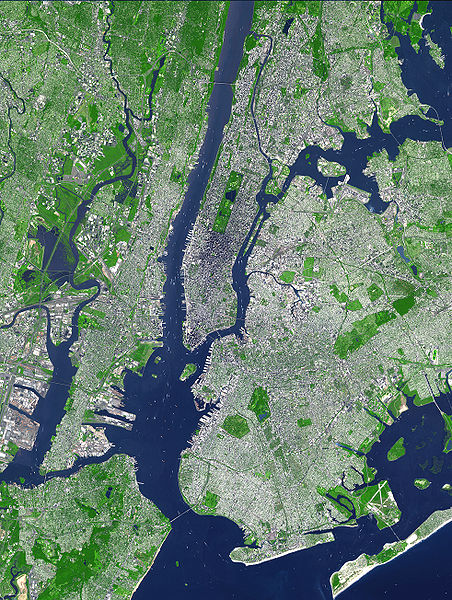
As the boat eased out of Jamaica Bay and turned into New York's impressive lower harbor, I could look to the southwest and see Sandy Hook, New Jersey. But back in 1776, the Sandy Hook included a sand bar that blocked the lower harbor, preventing large British warships from crossing over it except during extreme high tide. A few minutes later we were approaching the Verrazano Narrows. The British went through the narrows and landed an army of twenty-four thousand or so on Staten Island, then a Tory stronghold. After recovering for a few weeks they launched barges and longboats across the narrows and landed troops at Gravesend Bay. This was on my right (starboard side) just before I reached the narrows, not far from today's Fort Hamilton. The few American defenders there ran off at the sight of the British. We continued on another ten minutes with Bayonne on our port and Bay Ridge, then Red Hook, on our starboard. Near Red Hook is the Gowanus Canal: the remnant of the Gowanus Creek that played such a critical role in Washington's defenses on Long Island. The boat soon approached Governor's Island, where the Royal Governors resided during colonial times.  The last  Royal Governor of colonial New York, nasty William Tryon, evacuated a year earlier but returned in 1776 with the British armada.


The Sea Streak sails from the Rockaway peninsula on the lower right and up
the harbor to the lower extreme of Manhattan. Note the narrows and
 Governors Island. The Sandy Hook is just off the bottom of the photo,


The final heading


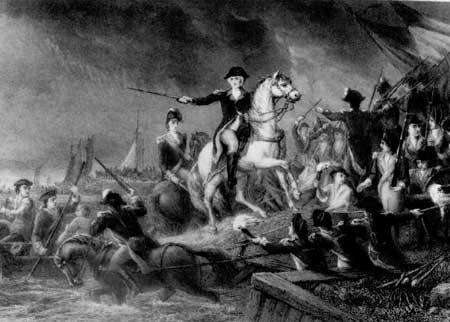
The Gloucester Regiment evacuates Washington's army from its defenses
near the Heights of Brooklyn
Passing the narrow channel between Governor's Island and Brooklyn, the boat entered the waters of the lower East River. To our starboard front lay Brooklyn Heights, just south of the famed Brooklyn Bridge. This was the location of Washington's headquarters during the battle for Long Island, and the point from which the Gloucester seamen evacuated the beleaguered army on a stormy night with the British front lines not more than a few hundred yards distant! The crossing from Brooklyn to New York was considerably wider than it is today, as the Manhattan's expansive use of landfill has narrowed the river by almost a quarter-mile.


The (old) City of New York


We arrived at lower New York, which during the time of the Yankee Doodle Spies extended not too far beyond today's Wall Street. We landed in the lower central portion of this image of early colonial New York. Note how the city abruptly ends at the Wall Street, it extended past Chambers Street by the mid-1700s.


Pearl Street was a contemporary thoroughfare about a half-mile north of where we landed. It probably looked little different from this image from the Dutch era, although the docks and buildings would be more extensive as the city had grown. I will do a future blog on some of the revolutionary war era sites that still remain in the city.  Of course, the march of history (not progress) has limited them to only a few.

Dutch-style buildings still dominated New York during the
time of the Yankee Doodle Spies


I

Saturday, April 27, 2013

Gallant Old Patriot

Those of you who follow my postings on Facebook might have caught a flurry of them this week on the small  engagement that took place near Danbury, Connecticut, and the death of a "little known First Patriot, David Wooster." The American Revolution is replete with people from all walks of life who served quietly and diligently (on both sides) for the cause they believed in. This is the story of one...one of the First Greatest Generation.

Captain David Wooster
Much of David Wooster's fame came early in life during two of the many wars fought between England and France in North America.  A  Yale graduate, he had married the beautiful daughter of the president of that college but chose a life of action over books.  He took to the water (even today, Connecticut has more ports than any other state) and became an officer in that colony's coast guard.

During the War of the Austrian Succession (King George's War in America), the colonists of New England waged a bitter struggle against the French in Canada and Nova Scotia to their north. Wooster was commissioned a captain in command of a company in Colonel Andrew Burr's Regiment.  Coincidentally, Burr was the uncle of  Aaron Burr. He took part in the campaign against the mighty French fortress of Louisbourg. Captain Wooster distinguished himself enough to be named as part of the escort of prisoners back to France when the fortress finally fell.  His journey took him to Britain where his achievements were celebrated in the press. Wooster met the King and received for his service a commission in Sir William Pepperrell's Regiment (a regular British army regiment)  that included a pension for life. In 1748, the Treaty of Aix la Chapelle ended the war and Wooster returned to civilian life in Connecticut.


Jeffery Amherst at Ticonderoga,
the land between the waters
When the French and Indian War broke out, Wooster served from 1755 to the war's end in 1761, during which he was promoted to colonel and given command of the 3rd Connecticut regiment. In 1758 his regiment was at the disastrous Battle of Carillon, near the French fort of that name, at the southern extreme of Lake Champlain. There, General James Abercrombie launched a disastrous frontal attack that was torn to ribbons by Marquis de Montcalm's force of French regulars, Canadians, and Indians. This was the bloodiest battle of the French and Indian War, the British lost over  2,000 of the 3,000 casualties. But Wooster was  again in the thick of things in 1759 when General Jeffery Amherst captured the Fort Carillon and renamed it Ticonderoga, the Indian name
for that strategic place between the waters.


Rebels stopped cold at Quebec
By the time of the American Revolution, Wooster was in his mid-sixties and settled in the mercantile business in New Haven. But this First Patriot sacrificed his comfortable pension and status to serve the cause of his country at a time when most men of his age were enjoying home and hearth. Appointed general in the Connecticut militia, he planned the attack on Fort Ticonderoga that gave the newly forming rebel army its first artillery train. He was named a Brigadier General in the Continental Army and second in command of the failed rebel attack on Quebec that same year. Wooster stayed with the force during the bitter retreat to Fort Ticonderoga.  The defeat in Canada resulted in his recall from Continental command but likely his age ruled him out for further active campaigning with the field forces. But Wooster was then appointed Major General of the Connecticut Militia and commanded all militia troops in that state.

Governor William Tryon


That placed him at the center of the action for the Danbury April 1777 raid launched by New York's Governor Tryon.  At the time, an arc of territory stretching from southeast Connecticut through the Hudson Valley and Highlands was a no man's land of bitter fighting on both sides.  Danbury was a key rebel base in that struggle. Leading a force of regulars and Loyalists in a swift landing at Fairfield, Connecticut,  Tryon's column over 2,000 strong marched north towards the rebel arsenal at Danbury, looting and burning patriot homes along the way.  They reached the arsenal and destroyed it on April 26th.

 Learning of the attack, Wooster and General Benedict Arnold had rallied around 600 Connecticut militia who tried to stop the British at Ridgefield as they returned south to the coast near Compo Point. Arnold took the main body of troops to block the British advance while Wooster led a small detachment of them in the British rear. His undisciplined troops could not stand up very long against the regulars and they soon broke.  Wooster's ire was up though and he tried gallantly to rally his men.  However, a British cannon unleashed canister and a piece of metal pierced his side and struck his backbone.

Battle of Ridgefield - Arnold and Wooster
could not stop Tryon's forces


The battle continued in sporadic skirmishes as the British retreated to the coast. But they carried the gravely wounded old warrior back to Danbury. Before he died on May 2nd, his wife and son had been sent for. They arrived soon enough to receive his parting blessing. The gallant old Patriot  told them that he was dying, but "with strong hope and persuasion that his country would gain its independence."

Monument to Major General David Wooster
in Danbury, Connecticut