Followers

Showing posts with label Manhattan. Show all posts

Saturday, July 13, 2013

How I Spent My Summer Vacation

New York - resort?


I took my annual summer resort vacation...in New York City! Now many folks wouldn't think of New York City as a resort and certainly not as a summer resort. But for most of its history, New York was precisely that - especially for the poor and middle class that make/made up so much of the city's populace. Why? Because they couldn't afford the time or the money to reach out to the numerous lakes in the mountains north of town or the expansive beaches of eastern Long Island. Nope, hundreds of thousands made do with the likes of the Bronx's Orchard Beach and City Island. The trolley and later the subway brought droves to Brooklyn's Coney Island, Manhattan Beach, Plum Beach, and Brighton Beach. Sheepshead Bay (it looks like a sheep's head from the air) offers deep-sea fishing at a reasonable price. And the prime resort area remains the Rockaways.  Queens's seven mile-plus stretch of sand from Far Rockaway to Rockaway Point with views of New Jersey's Atlantic Highlands provides some of the finest beaches on the east coast.


Some work - some play


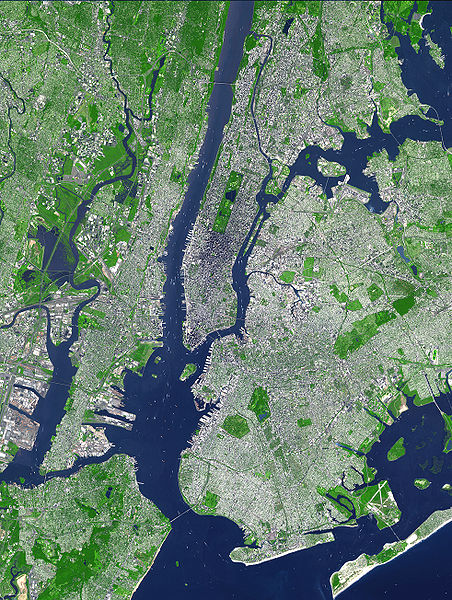
Although I was in Rockaway, this year my resort activity was somewhat curtailed.  I was under a deadline to get the edited manuscript of The Cavalier Spy reviewed and back to the publisher (done). So my summer fun in the sun was restricted to a one day visit to the beach. However, I took advantage of a special deal set up by NYC as a result of Hurricane Sandy.  Because of Sandy's impact on mass transit in the Rockaways, the city contracted a fast boat to go from Beach 108th Street and Jamaica Bay around the end of the Rockaways and up New York bay to lower  Manhattan. Readers of The Patriot Spy know Manhattan was called The Island of New York during the time of the American Revolution. The trip takes an average of 38 minutes each way for the round trip cost of $4! Like that, badabing, you are staring up at the lofty buildings of New York's financial district.  So what the heck does this have to do with the American Revolution? Well, the boat ride passed many of the critical points of the British invasion of New York back in the summer of 1776.


Sailing into the past


British cross the harbor towards Gravesend Bay


As the boat eased out of Jamaica Bay and turned into New York's impressive lower harbor, I could look to the southwest and see Sandy Hook, New Jersey. But back in 1776, the Sandy Hook included a sand bar that blocked the lower harbor, preventing large British warships from crossing over it except during extreme high tide. A few minutes later we were approaching the Verrazano Narrows. The British went through the narrows and landed an army of twenty-four thousand or so on Staten Island, then a Tory stronghold. After recovering for a few weeks they launched barges and longboats across the narrows and landed troops at Gravesend Bay. This was on my right (starboard side) just before I reached the narrows, not far from today's Fort Hamilton. The few American defenders there ran off at the sight of the British. We continued on another ten minutes with Bayonne on our port and Bay Ridge, then Red Hook, on our starboard. Near Red Hook is the Gowanus Canal: the remnant of the Gowanus Creek that played such a critical role in Washington's defenses on Long Island. The boat soon approached Governor's Island, where the Royal Governors resided during colonial times.  The last  Royal Governor of colonial New York, nasty William Tryon, evacuated a year earlier but returned in 1776 with the British armada.


The Sea Streak sails from the Rockaway peninsula on the lower right and up
the harbor to the lower extreme of Manhattan. Note the narrows and
 Governors Island. The Sandy Hook is just off the bottom of the photo,


The final heading


The Gloucester Regiment evacuates Washington's army from its defenses
near the Heights of Brooklyn
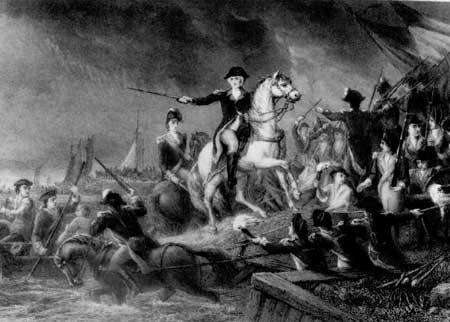
Passing the narrow channel between Governor's Island and Brooklyn, the boat entered the waters of the lower East River. To our starboard front lay Brooklyn Heights, just south of the famed Brooklyn Bridge. This was the location of Washington's headquarters during the battle for Long Island, and the point from which the Gloucester seamen evacuated the beleaguered army on a stormy night with the British front lines not more than a few hundred yards distant! The crossing from Brooklyn to New York was considerably wider than it is today, as the Manhattan's expansive use of landfill has narrowed the river by almost a quarter-mile.


The (old) City of New York


We arrived at lower New York, which during the time of the Yankee Doodle Spies extended not too far beyond today's Wall Street. We landed in the lower central portion of this image of early colonial New York. Note how the city abruptly ends at the Wall Street, it extended past Chambers Street by the mid-1700s.


Pearl Street was a contemporary thoroughfare about a half-mile north of where we landed. It probably looked little different from this image from the Dutch era, although the docks and buildings would be more extensive as the city had grown. I will do a future blog on some of the revolutionary war era sites that still remain in the city.  Of course, the march of history (not progress) has limited them to only a few.

Dutch-style buildings still dominated New York during the
time of the Yankee Doodle Spies


I

Saturday, January 19, 2013

Blast from the Past


Several "open sources" reported a dangerous and historic discovery made in Central Park the week before last.

New York City Parks workers found a live cannonball loaded in a cannon. The artillery piece, dating back to the Revolutionary War, was one of two cannons stored at the park’s Ramble shed near the 79th Street transverse, a road that crosses the park from east to west. Preservation workers from the Central Park Conservancy called the police after opening the capped cannon for cleaning. The police discovered over 800 grams of black powder, along with cotton wadding and a cannonball. More importantly, the powder was still capable of firing!

                                                                                       
                                             Revolutionary War cannon found in Central Park

The cannon, donated to the park around the time of the Civil War, was on public display for over 125 years until 1996, when the Conservancy decided to bring it inside to protect it from vandalism. So, a loaded cannon sat amidst joggers, school kids, picnickers, and lovers (not to mention assorted hookers, pimps, junkies, and muggers). It’s amazing that loaded ordnance could have gone unnoticed for so long. However, the gun posed little real threat, as it was already over 90 years old and is believed to have come from a sunken British vessel in the East River. Additionally, it was capped with concrete.


The Patriot Spy recounts the British invasion of Long Island (modern-day Brooklyn) and then the Island of New York (modern-day Manhattan)... The gun appears to be a small-caliber (6 or 12-pound) carronade. During the Revolutionary War, guns like these would have mostly been used to arm British merchant ships, not frigates as the New York papers speculate.

Carronades (named after the British Carron ironworks that developed them) were short-barreled guns used on merchant ships for defense. More economical and easier to operate than high-velocity "long guns," the carronade's lower muzzle velocity gave it a better "smashing" ability. The carronade's shot could devastate its target, tearing the ship's gunwale and masts into much larger chunks and splinters that were as deadly to the enemy as the munition itself. Additionally, because they required less run-out space, they needed a smaller crew, and more carronades could be mounted in the same space as long guns. They could also be brought back into battery for the next shot more quickly than traditional guns, giving carronades a faster rate of fire.


Carronades had a higher trajectory than long guns
Why merchant ships? The carronade sat high in its gun carriage, making it more difficult to smash the hull at the waterline. However, the deck line and the masts were easy targets. Merchant vessels typically only needed to smash masts, yardarms, and rigging to reduce the sail power of their pursuer—usually an American privateer—and then make their escape. It wasn't until 1791 that the Royal Navy started mounting these devastating little weapons on the men o' war. And not just on frigates: schooners, brigs, and even ships of the line (large sailing battleships with 60 or more guns). The concentrated close-range fire of the carronade proved deadly to French, Spanish—and sometimes American—ships during the numerous naval battles and duels that took place from 1792 until 1814.


Merchant vessel fleeing privateers


However, during the time of Yankee Doodle Spies, the carronade was viewed as a defensive weapon suitable for merchant ships. One can wonder whether any of the American privateers mounted these guns. They probably did once they captured a British merchant prize. The importance of merchant shipping and privateers during the Yankee Doodle Spies era is often overlooked in popular histories, but I will discuss in a future blog how vital, even decisive, that aspect of the War for Independence truly was.


Heading east from Mc Gowans Pass - today

With this recent discovery, Central Park once again links itself to the War for Independence and the Yankee Doodle Spies. Not far from where the mysterious gun was found near McGowan's Pass—a crucial approach to the Heights of Harlem that played a significant role during the British invasion of Manhattan. And a key setting in...The Patriot Spy.


Saturday, September 29, 2012

The First Patriot Spy?

Nathan Hale


Earlier this week marked the 236th anniversary of Nathan Hale's death. Hale is a minor yet significant figure in the first two books of the Yankee Doodle Spies Series.

On September 22, 1776, Nathan Hale, the first American (not rebel) spy, was hanged by the British. Born in 1755 on a farm near Coventry, Connecticut, Hale attended Yale and, after graduating in 1773, became a schoolteacher. Caught up in the patriotism sweeping the colonies after the battles of Lexington and Concord, he joined the Continental Army forming around Boston in 1775. Initially ambivalent, Hale decided to join the Cause after receiving a letter from his close friend, Benjamin Tallmadge, urging him to serve. Ironically, or perhaps causally, Tallmadge later became the head of Washington's intelligence unit (and a recurring character in Yankee Doodle Spies).

Hale rose to the rank of Captain in a Connecticut Regiment but later joined Lieutenant Colonel Thomas Knowlton's (also a peripheral figure in the series) elite Ranger battalion. Hale was, by all accounts, an extremely handsome man—tall for his era—and very well-spoken. Liked by everyone, his commander, Knowlton, held him in special regard. After the Continental Army retreated from its disastrous defense of Long Island, Lieutenant General George Washington needed to assess the strength, activities, and morale of the British occupiers. Washington was especially concerned about the timing and location of the inevitable British assault on the Island of New York (now called Manhattan). He asked Knowlton to provide an agent for this very high-risk mission. In a society obsessed with "honor," espionage was considered even dirtier than it is today. Because of that, none of the officers in Knowlton's unit volunteered. But Hale, who had yet to see combat and was bored with the administrative duties he had so far, offered his services.
Spying under spurious cover?

In a mission both daring and futile, he was clandestinely transported onto Long Island from Connecticut by longboat, disguised as an itinerant schoolmaster. In a lesson in tradecraft, the idea of a young schoolmaster traveling through a war zone seems desperate, if not downright absurd. However, Hale was indeed a schoolmaster, and it’s always easier to depict something similar to your own experience or background. The exact details of his capture are a matter of much debate. In his book, *Washington's Spies*, author Alexander Rose states that the renowned Loyalist Ranger Robert Roberts captured him. Roberts was a hero during the French and Indian War but switched allegiances and sold his services to the British during the American Revolution. According to Rose, Roberts and his men identified Hale on Long Island and lured him into a trap. Other accounts tell a different story. Regardless, the cover was blown.

A Spy Uncovered


What we do know for sure is that Hale was captured on September 21 and immediately brought in for questioning by the British commander, General William Howe. By then, the British Army had already invaded New York. Howe had just moved into the Beekman Mansion, near the current corner of 51st Street and 1st Avenue in Manhattan. Intelligence found on Hale, which was not in code or invisible ink, meant he was completely compromised.

The next morning, a Sunday, the former spy was marched north about a mile along the post road to the Park of Artillery, located next to a pub called the Dove Tavern, roughly 5 1/2 miles from the city limits. There, he was hanged. Hale's supposed quote before execution is somewhat debated, and several different accounts exist from various sources, all of which seem plausible. Traditionally, hanging was reserved for thieves and murderers, not soldiers, especially not officers. It’s likely Hale intended his last words to both dispel the dishonor of being labeled a spy and to serve as a model of patriotic sacrifice.

I have but one duty...

To me, the most credible statement reportedly made by Nathan Hale before his execution comes from the diary of a British officer named Lt. Robert MacKensie, who was serving in New York at the time. The entry is especially believable because it was written on the very day of Hale's execution.

"...He behaved with great composure and resolution, saying he thought it the duty of every good Officer, to obey any orders given him by his Commander-in-Chief; and desired the Spectators to be at all times prepared to meet death in whatever shape it might appear."