Followers

Showing posts with label John Burgoyne. Show all posts

Friday, February 21, 2025

Book Review: Gone for A Soldier

Avellina Balestri's "All Ye That Pass By: Book 1: Gone for a Soldier" is an important addition to historical fiction. It emphasizes not just facts, deeds, and battles but also the subtle interaction between faith, identity, and the chaos of war in the late 18th century. 


Historical Background

Against the backdrop of the French and Indian War and the American Revolution, "Gone for a Soldier" highlights the lesser-known stories of British Loyalists and Catholic recusants in England. The novel's main character, Edmund Southworth, is a Catholic during a time when his faith could lead to social ostracism or worse, offering a unique look at the struggle between personal beliefs and societal expectations. Balestri uses this setting to explore the complexities of identity during a period of upheaval, where loyalties were often divided among country, faith, and family. All of this takes place across the vast landscapes of Canada and New York during the failed British Saratoga campaign.


The Players

The fictional English Catholic Edmund Southworth is at the center of the story, embodying the conflicts of his time. His path from a boy fascinated by military life to a man wrestling with the contradictions between his Catholic faith and his duties as a soldier is depicted with depth and sensitivity. Balestri's character development reveals Edmund's internal struggles, moments of doubt, and his eventual growth into a morally strong figure. Generals John Burgoyne, Simon Fraser, and other key officers play significant roles across this broad narrative, and the author captures their personalities accurately. Gentleman Johnny Burgoyne has a special role as Edmund's mentor.


General John Burgoyne


Other characters, such as Edmund's Protestant friends, military figures from the British army, and even historical personalities like King George III, are made vivid, creating a grand and intimate narrative. Her characters serve not just as foils to Edmund but also as reflections of society's diverse views on religion, politics, and war.


A Tapestry of Conflict

The novel explores several themes, with faith and loyalty at the core. Balestri investigates how these ideas connect with personal identity and societal roles. Edmund's Catholic faith is a steady influence, shaping his decisions, interactions, and view of the war. This look at faith during conflict adds a philosophical layer to the story, questioning how one balances personal beliefs with the demands of war.


Death of Simon Fraser


Loyalty is another theme woven into the plot. Edmund's loyalty to his faith, king, and comrades in arms often conflicts, creating opportunities for character growth and ethical discussion. The novel also subtly questions the idea of loyalty to a nation or cause when that loyalty might oppose one's morals or spiritual beliefs.


A Bit of the Bard

Balestri's prose is both lyrical and precise, capturing the essence of the 18th-century setting while maintaining a pace that engages the reader. The narrative style is reflective, often pausing to consider the implications of actions and human effort, which fits the novel's introspective themes. Readers who enjoy rich historical detail along with engaging character interactions and plot development will appreciate this. As John Burgoyne was a playwright himself, there are many references to Shakespeare's work.


The Bard

Cultural and Educational Impact

"All Ye That Pass By: Book 1: Gone for a Soldier" does more than entertain; it also educates. Besides being an important Revolutionary War story, by emphasizing a Catholic perspective during a critical moment in British and American history, Balestri addresses a gap in historical fiction where the experiences of religious minorities during colonial conflicts are often ignored. This novel is a useful resource for teachers aiming to give students a more complete view of the historical period.


Burgoyne Surrenders at Saratoga

Why Read?

"All Ye That Pass By: Book 1: Gone for a Soldier" is a commendable piece of historical fiction that blends a passion for history with a deep understanding of the human condition. It prompts readers to reflect on loyalty, faith, and identity in ways that remain relevant today. This work offers readers a vivid portrayal of historical events through an intensely personal narrative, powerfully exploring human resilience, loyalty, and the search for spiritual and personal truth. 


This book is for anyone interested in the intersection of faith and war (and who isn't?) or readers looking for a different perspective on the Revolutionary War era. It showcases Balestri's skill in weaving history into a compelling story, making readers not just spectators but participants in Edmund Southworth's moral and spiritual journey. We look forward to a future book to see where his journey takes him.

Tuesday, November 30, 2021

Fighting Fraser

This is the third profile in a series highlighting a character from book four of the Yankee Doodle Spies series, The North Spy, which is set to be released next year. Since my previous profile featured a Scotsman who fought for America, it only makes sense to follow up with a Scotsman who fought for England. Not just any Scotsman, but a member of the famous Fraser clan of Highland warriors. 


Proud Lineage

Simon Fraser was born into a proud Scottish Highland lineage in Balnain, Scotland, on May 26, 1729. His family and clan were courageous warriors, and many of them fell at the pivotal Battle of Culloden in 1745. Those who survived lost their lands and heritage and were forced into exile.


Culloden smashed the Clans - but not the Highland spirit

Dutch Service

The Scots, like their cousins across the Irish Sea, often fight for the English even when they are not technically fighting against them. This is what young Fraser did, starting with a period in one of the Scottish Brigades hired by the Netherlands—the 4th Brigade, specifically. In the final years of the War of Austrian Succession, young Simon fought in the 1747 siege of Bergen-op-Zoom. The attacking French forces overwhelmed the defenses and flooded into the town, where fierce fighting took place. During the attack and counterattack, Fraser was wounded. 


Seige of Bergen-Op-Zoom

Royal American

With the end of the war, the Dutch Brigade was reduced to a single battalion, prompting Fraser to look for opportunities elsewhere. The start of the Seven Years' War provided a prime chance for an eager and now experienced young Highlander. In 1756, Fraser joined the British Army’s 62nd Royal American Regiment of Foot. Renumbered as the 60th the following year, it later became known as The King’s Royal Rifle Corps.


Back to the Clan

Fraser did not stay with the 60th for long. In January 1757, he accepted a commission in a newly formed regiment of highlanders, the 63rd Highlander Regiment of Foot. The regiment was led by Simon’s cousin, Lord Lovat, who was also named Simon Fraser. The unit was called Fraser’s Regiment, and its ranks mostly consisted of Frasers. This was probably the main reason for joining—the chance to fight alongside and for kin.


Fighting French & Indians

Fraser traveled to America to fight the French, taking part in the siege of Louisbourg, which, when captured, gave Britain control of the mouth of the Saint Lawrence River. He served under British General James Wolfe during the 1759 attack on Quebec, the decisive battle of the war in America. The 78th Regiment climbed the Heights of Abraham with Wolfe, and Lieutenant Fraser was wounded in the fierce fighting, while Wolfe was mortally wounded in this great victory. 


Scaling the Heights of Abraham

Fraser’s time with the 60th and his service in America with the 78th opened his eyes to a different style of fighting in the wooded wilderness—the need for disciplined troops who could fight outside of massed formations and rely on terrain and marksmanship to take down enemies like the Indian allies of the French. After Quebec, Fraser’s unit had garrison duty in the city and spent some time in New York, but the French and Indian war was nearing its end.


Fraser's Highlanders mingle with Iroquois Braves

Seven Year Itch

By 1760, Fraser was back in Europe—though the Seven Years' War had not yet ended. This led to another transfer—this time to the 24th Regiment of Foot, which was sent to Germany to serve in Lord Granby’s Corps. Over the next two years, the 24th fought in more than half a dozen sieges and major battles against the French. He was recognized for heroism at the Battle of Wezen in November 1761. Fraser led a hand-picked company of fifty men in an attack that drove off about 400 French troops. He was promoted to major during this time, learning a lesson about what specially trained men could accomplish against greater odds.


British infantry in the Seven Years' War

Post-Treaty of Paris

After the Treaty of Paris was signed in 1763, Fraser continued his military service in Germany, Ireland, and Gibraltar. From 1763 to 1769, Simon Fraser and the 24th Regiment were stationed in Gibraltar. He performed well and was promoted to Lieutenant Colonel of the 24th in 1768. Fraser trained the regiment in specialized light infantry tactics, making it one of the first British regiments to focus on this approach.


Gibraltar

It was also in Gibraltar that he met Margarita Hendrika Beck Grant, the widow of Major Alexander Grant, a fellow Scot. After exchanging letters for some time, they married. Soon afterward, they moved to Ireland when the 24th was transferred there. The couple had no children.


Brigadier General Simon Fraser

War Clouds in America

Fraser had watched as the North American colonies went into rebellion and war. The rebels expelled a British Army from Boston in 1775 and invaded Canada. More troops were needed to put down the rebellion. More importantly, Britain needed experienced officers. So, as commander of a brigade of five battalions, Fraser set sail from Ireland and returned to North America in April 1776. He was sent to support the beleaguered Governor-General Guy Carleton, who was surrounded in Quebec by American rebels. Carleton had held off the invading army against all odds during a brutal winter campaign. Fraser’s arrival helped him go on the offensive.


Governor-General Guy Carleton

In the Vanguard

Fraser wasted no time; he defeated American General William Thompson’s division at Trois Rivieres in June. Named brevet Brigadier General by Carleton, Fraser took command of the Advance Guard of the British counterattack into New York’s Champlain Valley. Although Carleton’s campaign was successful, the stubborn American defense, led by Brigadier General Benedict Arnold, disrupted his schedule by engaging him at Valcour Island. The battle was won, but winter was approaching.


Valcour Island

An Unsavory Pause

Rather than risk a final descent into Albany as winter approached, Carleton retreated to the northernmost part of Lake Champlain, planning to move again the following year. Fraser, like many other officers, was unhappy with this cautious strategy, but they had to wait for a new season—and a new commander. During the winter quarters, Fraser trained his troops in light infantry tactics and prepared them for operations in the rugged American wilderness.


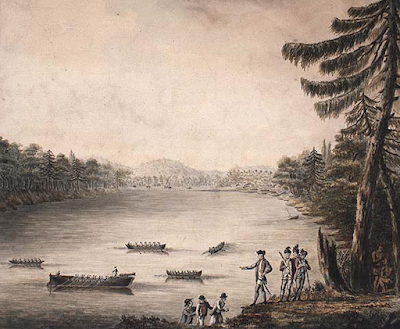
The upper end of Lake Champlain

New Boss, New Plan

In the spring of 1777, Major General John Burgoyne returned from London with 8,000 British and German troops and a new invasion plan. This plan involved three separate pushes from the west, north, and south, all aimed to meet at Albany. It also specified that Burgoyne, not Carleton, would command the main attack from Canada.


General John Burgoyne

Advance Guard Again

Brigadier General Fraser took command of Burgoyne’s advance guard, consisting of about 1,200 troops now trained as light infantry. The army launched from the mouth of the Richelieu River into Lake Champlain in an array of bateaux and canoes. Moving swiftly, Fraser’s forces protected the advance toward Fort Ticonderoga and captured it during a surprise attack as the American defenders retreated into the night. Fraser himself led the troops and raised a British flag.


Ticonderoga

A Hot Pursuit

Fraser then sent his advance guard in hot pursuit as the Americans chose to retreat through the dense forests to the south and east instead of taking the waterways that led south. The British vanguard continued on their trail and eventually cornered the American rear guard under Colonel Seth Warner, also an experienced fighter in the woods, near Hubbardton. In a back-and-forth struggle, the larger American force actually started to gain the upper hand, but a column of Germans under General von Riedesel helped turn the tide of battle.


The American militia acquitted itself well against
 the professionals at Hubbardton

Supply Chain Blues

The rest of Burgoyne’s army was now moving south again, with Fraser’s brigade leading the way. Albany was within reach with just one final push. However, Burgoyne faced a supply chain problem because he was far from his base, and shortages began to occur. Additionally, Fraser’s scouts, including some Canadians and Iroquois, reported a large concentration of Americans just north of Albany, under the command of a former British officer, General Horatio Gates.


Horatio Gates


Burgoyne began to lose his nerve. The other two attacks failed, and he was on his own. Instead of launching a full-scale assault, he ordered a reconnaissance in force with Fraser leading the right wing through thick woods and rugged terrain. 


Freeman's Farm

Clash of Titans

There, Fraser’s elite force clashed head-on with their American counterparts, the Virginia and Pennsylvania riflemen led by Colonel Daniel Morgan. Morgan’s riflemen wielded long rifles with grooved barrels that allowed for accurate fire over distances of more than one hundred yards. Fraser's brigade consisted of the best marksmen in the British Army. The lead flew as the top soldiers from each side exchanged fire, and ultimately, Morgan’s force was pushed back, creating an opportunity to exploit the situation and maneuver around the American flank.


Dan Morgan


 A Pause and a Probe

But Burgoyne did not approve and instead withdrew his army back to camp to assess the supply situation. That situation only worsened, and as autumn advanced, Burgoyne found himself in a desperate predicament. This time, he launched a probing attack. The idea was to gauge the enemy and exploit any weaknesses. He initiated his probe on October 7 in what would become the Battle of Bemis Heights.


Bemis Heights

Frenzied Fighting

Once again, Fraser found himself in the thick of things with his brigade. However, the Americans showed no signs of backing down and launched fierce counterattacks all along the front, led by General Benedict Arnold. The British forces held their ground and, under the relentless pressure of American volleys and bayonet charges, withdrew. Time and again, Fraser rallied units and formed the line. Mounted, and despite the sheets of lead whistling all around, he waved his saber. 


Fraser struck on the third shot

In the Crosshairs

From somewhere far off, an American rifleman cocked his hammer and gazed down the long barrel of his rifle, leveling it on a red-coated figure on horseback. Legend has it that the sniper was Private Tim Murphy, who allegedly said, “That is a gallant officer, but he must die.” He squeezed the trigger; the hammer cracked down, igniting the firing pan and launching a ball that just missed Fraser. A second shot struck his saddle, but Fraser ignored the fire. Ignoring pleas from his aides, he continued until a third shot hit home with a ball into his belly – a mortal wound.


American Riflemen moving into firing positions

A Blow to an Army

The fall of Fraser shocked the entire British Army—especially Burgoyne, who quickly ordered his battered forces back to their camp north near Saratoga.


Baroness Fredericka von Riedesel


Desperate hands dragged the dying general to the rear, where von Riedesel's wife, Baroness Fredericka, who had traveled with her husband on the wilderness campaign, cared for him.


Fraser mourned on the battlefield


The brave highlander died the next day and was buried at the Great Redoubt in a solemn ceremony held under the guns and muskets of the surrounding rebel army. A stray round from the American artillery nearly disrupted the event. Upon learning of it, Horatio Gates ordered a gun salute instead. Burgoyne would soon surrender his army, ending the campaign and influencing the indecisive King of France to favor the Americans.


The fighting Scot's exact resting place 
at the Great Redoubt is unknown

Death's Legacy

Fraser’s life of action and service ended in a way any warrior would have chosen. But Britain lost more than a warrior; it lost one of its best generals, a man who truly understood the kind of fighting and the kind of fighting man required to win the war. Had he not fallen on that October day, he might have risen as the leader capable of subduing the colonies for the Crown, just as he once subdued his own Highland clans. Yet, ironically, the gallant Scot who fought for England, Holland, and German allies never fought for Scotland and is most remembered in America.


Thursday, September 30, 2021

Gentleman Johnny


This edition of the Yankee Doodle Spies begins a series that profiles key historical figures in the upcoming novel of the acclaimed series, The North Spy. As a minor spoiler, this part of Jeremiah Creed's adventures centers on the British invasion of New York from Canada in 1777. No one is more pivotal to that event than John Burgoyne.


The flamboyant and controversial figure at his best, Burgoyne embodies the classic noble-warrior-literati-celebrity archetype. As distinctive a personality as any archetype can be... His nickname, Gentleman Johnny, reflects how his soldiers see him—and how he perceives himself.

Military Brat or Bastard?

Burgoyne was born on February 24, 1722, in Sutton, to Captain John Burgoyne and his wife Anna Maria, the daughter of a wealthy merchant. Speculation suggests that young John might be a bastard—the illegitimate child of Lord Bingley. Bingley became John’s “godfather” and named him in his will as his heir if his daughters did not produce male heirs.

There was definitely money available to give John a head start in life. So at age 11, Burgoyne began attending Westminster School in London. There, he made some useful friends (always the goal), including Thomas Gage – a future General and the last Royal Governor of Massachusetts. Another close friend was James Smith-Stanley, also known as Lord Strange, who was the son of the wealthy and influential Lord Derby. At 15, Burgoyne joined the British Army by purchasing a commission in the Horse Guards.


John Burgoyne


Since the Guards were based in London and his duties were light, he had plenty of time and opportunities to socialize with high society. He soon earned the nickname, "Gentleman Johnny" for his stylish uniforms and fast lifestyle. However, he quickly accumulated large debts, and it is believed he sold his commission in 1741 to pay them off.

Return to the Colors

The War of the Austrian Succession gave the young dilettante a chance to reinvent himself or, better yet, to rebuild his military career. The British Army was expanding to counter the threat from France, and in April 1745, he was commissioned in the newly formed 1st Royal Dragoons. Unlike most “bought” commissions, as a new regiment, Burgoyne received his commission without any cost. 

Promoted to lieutenant later that year, he served with his regiment at the Battle of Fontenoy, leading troopers in several charges against the French. By 1747, Burgoyne had saved enough money to buy a captaincy—a rank that would give him the platform to get noticed, but the end of the war in 1748 ended any chances of further active service.


Battle of Fontenoy


Cupid’s Arrow

After the war, Burgoyne began courting Charlotte Stanley, the sister of his close friend at Westminster School, Lord Strange. When Charlotte's father, Lord Derby, disapproved of the match, John and Charlotte eloped, causing a scandal and leading his father to cut off her substantial allowance. Since officers on inactive duty received no pay, Burgoyne was forced to sell his commission for 2,500 dollars. 

The young lovers then traveled around Europe, mainly in France and Italy. But it wasn't just about love. During this period, Burgoyne became a dedicated fan of the arts and literature, and this journey helped inspire his creative side. He also began studying treatises on warfare and touring battlefields and fortresses. 


Cupid's Arrow


Return to England and the Army

When his wife gave birth to their only child, Charlotte Elizabeth, they moved back to Britain. Arriving in 1755, his former schoolmate Lord Strange helped the couple reconcile with Lord Derby, who then assisted Burgoyne in purchasing a captaincy in the 11th Dragoons. 

In 1758, Burgoyne joined the prestigious Coldstream Guards, where the ongoing Seven Years' War helped him rise to the rank of lieutenant colonel. In June 1758, he took part in a raid on St. Malo, France, where British forces burned French ships. This was followed by another raid on Cherbourg under then-Captain Richard Howe, who would later lead the Royal Navy in North America during the American War.


Richard Howe


A New Kind of Command

But John Burgoyne quickly developed new ambitions—to command one of the British Army's two new cavalry regiments, the 16th Light Dragoons. This new unit allowed John to apply some of his ideas about military science in practice. Burgoyne was no longer a dilettante. Unlike others who did not get directly involved in managing their regiments, he personally oversaw the formation of his unit and recruited officers from the landed gentry in Northamptonshire. 

He aimed to create a model unit built around his principles of military service: honorable officers, a strong sense of duty, and well-trained, well-equipped men treated with respect. He did not want his men to be the stereotypical dregs of society. To attract high-quality recruits, he worked to provide his men with the best horses, uniforms, and equipment.


Young Cavalry Commander


Unlike British Army traditions, Burgoyne encouraged his officers to get to know the “other ranks.” His concept of warfare emphasized that men should be independent thinkers in combat, not mindless robots like Frederick the Great’s. To facilitate this, he created and published a transformative regimental code of conduct. He also expected his officers to be better educated, urging them to spend time each day reading and learning French, since many of the top military texts were in French, such as the writings of Marechal Maurice de Saxe.


Marechal Maurice de Saxe


Politics, War & Arts

Somehow, Burgoyne found the time and money to get elected to Parliament for Midhurst in 1761. But the next year, he headed to Portugal as a new brigadier general. He gained recognition for capturing Valencia de Alcántara and then defeating the Spanish in the Battle of Vila Velha. During the battle, Burgoyne directed Lieutenant Colonel Charles Lee, future Deputy Commander of the Continental Army, to charge a Spanish artillery battery. 


Charles Lee


Burgoyne returned to Britain at the end of the war. In 1768, he was re-elected to Parliament and appointed governor of Fort William, Scotland. He was outspoken and somewhat “progressive” in Parliament—advocating for military and colonial reform, especially within the East India Company. By this time, he was a major general, but he also dedicated a significant amount of his time to the arts. He had enough free time to write plays and poetry. In 1774, his play The Maid of the Oaks was performed at the Drury Lane Theater.


Drury Lane Theater

Member of the Dream Team

When the American colonial resistance broke out into war in April 1775, Lord George Germain, Minister for the Colonies, sent three of the most promising officers willing to face the Americans (several others refused to serve against fellow Britons). So the dream team of John Burgoyne, William Howe, and Henry Clinton, all highly experienced and renowned veterans, sailed to Boston. With General Thomas Gage in command, there was a surplus of officers, so Burgoyne did not take on field command. However, the debacle at Bunker Hill and the siege gave him plenty of opportunities to learn from others’ mistakes.  


General Thomas Gage

Home and Back and Home

Frustrated, Burgoyne returned to England in November 1775. His wife Charlotte died in February 1776, which deepened his sorrow. Although Burgoyne never remarried, he started a long affair with a married actress, Susan Caulfield, with whom he had four children between 1782 and 1788. The children were raised in Lord Derby's household, and the oldest became Field Marshal Sir John Fox Burgoyne.


General Sir Guy Carleton

His wife gone and eager to prove himself, Burgoyne returned to North America in the spring. This time, arriving at Quebec, where he served under Governor Sir Guy Carleton, who had just stopped the American invasion. Although Carleton managed to push American forces out of Canada, he failed to follow up with a drive on Albany, NY. Burgoyne became critical of Sir Guy’s caution and once again sailed for Britain.

A Brilliant Scheme

Among his other traits, Burgoyne was a smooth talker. Once back in London, he began pressing the Minister for the Colonies, Lord Germain, who was the key figure for defeating the rebellion, about his plan to win the war in 1777. 

The plan involved a three-pronged attack: a thrust south from Lake Champlain aimed at seizing Albany, supported by a detachment led by Lt. Colonel Barry St. Leger approaching from the west through the Mohawk Valley, and a northward advance up the Hudson River from New York led by Sir William Howe to seal the Americans' fate. 

The goal was to cut off New England from the rest of the American Colonies—a classic divide and conquer strategy. Burgoyne’s plan was brilliant but ultimately impractical due to political and geographical challenges.


Lord George Germain


What we have here is Failure to Communicate

Confusion between Germain and Lord Howe, commander-in-chief in North America, would be their undoing. Howe planned to move south toward Philadelphia that year. It is unclear when Germain informed Burgoyne that his support from New York City would be limited. Still, Burgoyne landed in Canada and assembled more than 7,000 men – British regulars, German auxiliaries, as well as some Canadians and Indians.


Burgoyne devised a brilliant but complex plan

Howe (sic) He Lost

I will not delve deeply into this complicated and crucial military event. My future novel, The North Spy, will cover most of the major and some of the minor activities. Burgoyne’s plan was thwarted by several factors. 

Time was not on his side, as the campaign season in the north was short, and he started late and slowly. The terrain was some of the most difficult in North America, with dense forests, numerous bodies of water, and mountains to navigate. Additionally, the Americans rallied most fervently against the incursion, spurred on by atrocities committed by Burgoyne’s Indian allies – both rumored and real. 

Delays & False Assumptions

The initial delay was gathering enough vessels to exploit the excellent waterways—a virtual superhighway leading straight into the heart of the colonies. It was already late June when they arrived on Lake Champlain. Burgoyne’s assumption that widespread Loyalist and Indian support would rally around him was immediately shattered. 

This was a consistent misjudgment in British thinking throughout the war. There was never a large number of Loyal Americans eager to fight, and only a few Native Americans and Loyalists joined his forces. Although Burgoyne captured the northern stronghold, Fort Ticonderoga, by early July, he made a critical mistake by pursuing the Americans. He started diverging from his supply line as his men were lured further away from the waterways. 


Fort Ticonderoga


A Small Win & A Big Loss

A minor victory at Hubbardton on July 7 only gave him false confidence. Burgoyne’s advance south toward Forts Anne and Edward was delayed by the retreating Americans, who blocked roads and trails with trees and destroyed any bridges. Around this time, he learned Howe was sailing to Philadelphia – the crucial push from the south would not happen. Meanwhile, the supply situation worsened as the army lacked enough transport to cross the region's primitive roads.


Battle of Hubbardton


The need for supplies led him to send a force of Germans foraging to the east, where they stumbled into a hornet’s nest of American militia at Bennington on August 16. The New England militia under John Stark defeated the British, inspiring more men to join the cause. 

Many of Burgoyne’s Indian allies began to sense the changing situation and started to drift off to plunder and return home. To make matters worse, Barry St. Leger was turned back at Fort Stanwix. The other part of the triad was gone. Burgoyne had two options: consolidate at Fort Ticonderoga and continue the fight next year – or take a gamble and push farther south.


Battle of Bennington 

The Die is Cast

He took the plunge. Burgoyne decided to abandon his supply lines and attempt a “brute squad” push on Albany in time for winter quarters. He crossed to the west bank of the Hudson on September 13. But just south of Saratoga, a rapidly growing American army, fortified with defense works designed by famed Polish engineer Thadeuz Kozciusko at a place called Bemis Heights, waited. 

The weak Major General Horatio Gates commanded the force, composed mainly of New England and New York militia, but he also had some elite continental troops sent north by George Washington. Gates may have been called "Granny" (his nickname), but the next line of command included some of the war's best leaders, such as Brigadier General Benedict Arnold, Colonel Dan Morgan, Enoch Poor, Ebenezer Learned, and Benjamin Lincoln.


General Horatio Gates


Freeman's Farm

Burgoyne hesitated. His army was weakened and morale was dropping. Although Gates was happy to stay behind his defenses and wait (which wasn't a bad idea), he let Arnold try a strategy. On September 19, Arnold and Morgan attacked Burgoyne's troops at Freeman's Farm. Intense fighting broke out. Both sides suffered heavy losses, but the British retreated to regroup.  


Battle of Freeman's Farm

Bemis Heights

With their supply situation critical, many British commanders recommended a retreat. Burgoyne anxiously hoped that a small diversion from NYC launched by former dream team member Henry Clinton would draw some of the Americans south of Albany. But Clinton’s move was too little, too late. Yet unwilling to fall back to Fort Ticonderoga, Burgoyne tried a last desperate move at Bemis Heights on October 7. 

A strong column under General Simon Fraser was smashed, and Fraser, his best subordinate, was killed by a sniper. So were precious regulars and Germans who would never be replaced. Burgoyne showed personal bravery and was nearly shot several times by American marksmen. When Fraser's column was repulsed, the Americans launched their own attack and punished the British, although they failed to take and hold the British defenses. But Burgoyne had been beaten.


Battle of Bemis Heights

An “Unconventional” Surrender

The British retreated to their camp near Saratoga. Meanwhile, the Americans had cut off his retreat to the north and were daily harassing his lines with sniper fire. Stuck in two pitched battles and now unable to fall back on supply lines or break southward, Burgoyne surrendered on October 17 at Saratoga. 

Yet “Gentleman Johnny” tried to make the best of a bad situation through a technical protocol. He managed to persuade Gates (a former British officer) to allow him to sign a “convention” instead of an unconditional surrender. Also, he and his men were to be returned promptly to Britain. 

Congress later annulled the deal. While British and German officers were sent home on parole, the “other ranks" laid down their arms under the watch of American militia and Continentals, and roughly 5,800 soldiers marched off to captivity in Boston and eventually Charlottesville, Virginia.


Burgoyne Surrenders at Saratoga


Home in Disgrace

Saying Burgoyne returned to Britain in disgrace is an understatement. This was one of the worst defeats in British history – surpassing Malplaquet, Fontenoy, or Carillon. The American militia had routed a British army in the field – convincing France to openly ally with the emerging American nation, later joined by Spain. The impact on world history would be profound.


Burgoyne's demand for a court-martial
was denied

Attacked by the government for his failures, Burgoyne tried to clear his name by blaming Germain for not ordering Howe to support his campaign. He demanded, but did not receive, a court-martial to clear his disgrace. Instead, King George III stripped him of all titles. Once again, Burgoyne was out of the army. But not for long.

Political Winds

Frustrated by the lack of support from Lord North’s administration, whom he had strongly backed, Burgoyne switched his political allegiance from the Tories to the Whigs. Soon, things turned around for Burgoyne. 


Things went south for Lord North -
to Burgoyne's advantage


When Lord North’s cabinet fell in 1782, Burgoyne gained the favor of the Whigs, and his rank of major general was restored along with a colonelcy in the King’s Own Royal Regiment. Burgoyne maneuvered to secure a top military appointment—commander in chief in Ireland—and also became a privy councilor. 

However, he left the government when Lord Rockingham’s administration collapsed a year later. Still, this allowed him time to focus on his literary projects, which had become his main passions besides his mistress.

Burgoyne Reinstated

Acclaimed Playwright

Burgoyne wrote two romantic comedy plays: Maid of the Oaks, completed by 1774, and The Heiress, written in 1786, which is arguably his best work. He also collaborated with Richard Brinsley Sheridan on the production of The Camp in 1778. In 1780, he wrote the libretto for William Jackson’s The Lord of the Manor. Burgoyne translated Michel-Jean Sediane’s Richard Coeur de Lion for a semi-opera at the Drury Lane Theatre in 1788.


Actress Frances Abington 
in Maid of the Oaks


Legacy

Despite his failed strategy and campaign at Saratoga, John Burgoyne is best remembered for his literary achievements among contemporary and post-Revolutionary War Britons. He was most admired for The Heiress, which was a great success and beloved by many both before and after his death. Gentleman John Burgoyne died suddenly at his Mayfair home on June 3, 1792. He was buried at Westminster Abbey.


Burgoyne's Legacy was his plays