Followers

Showing posts with label Seven Years War. Show all posts

Tuesday, November 30, 2021

Fighting Fraser

This is the third profile in a series highlighting a character from book four of the Yankee Doodle Spies series, The North Spy, which is set to be released next year. Since my previous profile featured a Scotsman who fought for America, it only makes sense to follow up with a Scotsman who fought for England. Not just any Scotsman, but a member of the famous Fraser clan of Highland warriors. 


Proud Lineage

Simon Fraser was born into a proud Scottish Highland lineage in Balnain, Scotland, on May 26, 1729. His family and clan were courageous warriors, and many of them fell at the pivotal Battle of Culloden in 1745. Those who survived lost their lands and heritage and were forced into exile.


Culloden smashed the Clans - but not the Highland spirit

Dutch Service

The Scots, like their cousins across the Irish Sea, often fight for the English even when they are not technically fighting against them. This is what young Fraser did, starting with a period in one of the Scottish Brigades hired by the Netherlands—the 4th Brigade, specifically. In the final years of the War of Austrian Succession, young Simon fought in the 1747 siege of Bergen-op-Zoom. The attacking French forces overwhelmed the defenses and flooded into the town, where fierce fighting took place. During the attack and counterattack, Fraser was wounded. 


Seige of Bergen-Op-Zoom

Royal American

With the end of the war, the Dutch Brigade was reduced to a single battalion, prompting Fraser to look for opportunities elsewhere. The start of the Seven Years' War provided a prime chance for an eager and now experienced young Highlander. In 1756, Fraser joined the British Army’s 62nd Royal American Regiment of Foot. Renumbered as the 60th the following year, it later became known as The King’s Royal Rifle Corps.


Back to the Clan

Fraser did not stay with the 60th for long. In January 1757, he accepted a commission in a newly formed regiment of highlanders, the 63rd Highlander Regiment of Foot. The regiment was led by Simon’s cousin, Lord Lovat, who was also named Simon Fraser. The unit was called Fraser’s Regiment, and its ranks mostly consisted of Frasers. This was probably the main reason for joining—the chance to fight alongside and for kin.


Fighting French & Indians

Fraser traveled to America to fight the French, taking part in the siege of Louisbourg, which, when captured, gave Britain control of the mouth of the Saint Lawrence River. He served under British General James Wolfe during the 1759 attack on Quebec, the decisive battle of the war in America. The 78th Regiment climbed the Heights of Abraham with Wolfe, and Lieutenant Fraser was wounded in the fierce fighting, while Wolfe was mortally wounded in this great victory. 


Scaling the Heights of Abraham

Fraser’s time with the 60th and his service in America with the 78th opened his eyes to a different style of fighting in the wooded wilderness—the need for disciplined troops who could fight outside of massed formations and rely on terrain and marksmanship to take down enemies like the Indian allies of the French. After Quebec, Fraser’s unit had garrison duty in the city and spent some time in New York, but the French and Indian war was nearing its end.


Fraser's Highlanders mingle with Iroquois Braves

Seven Year Itch

By 1760, Fraser was back in Europe—though the Seven Years' War had not yet ended. This led to another transfer—this time to the 24th Regiment of Foot, which was sent to Germany to serve in Lord Granby’s Corps. Over the next two years, the 24th fought in more than half a dozen sieges and major battles against the French. He was recognized for heroism at the Battle of Wezen in November 1761. Fraser led a hand-picked company of fifty men in an attack that drove off about 400 French troops. He was promoted to major during this time, learning a lesson about what specially trained men could accomplish against greater odds.


British infantry in the Seven Years' War

Post-Treaty of Paris

After the Treaty of Paris was signed in 1763, Fraser continued his military service in Germany, Ireland, and Gibraltar. From 1763 to 1769, Simon Fraser and the 24th Regiment were stationed in Gibraltar. He performed well and was promoted to Lieutenant Colonel of the 24th in 1768. Fraser trained the regiment in specialized light infantry tactics, making it one of the first British regiments to focus on this approach.


Gibraltar

It was also in Gibraltar that he met Margarita Hendrika Beck Grant, the widow of Major Alexander Grant, a fellow Scot. After exchanging letters for some time, they married. Soon afterward, they moved to Ireland when the 24th was transferred there. The couple had no children.


Brigadier General Simon Fraser

War Clouds in America

Fraser had watched as the North American colonies went into rebellion and war. The rebels expelled a British Army from Boston in 1775 and invaded Canada. More troops were needed to put down the rebellion. More importantly, Britain needed experienced officers. So, as commander of a brigade of five battalions, Fraser set sail from Ireland and returned to North America in April 1776. He was sent to support the beleaguered Governor-General Guy Carleton, who was surrounded in Quebec by American rebels. Carleton had held off the invading army against all odds during a brutal winter campaign. Fraser’s arrival helped him go on the offensive.


Governor-General Guy Carleton

In the Vanguard

Fraser wasted no time; he defeated American General William Thompson’s division at Trois Rivieres in June. Named brevet Brigadier General by Carleton, Fraser took command of the Advance Guard of the British counterattack into New York’s Champlain Valley. Although Carleton’s campaign was successful, the stubborn American defense, led by Brigadier General Benedict Arnold, disrupted his schedule by engaging him at Valcour Island. The battle was won, but winter was approaching.


Valcour Island

An Unsavory Pause

Rather than risk a final descent into Albany as winter approached, Carleton retreated to the northernmost part of Lake Champlain, planning to move again the following year. Fraser, like many other officers, was unhappy with this cautious strategy, but they had to wait for a new season—and a new commander. During the winter quarters, Fraser trained his troops in light infantry tactics and prepared them for operations in the rugged American wilderness.
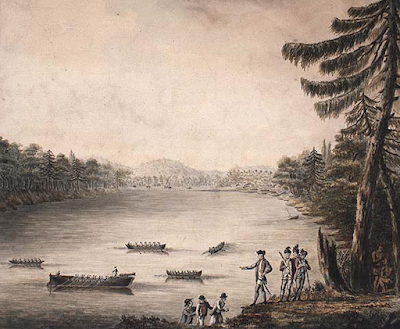

The upper end of Lake Champlain

New Boss, New Plan

In the spring of 1777, Major General John Burgoyne returned from London with 8,000 British and German troops and a new invasion plan. This plan involved three separate pushes from the west, north, and south, all aimed to meet at Albany. It also specified that Burgoyne, not Carleton, would command the main attack from Canada.


General John Burgoyne

Advance Guard Again

Brigadier General Fraser took command of Burgoyne’s advance guard, consisting of about 1,200 troops now trained as light infantry. The army launched from the mouth of the Richelieu River into Lake Champlain in an array of bateaux and canoes. Moving swiftly, Fraser’s forces protected the advance toward Fort Ticonderoga and captured it during a surprise attack as the American defenders retreated into the night. Fraser himself led the troops and raised a British flag.


Ticonderoga

A Hot Pursuit

Fraser then sent his advance guard in hot pursuit as the Americans chose to retreat through the dense forests to the south and east instead of taking the waterways that led south. The British vanguard continued on their trail and eventually cornered the American rear guard under Colonel Seth Warner, also an experienced fighter in the woods, near Hubbardton. In a back-and-forth struggle, the larger American force actually started to gain the upper hand, but a column of Germans under General von Riedesel helped turn the tide of battle.


The American militia acquitted itself well against
 the professionals at Hubbardton

Supply Chain Blues

The rest of Burgoyne’s army was now moving south again, with Fraser’s brigade leading the way. Albany was within reach with just one final push. However, Burgoyne faced a supply chain problem because he was far from his base, and shortages began to occur. Additionally, Fraser’s scouts, including some Canadians and Iroquois, reported a large concentration of Americans just north of Albany, under the command of a former British officer, General Horatio Gates.


Horatio Gates


Burgoyne began to lose his nerve. The other two attacks failed, and he was on his own. Instead of launching a full-scale assault, he ordered a reconnaissance in force with Fraser leading the right wing through thick woods and rugged terrain. 


Freeman's Farm

Clash of Titans

There, Fraser’s elite force clashed head-on with their American counterparts, the Virginia and Pennsylvania riflemen led by Colonel Daniel Morgan. Morgan’s riflemen wielded long rifles with grooved barrels that allowed for accurate fire over distances of more than one hundred yards. Fraser's brigade consisted of the best marksmen in the British Army. The lead flew as the top soldiers from each side exchanged fire, and ultimately, Morgan’s force was pushed back, creating an opportunity to exploit the situation and maneuver around the American flank.


Dan Morgan


 A Pause and a Probe

But Burgoyne did not approve and instead withdrew his army back to camp to assess the supply situation. That situation only worsened, and as autumn advanced, Burgoyne found himself in a desperate predicament. This time, he launched a probing attack. The idea was to gauge the enemy and exploit any weaknesses. He initiated his probe on October 7 in what would become the Battle of Bemis Heights.


Bemis Heights

Frenzied Fighting

Once again, Fraser found himself in the thick of things with his brigade. However, the Americans showed no signs of backing down and launched fierce counterattacks all along the front, led by General Benedict Arnold. The British forces held their ground and, under the relentless pressure of American volleys and bayonet charges, withdrew. Time and again, Fraser rallied units and formed the line. Mounted, and despite the sheets of lead whistling all around, he waved his saber. 


Fraser struck on the third shot

In the Crosshairs

From somewhere far off, an American rifleman cocked his hammer and gazed down the long barrel of his rifle, leveling it on a red-coated figure on horseback. Legend has it that the sniper was Private Tim Murphy, who allegedly said, “That is a gallant officer, but he must die.” He squeezed the trigger; the hammer cracked down, igniting the firing pan and launching a ball that just missed Fraser. A second shot struck his saddle, but Fraser ignored the fire. Ignoring pleas from his aides, he continued until a third shot hit home with a ball into his belly – a mortal wound.


American Riflemen moving into firing positions

A Blow to an Army

The fall of Fraser shocked the entire British Army—especially Burgoyne, who quickly ordered his battered forces back to their camp north near Saratoga.


Baroness Fredericka von Riedesel


Desperate hands dragged the dying general to the rear, where von Riedesel's wife, Baroness Fredericka, who had traveled with her husband on the wilderness campaign, cared for him.


Fraser mourned on the battlefield


The brave highlander died the next day and was buried at the Great Redoubt in a solemn ceremony held under the guns and muskets of the surrounding rebel army. A stray round from the American artillery nearly disrupted the event. Upon learning of it, Horatio Gates ordered a gun salute instead. Burgoyne would soon surrender his army, ending the campaign and influencing the indecisive King of France to favor the Americans.


The fighting Scot's exact resting place 
at the Great Redoubt is unknown

Death's Legacy

Fraser’s life of action and service ended in a way any warrior would have chosen. But Britain lost more than a warrior; it lost one of its best generals, a man who truly understood the kind of fighting and the kind of fighting man required to win the war. Had he not fallen on that October day, he might have risen as the leader capable of subduing the colonies for the Crown, just as he once subdued his own Highland clans. Yet, ironically, the gallant Scot who fought for England, Holland, and German allies never fought for Scotland and is most remembered in America.


Thursday, April 30, 2020

The King’s Engineer


The fight for North America during the 18th century involved a diverse group of brave and hardworking people, including frontier woodsmen, hearty yeoman farmers, professional soldiers, and clever politicians, as well as the merchants, tradesmen, and farmers who financed and supplied them. There is another crucial group that helped build an empire, especially one carved from the wilderness – the engineer. Skilled in planning, surveying, and map-making, engineers linked people to the land. Warfare in North America focused on land and was influenced by it. Geography shapes history.


Montresor would spend most of his
military career in North America


Servant of Empire

James Montresor

One such engineer was John Montresor. Montresor was the son of a British officer of French Huguenot descent, James Gabriel Montresor. John was born in 1736 at the key British base in Gibraltar. The senior Montresor served as chief engineer at that time. John attended Westminster School in England for four years (1746-1750). When he returned to Gibraltar, his father taught him the principles of engineering and took him to North America when he was appointed chief engineer for General John Braddock. 


Fighting the French and Indians

General Braddock

John Montresor was commissioned as an ensign in the 48th Regiment of Foot in March 1755 and appointed as an engineer in June. The Braddock campaign against Fort Duquesne is legendary (see Yankee Doodle Spies Blog Post: Road of Destruction). The defeat of Braddock’s column by native warriors and French soldiers at the Battle of the Monongahela, along with Braddock's death, had a chilling effect on the British effort. It also turned young George Washington into a hero. During that battle, young ensign Montresor saw action and was wounded himself during the massacre. 


Montresor was wounded at
The Battle of the Monongahela


Promoted to lieutenant, Montresor was assigned to New York, the main theater against the French. He sharpened his engineering skills by supervising the construction of Fort Edward. In 1757, he assisted Lord Loudoun (British commander in N.A.) in a failed campaign against the powerful French stronghold at Louisbourg in Nova Scotia. The failure did not damage his career. He would return!


Montresor's engineering skills helped
secure the fall of Louisbourg

The following year, John received his commission as a practitioner-engineer and resigned from the infantry. From a career perspective, he chose the less common path. Engineers were essential in modern warfare, but advancing beyond major was rare and certainly not a route to becoming a general. However, as was true then and remains true today, engineers prioritized their work over promotion. That summer, he joined General Jeffery Amherst’s army on another attempt to capture Louisbourg. As an engineer, he played a key role in the siege of the fortress, which this time was successful. Montresor stayed in Nova Scotia after the fort's fall and, in March 1759, conducted a reconnaissance around the Bras d’Or Lakes. 


British infantry scaling cliffs to
reach the Plain of Abraham during the
Battle for Quebec


Montresor’s skills were recognized, and he was soon sent to join the army under General Wolfe in what would become a successful but tragic campaign (commanders on both sides were mortally wounded) against the capital of French North America, Quebec.


British General Wolfe died in the battle for Quebec,
his opponent, General Montcalm, was also mortally wounded


Carving out a New Land


Montresor stayed in North America after the Treaty of Paris ended the war in 1763. A rugged new world needed mapping, and all kinds of infrastructure had to be planned and built—especially forts to protect the newly acquired empire. What better position for an engineer? He remained with the occupying army, working for the newly appointed governor, General James Murray, on a series of surveying expeditions in the freshly conquered territory. 

Probably the most important of these was helping Murray map the St. Lawrence River. Montresor was also involved in building forts in the new territory. His skills in French allowed him to serve in a pacification role, disarming local militias and securing the loyalty of the king’s new subjects. He also took time to explore the wilderness between Quebec and the Kennebec River (Maine). Ironically, his written records would later be used by Colonel Benedict Arnold in his campaign against Canada in 1775.


John Murray commissioned a seminal
map of the Saint Lawrence River 


Pontiac's War


In 1763, Montresor was stationed in New York, but the outbreak of Pontiac’s Indian rebellion forced him to return to Canada. There, General Jeffery Amherst assigned him a risky covert mission: to travel hundreds of miles through hostile wilderness and deliver dispatches to the commander of the besieged garrison at Detroit. His familiarity with the land made him the perfect choice to serve as chief engineer for the relief column sent to Detroit the next year. However, before heading west, Montresor took time to build forts along the Niagara River. 


Montresor braved hostile Indian territory
to complete his mission to beleaguered Detroit


On his return from the Detroit expedition, Montresor was shipwrecked on Lake Erie. After switching to another boat, the engineer Montresor took some time on his way back to practice a little hydrography, exploring the depth and width of several tributaries of the lake along the way. 


Montresor made lemonade from lemons
using even a shipwreck to explore Lake Erie


Pause and a Promotion


The arrow of Eros struck him while he was in New York. Montresor married an American woman, Frances Tucker, in New York City on March 1, 1764. It must have been a good match because they ended up raising six children. 


Frances (nee Tucker) Montressor decked out
as a British officer. 

Stationed at Fort George (formerly Fort William Henry) in 1765, he observed the rise of the political movement that would eventually lead to insurgency and open rebellion, marked by the rioting in Albany and New York City protesting the Stamp Act. Montresor traveled to England in 1766. 

After returning to America, Montresor held the rank of captain-lieutenant and served as the master of the Ordnance for America. In this role, he spent much time in the mid-Atlantic region, constructing forts mainly along waterways like Boston, New York, and Philadelphia. One notable fort guarding Philadelphia on Mud Island was named after him and became the site of bloody conflict a few years later. 


Montresor drew up one of the earliest
professional maps of  The Big Apple


During the interwar period, he took time to survey the boundary between New York and New Jersey and built or upgraded forts and military bases. While in New York, he bought an island in the East River, which was named Montresor’s Island after him, though New Yorkers know it as Randall’s Island. Montresor supervised the development of a map of New York City during his time there.


Chief Engineer


In April 1775, he was in Boston when open war in North America broke out again, changing the direction of his career. He was now made the de facto chief engineer for the British forces in America, which led to his promotion to captain in January 1776. 


Captain John Montresor

For a while, he seemed to be the Forrest Gump of the British effort – seemingly everywhere and meeting everyone. He secured river crossings for the march on Lexington and Concord and helped trap the British column trying to sneak back to Boston after being stung by an angry crowd. His engineering skills were used in the defense of Boston, and he was one of the last officers to leave the besieged city.


Boston


As the chief engineer during the Battle of Long Island in August 1776, he likely planned the siege works aimed at forcing Washington’s beleaguered forces out of Brooklyn. Montresor witnessed the execution of Nathan Hale in New York City the following month. He allegedly provided aid to Hale, allowing him to use his office to write final letters to his family. The British chose him to cross rebel lines to inform the Continental Army of the execution, which reportedly affected him deeply. 


Montresor witnessed Nathan Hale's Execution


He gave up his post as chief engineer and served as General William Howe’s aide de camp for a time, but Montresor was later reinstated as chief engineer. When the campaign for Philadelphia was launched in 1777, he was in the thick of the operations. He fought during the Forage War in New Jersey and served at the Battle of Brandywine later that year. He also accompanied the army to Philadelphia, where he rebuilt the garrison's fortifications and later launched a brutal series of attacks that destroyed his former Mud Island defenses, which ironically included Fort Mifflin, the fort that once bore his name. 


Plans for Fort Mifflin, once known as Fort Montresor


With the British occupation of Philadelphia, he oversaw the construction of new defenses for the American capital. Montresor also planned the building of a pontoon bridge at Gray's Ferry on the Schuylkill River. 


Fort Montressor was renamed Fort Mifflin,
giving the King's Engineer the honor of attacking
his own creation


Major Andre

A Rapid Closure


As the British occupation continued, the commander in chief, Sir William Howe, was called back to England. Montresor, Howe’s former aide, aided Major John Andre (a future spymaster) in planning an elaborate farewell celebration known as the Meschianza.  


The Meschianza included parades


This was a series of extravagant events including shows, parades, musical concerts, displays, banquets, and a ball, ending with a fireworks display worthy of Broadway or Hollywood impresarios.


Major Andre arranging a Meschianza display
with an exotic oriental theme


The spring of 1778 marked the arrival of a new commander-in-chief, General Henry Clinton, and at some point that year, Montresor was replaced as chief engineer. He returned to England in October, where he retired from the army after more than twenty years of service to the king and country, although he spent little time in the latter. 

However, the king’s engineer faced difficulties in civilian life after the army. Montresor was unhappy with how the army treated him, feeling resentful because he had not received a promotion. He blamed the Ordnance Office for this and believed that his talents and achievements went unrecognized and unrewarded.


Sir Henry Clinton replaced Howe

It is unclear exactly why he left so abruptly. Perhaps he did not get along with Clinton because of his close association with Howe. However, it might have been related to something more basic – money. There were suspicions that he misused his broad discretion in carrying out his responsibilities as an engineer. 

In that role, he managed significant funds for procuring equipment, materials, and manpower for construction projects. The lack of effective accounting practices and financial controls may have allowed him to accumulate a substantial amount of money for himself.

Montresor was a highly precise and demanding engineer, often requisitioning the best materials for his projects. During the construction of the forts around Philadelphia, he submitted invoices for extensive materials that were ultimately denied by the colonial government. His high standards may also have put him at odds with General Murray in Quebec and possibly Henry Clinton.

A Desperate End


In 1782, his accounts went through a detailed audit, which led to him being held financially responsible for £50,000 of the roughly £250,000 he claimed as chief engineer in America. Despite vigorous appeals by Montresor, he lost. The Exchequer went after his estate, seizing his London home and property in Kent, eventually recovering £48,000. Despite his service, Montresor ended up in Maidstone prison, a debtors’ prison, where he tragically died on June 26, 1799. 


Debtor's Prisons were the final destination
of the bankrupt in the 18th century


Legacy


Two of Montresor’s sons received commissions in the British Army despite their father’s challenges, allowing the family tradition of service to king and country to persist. One is struck by the significant contribution Montresor made to British success in North America during three wars and a period of consolidation between them, yet he receives little recognition. 

This was probably partly because of the low regard for the more technical branches within an army rooted in old-fashioned tradition and social hierarchy. Had he been noble by birth rather than by achievement, or part of a prestigious regiment, his mistakes might have been overlooked. And of course, as a descendant of French Huguenots, he was not English. Just saying. This isn’t to justify sloppy accounting or ignore the facts of embezzlement, just a period of social observation.  


Cypher later adopted by
the Royal Engineers


Montresor, in an engineering style, kept a meticulous journal that recorded minutiae of daily operations and conditions. Precise distances and measurements were documented, along with daily temperatures. The surviving parts of his journal show a man with great attention to detail, but it also reveals a bit of hubris. Perhaps that hubris caused friction with peers and superiors, and possibly something worse. We will never know.


Surviving Montresor journals
provide an insight into the man and his times


Saturday, February 23, 2019

The First Baronet

Who is Peter Parker?


This edition of the Yankee Doodle Spies will recount the exploits of one Peter Parker. No, not that Peter Parker. Our Peter Parker was not a web-crawling teen like his comic book namesake. But before he was a teen, he was skipping along the rigging with a speed and grace that would make even Spider-Man jealous. This is our first naval topic in a while and focuses on a little-known British sailor who rose through the ranks due to long service, some patronage, good timing, and courage. Sometimes, all it takes to rise to the top is simply being there.


Skipping up the rigging


Midshipman


Our Peter Parker was born in Ireland in 1721, the son of Vice-Admiral Christopher Parker. Like all legacy officers of the Royal Navy, he started his career early, serving as a cabin boy and midshipman. During this period, he served on several ships under Vice-Admiral Edward Vernon of the West Indies station at the beginning of the War of Jenkins' Ear.


Vice Adm Sir Edward Vernon


War of the Austrian Succession


The eight-year War of the Austrian Succession provided plenty of action for the Royal Navy and numerous opportunities for up-and-coming young officers like Peter. Parker received his lieutenant’s commission in the summer of 1743 aboard the HMS Russell, a second-rate, 80-gun ship of the line. He served on several warships at various stations, most notably in the Mediterranean, where he participated in the battle of Toulon on February 11, 1744, aboard the flagship of Rear-Admiral William Rowley, the 90-gun HMS Barfleur.

Admiral William Rowley


In May 1747, he was promoted to captain and commissioned a captured French privateer as the 24-gun frigate HMS Margate. Captain Parker commanded this vessel in the Channel, the North Sea, and the Mediterranean. When she was paid off in April 1749, he had a brief stint aboard the 66-gun HMS Lancaster before going on half-pay with the end of the war. It was common practice to place officers on half-pay during periods between active conflicts.


Young Lieutenant Parker served at Toulon

Seven Years of War


Captain Parker remained ashore on half-pay for several years while overseeing the construction of the 44-gun HMS Woolwich in Portsmouth. With the outbreak of the Seven Years’ War, he went to sea on the Woolwich and commanded it on a voyage to the Baltic Sea. However, he fell seriously ill during the trip after catching a fever that swept through the ship.

After he recovered, the navy sent him to the Leeward Islands in December 1756, where, in January 1759, he transferred to the 50-gun HMS Bristol. Parker commanded the Bristol during the unsuccessful campaign against Martinique and later in the campaign that captured Guadeloupe.


Taking Fort Louis at Guadeloupe was one
of many sea-land campaigns in Parker's career


In 1760, he returned to his home station in the Channel, where he took command of the 64-gun HMS Montague. Parker captured several prize ships while navigating the narrow but dangerous waters between Britain and the Continent. His success earned him command of the 70-gun HMS Buckingham and a squadron that dismantled French fortifications on the Isle d’Aix. The next year, he took part in the assault on a fort at Belle-Isle. This was typical 18th-century warfare, involving the capture of positions and negotiations to secure a better peace. But fierce action and naval skill made this possible. His last wartime command was the 74-gun HMS Terrible just before the 1763 Treaty of Paris.


HMS Terrible in action

Another Half-Pay Hiatus


The 1763 Treaty of Paris placed Parker and most of his fellow officers on half-pay. This half-pay status aimed to cut costs while keeping experienced officers available for future conflicts. In the 18th-century Royal Navy, there was always the next war. Parker stayed without a command for nearly ten years. But then things changed. Knighted in 1772, Sir Peter Parker was given command of the second-rate but heavily armed (90-gun) HMS Barfleur when he rejoined the service in 1773. By then, tensions were rising in the North American colonies. In 1775, Parker was assigned to command the fourth-rate 50-gun HMS Bristol, but more importantly, he was soon to command a squadron and promoted to commodore.


Ships returning to Plymouth

War of Rebellion


In February 1776, Captain Peter Parker was appointed commodore of a small squadron at Plymouth and tasked with transporting several Irish regiments under General Charles Cornwallis to America. The destination was the Cape Fear region of North Carolina. This was part of a complicated plan in which he would work with North Carolina’s infamous Royal Governor Josiah Martin and General Henry Clinton to rally Loyalist support in the unrest-filled colony.


Sir Peter Parker, 1st Baronet

Ill-Fated Southern Rendezvous


Bad weather and bad luck thwarted these efforts. A rough Atlantic voyage followed, and by the time Parker’s fleet reached its rendezvous with Clinton, the expected Loyalist uprising they depended on had been crushed. To their dismay, they learned of the decisive battle at Moores Creek Bridge on February 21, 1776. 

The resettled Scots Highlanders of the Carolina hill country had agreed to march to the coast in support of the crown. Ironically, many of them had been resettled after the disaster at Culloden decades earlier in Scotland. Now, they had taken up the claymore for the crown that defeated them in 1745. The Highlanders’ attack was easily scattered by the rebels from the coastal Tidewater—thus, there was no force to link up with.


Battle at Moores Creek Bridge


But no armada should ever go to waste, so Parker and Clinton shifted their focus south to Charleston, South Carolina. The town was seen as being poorly defended. Quickly capturing it would provide a good naval base in the South and a safe haven for Loyalists across the region. The idea of winning hearts and minds remained a central part of the British approach to the war.

Charleston


On June 1, 1776, Parker’s flotilla was off Charleston, but the lack of charts (see the Yankee Doodle Spies Blog Post on hydrography) forced the British to sound the waters while they waited for the tides to favor an attack. It was a good plan given the circumstances, but the delay allowed the American commander, Colonel William Moultrie, time to strengthen the defenses of Fort Sullivan on Sullivan’s Island.


Moultrie's gallant defense of Fort Sullivan
spared the South for a few years


On June 28, Parker finally managed to land British troops on Long Island, the island further up the coast to the northeast of Sullivan’s Island, and positioned ships where they could bombard the island. Despite a severe bombardment, the defenders held their ground, shielded by Fort Sullivan’s palmetto walls. The spongy bark of the palmetto logs absorbed cannon fire. The defenders had only a few guns, but Moultrie utilized these effectively. He concentrated their fire on Parker’s flagship, HMS Bristol. In a stroke of bad luck, the ship’s cable was severed. Out of control, the Bristol swung around, and the guns from the fort unleashed enfilade fire upon her.

Our commodore bravely stood his post on the quarterdeck in the finest tradition of the Royal Navy. But a heated cannonball, deadly red-hot shot, burned his pants off his rear end and caused serious injuries. Meanwhile, things worsened further. To avoid capture, the frigate HMS Actaeon ran onto shoals and ran aground. Under American fire, the resourceful British sailors set their ship ablaze to prevent it from being captured. The intense fighting continued for 10 hours. Finally, with casualties exceeding 250, Parker signaled the flotilla to break off, and they disengaged.


Shoals, palmetto logs, and well-aimed guns set
our commodore's pants afire


Parker’s failure at Charleston preserved the South for the cause, at least for a few years. The resulting boost in American morale rallied southern patriots and subdued southern Loyalists. In this type of war, morale would prove to be decisive.

True North


With their commodore recovering from his burns, Parker’s flotilla returned to New York. There, it joined the fleet under Admiral Richard Howe. Commodore Parker recovered enough to command the squadron that captured Long Island in August 1776. At that time, his ships supported the landing of British troops on Long Island, forcing the rebel army to retreat from New York City.


Parker's leadership was part of a brilliant sea-land
campaign that resulted in victory on
Long Island and New York


In December 1776, Parker was entrusted with command of a flotilla that carried an invasion force under Henry Clinton in another successful operation: capturing Newport, Rhode Island. This gave the British an extra base from which to threaten Massachusetts and Connecticut. More maritime success for the commodore that would not go unnoticed.


Sir Henry Clinton


Commodore Parker stayed at Rhode Island for nearly a year with two 50-gun warships and several frigates under his command. Although the assignment seemed like a remote posting, his career was about to take a turn toward higher rank: flag officer!

A Flag Officer


Comte de Grasse
  Parker was promoted to rear admiral on April 28, 1777. He was soon named commander of the Jamaica Station (not the subway stop). By that time, British strategy had shifted to capturing as much of the West Indies as possible. The rest of the war focused on supporting efforts there against the French and Spanish. He performed his duties well and was promoted again to rear admiral in March 1779.

His time in America ended in 1782, and Parker returned to England in August of that year. He had the distinct privilege of carrying the captured French admiral, Francois-Joseph-Paul, Comte de Grasse, and his staff as prisoners from the Battle of the Saintes. Despite the defeat at the Saintes, de Grasse gained honors for his victory at the Battle of the Chesapeake in 1781-a rare defeat of the Royal Navy that set the stage for American victory. One can only wonder about the sea stories they shared over wine during the voyage back! In London, de Grasse would set the stage for negotiations that led to the Treaty of Paris, which ended the American War for Independence.

High Command

Service in American waters brought Parker great distinction, despite Charleston. He was elevated to baronet in 1783 and appointed commander of Portsmouth Harbor, the home port of the Royal Navy. During this time, he met and mentored a young Lieutenant Horatio Nelson, the future victor of Trafalgar. Parker helped Nelson early in his career, and for that, the British should hold him in high regard. Parker was named admiral of the fleet in September 1799 after the death of Admiral Lord Howe. He was also appointed a general of marines. Sadly, one of Parker’s last official acts was serving as the chief mourner at Vice-Admiral Lord Nelson’s funeral on 9 January 1806.


Parker would mentor a young Horatio Nelson
and sadly preside at his funeral


An MP


While not unusual for military officers of that era, Parker served in Parliament as the MP for Seaford from 1784 to 6. In 1787, he became the MP for Malden, holding the position until 1790. Parker’s West Indian prize money enabled him to build an estate in Essex, although his parliamentary address was registered as Bassingbourn in Cambridgeshire. He supported the government but delivered only two speeches during his time in the House of Commons. 

As a Member of Parliament, Parker held pro-slavery views, stating that “the abolition of the Africa Trade would, in my opinion, cause a general despondency amongst the Negroes and gradually decrease their population and consequently the produce of our islands, and must in time destroy near half our commerce and take from Great Britain all the pretensions to the rank she now holds as the First Maritime power in the World.”


Parliament

Family Life


True to his class and position, Parker made a good match in his family life by marrying Margaret Nugent. They had two sons and two daughters, with one son, Christopher, rising to Vice Admiral.

Admiral Sir Peter Parker, 1st Baronet, was regarded as tough and opinionated, yet well-respected for his composure and coolness in action. After all, how many admirals continued to fight with their pants seared off? While he was considered cantankerous, he met his match with Margaret, who had a very strong personality. During his command period in Jamaica, she was almost his equal in managing the station. He died in London on December 21, 1811, and was buried at St. Margaret's, Westminster.


Peter Parker's resting place at
St. Margaret's Church

Legacy


Peter Parker's career, reminiscent of Forrest Gump, spanned decades, continents, battles, and interactions with prominent figures of the 18th-century Royal Navy — a path that was not unusual. After all, building an empire often requires men to place themselves in strange situations, sometimes for years at a time. Naval officers frequently came from a long line of naval leaders. 

As we see, Parker's lineage was notably distinguished. Besides being the son and father of an admiral, he was also the grandfather of one. Parker's use of patronage helped elevate his son Christopher (who served under him) to captain and then admiral at a young age. Christopher's son, Captain Peter, the renowned 2nd Baronet, also served under his grandfather and alongside Horatio Nelson. 

The second Peter Parker fought in America, just like his father and grandfather, during the War of 1812. In 1814, near Baltimore, he was shot in the pants during combat, similar to the first Sir Peter — though sadly, it proved to be fatal. He was buried at St. Margaret's.


Captain Peter Parker, 2nd Baronet