Followers

Showing posts with label William Howe. Show all posts

Monday, November 28, 2022

The North Spy Retrospective

One of my "stretch" books in the Yankee Doodle Spies series is The North Spy, which takes my protagonist on a harrowing mission in a venue both exotic and remote. And me along with him! 


General Washington's Dilemma

As the winter snows of 1777 melt into spring blossoms, General George Washington faces a tough choice. He knows the British Army, hunkered down in their winter quarters, will strike like a snake at the first chance to take the American capital, Philadelphia. But where and how? Rumors are flying: across the Jerseys by land? Up the Delaware River by sea? Or maybe a mix of both? Yet another option proves to be the toughest puzzle: a move north to link up with a British Army gathering in Canada.


General George Washington


Diverse Approaches

General Washington did not realize that the British armies in New York and Canada would soon be working against each other. Washington has the Yankee Doodle Spies, in the form of Major Benjamin Tallmadge's troop of the 2nd Continental Line Dragoons, patrolling, scouting, and spying in hopes of understanding what the British commander in New York, Major General Sir William Howe, is planning. Despite the soundness of Major General John Burgoyne's "three-pronged" plan to join with Howe at Albany and split the colonies in two, Howe hesitates.

General William Howe


Northern Storm Clouds, Southern Squalls

The capable yet often slow-moving Howe faces significant criticism for failing to capture the rebel capital in 1776 but remains resolute in his mission to complete the task and defeat Washington. As Burgoyne gathers his forces, totaling over 8,000 men south of Montreal to make a move across Lake Champlain and down the Hudson River, he remains unaware that Howe has shifted his focus southward. Howe does instruct his second in command to stay in New York City with a few thousand men to help Burgoyne if possible. We will see how that plays out.


General John Burgoyne


Hopeless Mission

Enter Lieutenant Jeremiah Creed, whom Washington sends on a daunting, if not hopeless, mission to penetrate Burgoyne's Army, ostensibly to report back on its strength and objectives. Washington's "Intelligence Advisor" and senior intelligence officer, Colonel Robert Fitzgerald, provides Creed with secret orders that will connect him with an agent in Canada. Now all Creed has to do is figure out a plan to get there, find the agent, and work his way into the British Army!


Jeremiah Creed must cover a vast wilderness for his mission


To the North

As Creed continues his journey, he reconnects with old friends and faces new enemies. He will confront ruthless Canadian backwoodsmen, fierce Iroquois (Mohawk) warriors, and an army of British regulars and German auxiliaries eager to impose the war on the Americans by any means necessary. Throughout his journey, Creed must use deception and cunning at every turn. He also struggles with a crisis of conscience, as he is compelled to deceive and manipulate people in new and challenging ways.


Creed must face Iroquois warriors


This is a story of skill and bravery as much as of action – and there is enough action to fill Lake Champlain with blood!

TurningPoint

Americans rally to the cause as General Horatio Gates assumes command of the Northern Department. The armies engage in a series of battles, and Jeremiah Creed becomes involved. The Saratoga campaign is arguably the most important turning point of the American Revolutionary War. The North Spy offers my perspective on it, closely following the actions of British and American commanders and soldiers as they clash in deep forests, shimmering lakes, and flowing rivers of the great north. Spoiler alert: Burgoyne's army surrendered to the American rebels at Saratoga in October 1777, bringing France openly into the conflict.


Saratoga  surrender: the Turning Point


The North Spy was released by Lanyard Press. Available at Amazon via https://www.amazon.com/North-Spy-Yankee-Doodle-Spies/dp/1737663678

And at other purveyors of fine books!


Thursday, April 30, 2020

The King’s Engineer


The fight for North America during the 18th century involved a diverse group of brave and hardworking people, including frontier woodsmen, hearty yeoman farmers, professional soldiers, and clever politicians, as well as the merchants, tradesmen, and farmers who financed and supplied them. There is another crucial group that helped build an empire, especially one carved from the wilderness – the engineer. Skilled in planning, surveying, and map-making, engineers linked people to the land. Warfare in North America focused on land and was influenced by it. Geography shapes history.


Montresor would spend most of his
military career in North America


Servant of Empire

James Montresor

One such engineer was John Montresor. Montresor was the son of a British officer of French Huguenot descent, James Gabriel Montresor. John was born in 1736 at the key British base in Gibraltar. The senior Montresor served as chief engineer at that time. John attended Westminster School in England for four years (1746-1750). When he returned to Gibraltar, his father taught him the principles of engineering and took him to North America when he was appointed chief engineer for General John Braddock. 


Fighting the French and Indians

General Braddock

John Montresor was commissioned as an ensign in the 48th Regiment of Foot in March 1755 and appointed as an engineer in June. The Braddock campaign against Fort Duquesne is legendary (see Yankee Doodle Spies Blog Post: Road of Destruction). The defeat of Braddock’s column by native warriors and French soldiers at the Battle of the Monongahela, along with Braddock's death, had a chilling effect on the British effort. It also turned young George Washington into a hero. During that battle, young ensign Montresor saw action and was wounded himself during the massacre. 


Montresor was wounded at
The Battle of the Monongahela


Promoted to lieutenant, Montresor was assigned to New York, the main theater against the French. He sharpened his engineering skills by supervising the construction of Fort Edward. In 1757, he assisted Lord Loudoun (British commander in N.A.) in a failed campaign against the powerful French stronghold at Louisbourg in Nova Scotia. The failure did not damage his career. He would return!


Montresor's engineering skills helped
secure the fall of Louisbourg

The following year, John received his commission as a practitioner-engineer and resigned from the infantry. From a career perspective, he chose the less common path. Engineers were essential in modern warfare, but advancing beyond major was rare and certainly not a route to becoming a general. However, as was true then and remains true today, engineers prioritized their work over promotion. That summer, he joined General Jeffery Amherst’s army on another attempt to capture Louisbourg. As an engineer, he played a key role in the siege of the fortress, which this time was successful. Montresor stayed in Nova Scotia after the fort's fall and, in March 1759, conducted a reconnaissance around the Bras d’Or Lakes. 


British infantry scaling cliffs to
reach the Plain of Abraham during the
Battle for Quebec


Montresor’s skills were recognized, and he was soon sent to join the army under General Wolfe in what would become a successful but tragic campaign (commanders on both sides were mortally wounded) against the capital of French North America, Quebec.


British General Wolfe died in the battle for Quebec,
his opponent, General Montcalm, was also mortally wounded


Carving out a New Land


Montresor stayed in North America after the Treaty of Paris ended the war in 1763. A rugged new world needed mapping, and all kinds of infrastructure had to be planned and built—especially forts to protect the newly acquired empire. What better position for an engineer? He remained with the occupying army, working for the newly appointed governor, General James Murray, on a series of surveying expeditions in the freshly conquered territory. 

Probably the most important of these was helping Murray map the St. Lawrence River. Montresor was also involved in building forts in the new territory. His skills in French allowed him to serve in a pacification role, disarming local militias and securing the loyalty of the king’s new subjects. He also took time to explore the wilderness between Quebec and the Kennebec River (Maine). Ironically, his written records would later be used by Colonel Benedict Arnold in his campaign against Canada in 1775.


John Murray commissioned a seminal
map of the Saint Lawrence River 


Pontiac's War


In 1763, Montresor was stationed in New York, but the outbreak of Pontiac’s Indian rebellion forced him to return to Canada. There, General Jeffery Amherst assigned him a risky covert mission: to travel hundreds of miles through hostile wilderness and deliver dispatches to the commander of the besieged garrison at Detroit. His familiarity with the land made him the perfect choice to serve as chief engineer for the relief column sent to Detroit the next year. However, before heading west, Montresor took time to build forts along the Niagara River. 


Montresor braved hostile Indian territory
to complete his mission to beleaguered Detroit


On his return from the Detroit expedition, Montresor was shipwrecked on Lake Erie. After switching to another boat, the engineer Montresor took some time on his way back to practice a little hydrography, exploring the depth and width of several tributaries of the lake along the way. 


Montresor made lemonade from lemons
using even a shipwreck to explore Lake Erie


Pause and a Promotion


The arrow of Eros struck him while he was in New York. Montresor married an American woman, Frances Tucker, in New York City on March 1, 1764. It must have been a good match because they ended up raising six children. 


Frances (nee Tucker) Montressor decked out
as a British officer. 

Stationed at Fort George (formerly Fort William Henry) in 1765, he observed the rise of the political movement that would eventually lead to insurgency and open rebellion, marked by the rioting in Albany and New York City protesting the Stamp Act. Montresor traveled to England in 1766. 

After returning to America, Montresor held the rank of captain-lieutenant and served as the master of the Ordnance for America. In this role, he spent much time in the mid-Atlantic region, constructing forts mainly along waterways like Boston, New York, and Philadelphia. One notable fort guarding Philadelphia on Mud Island was named after him and became the site of bloody conflict a few years later. 


Montresor drew up one of the earliest
professional maps of  The Big Apple


During the interwar period, he took time to survey the boundary between New York and New Jersey and built or upgraded forts and military bases. While in New York, he bought an island in the East River, which was named Montresor’s Island after him, though New Yorkers know it as Randall’s Island. Montresor supervised the development of a map of New York City during his time there.


Chief Engineer


In April 1775, he was in Boston when open war in North America broke out again, changing the direction of his career. He was now made the de facto chief engineer for the British forces in America, which led to his promotion to captain in January 1776. 


Captain John Montresor

For a while, he seemed to be the Forrest Gump of the British effort – seemingly everywhere and meeting everyone. He secured river crossings for the march on Lexington and Concord and helped trap the British column trying to sneak back to Boston after being stung by an angry crowd. His engineering skills were used in the defense of Boston, and he was one of the last officers to leave the besieged city.


Boston


As the chief engineer during the Battle of Long Island in August 1776, he likely planned the siege works aimed at forcing Washington’s beleaguered forces out of Brooklyn. Montresor witnessed the execution of Nathan Hale in New York City the following month. He allegedly provided aid to Hale, allowing him to use his office to write final letters to his family. The British chose him to cross rebel lines to inform the Continental Army of the execution, which reportedly affected him deeply. 


Montresor witnessed Nathan Hale's Execution


He gave up his post as chief engineer and served as General William Howe’s aide de camp for a time, but Montresor was later reinstated as chief engineer. When the campaign for Philadelphia was launched in 1777, he was in the thick of the operations. He fought during the Forage War in New Jersey and served at the Battle of Brandywine later that year. He also accompanied the army to Philadelphia, where he rebuilt the garrison's fortifications and later launched a brutal series of attacks that destroyed his former Mud Island defenses, which ironically included Fort Mifflin, the fort that once bore his name. 


Plans for Fort Mifflin, once known as Fort Montresor


With the British occupation of Philadelphia, he oversaw the construction of new defenses for the American capital. Montresor also planned the building of a pontoon bridge at Gray's Ferry on the Schuylkill River. 


Fort Montressor was renamed Fort Mifflin,
giving the King's Engineer the honor of attacking
his own creation


Major Andre

A Rapid Closure


As the British occupation continued, the commander in chief, Sir William Howe, was called back to England. Montresor, Howe’s former aide, aided Major John Andre (a future spymaster) in planning an elaborate farewell celebration known as the Meschianza.  


The Meschianza included parades


This was a series of extravagant events including shows, parades, musical concerts, displays, banquets, and a ball, ending with a fireworks display worthy of Broadway or Hollywood impresarios.


Major Andre arranging a Meschianza display
with an exotic oriental theme


The spring of 1778 marked the arrival of a new commander-in-chief, General Henry Clinton, and at some point that year, Montresor was replaced as chief engineer. He returned to England in October, where he retired from the army after more than twenty years of service to the king and country, although he spent little time in the latter. 

However, the king’s engineer faced difficulties in civilian life after the army. Montresor was unhappy with how the army treated him, feeling resentful because he had not received a promotion. He blamed the Ordnance Office for this and believed that his talents and achievements went unrecognized and unrewarded.


Sir Henry Clinton replaced Howe

It is unclear exactly why he left so abruptly. Perhaps he did not get along with Clinton because of his close association with Howe. However, it might have been related to something more basic – money. There were suspicions that he misused his broad discretion in carrying out his responsibilities as an engineer. 

In that role, he managed significant funds for procuring equipment, materials, and manpower for construction projects. The lack of effective accounting practices and financial controls may have allowed him to accumulate a substantial amount of money for himself.

Montresor was a highly precise and demanding engineer, often requisitioning the best materials for his projects. During the construction of the forts around Philadelphia, he submitted invoices for extensive materials that were ultimately denied by the colonial government. His high standards may also have put him at odds with General Murray in Quebec and possibly Henry Clinton.

A Desperate End


In 1782, his accounts went through a detailed audit, which led to him being held financially responsible for £50,000 of the roughly £250,000 he claimed as chief engineer in America. Despite vigorous appeals by Montresor, he lost. The Exchequer went after his estate, seizing his London home and property in Kent, eventually recovering £48,000. Despite his service, Montresor ended up in Maidstone prison, a debtors’ prison, where he tragically died on June 26, 1799. 


Debtor's Prisons were the final destination
of the bankrupt in the 18th century


Legacy


Two of Montresor’s sons received commissions in the British Army despite their father’s challenges, allowing the family tradition of service to king and country to persist. One is struck by the significant contribution Montresor made to British success in North America during three wars and a period of consolidation between them, yet he receives little recognition. 

This was probably partly because of the low regard for the more technical branches within an army rooted in old-fashioned tradition and social hierarchy. Had he been noble by birth rather than by achievement, or part of a prestigious regiment, his mistakes might have been overlooked. And of course, as a descendant of French Huguenots, he was not English. Just saying. This isn’t to justify sloppy accounting or ignore the facts of embezzlement, just a period of social observation.  


Cypher later adopted by
the Royal Engineers


Montresor, in an engineering style, kept a meticulous journal that recorded minutiae of daily operations and conditions. Precise distances and measurements were documented, along with daily temperatures. The surviving parts of his journal show a man with great attention to detail, but it also reveals a bit of hubris. Perhaps that hubris caused friction with peers and superiors, and possibly something worse. We will never know.


Surviving Montresor journals
provide an insight into the man and his times


Saturday, December 13, 2014

Solid Soldier

Oft mentioned, Little Known


I have profiled a few of the "second-tier" First Patriots, those who played important but less widely celebrated roles in the American fight for independence. This blog examines one such individual from the British side. While researching the background of the Yankee Doodle Spies, I noticed that the name Alexander Leslie appeared more often than others. His name came up in battles and campaigns from New York to the Carolinas. I started to wonder about this man, who seemed to lead troops and be involved in the most interesting places but never quite became a household name like Simon Fraser or Banastre Tarleton.


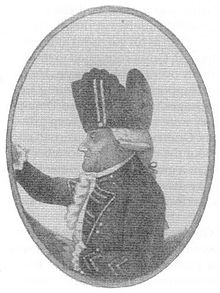
Alexander Leslie


Before the outbreak of War


Alexander Leslie, son of the Earl of Leven and Melville, joined the army in 1753 as an ensign in the Third Foot Guards. By 1768, he had become a lieutenant-colonel of the 64th regiment, stationed in Boston. His rapid rise in rank reflects Britain's extensive military commitments during that period of warfare. Leslie served with the British garrison at Boston before the outbreak of hostilities in 1775. Before the American War of Independence began, he led troops on a mission to Salem, Massachusetts, to search for contraband weapons, including cannon, held by the Patriots. A confrontation—not physical—with rebels at a raised bridge disrupted the mission and delayed his advance. His force was eventually allowed to proceed into Salem, but they found nothing of importance and retreated. An early version of Lexington and Concord was narrowly avoided. One wonders if a more hot-blooded commander might have produced a different outcome. It is said that a spy provided Leslie's commander, Gage, with faulty intelligence.


The Retreat at Salem Bridge


Mostly success in the North


Leslie's Light Infantry led the night movement
that cut off a large part of the rebel army on Long Island
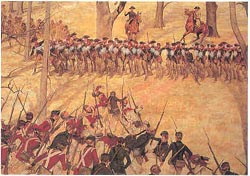
By the New York campaign of 1776, he became a brigadier-general. He led troops on Long Island, at Kip's Bay, and at Harlem Heights. Leslie commanded a brigade of Light Infantry, elite soldiers skilled at fighting in America's fields and forests. Men who could shoot, move, and fight better than most. His brigade formed the advanced guard of General William Howe's strategic night envelopment of Washington's forces. The Light Infantry seized the strategic Jamaica pass at night and led a nighttime advance that cut off a large part of the American troops. Leslie's command suffered 63 casualties for their efforts. This was a relatively small number for such a critical and successful action, but it mirrored the casualties of other brigades that fought during that hot day near Brooklyn. However, when the British took New York, Leslie's Light Infantry was mauled by Colonel Thomas Knowlton's Rangers at the Battle of Harlem Heights. Unfortunately for the American cause, Knowlton was mortally wounded. Much of this is captured in book one of "Yankee Doodle Spies," The Patriot Spy.


Battle of Harlem Heights


When the British landed north of New York in October 1776, Leslie's command was once again in the fight, but he suffered heavy losses at the Battle of White Plains. The solid and steady Leslie missed a chance to earn glory at Princeton in January 1777. General Washington had escaped the British under Lord Cornwallis through a night march around the British left toward Princeton, which was several miles behind Cornwallis. Leslie commanded the brigade garrisoning Maidenhead (today's Lawrenceville, NJ). Lord Cornwallis ordered Leslie and Mawhood's brigades into action. But before Leslie could get involved, the vanguard of the Continental Army broke through Colonel Mawhood's brigade and took Princeton. The Continental Army escaped Cornwallis and found safety behind the Watchung Mountains at Morristown. Leslie also took part in the siege of Charleston as commander of the combined brigade: four battalions of Light Infantry and elite Grenadiers, the best of the British troops. When Charleston fell, Leslie initially took command of the city. He stayed there only a few weeks. Once he had organized the garrison, General Henry Clinton ordered him back to the main British garrison in New York, where he took command of the Light Infantry and Grenadiers stationed there.


Washington leads the attack at Princeton


Struggling in the South


In the autumn of 1780, Clinton sent Leslie to the Chesapeake Bay leading an expedition aimed at distracting American forces and then capturing the supplies the Americans had gathered for their defense. Leslie reached Virginia in October but soon received orders from Cornwallis (who was now under his command) to proceed to Charleston. Leslie likely realized that Virginia would be critical to the war's successful ending, so before heading south, he sought confirmation from Clinton. His correspondence indicates he was reluctant to go south. Before leaving Virginia, he wrote Clinton expressing hope that "you will be able to take up this ground; for it certainly is the key to the wealth of Virginia and Maryland." Nonetheless, he headed south. Leslie arrived in Charleston in mid-December and received orders to march inland and meet up with Cornwallis's army. Cornwallis decided to wait for Leslie to reinforce him before moving to join forces with Banastre Tarleton. That decision proved a critical mistake. Due to bad weather, Leslie's force only reached the main army camp on January 18, one day after the Battle of Cowpens. Tarleton then had to face Daniel Morgan's division without support from Cornwallis, whose presence might have turned it into a British victory instead of a decisive defeat.


The Cowpens


 Leslie's command accompanied Cornwallis's forces in pursuit of General Nathanael Greene's army. At Guilford Courthouse, he commanded the British right in a style Cornwallis praised in his follow-up dispatch: "I have been particularly indebted to Major-General Leslie for his gallantry and exertion in the action, as well as his assistance in every other part of the service." Leslie took part in the challenging march north from the Carolinas into Virginia, one of the remarkable feats of the war. However, Leslie was not with Cornwallis at the siege and surrender of Yorktown. By the summer of 1781, his health had declined to a point where Cornwallis transferred him to Charleston, from where Clinton recalled him to New York.

But the stay in New York was short. On August 31st, Clinton ordered him to sail once again to Charleston and take command. After Cornwallis surrendered at Yorktown, Clinton placed Leslie in charge of all British forces in the South. The weather and stress of command took a toll on Leslie. He had a bad fall from his horse that weakened him and complicated his other health issues. Recognizing his poor health, he asked to return to New York, but Clinton could not spare him. He remained in command throughout the rest of the year despite numerous requests to be relieved due to worsening physical stamina and stress management. Leslie had worked in America for years, his wife was dead, and he had a daughter he wanted to see and ensure a good marriage for. He suggested several suitable replacements, but Clinton, although claiming sympathy, delayed and stalled his requests.


After the British took Charleston, it became the
"Green Zone"of the southern theater

Frustrating Finish


So Leslie soldiered on, supervising the decline of British interests in the south. After the treaty, he organized the consolidation and removal of British garrisons while dealing with relentless rebels, disheartened troops, and complaining Loyalists. These groups watched in disbelief as their birthright and lives evaporated, as the British withdrawal from Charleston approached. In the end, Leslie's command in Charleston outlasted Clinton's stay in New York, which the new British commander-in-chief, General Guy Carleton, would have the honor of evacuating. Gradually pulling back the British inland garrisons from outposts, maintaining order, and repelling rebel attacks was a difficult task that offered little glory. The time in Charleston would have drained even a strong man. The southern rebels were among the most active throughout the war, engaging in bitter small-scale fighting, property theft (by both sides), and general chaos. As thousands of Loyalists moved into Charleston (another kind of "Green Zone,” like New York), the challenge of caring for civilians became overwhelming. Leslie's attempts to arrange a cease-fire of sorts went unanswered by the Americans, who now sensed blood and always suspected British traps. Leslie remained in command of the city until it was finally evacuated in December 1782.


Back (at last) to Britain


Leslie, who would remain a widower his entire life, returned to Scotland in 1783. On a happy note, he was able to witness his daughter Mary-Anne's wedding in 1787. According to accounts, Leslie was well-liked by his peers and considered genteel and mild-mannered by most. His life after America is surprisingly obscure, given that he was appointed deputy commander of the forces in Britain. In 1794, he was near Glasgow, Scotland, where he led troops to suppress a rebellion by the Breadalbane Regiment of Fencibles. Some reports claim he was hit by a stone while marching some of the prisoners away and died shortly afterward. However, at least one eyewitness account disputes that and points to a Major Leslie as the victim. Regardless, the quiet and easygoing Scot died in December of that year. His death was, like his army career, unannounced and little noted. Yet the stalwart Scot should not be dismissed lightly. He served honorably through great hardship and, unlike many of his contemporaries, with little regard for his own glory.