Followers

Sunday, August 5, 2018

The King's Rake


Beauing, belling, dancing, drinking,

Breaking windows, cursing, sinking

Every raking, never thinking,

Live the Rakes of Mallow,


Spending faster than it comes,

Beating waiter's bailiffs, duns,

Bacchus' true begotten sons,

Live the Rakes of Mallow.


And so begin the lyrics of the mid-18th-century song that remains in today's culture as an international classic, "The Rakes of Mallow." This song tells of the rakes from the farming town of Mallow, about 20 miles north of the city of Cork. What exactly is a rake? Although Mallow is a farming town, we aren't talking about the gardening tool. The other rake is an old-fashioned term for a person who indulges in drinking, gambling, womanizing, and rowdy behavior — traits both celebrated and condemned in Georgian England. This brings us to the rake in this story—the complex and never uninteresting George Hanger...


The Rake at Dawn


George Hanger was born near Berkshire, England, around 1751. His father was Gabriel, the 3rd Baron Coleraine, an Irish peer. As the third son of an upper-class noble, it was almost destined that he would pursue a military career. Hanger was educated at Eton and then spent a year at the University of Göttingen in Hannover, Germany. 

A bright student, Hanger had a rakish appearance and enjoyed the proverbial wine, women, and gambling—not necessarily in that order. He allegedly fought three duels by the age of 20 and was reputed to be an excellent shot. While in Germany, Hanger observed the legendary Prussian Army of Frederick the Great during maneuvers and decided then and there to follow a military path. 

In January 1771, he was appointed an ensign in the 1st Foot Guards, a prestigious regiment of the household troops. Hanger performed well but resigned after being passed over for a promotion just four years later. Early signs of his lifestyle began to surface.


George Hanger

Soldier for Hire


Hanger's German contacts served him well, and he soon received a captain's commission in the Feldjäger Korps of the forces of the Landgrave (Elector) of Hesse-Kassel, another elite unit. I think we know where this is going... It was as part of this group of young Teutonic aristocrats that Hanger sailed for America when the Landgrave "rented" his troops to King George III. 

Leaving Portsmouth in March 1776, young Hanger arrived just in time for some of the most "fun" episodes for crown forces during the entire eight-year struggle. He played a role in the relentless campaigns that swept the rebels from New York and the Jerseys in 1776, as well as in the less glamorous but equally brutal skirmishes of 1777. His performance was so impressive that he took command of an elite Hessian Jaeger (light infantry) company recruited from all the Hessian regiments in the army. 

According to reports, Hanger distinguished himself in the months that followed. His unit undertook much of the screening, patrolling, and small-scale fighting around Kingsbridge, Spuyten Duyvil, and Westchester. Around this time, he learned that his estate back in Britain had gone into foreclosure, and through a series of misfortunes, he found himself in dire financial straits. Our young hero had become a self-proclaimed "soldier of fortune,"


Hanger became a master of light infantry


An Unlikely Spy


When the British occupation of Newport, Rhode Island, ended in 1779, Hanger was chosen by the British commander in chief, General Henry Clinton, to undertake a daring reconnaissance mission to see if the American occupiers had left their defenses vulnerable for reconquest. He sailed 150 miles north from the mouth of New York Harbor on a frigate and led a twelve-man longboat into dangerous waters during a bold night raid. He captured a prisoner and returned to New York with him. Hanger was later criticized in American papers when the prisoner unexpectedly fell ill and died.


An unlikely Hanger sails on a secret mission
 to Rhode Island: espionage


Moving South


Patrick Ferguson
 - a badass
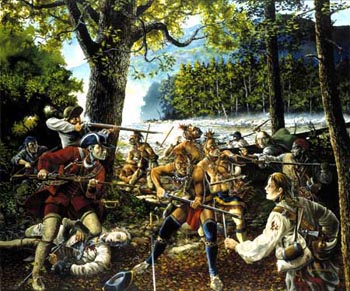
Later, Hanger took command of a mix of rifle and musket units and was seconded to the renowned "counter-guerrilla" Major Patrick Ferguson, one of the tough British officers of the war whose death at King's Mountain signaled the beginning of the end in the South. But I digress. With Ferguson, Hanger sailed to the Carolinas under General Henry Clinton in the spring of 1780, marking the start of the "southern strategy." After a brief stint as Clinton's aide-de-camp and then inspector of militia under Ferguson, the ever-adaptable Hanger managed to transfer to Banastre Tarleton's British Legion. The two hard-drinking, rough-and-tumble aristocrats hit it off, and Tarleton made Hanger his deputy. Hanger joined the green-jacketed band of Loyalist regulars that would become infamous under Tarleton.


Infamous Banastre Tarleton
Hanger's mentor and commander


The Legion


Lord Charles Cornwallis
The Legion led Major General Charles Cornwallis's invasion of North Carolina. When Tarleton was struck down by yellow fever, Hanger took command. Although an accomplished infantry fighter and dependable deputy, Hanger struggled with the cavalry, which was the vital strike force of Tarleton's Legion. 

He allowed himself to be ambushed at Wahab Plantation on September 21, 1780, where a partisan force under American Colonel William Davie attacked early in the evening. Surprised and overwhelmed, Hanger suffered 12 killed, 47 wounded, and almost 100 valuable horses captured. 

Tasked with leading the British advance against Charlotte less than a week later, he faltered again. This time, he let his horsemen become separated from their supporting infantry. Once more, Davie outmaneuvered him when Hanger's cavalry charged recklessly into the town without support. 

Hanger led several assaults against Davie's American riflemen, who were defending behind a wall. Hanger's men started to fall to the precise fire. Cornwallis himself had to step in to stabilize the situation. Hanger was severely wounded during the fight and later contracted yellow fever. Sick and injured, he was sent to the Bahamas (of all places) to recover.


Hanger led the Legion's cavalry to savage fighting and defeat
at Charlotte


Dead Ender?


Guy Carleton
When he recovered sufficiently, Hanger returned to New York in the summer of 1781 and resumed garrison duties. As the key to Britain's control over North America, New York was the center of attention, and Hanger found himself right back in the middle of things. He also returned to a city filled with bars, brothels, and rooms for him to enjoy during his downtime from drilling troops or patrolling the outskirts. 

One might think our young rake had the best of both worlds during this time. Ever the soldier, he sailed with General Clinton's relief force, aiming to rescue Cornwallis's trapped army at Yorktown. Upon hearing of the surrender, he went back to the city with the rest of the fleet. 

As peace negotiations settled on terms, Hanger took on another role: resettling members of the Legion. For that, he made a trip to Halifax, Nova Scotia, to find land and housing for the loyalists who chose not to go to England. Mission accomplished, he returned to New York. One has to see George as a proverbial dead-ender. He stayed with one of the last British units to evacuate the city, sailing with the final British commander and governor in North America, General Guy Carleton.


Hanger, "Forrest Gump-like," manages to
witness the American Revolution's climax


The Bad Boy of Georgian England


Once home, Hanger resumed the life of a flamboyant party boy. He became a social companion to another rake, the Prince of Wales, who later became King George IV. The prince enjoyed Hanger's rakish ways. Hanger seemed to have become famous simply for being famous — the subject of much satire and ridicule in what would be today's tabloids. His reckless lifestyle landed him in debtor's prison, where he spent two years (1798-1800). While in prison, he turned to writing and produced his memoirs there.


Hanger and his buddy, the Prince of Wales
attended many a party


When he left, he became a coal merchant (in which he was quite successful) but continued his addiction to gambling and partying around London. Throughout, Hanger flaunted contemporary mores, cavorting openly with women of all kinds, keeping a peculiar collection of dogs, cats, and monkeys, and generally thumbing his nose at the upper crust and middle class. One of his celebrated exploits was arranging a cross-country race between a flock of turkeys and a flock of geese!


Cartoon satire of Hanger


At the same time, he learned to leverage some of his strengths as a pamphleteer—similar to bloggers today. Reinventing himself as a subject matter expert, he published pamphlets on military topics, gambling, hunting, and shooting. Hanger engaged in public disputes over military policy during the Napoleonic Wars. He also wrote humorous advice columns on various subjects, most famously about the fairer sex. His antics and opinions were closely followed by the media of his time. In 1814, he was offered the barony of Coleraine but declined it to continue his "celebrated" lifestyle in London.


Cartoon satire of Hanger

The Legacy


Cartoon satire of Hanger


Despite his hard lifestyle, Hanger kept up his reputation as a notorious figure in town, a military expert, and a celebrated eccentric until his death in London on March 31, 1824. He left behind a second wife, possibly his housekeeper, and their son, who was denied his father's peerage. George Hanger was undoubtedly one of the more complex men of his era and certainly one of the most intriguing, if not amusing.

 Eventually, his notoriety caught up with him. The king distanced himself from him, high society shunned him, and the press ridiculed him. Yet, in many ways, he embodied his class and era: a curious mix of breeding, talent, courage, rapacity, and culture. It's a pity he didn't settle in America...


George Hanger, 4th Baron Coleraine?


Saturday, June 30, 2018

The Spy of Massachusetts


In my last blog post, I discussed the origin of the term "Spy" and hinted at its use as a naming rubric for 18th-century newspapers. Now, a deeper dive into the subject of newspapers of the American Revolution.

A Literate Frontier

By the mid-1760s, there were 24 weekly newspapers in the 12 colonies, and satirical attacks on the government became common. Weekly newspapers in major cities and towns were strong symbols of patriotism, although a few Loyalist papers still existed.


Twelve of the British colonies had 24 newspapers 


Spy as a Newspaper

So, we can see that using the name “Spy” for a newspaper matches the origin of the word and its broader use. A newspaper’s staff and contributors observe, question, watch, and follow closely. At least, that is the hope of the public, who rely on their objectivity and fairness. As American society became more literate, the influence of the press increased.

Turbulent Times


The turbulent years between 1775 and 1783 were a time of great trial and disturbance for newspapers. Interruption, suppression, and lack of support significantly hindered their growth. Although there were forty-three newspapers in the United States when the Treaty of Paris was signed in 1783, compared with thirty-seven at the time of the Battle of Lexington in 1775, only about a dozen published regularly during that period. Curiously, not one newspaper in the larger coastal cities—Boston, New York, and Philadelphia—published uninterrupted throughout the war.


Voices of Rebellion

Obstacles


The nature of the rebellion contributed to some of these issues. When the colonial forces were in control, Loyalist papers were suppressed. Conversely, during the British occupation, patriot papers were either dispersed, discontinued, or temporarily converted into loyalist publications until the patriots regained control. As a result, some newspapers from coastal cities moved inland to continue publishing. War-related challenges led to logistical problems, including shortages of paper, ink, and other essential materials. This led to the production of poor-quality papers or the skipping of issues to conserve resources.


Papers often ran political cartoons and caricatures
that bordered on the absurd 


The Massachusetts Spy


Let’s examine the paper that exemplifies the kind of “Spy” we are discussing. Isaiah Thomas's Massachusetts Spy, published in Boston and Worcester, was often close to being shut down from its founding in 1770 through 1776 and during the American Revolution. Between 1771 and 73, the Spy featured writings from several anonymous political commentators who called themselves "Centinel," "Mucius Scaevola," and "Leonidas." They shared similar views on issues, kept patriot concerns on the front page, and responded to attacks from pro-government papers. Rhetorical combat was a patriot strategy that explained current issues and fostered patriotism without outright rebellion. The columnists addressed the colonists as an independent people, linked to Britain only through a voluntary legal compact. The Spy soon expanded its radicalism to a logical conclusion. Later, when articles from the Spy were reprinted in other papers, the entire country was prepared for Tom Paine's influential patriotic statement: Common Sense in 1776.


A critical voice in its heyday


Who was Isaiah Thomas?


We are not talking about a legendary NBA player but about a legendary newspaperman. Our Isaiah Thomas was born in Boston, Massachusetts, and apprenticed in July 1756 to Zechariah Fowle, a Boston printer, with whom he formed a partnership in 1770. This led to the publication of the Massachusetts Spy. The partnership dissolved after a few months, but Thomas continued publishing alone. He had a motto for his paper: “Open to all parties, but influenced by none.” Sort of the “Fair & Balanced” of its day. The Spy initially published three times a week, but under Thomas’s sole ownership, it became a semi-weekly, and then, in 1771, a weekly. The Spy championed the Whig cause early on, which led to the British government's attempt to suppress it. Massachusetts’s last Royal governor, Thomas Hutchinson, ordered the attorney general to prosecute Thomas, but the grand jury failed to find cause for an indictment.


Isaiah Thomas holds an essential place in America's
publishing pantheon

More Flash than Bang?


The overall spirit of the era generated many mottoes, editorials, letters, and poems. At the beginning of the struggle, both editorials and communications called for united resistance to oppression, praised patriotism, and condemned tyranny. As time passed, these patriotic appeals grew stronger and shaped public opinion. Later, the idea of independence took shape, and debates about government were held. Sadly (or perhaps fortunately), enthusiasm for the cause often overshadowed journalistic standards, leading to exaggerated or even false reports.


A Struggle of Ideas

Despite their flaws, the newspapers of the Revolution were a powerful force in uniting people's feelings, sparking a shared sense of purpose, interest, and vision among the separate colonies, and fostering the determination to see the war through to a successful conclusion. They were often more focused than the people themselves and carried a significant share of the responsibility for inspiring and sustaining the often discouraged and indifferent public spirit. In this way, they played a vital role in guiding the thirteen struggling colonies through a long and seemingly impossible fight that resulted in an unlikely victory.


The struggle of ideas led to and buttressed the
struggle for independence


Sunday, May 20, 2018

Why Spy?


During my years in US Army intelligence, I had the bright idea of writing a spy novel. Half the people I worked with thought of the same idea. Some even tried to write drafts. But very few finished, and to my knowledge, even fewer got published. As a long-time student of history, I wanted to create a historical portrait, not just craft a spy story. 

Until recently, few Americans knew that, besides being the top soldier during the Glorious Cause, George Washington was also the country's leading spymaster. However, we in Army Intelligence were aware of his secret role. So, when I decided to start writing my spy novel(s), I chose to blend spy themes with fictional versions of James Bond set against the American Revolution. 

The Yankee Doodle Spies series celebrates—tales of men and women who fought the secret war—gathering intelligence to give Washington an edge over the mighty British land and sea forces.


George Washington was the great case officer
of his day


Origins of the Term, Spy


Words have meaning. So let’s examine the word, Spy – the key term in this series. Where does it originate from, and what does it mean? According to one source, the word comes from Old French and other European languages.


Benjamin Tallmadge coordinated
Washington's spies

A Noun


The word 'Spy,' as a noun, dates back to the mid-13th century and originally meant "one who spies on another." This comes from the Old French word 'Espie,' meaning a "spy, look-out, or scout." In Middle English, 'spy' derived from the shortening of the Old French word 'Espie,' which included 'espying,' 'espier,' and 'espy.' The Old French term itself has Germanic roots, originating from an Indo-European root shared by the Latin word 'specere,' which means to behold or look.


Old French was connected to Latin


A Verb


To spy, the verb has the same mid-13th century origin and meant to watch secretly. This originated from the Old French verb espier, which meant "observe, watch closely, spy on, or find out," likely from the Frankish spehon or another Germanic source. The term spehon appears in Proto-Germanic and Old High German, where it also meant "to look out for or scout." Old English had the verb spyrian, meaning "to make a track, go, pursue; ask about, investigate." The related noun was spyrigend, meaning "investigator, inquirer."


Old High German was connected to Frankish and Old French


The Italian verb, spiare, and Spanish espiar also derive from the Germanic root from around 1300 and similarly mean "to catch sight of.” The term evolved into the modern German verb, spähen, meaning "to spy." The word further developed in Middle Dutch to become Spien.


One of many iterations of the Army
Special Agent's Badge 


Interestingly, as I worked with German counterintelligence during the Cold War, I noted that their modern term for a spy is 'Spion,' and espionage is 'Spionage.' The root of the words and their basic sounds remain unchanged. However, pay attention to some other action descriptors in the etymology, such as observe, watch closely, find out, look out, ask about, and so on.

A Curious 18th Century Use


We can see that the term, “to spy,” means learning through observation and, of course, reporting. Now, done clandestinely during wartime, it aligns more closely with the modern definition. However, the term spy once had another use - related to observing and gathering information to report on it. So, it’s not a big leap to connect this terminology to another meaning for the word, “Spy."


"Spy" used a journal


In the 18th century, the term “Spy” was used as the name for major periodicals in colonial and post-colonial America. These publications played a significant role in shaping colonial thought during the struggle for independence before the actual war. We will discuss this in more detail in an upcoming post.


Sunday, April 15, 2018

The Shot Heard Round the World

This is the anniversary week of the battles of Lexington and Concord – the famous “shot heard round the world” did not occur in a vacuum. Over a decade of political strife and miscalculation led to Englishmen firing upon Englishmen, a concept that would have been considered absurd just months before the event. So I am going to provide a short overview of those events that took a political crisis to insurgency and finally open rebellion.

Colonial Crisis


Almost after the last whiff of gunpowder dispersed into the blue skies over North America at the end of the French & Indian war in 1763, a crack began to develop in Britain’s newly won empire. The problems involved the management of the new empire and the governance of the English settled colonies, native Indians, and the French-speaking Quebec and the economics of the empire.  These cracks were subtle at first but over time, they seemed to split of their own weight. The war had plunged the British government deep into debt, and the British Parliament sought to exploit the colonies for quick funds. They enacted a series of coercive measures to pull revenue from the colonies.

The French and Indian War sowed the seeds of later conflict
between Britain and her colonies


The Stamp Act


The Stamp Act of 1765 was one of the first initial measures forced upon the American colonists, instated to help pay for troops stationed in North America after the British victory. A tax on paper – it was not well received and more and more American colonists became politically active.


The Townshend Acts


Charles Townshend


Then in 1767, Parliament passed a series of acts called the Townshend Acts, named after Charles
Townshend, the Chancellor of the Exchequer who devised the program. These included: the Revenue Act of 1767, the Indemnity Act, the Commissioners of Customs Act, the Vice-Admiralty Court Act, and the New York Restraining Act. This stirred up more agitation across the colonies but especially in New England where the acts met immediate resistance.


The King Street Incident


The political unrest caused by the Townshend Acts would lead to the event known to the British as the King Street incident. But you know it as The Boston Massacre. Colonial agitators accosted British soldiers and threatened them with violence. Their reaction led to the shooting of that name. By now the colonists in opposition to the Crown began organizing. The British met the colonial reaction with one more action. The Tea Act was one of the final coercive measures passed by Parliament and became the last straw, making it the final unifying factor that brought the colonies from political agitation to an insurgent-like movement that would lead to open rebellion. The Parliament's insistence on the right to tax the colonies, in the end, became too much. The Tea Act was a lame attempt to convince the Americans to buy British tea and recognize Britain's right of taxation.


Boston Massacre provided rebels propaganda 


The Party


The colonies refused to accept this policy, and instead, the Sons of Liberty, one of many local insurgent groups, staged what became known as the Boston Tea Party. The Loyalist governor, Thomas Hutchinson, refused to let ships leave without the colonists paying the duty. The radicals were stirred to action. The Sons of Liberty and their supporters disguised themselves as Mohawk warriors and clambered aboard the remaining British vessels in port tied at Griffin’s Wharf. They sent 342 chests of British tea to the bottom of the harbor.


Boston Tea Party


The Reaction

The British responded to the party by instating the Intolerable Acts, which the colonies refused to submit to. The British government now tightened its grip on Massachusetts. The new royally appointed governor, General Thomas Gage, was given expanded powers, and several thousand more troops to garrison Boston and cow the colonists with a show of force. Along with these acts, Parliament closed the Boston harbor, and sent 4,000 British troops to Boston, to patrol the "rebellious areas." Parliament believed that these acts were perfectly legitimate, that the colonies needed to pay for the maintenance of the British Empire. The colonies thought differently. And a drumbeat of actions began a small but growing political rift that would lead to an insurgency of sorts.


Boston Port Bill closed the harbor
impacting New England's economy


Birth of Rebellion


Lieut Col Francis Smith
led the ill-fated column
But the colonists reacted with more action, and by 1775 political crisis morphed to open insurgency careening towards rebellion. The Massachusetts colonial assembly directed the townships to ready their militias, which had already been preparing for what many foresaw as the coming conflict. The British had many sympathetic Loyalists who kept them apprised of the growing resistance. In April 1775, Gage received orders to disarm the rebels. Gage ordered Lieutenant Colonel Francis Smith to gather 700 British Army soldiers and march to Concord, where the rebels were reportedly storing mass quantities of arms and ammunition. Their orders were to find the stash and destroy it. He also had orders to arrest certain rebel leaders such as Sam Adams and John Hancock. Smith’s column was drawn from 11 of Gage's 13 occupying infantry regiments. Major John Pitcairn commanded ten elite light infantry companies, and Lieutenant Colonel Benjamin Bernard commanded 11 grenadier companies. Quite a shock force by any measure.


General Thomas Gage faced a difficult situation


An Intelligence War


But the patriots, as the rebels deemed themselves, had an intelligence network. Some believe Gage’s American wife, Margaret Kemble Gage, was a rebel spy. See my blog post, “The Lady was a Spy?” Regardless of the source, the rebels had received word of the British orders. On 8 April, Paul Revere rode to Concord and notified local militias in the area to be on the alert for the British army forces. On 18 April, Revere received word of British “regulars” making their way to Lexington and Concord. Having already warned the militia in Concord, which had secured the weapons supply, Revere and William Dawes rode quickly to Lexington to warn the townspeople of the expected British onslaught.


Margaret Kemble Gage: Spy?

Shot Heard Round the World


This began a frantic race to Lexington during the night: The British pressing to maintain surprise, the patriots to gather enough forces to challenge them.  The celebrated first clash took place at Lexington Green, the town square, dawn on the morning of 19 April. Militia Captain John Parker, a veteran of the Seven Years' War, led some 80 Lexington militiamen, known as minutemen. The British had 700. Years later, one of the participants recalled Parker’s alleged words before the skirmish: “Stand your ground; don’t fire unless fired upon, but if they mean to have a war, let it begin here.”


Race to Concord


A British officer demanded that the militia disarm and disperse, and in the ensuing confusion, muskets were fired. To this day, there exists considerable uncertainty over whether the militiamen or the British soldiers fired first. Regardless, the British soldiers rushed forward with their bayonets. A skirmish ensued, during which eight militiamen were killed and only one British soldier wounded. Resistance melted away at Lexington, and the British moved on to Concord, where militia from Concord and nearby Lincoln awaited anxiously. The British found and destroyed some rebel weapons caches, but most of the colonists’ military supplies were hidden or destroyed.


The shot heard round the world on Lexington Green


At the approach of the huge British column, the Concord militia retreated to a ridge overlooking the town and militia colonel James Barrett withdrew from the town of Concord and led the men across the North Bridge to a hill about a mile north of town, where they could continue to watch the troop movements of the British and the activities in the center of town. The militia faced off against the regulars at the North Bridge.

Minutemen take on British at North Bridge


When a British covering party of around 100 regulars moved to secure the North Bridge, they were attacked by some 400 American patriots.  The regulars were both outnumbered and outmaneuvered. Confused orders from their commander and the superior numbers of the rebels broke their morale. In a confused retreat, they abandoned their wounded in search of the safety of the approaching grenadier companies coming from Concord. Despite the setback at the North Bridge, the regulars continued to search for and destroy colonial military supplies in the town while the rebels watched anxiously. They paused for lunch, assembled for a march, and left Concord in the afternoon.


Militias swarmed the returning British column inflicting maximum casualties


But the deliberate actions of the British, aimed at displaying British superiority, had an unintended consequence. It gave the colonial militiamen from outlying towns and villages additional time to reach the road back to Boston. The call went out and more and more companies of militias swarmed along the British column as they marched back to Boston. It was all the officers could do to avoid panic with revenge-minded rebels continually firing on them from behind roadside houses, barns, trees, and stone walls. Some estimates give the rebel strength at 2,000 by the time the British column returned to Boston. The bill for the day’s actions: British 273, Americans 95.

Aftermath


When the British returned to garrison, the militiamen began to lay siege to Boston.  The call went out to the other colonies and soon they were joined by militias from Connecticut, New Hampshire, and Rhode Island. These colonial forces would be constituted as the Continental Army by the Second Continental Congress. The Battles of Lexington and Concord turned the decade-long crack between the colonists and the mother country into a chasm Britain could never breach. It also widened the split between the patriots and Loyalist colonists, who soon would wage their own savage war within a war. But the immediate result was impressive: it roused 16,000 New Englanders to the join forces around Boston.  Less than a year later, the British army of occupation would withdraw to Canada to prepare for a long war.


The British occupation of Boston


The American Revolutionary War had begun. But it would take another year for that to morph into a war for independence.

Sunday, March 11, 2018

First Commander

When choosing what to cover about People, I try to focus on the "second-tier" first patriots—those men and women whose actions helped shape the course of the American Revolution but are often overlooked in the brief history taught these days. I put "second-tier" in quotes because, in reality, the sum of their activities, and sometimes their only actions, were crucial to the success of the Glorious Cause. With that in mind, this blog post highlights one of our lesser-known great first patriots, Artemas Ward of Massachusetts. A dependable, serious leader of the patriot cause in New England, the little-known Ward was the first commander in chief of the American army during the early days of the War for Independence.

Early Life


This first patriot was born in Shrewsbury on November 26, 1727. His father, Nahum Ward, was a skilled sea captain, merchant, land developer, farmer, lawyer, and jurist. Young Artemas went to common schools, was prepared for college by a private tutor, and graduated from Harvard College (B.A. 1748, M.A. 1751). Like his father, he held many public offices at the town, county, and state levels. In 1750, he married Sarah Trowbridge, daughter of Rev. Caleb Trowbridge and Hannah Walter of Groton, Massachusetts. They had eight children. To support his wife and growing family, he opened a general store and became a tax assessor.


Silent Servant


Ward held numerous offices at the town, county, and state levels. However, his military service was the highlight of his career. He was appointed Justice of the Peace in 1752 and served multiple terms as a representative in the Colonial General Assembly and on the executive council. When the war with France broke out in 1755, Ward became a major in the 3rd Massachusetts Regiment, the militia of Middlesex and Worcester counties. The regiment served as garrison forces along the frontier in western Massachusetts. This duty called him at intervals from 1755 to 1757 and alternated with his attendance at the General Court.


Massachusetts militia protected the western frontier


In 1757, he was appointed colonel of the 3rd Regiment, which marched with British General James Abercrombie's forces to attack Fort Ticonderoga in 1758. The French army, led by General Louis-Joseph de Montcalm, consisted of 3,600 men and decisively defeated the numerically superior force of Abercrombie. However, Ward was sidelined during the critical (losing) battle at Fort Carillon due to an "attack of the (kidney) stone." This was clearly a recurring condition for Ward, as we will see.


Abercrombie's Campaign vs Ticonderoga would end in failure


When he returned from the war, Ward was appointed to the Court of Common Pleas. He also became involved in the heated politics of the Bay Colony as a member of the governor's council, while maintaining many of his militia connections. As tensions with Britain grew in the next decade, he associated with figures like John and Samuel Adams, John Hancock, and Joseph Warren. In the General Court, he was appointed to the taxation committee alongside Samuel Adams and John Hancock. On the floor, he was second only to James Otis in speaking out against the acts of Parliament.

It's safe to say he was a Whig. In fact, his often outspoken support for the increasing demands of the colonists put him at odds with the Massachusetts governor, Francis Bernard, who revoked his militia colonelcy. But Ward's growing popularity helped him get re-elected to the governor's council until 1774, when the new governor, the infamous Thomas Hutchinson, removed him from the council for his political activism. Tensions were reaching a boiling point in New England, and by October of that year, Ward sat with the first Provincial Congress of Massachusetts. He was also appointed Brigadier General by the Congress on October 24, 1774.

Struggle for Freedom Begins


As political crises led to an American Revolution, the people in and around Boston, as well as New England overall, were close to insurrection by the spring of 1775. Local militias, minutemen, and other groups gathered around the British-occupied city in a wave of patriotism. If New England was the most rebellious region and Massachusetts the most aggressive rebel colony, Artemas Ward was one of its most aggressive, if little-known, leaders.

The insurgency didn't need much to turn into an open rebellion. It reached that point when "the shot heard round the world" was fired on April 19, 1775. Ward missed Lexington and Concord because of illness. However, upon hearing about the action, he got out of bed, mounted his horse, and rode through pain (he was suffering from kidney stones again) to Boston to help organize the siege of the city.


Ward missed Lexington & Concord but rallied from
his sickbed to take charge


Ward was popular with the troops, and because of his military experience, he was soon proclaimed commander of all Massachusetts state militia. In June, the Continental Congress appointed him Major General and commander of all forces besieging Boston—some 15,000 strong. Boston-strong, I suppose. By now, other New England colonies as well as New York were sending men to Boston—America's first national army was forming. Ward was soon to be tested in both his military and political skills.


First Commander


Ward had his hands full with the army, whether it was New England's or the United States' forces; the men were ill-trained, ill-led, ill-equipped, and had little regard for military discipline. But Ward, like Washington later, also faced a complex array of political issues: Committees of Safety from several states, locals, his commanders, and the Continental Congress. Never flashy but always steady, Ward worked through these as best he could.


General Artemas Ward was the
first American commander


Ward faced formidable challenges. Not only was he confronting the world's most powerful army, but he was doing so with a force of volunteers who had agreed only to fight in a single battle. Once the British had been pushed back to Boston, many militiamen wanted to return to their farms. In their minds, they had volunteered to fight but had not enlisted in an army. The independent-minded Yankees had little enthusiasm for camp life, especially given the harsh and unsanitary conditions at the sprawling camp in Cambridge. Ward faced the daunting task of building an army from chaos.

Job one was to keep the army together. He called for volunteers to become the first enlistees. Men from Massachusetts, New Hampshire, Connecticut, and Rhode Island began filling the ranks. Some claimed Ward was a poor disciplinarian and that his "Grand American Army" was anything but grand. But the solid Yankee puritan understood his volunteer Yankee soldiers. He knew from experience they would resist strict discipline, a discipline the jurist in him felt he had no legal authority to impose. Ward believed he had to lead by consensus and mutual respect. These were, after all, the men of whom Samuel Adams wrote, "our soldiers will not be brought to obey any person of whom they do not themselves entertain a high opinion." Ward's calculated soft management helped his raw recruits hold the siege.


Ward began his RevWar service commanding the ragtag force
besieging Boston


Job two was to keep the British in Boston. The Battle of Bunker Hill took place under Ward’s overall command. On June 13, 1775, after learning from a "line crosser" that the British planned to send troops from Boston to occupy the hills around the city, Ward ordered General Israel Putnam to establish defenses on the Charlestown Peninsula, specifically on Bunker Hill. On June 16, approximately 1,000 colonial militiamen under Colonel William Prescott constructed earthen fortifications on top of Breed’s Hill, as it was smaller but closer to Boston. The battle that followed became iconic: a draw that resulted in the slaughter of British regulars by militia rebels.


Lack of munitions caused rebels to abandon
Breed & Bunker Hills


From Number One to Number Two


On June 17, Congress debated who should be appointed as the supreme commander of the American forces. Fellow (and completely biased) New Englander John Adams suggested that "the greatest number" wanted the job to go to Ward. But Congress needed to persuade delegates from the South that this was not just New England's war and instead chose George Washington of Virginia, making Ward his second in command.


Adams suggested Ward was the initial first choice
for the commander in chief


While General Ward gained national recognition for the heroic stand at Bunker Hill, the failure to supply enough ammunition to hold the position prevented the Americans from winning. When Washington took command of the army in Cambridge on July 2, 1775, Ward became his second in command. The New England militiamen who made up most of the first American army trusted and admired Ward, but Washington quickly became a critic. Accustomed to serving with professional officers, Washington dismissed Ward as "a fat old churchwarden." Washington was also shocked by the lax discipline among Ward's New England soldiers.


Ward was instrumental in the successful siege of Boston in 1775


The New England versus Virginia clash became an early challenge to the army's unity. Washington's open criticism deeply offended Ward, but over the next nine months, he helped Washington transform the assembled militia units into the Continental Army. He was stationed with the right wing on Roxbury Heights. Because of impaired health and the British now gone from Boston, he resigned his commission in April 1776. However, at the request of General Washington, who now saw the importance of winning over the New Englanders, he continued to serve as his second until the end of May.


Ward was part of the leadership team that forced the
mighty British Army from Boston 


Post-Military Public Service


When Ward returned to civilian life, he held important and demanding positions in Massachusetts. He was Chief Justice of the Court of Common Pleas of Worcester County in 1776 and 1777. He served as President of the Massachusetts Senate's Executive Council for about three years. In this role, Ward acted as Massachusetts’ chief executive during the crucial years of the war (1777-1779), essentially filling the position that replaced the Royal Governor. Ward also served as a member of the Continental Congress from January 1780 to May 1782.

Post War Public Service


Shay's rebellion led to
the Constitutional Convention
Ward was elected Speaker of the Massachusetts House in 1786, which made his actions as a Justice of the Peace of the Worcester Court during the 1786 Shays’ Rebellion all the more significant. He faced down the rebels on the courthouse steps, demonstrating his popular influence and respect for the rule of law. Shays' rebellion led to demands for a new form of government and the Constitutional Convention was convened. With the ratification of the new constitution, Artemas Ward was elected as a Federalist to the 2nd and 3rd Congresses (1791-1795).


Ward House in Shrewsbury


In December 1797, Ward ended his long career as a judge and spent his final years peacefully at home with his family. He died on October 28, 1800, and is buried at Mountain View Cemetery in Shrewsbury Center.


Ward is buried in Mountain View Cemetery


Legacy


Ward's accomplishments as a jurist and politician place him among the top founders who helped lead the colonies to statehood, transition, and the formation of a nation. As a military commander, he was overshadowed by Washington and held back by health issues and his personality. Still, he served as a popular figure for the New England colonists to rally behind during a time of near chaos, when a single mistake by the British could have easily ended the American cause. He faced criticism from his commanding officer but showed the strength and patriotism to persist long enough for the culture of a new American army—the Continental Army—to develop from the early chaos around Boston. For that alone, we give a hearty cheer to the rebellion's first leader.


Artemas Ward Memorial


On November 3, 1938, a bronze statue of General Ward was unveiled at Ward Circle in Washington, D.C., positioned at the intersection of Nebraska Avenue and Massachusetts Avenue. The stone base bears the inscription, “Artemas Ward, 1727-1800, Son of Massachusetts, Graduate of Harvard College, Judge and Legislator, Delegate 1780-1781 Continental Congress, Soldier in Three Wars, First Commander of the Patriotic Forces.”