Followers

Tuesday, April 30, 2024

Fallen Founder

Surgeon Spymaster

For hours, Doctor Joseph Warren had been piecing together reports and rumors from sources close and not so close to Boston’s British occupiers. One of the last of the Committee of Safety left in the city, he served as organizer of spies and reporter of rumor, innuendo, and sometimes—intelligence. He glanced at the Almanack on his desk. It read April 18th,1775.


Joseph Warren remained in occupied Boston


The soft rap at the door stirred him from his writing.

“What brings ye here at this early hour?” he asked. The visitor was one of his better sources.

“A column is definitely leaving in the morning. Hoping to seize the rebel leaders, Hancock and Adams. They’ll be traveling over water.”

Warren scratched out the rest of his source’s information. “Thank ye, sir.”


Warren ran sources across Boston


When the informant left, he summoned two of his ablest men. For weeks, his dwindling network had sent him bits and pieces about British activity, but this was a strong warning, and he needed to act. When William Dawes and Paul Revere arrived, he gave them instructions, saying finally, “The good work of patriots have provided enough warning to steal a march on the British, but we must get the word we must take advantage of it. Go now, and Godspeed!”


Nightriders spreading the word


The spymaster, whose tireless intelligence work helped launch thousands of farmers and townsfolk against the cream of the British Army, was well-known to the authorities. A farmer, Harvard scholar, schoolmaster, surgeon, and family man, he was a political activist who pushed back against Crown policies.


Doctor Joseph Warren

From Surgeon to Patriot

Born in Roxbury, Massachusetts, in 1741, young Joseph Warren rose from being a yeoman farmer to becoming part of the colony's landed gentry. After attending Harvard, he studied medicine under Doctor James Lloyd. Warren became a prominent surgeon and was celebrated for adopting the new technique of immunization against smallpox during a devastating outbreak in the community. One of his patients, a lawyer named John Adams, recruited Warren into his circle of political confidants.


Pioneer in smallpox treatment


From Whig to Radical

The Stamp Act of 1765 transformed Warren from a moderate Whig into a leading radical in Boston politics, aligning him with Sam Adams, John Hancock, and James Otis. Political gatherings over coffee and raucous protests soon began to compete with his practice, farm, and family. However, the brilliant thinker, organizer, and man of action found time for everything. What truly set him apart was his leadership by example.


Equally fervent politico Sam Adams
 

Passionate Speaker

Warren had a talent for retail politics, writing broadsheets, organizing events, and delivering speeches that energized crowds. He opposed the flood of regulations from London and the Royal Governor. The Stamp Act, in particular, infuriated him. On the second anniversary of the Boston Massacre, Warren delivered a powerful and impassioned oration as he defiantly stared down the British in the audience.   


Defying the Stamp Act


From Radical to Rebel

His passionate speech brought him notoriety across Massachusetts and beyond. Warren gained celebrity throughout the colony for his scorching speech memorializing the second anniversary of the Boston Massacre. Two years later, he was an original member of Boston’s Committee of Correspondence. 


Committees of Correspondence drove 
the Revolutionary agenda


In 1773, Warren was among the leaders protesting forcefully against the Tea Act imposed by London, and he likely had a hand in planning the Sons of Liberty’s famous raid that December on the merchant ships—the Boston Tea Party.


Boston Tea Party Organizer?

Not content with being the spymaster behind the scenes, Warren saddled up the day after dispatching the night riders and rode out to the Concord battlefield, put on his surgeon’s hat, and began treating the wounded militiamen. For the next few months, he was a whirlwind of political leadership and military action. 


Riding to the battlefield - rare photo


Political Leader

As president of the Third Massachusetts Provincial Congress, he acted swiftly to spread the word and garner support across the colonies for transitioning from rebellion and insurgency to war. His account of the actions at Lexington and Concord reached readers in England a fortnight before General Thomas Gage’s official dispatch.


Warren's London dispatch scooped General Gage

Military Leader

While doing all this, he helped General Artemus Ward assemble and shape the militia regiments of the New England Army forming around Boston—soon locking the redcoats in a cauldron from which they would never escape. Warren’s talent and decisive actions gained him an appointment as a major general of the militia on 14 June 1775. Fate and his innate modesty would deny him the assumption of those duties.


First Commander - Artemus Ward


Besieging Boston

The rattling of drums meant the British were stirring, and spies reported plans to assault the Americans digging in on Breed’s Hill in Charleston—a town across the water north of Boston. Warren arrived with a musket, pistol, and saber but refused to pull rank and assume command from the commander in loco, French and Indian War veteran General Israel Putnam. Instead, Warren volunteered to fight in the line, serving under Colonel William Prescott.


Israel Putnam

Breed's Hill

On 17 June 1775, the regulars ferried to the neck, and rows of redcoats assembled at the base of the long sloping hill where the rebels waited. The New Englanders were ready in all respects: will, determination, and courage, plus the high ground, prepared breastwork with ample fields of fire. However, they lacked a crucial element of 18th-century warfare—gunpowder. The volunteer Warren fought bravely with his comrades and fellow patriots— who shot two determined British attacks to pieces in volleys that filled the air with lead and smoke. 


The Crimson Wave


Warren’s commander, Colonel Richard Prescott’s steely eyes, watched the wave of crimson rumble up the hill one last time—barely enough powder for a volley—not enough to stop them. At the last possible moment, he ordered them to fire. The woosh and boom of the volley attested to its weakness. The redcoats dropped, but not in the numbers previously. Now, they were coming with their own grim determination.

William Prescott scans the battlefield


Overwhelmed and Cut Down

The patriots’ lack of powder allowed the third British charge to breach the breastworks and push into the trenches. A ferocious melee erupted, leading to chaotic hand-to-hand combat. Warren aided in covering the retreat of his comrades but was quickly gunned down. Later, the redcoats, enraged by their heavy losses at Breed’s that day, pierced his body with bayonet thrusts. Days later, Warren’s body suffered further mutilation and decapitation at the hands of a naval officer, Lieutenant James Drew. Following these atrocities, the body of arguably one of the most prominent and promising men in America was discarded into an unmarked grave.


Desecration of a Hero


Fallen Founder

Joseph Warren’s ravaged remains lay in a shallow grave—discovered some ten months later when the British had, at last, evacuated Boston. His brother and Paul Revere identified the remains through dental forensics. Revere, the tinsmith, had fashioned teeth for the doctor. Doctor Joseph Warren was officially buried at Forrest Hills Cemetery in 1855. One of the first lamented martyrs of the Revolutionary War is commemorated by a statue in the Bunker Hill Monument.


Joseph Warren Statue  at Bunker Hill Monument


Had he not fallen, it is not clear to what heights Joseph Warren could have climbed in service to his country. Some opine that he might have led the Cause instead of George Washington. Because Virginia was critical to the Cause, it is not likely that Warren would have been chosen. Even less likely, he would have accepted the command. However, his political canny, organizational energy, and leadership might have made the Continental Congress much more effective, especially in terms of support for the beleaguered Continental Army. 


Sunday, March 31, 2024

The Once and Future Spy

Hogan’s Heroes

Fans of TV Land probably remember the hit comedy from the 1960s, Hogan’s Heroes. The story centered on a team of spies who were shot down over Nazi Germany to set up a spy network operating from a prison camp (Luft Stalag 13) deep inside Germany. From there, Colonel Hogan and his diverse group kept radio contact with “London” while planning various activities, from espionage to sabotage. Much of the show revolved around jokes at the expense of their clumsy captors, Colonel Klink and Sergeant Schultz, but they often sneaked out of the prison camp to nearby Hammelberg for secret missions. Yet, unlike other POWs—they would slip back in.


POWs as Spies - but for laughs

Winter War

Something like this happened during the height of the American War for Independence when General Washington needed intelligence after his victory at Trenton. Word had arrived that General Charles Cornwallis was leading an army south to seek revenge for the embarrassment. Washington ordered that someone be sent to Brunswick to evaluate the size of the British forces, especially the troops guarding the recently captured General Charles Lee. The status of British supply trains was also of interest because Washington considered marching north to seize their baggage and supplies for his under-supplied army.

Trenton


Daring Mission

Lieutenant Lewis Costigan of the 1st New Jersey Continental Line Regiment volunteered for the task. He was well-suited for the mission since he had been a merchant in the area and knew it well. Costigan’s mission is similar to Lieutenant Jeremiah Creed’s spying in my novel, The Cavalier Spy. He traveled north over icy roads during a bitterly cold winter that chilled the soul. He evaded British patrols, sentries, and Loyalist informers, successfully avoiding detection. Costigan gathered the intelligence Washington needed until British light dragoons swept in and captured him. The brave officer was in uniform, so his captors did not treat him as a spy.


British Light Dragoon


Prisoner on Parole

The British sent their new prisoner to New York City, where he was soon granted parole—a common practice that allowed officers to move freely. Less fortunate prisoners, usually enlisted men, were sent to the Sugar House or, worse, to prison hulks (ships) to wither away and die. However, officers, who had pledged certain restrictions as gentlemen, fared better. Paroled officers were not allowed to engage in military activities, communicate with colleagues, or criticize the British war effort. They agreed to report back to the British if instructed. Costigan led a dull life as a parolee, idling in the garrison city, visiting taverns, and mingling with locals. He was formally released in September 1778 as part of an exchange for a British officer.


Prison Hulk HMS Jersey

Learning about this, Washington wrote to his Commissary General for Prisoners, Colonel John Beatty, who was responsible for handling prisoner affairs, including exchanges. Washington urged him to free Gostigan quickly but to avoid appearing too eager to the British. His Excellency had plans for his past and future spy. General William Alexander, who called himself Lord Stirling, was to pressure Costigan to re-enter the fray once more. 

Costigan took a boat to New Brunswick, where he received a new mission from one of Stirling’s subordinates, Colonel Ogden, who urged the exchanged parolee to return to New York for a few more months and spy for the Continental Army! Washington must have been desperate for intelligence at the time, as the mission was highly unorthodox and fraught with significant risk. For his part, Costigan must have had a lot of guts and nerves of steel to agree.


Lord Stirling

Agent Z

What disguise would Costigan use to slip past the British and sneak around a garrison filled with enemy troops, Loyalists, and the rogue Provost William Cunningham’s thugs? Actually, none. His handlers were betting that the British prison bureaucracy wouldn't realize he had come back, nor would they alert the garrison regiments, Loyalist units, and Cunningham’s provosts when they exchanged prisoners. Stirling and Ogden were counting on the communication channels not connecting, and they were risking Costigan’s life. Costigan was given the code name Agent Z for this unusual mission.


Agent Z would walk among the NY garrison that winter

Prisoner Spy

Costigan made his way back and adopted the disguise of hiding in plain sight—living as the prisoner on parole he had been. Since he was legally exchanged, his previous parole restrictions no longer applied. Interestingly, no one seemed to pay much attention to Costigan as he wandered the city, observing troop movements, living conditions, supply issues, and more. Word of his exchange clearly hadn't spread among the dockside dives or the city’s many taverns and coffee houses. To everyone, he was just another parolee out in the town. Using his code name, Agent Z, the volunteer prisoner sent his intelligence reports to Washington through Colonel Ogden and Lord Stirling.


Agent Z had the run of the City

Intelligence

Agent Z successfully sent out three reports before leaving New York. The first was dated December 7, 1778. It included intelligence on troop and ship movements, the location of the British commander, General Sir Henry Clinton, the supply situation (low on bread), the names of captured prize vessels, and the origins of British provisions from sympathizers and profiteers in New Jersey. His correspondence mentioned several other reports concerning troop strength, but it remains unclear whether these ever made it through.


Sir Henry Clinton


A second report to Washington, dated December 13, 1778, provided more details on British activity that amounted to "indications and warning” of British forces sailing south for Georgia. Lord Sackville (George Germain), the British Secretary for the Colonies, had implemented his Southern Strategy, which would start with the capture of Savannah on December 29. He mentioned the notorious former Royal Governor William Tryon and reported on the movements and promotions of other senior officers. 


Agent Z provided I&W on Germain's 
Southern Strategy

Costigan’s final report from December 19 outlined British officers who had deserted in Florida, as well as the status and size of “the Jamaica fleet,” which he estimated to be about 40 or 50 vessels. 

The Spy Who Came in from the Cold

Agent Z clearly had a talent for observation and elicitation. There is no record of how he sent out his reports. Did he co-opt legal travelers? Send correspondence under a false name? Whatever method he used must have encountered a problem, because he left New York in mid-January 1779, presumably posing as an exchanged parolee. In March of 1779, General Washington inquired of Lord Stirling about his reporting (or lack thereof). Stirling replied tersely that Agent Z was no longer active and believed to be “out” (presumably of the city and the intel game) and thought to be residing in Brunswick.


Lieutenant Lewis Costigan - Agent Z

Lieutenant Lewis Costigan’s activities demonstrate how Washington used multiple channels of intelligence, as he was not connected to the Culper Ring organized by Major Benjamin Tallmadge but reported through Colonel Ogden to Lord Stirling. His exploits provide a unique glimpse into espionage during the American Revolution. As Agent Z, he took on the role originally meant for the unfortunate Nathan Hale, although his clever use of a “non-cover” added an elegant twist. Hiding in plain sight seems to have been all the tradecraft he needed.


Thursday, February 29, 2024

Defiant Doyenne

This leap-year edition of the Yankee Doodle Spies highlights the bold and brave housewife who played a hand in saving her home, her state, and her country. Meet the up-country distaff doyenne who stood up to British bullies like few men could.


Martha Bratton was  a patriot farmwife


Upcountry South Carolina saw some of the most vicious fighting of the American War for Independence. The rugged Scots-Irish settled on the rolling hills and fertile meadows north of Columbia. Among them were William and Martha Bratton, who, in 1766, bought 200 acres along the South Fork of Fishing Creek in what today is York County, South Carolina. William built a rough-hewn log home and, with the help of a few slaves, turned the land into a thriving, if modest, homestead.


The Bratton's built a log farmhouse on the frontier

The world changed when the Shot Heard Round the World was fired in April 1775. As South Carolina formed both militia and Continental Line regiments for the upcoming struggle, William Bratton did his bit and marched off to join. Martha was now the head of the household and responsible for keeping their plantation alive.


Shot Heard Round the World - Lexington Green


But in  May 1780, the British took Charleston and occupied a string of garrisons from the port city on the low country coast to the famous star fort at Ninety-Six, the last outpost along the South Carolina frontier. The governor of South Carolina had asked William Bratton, a militia commander, to use his house to store some of the patriot gunpowder, which was a precious commodity for both sides but mainly for the patriots. With William away, Martha, as head of the household, had responsibility for securing it.


Ruins of Ninety-Six


The Whig-Tory struggle in the Carolinas was brutal, with neighbors fighting neighbors and sometimes families being torn apart. Bands from both sides roamed the countryside, either supporting the Continentals and Regulars or acting as independent bands. Spies and traitors lurked everywhere. British gold easily bought information. Exactly how they found out that Martha held a store of the powder is unknown. What is known is they approached her farm to demand she turn it over or face reprisal.

But spies worked both ways, and someone raced to the Bratton farm to warn Martha of the approaching column. She knew she did not have time to move it—it filled a nearby shed. What to do?


Gunpowder was a valuable commodity


Martha ordered one of her slaves, named Watt, to bring her a flaming piece of wood from the kitchen stove. Before the British could arrive, Martha tossed the flaming faggot into the shed, and in seconds it blue sky high with a thunderous boom that sent chunks of burning logs into the air and thumping into the fields around them.


Gunpowder explosion

The explosion warned the British, who arrived to see the last charred timbers of the shed collapse into a smoking pile. She defiantly told them, "Let the consequence be what it will. I glory in having prevented the mischief contemplated by the cruel enemies of my country."

Martha had foiled them, but she was now marked as a rebel, and they would keep an eye on her and the Bratton farm.

By the summer of 1780, the war was setting York County ablaze. Columns of British Regulars, patrols of mounted dragoons, and bands of Tories and Loyalist Provincials scoured the land. This was the epic struggle between American partisans like Sumter and Marion and the likes of Banastre Tarleton and Patrick Ferguson. But the most hated enemy was the Loyalist officer of the British Legion, the German-born Captain Christian Huck. In a struggle that featured brutality on both sides, Huck stood tall. He rampaged across the state, destroying rebel property, burning homes, and killing his enemies.


Loyalist Dragoons rampaged the Carolinas

On 10 July, Huck set out to arrest rebel leaders in York County at the head of 120 determined men, But word spread like wildfire, sending most scurrying for safety. On Huck's list was the husband of the rebel whose wife had humbugged the British before—William Bratton. As they rode hell-bent for leather toward the plantation, Huck's men, true to form, took foodstuff, horses, and other valuables from the small farms along the way.

Fortunately, Colonel Bratton's militia regiment was on the Catawba River, where it had joined up with General Thomas Sumter's forces. Huck's troops arrived at the Bratton plantation as the sun was setting on 11 July. Knowing the threat Huck and his men posed, Martha Bratton sent Watt to warn her husband of their presence.


Martha sends Watt to warn her husband

Entering her log home, Huck demanded to know her husband's whereabouts.


Notorious Christian Huck

"You'll have to find him on your own, as I am not privy to his whereabouts, sir," she told the British commander.

An enraged officer reached for a reaping hook dangling from the wall and thrust the cutting edge to her throat. "Madam, you'll tell us what we want, or you'll not say anything again, as your pretty head will be shorn from your shoulders!"


Martha defied all threats


Martha straightened and glared defiantly. "Even if I knew where my husband and the militia were. I would not betray them or my country, sir. Do your worst!"

"Put that thing down," ordered Huck as he drew his saber and slammed its hilt into his hot-tempered officer, sending him tumbling to the heavy plank floor. Frustrated by her refusal, Huck angrily ordered Martha to fix a meal for him and his officers.

Once they had eaten their fill, the officers and their men mounted and rode off for their next destination—the nearby William plantation. The delay gave the patriots time to assemble a force that gathered at the plantation and launched a surprise attack as the sun rose. Lead flew in all directions, but the Loyalists were trapped. Huck leaped on his horse to escape but was struck by a hail of musket balls. The notorious raider fell out of the saddle, dead.

Huck's forces were surprised and destroyed at Williams Plantation

It did not take long to eliminate one of South Carolina's worst scourges. The battle was over in just a quarter-hour. The American Legion lost 30 killed and 50 wounded, with the rest taken prisoner. Almost poetically, some of the gravely injured Legionnaires were taken to the Bratton farm, where Martha herself ministered to their wounds.

Huck's defeat was just a minor skirmish, but it gave a considerable boost to patriot morale in the Carolina backcountry, and more and more men flocked to the cause. From it stemmed a chain of events that included the Overmountain Men crushing Fergusson's Loyalist brigade at King's Mountain and Dan Morgan smashing Tarleton at Cowpens. And finally, Nathanael Greene forced Cornwallis's abandonment of the Carolinas for the safety of Yorktown, Virginia. So, in no small way,  Martha Bratton's courage and craftiness played a pivotal role in the ultimate defeat of the British cause in the Carolinas.


The family expanded the farmstead after the war, with their son building a new home, which is now the site of a historic interpretation center called Brattonsville.


Historic Brattonsvile, South Carolina, commemorates 
the life and times of William & Martha 


Tuesday, January 30, 2024

The Lafayette Circle

I have a tradition of writing a blog post about the "back story" of most of the books I write. With the release of The Lafayette Circle, it is time to do it again.

A Friend in Need

About a year ago, a Xavier High School classmate, Peter Reilly, reached out to me with a suggestion that I get involved in celebrating the upcoming 200th Anniversary of the Marquis de Lafayette's celebrated 1824 tour of America. Truth be told, I had never read about or heard of the event, so I was caught off guard. Peter, a CPA and contributor to Forbes.com and Think Outside The Tax Box, is also chair of the Massachusetts committee for the Bicentennial of Lafayette's Farewell Tour 2024-2025. I wondered how to respond.

Lafayette by Bryon Line


Maybe I could repost items about the upcoming celebration on my social media platforms. Or write a book about life in America in 1824? I knew quite a bit about Marie-Joseph-Paul-Yves-Roch-Gilbert du Motier, the Marquis de Lafayette, from my study of the American and French Revolutions, but little of the events after the fall of Napoleon in 1815. Most of what I remembered from that era came from Peter Neary's American History class when I attended Xavier High School in New York City—Jacksonian Democracy and all that.


Background

When in doubt, do some research. I started by rereading two legacy books on Lafayette from my library and immersing myself in a recently released biography. I also took the opportunity to join The Friends of Lafayette, and when I did, I got behind their paywall and found a trove of information about Lafayette's trip and the dynamics behind it. A review quickly led me to conclude that this was more than a feel-good junket—although it certainly was that, too.


A World in Upheaval

Although the Congress of Vienna, convened after Napoleon Bonaparte's abdication in 1814, set up a framework for a much-needed fifty years of peace among the European powers, the world itself was shaking from the movement of the tectonic plates of liberty. The Spanish colonies in America looked to North America and, to some extent, to revolutionary France as examples. Liberation movements, some long-simmering, began to erupt into rebellion and wars of liberation.


Congress of Vienna

Names like Simon Bolivar and Bernardo O'Higgins would become figures equal to George Washington throughout most of the continent to our south. In Spain itself, the newly formed Asturian battalion, one of ten organized to sail to America to suppress the wars of liberation, revolted, led by its commander, Rafael del Riego y Flórez.


Rafael del Riego y Flórez

Other regiments joined. The soldiers demanded a return to the 1812 Constitution. In March 1820, they surrounded the royal palace, and the king capitulated. A junta ruled Spain for several years until the autocrats of Europe pushed Royalist France to invade, restoring the king to his rightful place as an absolute monarch. Now, General de Riego was put on trial and hanged for treason.

Entry into Geopolitics

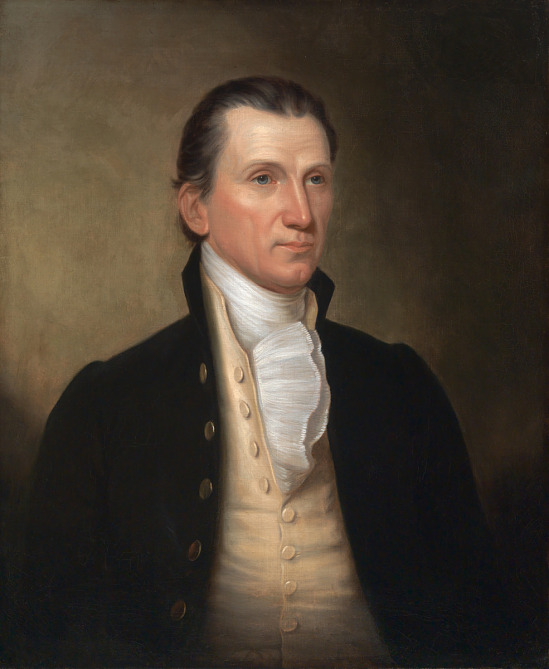
The long-isolationist United States grew concerned about the possibility of some European powers stepping into the void left by Spanish authority in the New World. Britain felt the same, especially fearing Russia's incursions from the North and threats to its holdings in South America and the West Indies. A suggestion for a joint declaration of the status quo ante in the New World resonated somewhat with President Monroe but not with the Secretary of State, John Quincy Adams. After all, two wars had been fought against Britain, one quite recently. America would render its own statement. Adams was the prime drafter of what became, many years later, known as The Monroe Doctrine.


James Monroe


A  Birthday Celebration—and More

Monroe's administration was nearing its close as the nation approached its 50th anniversary. He would be out of office by April 1825, yet he wanted to do something celebratory before his departure. Inviting the last surviving Continental Army general to return to his adopted land seemed a fitting way to begin the celebration on his watch, to underscore the young republic's arrival on the world stage, and to rebuild patriotic fervor. Lafayette was beloved in America and a world-renowned figure for his leading role in two revolutionary movements.th Anniversary. He would be lawfully out of office by April 1825, yet he wanted to do something celebratory before his departure. Inviting the last surviving Continental Army general to return to his adopted land seemed a great way to begin the party on his watch, underscore the young republic's arrival on the world stage, and rebuild patriotic fervor. Lafayette was beloved in America and was a world-renowned figure for his lead role in two revolutionary movements.


Lafayette in Winter


The Plot Thickens

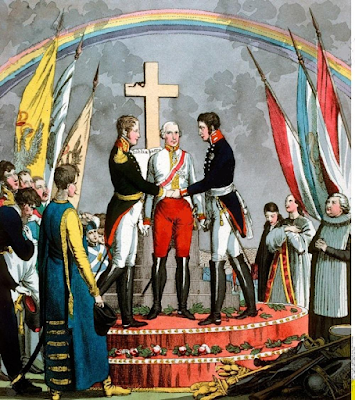
As I learned all this, I realized the tour was more than a feel-good event; it was a tool for both internal and external politics. This was pretty slick. Others thought so, too. Among them were the members of the Holy Alliance, a reactionary (and not so holy) pact among the Empire of Austria, the Kingdom of Prussia, and the Empire of Russia, aimed at curbing the spread of democracy and buttressing autocracy.


Holy Alliance?

Of course, I built on this by creating the fictional subcommittee of the Holy Alliance, which I named the Aulic Council. The historical Aulic Council was an executive-judicial council for the Holy Roman Empire, active from the Late Middle Ages until Napoleon dissolved the Holy Roman Empire in 1806. I spin it into a Spectre-like organization run by villainous barons who answer to Austen Powers's Mr. Evil.


Mister Evil

Protecting the Man

How does a country with no Secret Service or FBI and a small military scattered across coastal forts and western outposts protect a dignitary during a highly publicized series of events? That's the central theme of the tale. An eclectic mix of characters, both inside and outside government, come together with minimal help from federal and state governments. Catholic monks, diplomats, US naval officers, US Marines, the New York militia, and others all play a role in protecting the general. They call themselves The Lafayette Circle. 


New York Militia Guarding Lafayette

Boris and Natascha x Three

Three assassin teams, each consisting of one male and one female, are dispatched to seek out Lafayette and kill him. This is another eclectic cast of characters, intentionally evil yet, like the famed "nogoodnik" Boris Badanoff and his sultry sidekick Natasha in the Rocky and Bullwinkle Show, not entirely unlikeable. Their struggle to "acquire" their target as they roam early 19th-century America adds to the suspense.


Boris and Natasha

Who's Your President?

The fact that one of the most controversial presidential contests in America's history took place in the middle of all this provided a subplot I could not resist. The events prove that the more things change, the more they stay the same, with backroom deals, fights for votes, and a "rigged election" that was also, curiously, legitimate. The events that deprived Andrew Jackson of the White House in the 1824 election are more obscure to most Americans than Julius Caesar's assassination, which at least was celebrated in a play by the Bard himself. 


1824 Election was Controversial

Yet the election took place during Lafayette's visit, and he was known to all the principals involved when the election was thrown to the House of Representatives for just the second time in America's history. Deals were struck, and John Quincy Adams went to the White House. The man with the most electoral votes went home to his estate, The Hermitage, outside Nashville. Lafayette would go out of his way to meet the war hero Jackson while Jackson was home, licking his wounds.


The Hermitage

Companions

Lafayette's journey was captured by his personal secretary, Auguste Levasseur, who penned an account titled Lafayette en Amérique, en 1824 et 1825 ou Journal d'un voyage aux États-Unis. His son, Georges Washington Lafayette, also accompanied the general. Both appear in fictionalized scenes meant to move the plot along while revealing different sides of the great man. Likewise, Fanny Wright, a socialist activist (and Lafayette's purported mistress) from Scotland, who was some thirty years younger than Lafayette, accompanies him for part of the trip.


Frances "Fanny" Wright

Glimpses

The novel includes several flashback sections—scenes meant to place Lafayette back in his youth, fighting in the American Revolution, leading the French Revolution, and dealing with the consequences of both. These are intended to give a bit of historical perspective to those uninformed about his role in those earlier significant events that shaped the Western world.


Flashback: Lafayette's wounding at Brandywine 1777

The Ordeal

I also attempted to offer a look at America and the world in 1824. Travel was by wind, steam, and horse. It was slow and steady, always an ordeal with hundreds of stops across a vast continent. Meetings with folks from all walks of life. Reminiscing with old comrades. Shaking thousands and thousands of hands around the clock. Lafayette's prodigious schedule of events and speeches was like a MAGA tour of the day and bound to take a toll on a man approaching seventy. Yet he did it with aplomb and graciousness. One has to ask why, and the answer is simple. Indeed, he loved America and what it stood for. But even more than that, he loved its people.


The Lafayette Circle is available now!