Followers

Showing posts with label Lord Stirling. Show all posts

Sunday, March 31, 2024

The Once and Future Spy

Hogan’s Heroes

Fans of TV Land probably remember the hit comedy from the 1960s, Hogan’s Heroes. The story centered on a team of spies who were shot down over Nazi Germany to set up a spy network operating from a prison camp (Luft Stalag 13) deep inside Germany. From there, Colonel Hogan and his diverse group kept radio contact with “London” while planning various activities, from espionage to sabotage. Much of the show revolved around jokes at the expense of their clumsy captors, Colonel Klink and Sergeant Schultz, but they often sneaked out of the prison camp to nearby Hammelberg for secret missions. Yet, unlike other POWs—they would slip back in.


POWs as Spies - but for laughs

Winter War

Something like this happened during the height of the American War for Independence when General Washington needed intelligence after his victory at Trenton. Word had arrived that General Charles Cornwallis was leading an army south to seek revenge for the embarrassment. Washington ordered that someone be sent to Brunswick to evaluate the size of the British forces, especially the troops guarding the recently captured General Charles Lee. The status of British supply trains was also of interest because Washington considered marching north to seize their baggage and supplies for his under-supplied army.

Trenton


Daring Mission

Lieutenant Lewis Costigan of the 1st New Jersey Continental Line Regiment volunteered for the task. He was well-suited for the mission since he had been a merchant in the area and knew it well. Costigan’s mission is similar to Lieutenant Jeremiah Creed’s spying in my novel, The Cavalier Spy. He traveled north over icy roads during a bitterly cold winter that chilled the soul. He evaded British patrols, sentries, and Loyalist informers, successfully avoiding detection. Costigan gathered the intelligence Washington needed until British light dragoons swept in and captured him. The brave officer was in uniform, so his captors did not treat him as a spy.


British Light Dragoon


Prisoner on Parole

The British sent their new prisoner to New York City, where he was soon granted parole—a common practice that allowed officers to move freely. Less fortunate prisoners, usually enlisted men, were sent to the Sugar House or, worse, to prison hulks (ships) to wither away and die. However, officers, who had pledged certain restrictions as gentlemen, fared better. Paroled officers were not allowed to engage in military activities, communicate with colleagues, or criticize the British war effort. They agreed to report back to the British if instructed. Costigan led a dull life as a parolee, idling in the garrison city, visiting taverns, and mingling with locals. He was formally released in September 1778 as part of an exchange for a British officer.


Prison Hulk HMS Jersey

Learning about this, Washington wrote to his Commissary General for Prisoners, Colonel John Beatty, who was responsible for handling prisoner affairs, including exchanges. Washington urged him to free Gostigan quickly but to avoid appearing too eager to the British. His Excellency had plans for his past and future spy. General William Alexander, who called himself Lord Stirling, was to pressure Costigan to re-enter the fray once more. 

Costigan took a boat to New Brunswick, where he received a new mission from one of Stirling’s subordinates, Colonel Ogden, who urged the exchanged parolee to return to New York for a few more months and spy for the Continental Army! Washington must have been desperate for intelligence at the time, as the mission was highly unorthodox and fraught with significant risk. For his part, Costigan must have had a lot of guts and nerves of steel to agree.


Lord Stirling

Agent Z

What disguise would Costigan use to slip past the British and sneak around a garrison filled with enemy troops, Loyalists, and the rogue Provost William Cunningham’s thugs? Actually, none. His handlers were betting that the British prison bureaucracy wouldn't realize he had come back, nor would they alert the garrison regiments, Loyalist units, and Cunningham’s provosts when they exchanged prisoners. Stirling and Ogden were counting on the communication channels not connecting, and they were risking Costigan’s life. Costigan was given the code name Agent Z for this unusual mission.


Agent Z would walk among the NY garrison that winter

Prisoner Spy

Costigan made his way back and adopted the disguise of hiding in plain sight—living as the prisoner on parole he had been. Since he was legally exchanged, his previous parole restrictions no longer applied. Interestingly, no one seemed to pay much attention to Costigan as he wandered the city, observing troop movements, living conditions, supply issues, and more. Word of his exchange clearly hadn't spread among the dockside dives or the city’s many taverns and coffee houses. To everyone, he was just another parolee out in the town. Using his code name, Agent Z, the volunteer prisoner sent his intelligence reports to Washington through Colonel Ogden and Lord Stirling.


Agent Z had the run of the City

Intelligence

Agent Z successfully sent out three reports before leaving New York. The first was dated December 7, 1778. It included intelligence on troop and ship movements, the location of the British commander, General Sir Henry Clinton, the supply situation (low on bread), the names of captured prize vessels, and the origins of British provisions from sympathizers and profiteers in New Jersey. His correspondence mentioned several other reports concerning troop strength, but it remains unclear whether these ever made it through.


Sir Henry Clinton


A second report to Washington, dated December 13, 1778, provided more details on British activity that amounted to "indications and warning” of British forces sailing south for Georgia. Lord Sackville (George Germain), the British Secretary for the Colonies, had implemented his Southern Strategy, which would start with the capture of Savannah on December 29. He mentioned the notorious former Royal Governor William Tryon and reported on the movements and promotions of other senior officers. 


Agent Z provided I&W on Germain's 
Southern Strategy

Costigan’s final report from December 19 outlined British officers who had deserted in Florida, as well as the status and size of “the Jamaica fleet,” which he estimated to be about 40 or 50 vessels. 

The Spy Who Came in from the Cold

Agent Z clearly had a talent for observation and elicitation. There is no record of how he sent out his reports. Did he co-opt legal travelers? Send correspondence under a false name? Whatever method he used must have encountered a problem, because he left New York in mid-January 1779, presumably posing as an exchanged parolee. In March of 1779, General Washington inquired of Lord Stirling about his reporting (or lack thereof). Stirling replied tersely that Agent Z was no longer active and believed to be “out” (presumably of the city and the intel game) and thought to be residing in Brunswick.


Lieutenant Lewis Costigan - Agent Z

Lieutenant Lewis Costigan’s activities demonstrate how Washington used multiple channels of intelligence, as he was not connected to the Culper Ring organized by Major Benjamin Tallmadge but reported through Colonel Ogden to Lord Stirling. His exploits provide a unique glimpse into espionage during the American Revolution. As Agent Z, he took on the role originally meant for the unfortunate Nathan Hale, although his clever use of a “non-cover” added an elegant twist. Hiding in plain sight seems to have been all the tradecraft he needed.


Monday, September 28, 2020

The Winter War


“I shall constantly bear in Mind, that as the Sword was the last Resort for the preservation of our Liberties, so it ought to be the first thing laid aside, when those Liberties are firmly established.”

Letter from General George Washington to the Executive Committee of the Continental Congress, January 1, 1777


                                                Washington's pen was as mighty as his sword


January 1777

The Jerseys are aflame in a deep winter-war!

Backs against a frozen river and facing a column of crack redcoats intent on their destruction, George Washington’s army has a serious gut-check. They must outfight or outwit the British to preserve the faltering struggle for independence. With the help of the winter spy, General Washington intends to do both…

Back cover of The Winter Spy, June 2020


The Genesis

This is a book I never expected to write. But as I finished book two in the Yankee Doodle Spies series, my research and curiosity guided me to a straightforward question: what did Washington do AFTER crossing the Delaware? It turns out, quite a bit. I became so interested that I created a follow-up story to capture the feel and action of this important yet little-understood chapter in the American War for Independence.


                                       What did Washington do after he crossed the Delaware?


Winter Quarters

In the 18th century, armies typically fought from late April or early May through November. During the off-season, some soldiers and officers were sent home on furlough, but most simply tried to survive the winter while the armies were restocked and equipped for the next season of marching and fighting. The British had the advantage of quartering many of their forces in towns and cities, using stores, shops, stables, public buildings, and private homes.


                                         Gen Steuben drilling American troops at Valley Forge


For Americans, winter quarters were often a harsh experience of cold, disease, and starvation. For the British, it was a time of relative comfort between grueling military duties. Naturally, both sides had to keep guards and sentries posted. Some patrols were dispatched. During the 1778 Valley Forge encampment, winter quarters became a training ground with the arrival of General Steuben as Inspector-General and Drillmaster.


Winter Action


My readings for my second novel, The Cavalier Spy, opened my eyes to the actions General George Washington took after the Battle of Trenton: two major battles (2nd Trenton, Princeton), along with many skirmishes, marches, and hardships before his increasingly small army reached its final destination at Morristown, New Jersey. 

That decision was highly tactical. His actions compelled the British to withdraw most of their outposts in the Jerseys, leaving them in control of the area around Brunswick, Paulhus Hook (Jersey City), and their main strongholds in Staten Island, Long Island, and Manhattan. With the British in winter quarters, most armies would have hunkered down, recovered, and rearmed. The choice was tactical because Washington could monitor enemy movements with his forces safely behind the Watchung Hills, ready to move in any direction the British advanced in the spring. That was the original plan.


                                        Princeton was one of two actions fought in as many days


But as the British sent out foraging parties into New Jersey to buy or requisition foodstuffs, the Jersey militia responded. Small groups were ambushed, leading to larger foraging parties and bigger ambushes. The numbers grew until Washington authorized some of his Continental regiments, including those led by Generals Philemon Dickinson, William Alexander (Lord Stirling – an American who claimed a Scots peerage), and Ulster-born William “Scotch Willie” Maxwell. By the end of this winter of discontent, the British had lost roughly as many men killed or wounded during “winter quarters” as they did in the previous three pitched battles. Losses that British commander-in-chief, General William Howe, could not afford.


                                                     Gen William Alexander - Lord Stirling


The Plot

No spoiler alerts here – read the book! But needless to say, Lieutenant Jeremiah Creed and his White Knights are thrown into action once again, operating both within and outside the Continental Army. They clash again with the ruthless British dragoon, Major Sandy Drummond, who continues to use his intelligence network to break the rebellion. Along the way, a variety of soldiers and citizens clash, make friends, make enemies, fall in love, and struggle to stay sane during a time that tests men’s souls. Woven into the plot are two themes: the bonding of men in conflict and the war’s impact on families. And, there is always the weather—winds that can cut a man in two, frigid temperatures, and ice-covered roads and rivers play a significant role in a story that, after all, was named for them.


The Book


All three books in the Yankee Doodle Spies series are published by Lanyard Press.

The Winter Spy is available on Amazon in Paperback or Kindle.

https://www.amazon.com/Winter-Spy-Yankee-Doodle-Spies/dp/B08JVNPPKG/ref=tmm_pap_swatch_0?_encoding=UTF8&qid=&sr=


Sunday, November 29, 2015

The Surgeon Counterinsurgent

The cause of the American Revolution was a conflict between two motives: one for independence from Britain and its monarchy, and the other for continued allegiance to that same monarchy as part of the larger British "empire" that grew in the 18th century. The Loyalists often get a bad reputation. They were not evil, misguided, or any more treacherous than the patriots overall. They were simply traditional folks who saw greater benefits in remaining under the crown than in rejecting it. In the long lead-up to the War for Independence, many tried to steer the politics of their respective colonies toward resolving their grievances.


Political agitation caused some to  remain ambivalent


But by the outbreak of actual hostilities, Loyalists were forced to go underground (keep their sympathies secret) or assert royal prerogative through action. New Jersey was the most divided of all the states in this regard. Many influential Loyalists had participated in the various committees, associations, and even Congress to guide the disaffected toward a political solution. But once the challenge was made, they began to slip away quietly or suddenly to action.


Loyalists organized for the day the British would arrive


One such "First Loyalist" was a little-known doctor from Teaneck, New Jersey, in divided Bergen County, named Abraham Van Buskirk. Van Buskirk was a notable figure in the region. The Van Buskirk family was an old Dutch family that had lived there for many years. His father, Lawrence Van Buskirk, operated a successful stagecoach service. By the time of the war, the elder Van Buskirk had passed the enterprise, called The Flying Machine, to his son Andrew, who managed the stage to the Hoboken Ferry. He also ran a tavern in New Bridge.

Doctor Abraham occasionally helped out, usually making the run to Paulus Hook. Van Buskirk and his family were well established in the area. His travels on the stage and familiarity with the region would later prove useful. Abraham Van Buskirk and many other prominent New Jersey Dutch failed in their political efforts to keep the colony aligned with the crown. Additionally, they secretly took other measures as the cloud of war gathered over the troubled Royal Colony.

Despite his Tory leanings, Van Buskirk became an officer in the county militia. However, many local patriots were skeptical and saw him as a Loyalist. He had been associated with the patriot cause early on, having been elected as a moderate to the county committee and provincial congress. Van Buskirk managed to dodge accusations so skillfully that he appeared more like a patriot. But he was a man of principles; he broke ranks with the patriots over the issue of outright independence for the thirteen colonies, refusing to swear the oath of abjuration, renouncing his loyalty to the Crown, and resigning from the provincial congress. Yet, in his practical Dutch way, Van Buskirk and his fellow secret Loyalists would only openly declare if the British showed up in loco. Fortunately for them, and unfortunately for the patriots, they did not have to wait long.


Cornwallis's Invasion of the Jerseys


During late summer and into the fall of 1776, the people of Jersey waited anxiously as the British, under Lord William Howe, systematically drove Washington and his Continental Army from Staten Island, Long Island, and the Island of New York (Manhattan). After an inconclusive battle at White Plains (in Westchester), Washington moved most of his forces across the North (Hudson) River to the "safety" of the Jerseys.

In November, British General Lord Cornwallis led a force of 5,000 men up the palisades overlooking the Hudson River and forced the Continental Army into a hasty retreat toward Pennsylvania. Now was Van Buskirk's moment! On November 22, the British crossed the Hackensack River and captured the city. Swarms of Hessians dazzled or terrified residents, depending on their allegiance. The Volunteer Loyalists gathered in town. He and his men could openly declare and organize their unit, the 4th Battalion, New Jersey Volunteers. Van Buskirk, the citizen, soon proved himself as a capable military leader, guiding his unit with a steady hand and determined efficiency.

Loyalist Infantry

The War for Independence was fought fiercely at the local level, especially between Loyalists and rebels. Some of the most intense fighting took place in the Hackensack Valley. To support British efforts to control Jersey, Van Buskirk began sending his men on raids across Bergen County and later patrolling key areas like Bergen Neck and Staten Island. Van Buskirk's patrols captured prisoners for questioning or exchange. They foraged from the local people’s resources, just like the patriots did. They engaged in numerous skirmishes with the hated rebel militia and sometimes with Continental troops. Van Buskirk quickly became a terror to Hackensack Valley patriots and any Continental units passing through the area.

After Washington's surprise victory at Trenton, many British units left New Jersey, but a few stayed near Paulhus Hook and Bergen. From there, Van Buskirk's companies launched more raids into the so-called "neutral ground" of the valley. They played a part in the "Winter War" (or Forage War), helping to safeguard farmers trying to supply goods to the British forces concentrated in New York. Throughout 1777, Van Buskirk effectively waged unconventional warfare from his base at Bergen Point, sending operatives as far as the New York border to capture patriots for interrogation and retaliation.


In September 1777, the British commander in New York, General Clinton, launched a three-pronged, 2,000-man assault into New Jersey. Van Buskirk's men participated eagerly, landing at Elizabeth Town and moving quickly north, where they performed well during an engagement at Passaic. In August of that year, American General John Sullivan started an attack on British and Loyalist forces on Staten Island. Abraham Van Buskirk's battalion was part of Brigadier General Cortland Skinner's Loyalist Brigade.


Patrick Ferguson

In May 1779, Van Buskirk supported a British raid on Closter with the aim of reaching Paramus. Captain Patrick Ferguson, who would later gain fame for King's Mountain, played a key role in the operation. Later that year, Van Buskirk foiled local patriots in another way by escaping Light Horse Harry Lee's raid on Paulhus Hook, where he was among the intended targets. Van Buskirk's intelligence network was now well-established in that part of New Jersey, and it made a real difference.


The winter of 1779-80 was exceptionally cold. Van Buskirk's 4th New Jersey was based on Staten Island. Conditions would soon warm up. On January 14, American General Lord Stirling attempted a raid against Van Buskirk but was ultimately unsuccessful. Undeterred, Van Buskirk launched a counter-attack on January 25, capturing 50 prisoners despite the severe cold affecting both sides. In April of that year, Van Buskirk played a leading role in the Battle of Hooperstown.


In September 1781, Van Buskirk led his battalion during the turncoat Benedict Arnold's infamous burning of New London and the siege at Fort Griswold, where the surrendering fort commander, Colonel Ledyard, was infamously stabbed and many of his men were bayoneted to death. The last action of the war in the North somewhat symbolizes the true nature of the desperate struggle for America.

Benedict Arnold: British general


The action in Connecticut in 1781 was one of the last major engagements in the North. Following the lengthy negotiations after Yorktown in October 1781, the war returned to a state of "low intensity." One can imagine Van Buskirk played his part skillfully until the end. After the war, Van Buskirk's fate was no different from that of many other Loyalists whose dreams were shattered and whose homes were destroyed or seized by vengeful rebels. Someone as dedicated to the crown as Van Buskirk had few options. As a result, the surgeon, businessman, politician, and soldier joined many other Loyalists who emigrated to Nova Scotia. There, he settled in Shelburne, where he died in 1791.


Sunday, August 25, 2013

The Red Lion Inn

Most Americans are familiar with the American Revolution in New York. Still, even fewer are aware of the war on Long Island, which in 1776 encompassed the area on Long Island today known as Brooklyn. Sadly, those who actually live in the "How Sweet it Is" borough (also known as Kings County) may know the least.  History is ultimately about people and places, yet most Americans know little of their local history. I confess to sometimes falling into that category.  I blame the localities, not the schools, for failing to properly celebrate themselves.  Okay - rant over. Time to discuss a place, specifically a building, that was center stage for a few hours during the largest battle in the American War for Independence.


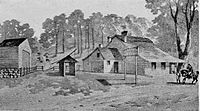
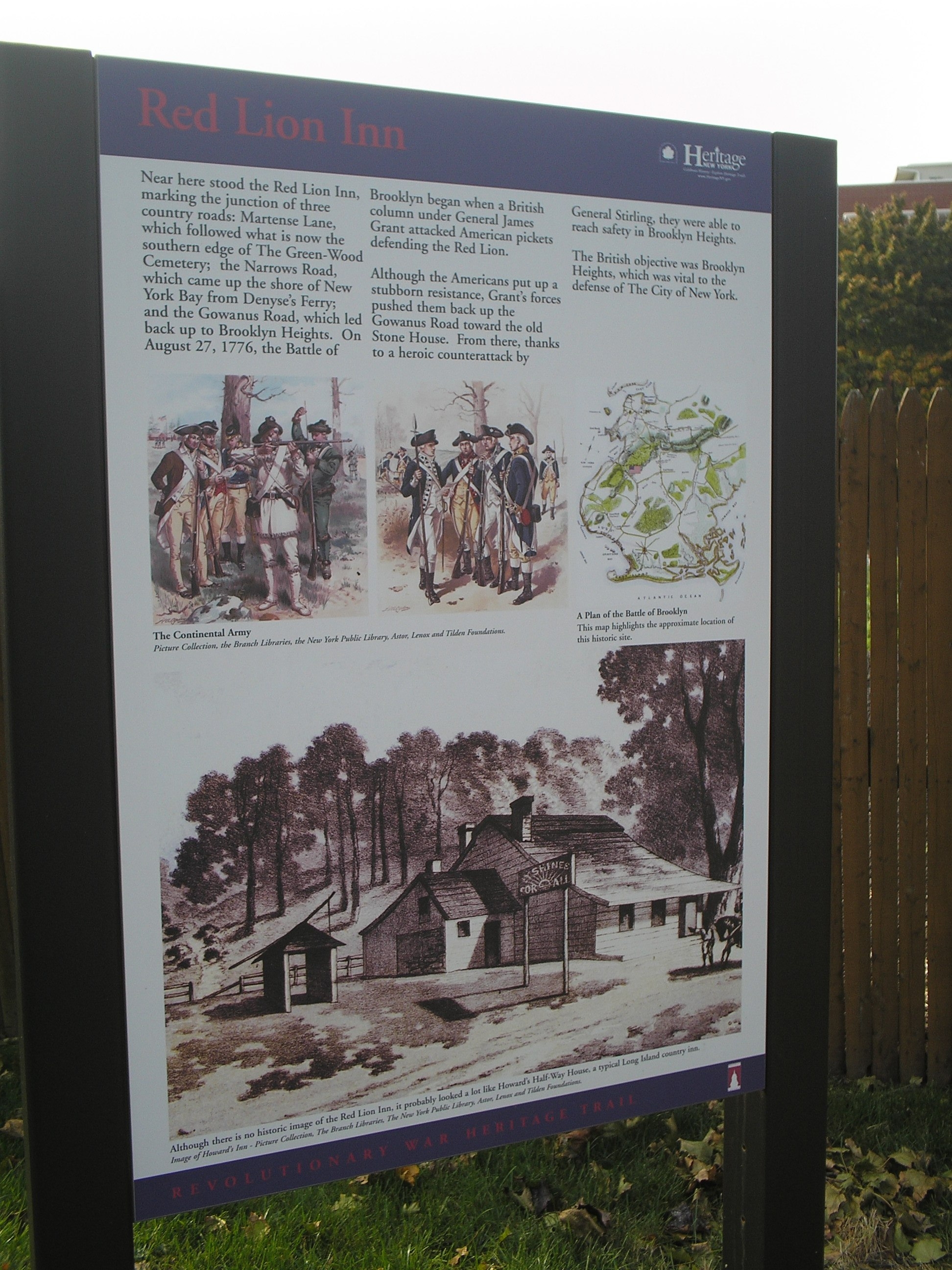
There is no existing image of the Red Lion Inn.
The building itself is Howard's Tavern located at the Jamaica Pass
Both were half-way houses.


The Tavern


The Red Lion Inn was named after the tavern where English King Henry V rested after defeating the French at the Battle of Agincourt. It is fitting that the first action in the first major British victory of the American Revolution took place near the inn. The Red Lion Inn was located at the junction of three country roads: Martense Lane, which followed what is now the southern edge of Green-Wood Cemetery; the Narrows Road, which came up the shore of New York Bay from Denny’s Ferry; and the Gowanus Road, which led back up to Brooklyn Heights. This area is roughly 39th Street and 3rd Ave. in Brooklyn, although other accounts place it on 4th and 40th. I refer to Mark M. Boatner's "Landmarks of the American Revolution" as my guide. Boatner states that many battle markers in Brooklyn are imprecise, and I agree. You can read an earlier blog of mine about my personal visit to that part of Brooklyn a few years ago.


The passes and the British flank march around the Americans.
The Red Lion lay along the Flatbush (western-most)
pass on the left


The Action 


Gen James Grant
On August 27, 1776, the Battle of Brooklyn started when a British column led by General James Grant attacked American pickets defending near the Red Lion Inn. Some accounts say the British were foraging for melons when they startled a rebel picket. It was in this, the westernmost pass, that American Major General William Alexander, a Jersey native also known as "Lord Stirling," stood with the largest force defending the Heights of Guan. The British commander was General James Grant, a Scotsman known for his stout heart and physique. Grant hated rebels and urged his men forward with a ferocity rarely seen from the British. His column of about five thousand professionals rolled into the pass, thirsting for action. But Lord Stirling managed to organize some of the Americans into a line of battle on a piece of high ground just off the Gowanus Road. He was joined by a two-gun artillery battery that covered the road. Grant's troops formed into battle lines—creating maximum volley fire at the front—and advanced up the road. This was perhaps the first open-field battle of the war. Stirling held a strong position, and the initial British assault was repelled by American musket fire and cannon shots. Grant then brought up some of his guns and bombarded the American position. His goal was to pin the Americans while a larger part of his forces completed their envelopment. Later, Grant sent a force to the left of the road, but Stirling countered with a detachment that stopped the British.


Lord Stirling


The  Finale


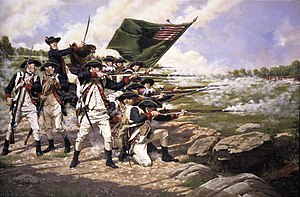
From 7 to 11 a.m., the Americans resisted stubbornly, but eventually, Grant’s forces pushed them back up the Gowanus Road toward the old Stone House. From there, thanks to a heroic counterattack by Lord Stirling, the remaining Americans managed to reach safety in Brooklyn Heights, the British objective, which was crucial for defending The City of New York. Stirling led 400 men from the Maryland and Delaware Continental Line in several frontal assaults on the British troops who had outflanked the defenders and now blocked their way. All but nine were killed, wounded, or captured in the fight. From those Heights, George Washington watched one-third of his force get wiped out. This is the pivotal event in my novel, The Patriot Spy.


Delaware Regiment on Long Island


A Factor?


The Red Lion Inn was not a factor in the battle, unlike the Old Stone House. However, it served as an important landmark. During a time when maps were scarce and often inaccurate, this was significant. Orders frequently referenced landmarks such as bridges, mills, taverns, or farms. Consequently, accounts from both sides mentioned "the Red Lion" or "the Red Lyon" to describe their locations during certain phases of the battle. One might imagine a sign hanging out front showing a red lion, since many taverns used visuals at a time when most men could not read.


Marker at Greenwood Cemetery commemorating
action near the Red Lion Inn (note: Howard's Tavern is the visual)

Friday, November 9, 2012

The Cortelyou House

The House

This edition of the Yankee Doodle Spies highlights the Vechte-Cortelyou House in Brooklyn, New York, the site of the high-water mark of the Battle of Long Island.

"Here on the 27th of August, 1776, Two hundred and fifty out of four hundred brave Maryland soldiers, under the command of Lord STIRLING, were killed in combat with British troops under CORNWALLIS."
...Inscription on a plaque commemorating the action near the Vechte-Cortelyou House, now called the Old Stone House.


Frontal View of the House today


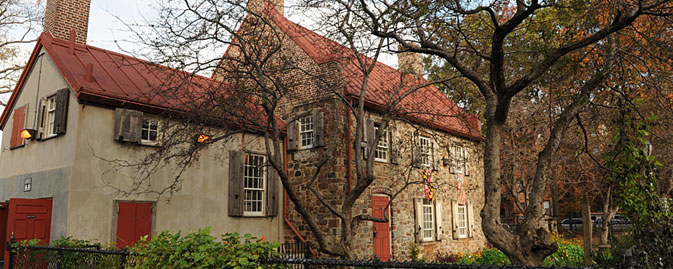
The Vechte-Cortelyou House in Brooklyn, New York, was built in 1699 by a Dutch settler named Claes Arenston Vechte. Vechte and his family worked the land, farming the neat fields and grazing animals in the verdant pastures of this rich farmland.  They also gathered oysters and other bounty from the nearby Gowanus Creek, which they used to ship their produce to Manhattan.  Around the time of the revolution the land was leased to the Cortelyou family, and one of them later purchased the property.  The simple architecture is classic Dutch colonial with a mixture of stone and mortar, steep tiled roof and a wood shingled appendage (what we might today call a "bump-out") that appears to function as the kitchen.

Major General Cornwallis

The house was situated near the intersection of today's 3rd Avenue and 5th Street in Park Slope. During the events leading up to the cataclysmic fight that took place there, the house served as the headquarters of William Alexander, who called himself "Lord Stirling," because of a claim to that Scottish peerage.While holding the passes south of the house, Lord Stirling found his army surrounded when Major General (himself a Lord) Cornwallis' force of several thousand seized the area around the house after a night march down the Jamaica Road into the unguarded east flank of the American Army. 


Lord Stirling


While he ordered most of his forces to attempt escape across the Gowanus Creek, Lord Stirling led some 400 hundred Continental Line from Maryland and Delaware against the British defending near the Old Stone House, which they had turned into a strong defensive position. Stirling led six assaults against the British at that location and around 250 Americans were killed there and are buried nearby (see my earlier blog on trying to find them entitled "On Hallowed Ground").  The importance of this battle is fully described in The Patriot Spy, and the fictional events that I added form the genesis of the Yankee Doodle Spies.
Thumbnail for version as of 09:46, 25 August 2011

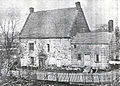
The Original House


Interestingly, in the 19th century the original house once served as the headquarters of the Brooklyn baseball club that later became the famed Brooklyn Dodgers. You can see from this photograph the once prosperous farmstead had by the latter 19th century fallen into disrepair. 

Back View of The Old Stone House Today


The original Cortelyou House was later torn down but a reconstruction was built from dug up debris and replica materials and can be found in J.J. Byrne Park in the Park Slope section of Brooklyn. It serves as a museum that celebrates the events of August 1776 that took place on the hallowed ground around it. 
Sadly, little of the feel or look of the times can be found there.  However, nearby Prospect Park and Greenwood Cemetery do present views that might have been "enjoyed" by Lords Stirling and Cornwallis back in August of 1776.
As you can see, the reconstructed house is smack in the heart of a major urban area.  Note the Gowanus Canal, the remains of the Gowanus Creek, not too far distant. 

Where in the world is the Cortelyou House?