Followers

Showing posts with label Continental Navy. Show all posts

Thursday, March 24, 2016

Block Island

Readers living in the New York metropolitan area have probably heard the broad weather report, "From Cape May to Block Island." The latter is much more than a meteorological geographic point. Block Island is a popular vacation spot for those wanting to experience a trip to Ireland or Scotland without the jet lag, or for those seeking a glimpse of America's earlier times. Yet, one of the most scenic and quietly charming destinations in America also played a small but significant role in the various actions of the American War for Independence.


Block Island sits in a strategic position


Background


The Narragansett Indians were the first inhabitants of Block Island. Their name for the island was “Manisses,” which translates to “Island of the Little God.” First noted by the same Verrazano whose namesake bridge spans New York Harbor, the small island sits in a strategic location at the east end of Long Island Sound, a few miles off the coast of New England. 


Adriaen Block


Verrazano wrote that the island was about the same size as the Mediterranean island of Rhodes, and this may have been the origin of the name of its parent colony and state: Rhode Island. In 1614, Adriaen Block, a Dutch explorer, sailed to the island and named it after himself. He called it Block Island, and it was in 1661 that the island was settled. Due to its geography, Block Island was a natural spot for smugglers, pirates, and during the War for Independence, for privateers. From its location, ships could quickly head toward New England or New York, or escape out to sea. From 1775 to 1783, during the Revolutionary War, the Block Islanders kept watch on Beacon Hill, which rises 211 feet high, by lighting fires to warn of approaching enemies.


Block Island - an ideal haven for smugglers


The New American Navy's Debut?

The Second Continental Congress created the Continental Navy in late 1775. By February 1776, the first ships of the fleet were ready for their first voyage. Commodore Esek Hopkins commanded a fleet of eight ships on an expedition to the Bahamas, where the British were known to have military supplies. After landing and capturing some supplies and two prize ships, Hopkins sailed north on March 17th. He sent one ship to Philadelphia, while the rest of the fleet headed to the Block Island channel. At that time, there was still debate over the role of the Continental Navy in relation to British shipping. Some wanted the Navy to focus on the Royal Navy, while others thought privateers should seize British merchant ships as prizes. Regardless, capturing prize ships was a main goal for all navies, since the prize money went to the officers and crew. When war at sea didn’t kill you, it could also bring riches to some.


By April 4th, Hopkins's fleet had reached the waters off Long Island and quickly captured ships, including HMS Hawk and the Bolton. Hoping to seize more easy prizes, Hopkins continued to cruise off Block Island that night, forming the fleet into a scouting formation with two columns. The right, or eastern, column was led by the USS Cabot, followed by Hopkins' flagship, the USS Alfred, which was the largest ship in the fleet with 20 guns. The left column was led by the USS Andrew Doria, with the USS Columbus following. Behind these ships came the USS Providence, with USS Fly and USS Wasp trailing further behind as escorts for the prizes. Besides the inexperience of his crew, the need to man the prize ships further reduced the fighting effectiveness of the fleet.


A Chance Encounter on a Clear Night


Nearby Newport, Rhode Island, was a British naval base, and the Royal Navy continued to do what it does best: control the seas. A large British naval force was assembling off Charleston, South Carolina. In early April, the Royal Navy 20-gun frigate HMS Glasgow, under the command of Captain Tryingham Howe, was sent from Newport to deliver dispatches to the fleet at South Carolina. Between 1 and 2 am on April 6th, with the American fleet headed generally south, Andrew Doria and Glasgow spotted each other about 20 nautical miles southeast of Block Island. Glasgow was heading west toward the open sea, en route to Charleston. Howe decided to "come about" (turn around) and reconnoiter the ships. For the Americans, Commodore Hopkins gave no signals, so the fleet formed no battle line. A confused maritime skirmish would follow.


Chance encounter on a clear night


Howe first encountered the Cabot. After some secret attempts at recognition, an overzealous seaman on this ship then threw a grenade onto the Glasgow's deck. The battle had started. Cabot, a small brig, opened with one ineffective broadside of its six-pounders. Glasgow responded with two broadsides with its heavier guns, making Cabot ineffective. As she drifted away, the Alfred sailed up to engage Glasgow, and again broadsides followed. Once more, superior British gunnery disabled its opponent. Glasgow raked the Alfred and sent her drifting directly into the path of the next American ship, the Andrew Doria, which also had to veer away to avoid the drifting Cabot. The movements of the last two American ships were uncoordinated, and neither could do much damage to Glasgow.


After the Battle


But with Glasgow now facing three ships, Howe broke off the battle to avoid being boarded and returned to Newport. Despite overwhelming ship superiority, Esek Hopkins had little to show for the night's work except damaged ships and Glasgow's tender. He brought these to New London, Connecticut, on April 8. The American officers faced much criticism, censure, and even military discipline for their less-than-glorious efforts. The battle also revealed deficiencies in the new Continental Navy's gunnery - the few British casualties were caused by musket fire.


Sunday, January 10, 2016

The Patriot Seaman

A Strategy of Sorts


The American Revolution was intensely complex. It started as a political movement and then turned into an armed uprising that developed into a war for independence, along with aspects of a civil war, a secret war, and ultimately a global conflict. But it was also an economic war. The British aimed to control and shut down American commerce, which was the colonies' vital lifeline. In some ways, British actions during the ten years leading up to Lexington and Concord were about gaining the most from the colonies without letting them become too wealthy, large, or influential. Some in Parliament and British leadership worried that someday the American colonies would surpass Britain in population, strength, and reputation. How right they were! Yet, instead of figuring out how to benefit from this, they tried to prevent it.


Down to the Sea in Ships


When war broke out, the British strategy involved surrounding the Americans with Indian and Canadian allies to the west and north. The east and south would be handled by the Royal Navy. So, a naval war became the less discussed but equally important, if not more so, than the land war. Great Britain had the largest and most powerful navy in the world, while the American colonies had none. America did have a growing and capable merchant marine, along with the raw materials to build ships. As a result, it began creating its own small navy and converting its merchant ships into privateers and naval vessels. This success was only possible thanks to the brave and determined men who sailed the ships and the resourceful, resolute men who captained them. This is one such captain's story.


A Navy Built from Merchantmen


Connecticut Navy


Seth Harding was born in Eastham, Massachusetts, although he moved to Norwich, Connecticut, when he was a young man. Harding went to sea early in his life and commanded several merchant ships during the French and Indian War. By 1771, he had moved to Liverpool, Nova Scotia. At the start of the American Revolution in 1775, he returned to Connecticut and offered his services to its nascent navy. Harding was commissioned as commander of the state brig, Defence. Harding captured many British ships while in command of this vessel and two others. He was first sent on patrol near Boston Harbor, where on June 12, 1775, he captured the British armed transport ship, George. Along with the ship, he took several hundred Scottish soldiers of the 71st Highland Regiment and their commander, Lieutenant Colonel Archibald Campbell.


Naval Actions Were Small


Most American actions, including Harding's, were small-scale but still played a vital role in the war. Here is a contemporary letter that mentions one of Harding's exploits:

FAIRFIELD, MAY 13, 1776.

More Tory business. Last Sunday Captain Harding, in the brig Defence, had the happiness of taking a number of Tories who were crossing over to Long Island, on some of their pious errands, I suppose; among whom was one McNeal, a wretch you have often seen up town. He generally wore a white hat and blue silk jacket; in exchange for which, I hope, they will give him a coat-of-mail, that is, one of lime and stone.

It is said there were a number of letters found on them, giving an account of their diabolical schemes, together with the names of several of their associates. In consequence of which, a number of gentlemen resolved to break up the den, and set off to Ridgefield; among whom was the bold asserter of his country's cause, Major Dimon, who, I have this moment heard, had like to have lost his life, in reposing too much confidence in one of the villains. It seems he was very active in taking one Lyons, who, after he had surrendered, invited him in, where he had a number of the brother murderers concealed, that fell on him and would have put an end to his life, had not some of his friends very providentially come to his assistance. The Major, I am told, is much wounded in the head, but still had resolution to go in quest of the others.

You shall hear further in my next.


During his service with Connecticut's navy, Harding actually commanded two brigs named Defence and   Oliver Cromwell. His success led to bigger and better things.


John Jay

Continental Navy


In September 1778, Harding accepted a Continental Navy commission and took command of a new 32-gun frigate, Confederacy. In 1779, he sailed along the East Coast with two other ships, Boston and Deane, capturing three prizes and performing convoy duties. His ship was undermanned, so he had to impress several French prisoners being exchanged by the British. During this cruise, the American flotilla captured a British privateer, Pole, and a schooner, Patsey, in addition to several merchant vessels. Overall, good work. In September of that year, Harding was instructed to take John Jay, the newly appointed American Minister to Spain, to Europe, but a tremendous Atlantic storm struck them, and the ship was dismasted 10 days out. Harding, through skillful seamanship, sailed his ship to Martinique for repairs, while his passengers continued on another vessel.


Continental Navy


"The Harding" goes to Work


Once repaired, Harding got back to work. Confederacy raided British merchant ships and protected convoys until April 18, 1781, when, at the Delaware Capes, she had to surrender to two British ships, the 44-gun Roebuck and 32-gun Orpheus. In early 1782, Harding was exchanged. He then commanded the privateer Diana, but was captured again near Jamaica. And once more, he was released. This was fairly common. Wanting more action, Harding volunteered to serve as First Lieutenant to famous American naval Captain John Barry on the Alliance. In October 1783, Harding was wounded during the final battle of the war, fighting off the coast of France against HMS Sybill. By then, Harding had gained a reputation, especially in France, where he was held in high regard. The King of France, Louis XVI, called him "the Harding."


John Barry


Back to the Merchant Navy


After the war, Harding returned to the merchant marine, sailing and trading in the Virgin Islands. He even became a Danish citizen to improve his business opportunities there. By 1786, Harding's war wounds had weakened him enough to retire, and he first settled in New York City. Clearly, New York drained his resources, and over time, he sank into poverty. In 1807, Congress granted him a pension. The fighting merchantman died in Schoharie, New York, in November 1814. Harding's talents and achievements reflect the young American navy and merchant marine, which played vital roles in securing independence, peace, and prosperity for the young nation.


The World War I vintage USS Harding, DD-91, is named after this fighting first-patriot...


Sunday, April 19, 2015

Sloop o' War

Hoist up the Sloop...


Apologies to the Beach Boys, but unfortunately, too many folks know the term "Sloop" from the great song "Sloop John B," which was actually first recorded by the Kingston Trio. However, "Sloop B." was originally a West Indies folk song, "The John B. Sails." Since the last Yankee Doodle Spies post had a naval theme, I thought I'd continue that theme, as April is the month when the great American naval legend John Paul Jones launched his renowned raids against Great Britain. And he set out in a sloop. I will save a detailed analysis of naval vessels for another time and will focus on the sloop. During the time of the Yankee Doodle Spies, "sloop" was more of a general term for a sailing ship of a certain size, rather than a specific type of vessel.


All kinds of Ships


The battleships of the Age of Sail were "rated ships" with square masts carrying more than 20 guns, and the most heavily armed carried over 100. There were six rates of these ships. The first and second rates were the largest battleships of the period, boasting ninety or more guns. 

However, most rated ships, or men-of-war, during the American Revolution were third rates, equipped with 64 to 84 guns. All of these ships were designed to fight in a line of battle, exchanging broadsides with the enemy line until one side surrendered. Lower rates of ships also existed, with the best known being frigates—the battlecruisers of their day—with around 28 to 40 guns. 

In the type of war fought by the upstart Americans, many non-rated ships proved to be the most practical to employ, especially at the beginning of the American War for Independence. While I won't detail all the types of cannon used, suffice it to say that the weapons were generally rated based on the weight of the iron ball shot fired. 

The larger weights ranged around 48 pounds, while middle weights included 32, 24, and 18-pounders. Smaller guns were 12 and 6-pounders. There were even smaller weights—around a pound—mainly swivel guns carried by most ships, which were not included in the ship's armament rankings. Yes, the larger-rated ships typically carried more of the larger caliber guns.


Ships of the Line were the
battleships of the age


Sloop O' War


The modern definition of a sloop is a one-masted sailboat with a fore-and-aft mainsail and a jib. However, during the time of the Yankee Doodle Spies, a sloop of war was described as a small, square-rigged sailing warship with two or three masts. Sloops were the next class below the rated ships. This loosely defined group of ships carried between 8 and 20 guns. They could be ship-rigged or brig-rigged, meaning they could have anywhere from one to three masts. 


There was no standard classification for sloops, making exact categorization difficult. A nautical dictionary from that period, Blanckey's Naval Expositor, shows how flexible the definition of a sloop of war could be: "Sloops are sailed and masted as men's fancies freed them, sometimes with one mast, with two and three, with Bermudoes, Shoulder of Mutton, Lugg, and Smack sails; they are in figure either square or round and stern'd."


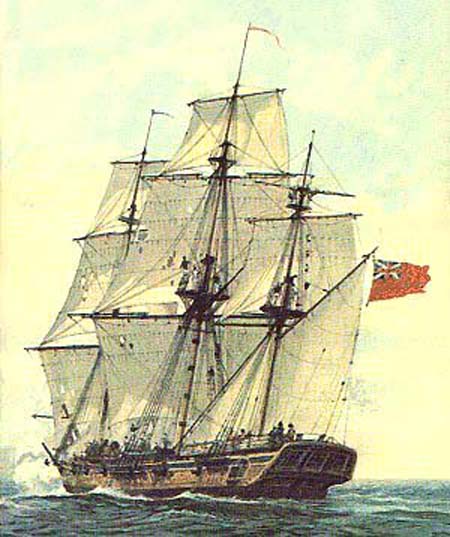
British Sloop O' War 1776


How They Fought

The war for American Independence at sea saw few large-scale battles between Continental and British ships. While the major battles in the later part of the eight-year conflict between the French and British were decisive for our victory, America's navy was small and limited. When Congress authorized a navy, the largest class built consisted of frigates, which were at the lower end of the rated ships. Therefore, most engagements involved sloops from the nascent fleet and American privateers. 

Most fights took the form of raids, one-on-one encounters, and, of course, the seizure of merchant vessels. Sloops were especially suited for all these tasks because they were fast, maneuverable, and carried just enough armament to get the job done. Besides, these small engagements held symbolic value in terms of propaganda, often influencing sentiments in America, Britain, and France. Now, let's take a look at the life of a sloop of war through the eyes of two of the war's most famous.


USS Enterprise


Neither from the Star Fleet nor the Pacific Fleet, the first Enterprise originally belonged to the British and cruised on Lake Champlain to supply their posts in Canada. After the capture of Fort Ticonderoga by the Americans on May 10, 1775, it became the object of desire in the mind of Benedict Arnold, who realized he would not have control of Lake Champlain until its capture. 

He learned it was stationed at a small British garrison at St. John’s on the Richelieu in Canada and set out from Skenesborough (Whitehall, New York) in the commandeered sloop Liberty for that place on May 14, 1775. He surprised and captured the British garrison on May 18, took possession of the 70-ton sloop, and sailed it south to Crown Point. Arnold named it Enterprise and outfitted it with twelve long 4-pound carriage guns and ten swivels. Around August 1, 1775, Captain James Smith was sent by the New York Provincial Congress to General Philip Schuyler and ordered to take command of “the sloop Enterprise."


USS Enterprise


USS Ranger 

Ranger, originally called Hampshire, was launched on May 10, 1777, by James Hackett, a master shipbuilder, at the shipyard of John Langdon on what is now Badger's Island in Kittery, Maine. Captain John Paul Jones was in command. Readers might recall that Kittery was mentioned in my last post. It set sail for France on November 1, 1777, carrying dispatches about General Burgoyne's surrender to the commissioners in Paris. During the voyage, Ranger captured two British prizes. Ranger arrived at Nantes, France, on December 2. 

On February 14, 1778, Ranger received an official salute to the new American flag, the "Stars and Stripes," from the French fleet at Quiberon Bay. On April 10, 1778, Ranger sailed from Brest toward the Irish Sea, and four days later, she captured a prize between the Scilly Isles and Cape Clear. On April 17, she took another prize and sent it back to France. Captain Jones led a daring raid on the British port of Whitehaven on April 23, spiking the guns of the fortress and burning the ships in the harbor. Sailing across the bay to St. Mary's Isle, Scotland, Jones planned to seize the Earl of Selkirk and hold him hostage to secure better treatment for American prisoners of war. 

However, the scheme failed. Several Royal Navy cruisers were hunting for Ranger, and Captain Jones sailed across the North Channel to Carrickfergus, Ireland, to lure out HMS Drake, a 14-gun ship, for a fight. Drake slowly emerged against the wind and tide, and after an hour of battle, the battered Drake surrendered, resulting in three Americans and five British killed in the fight. After making temporary repairs and putting a prize crew on DrakeRanger continued along the west coast of Ireland, capturing a storeship, and arrived at Brest with her prizes on May 8.


USS Ranger


John Paul Jones relinquished command of Ranger to take control of the refurbished prize, Bonhomme Richard. He left his first officer, Lieutenant Simpson, in command. Ranger departed Brest on August 21 and arrived in Portsmouth, New Hampshire, on October 15, with three prizes captured in the Atlantic. The sloop set sail from Portsmouth on February 24, 1779, and joined the Continental Navy ships Queen of France and Warren in harassing British shipping in the North Atlantic. Seven prizes were seized in early April and safely brought into port for sale. 

On June 18, Ranger set out again with Providence and Queen of France, capturing two Jamaican ships in July and nine more vessels off the Grand Banks of Newfoundland. Of the 11 prizes, three were recaptured, but the remaining eight, along with their cargoes, were worth over a million dollars when sold in Boston. These attacks on British merchantmen by Ranger and other sloops of war greatly contributed to funding U.S. efforts and undermining British mercantile interests, ultimately pressuring Parliament to respond. However, Ranger's fate would be disgraceful.


Siege of Charleston


On November 23rd, Ranger was ordered to Commodore Whipple's squadron, arriving in Charleston on December 23rd to support the garrison under British siege. On January 24, 1780, Ranger and Providence captured three transports loaded with supplies during a brief cruise along the coast near Tybee, Georgia. The British assault force was also found in the area. Ranger and Providence returned to Charleston with this news. 

Soon after, the British launched their final push. Although the channel and harbor layout made naval operations and support difficult, Ranger positioned herself in the Cooper River and was captured when the city fell on May 12, 1780. USS Ranger was then taken into the British Royal Navy and became HMS Halifax. But she was decommissioned the following year. This was a bit of an anticlimax for the famed and brave sloop of war.


Sloop o War USS Providence