Followers

Showing posts with label Siege of Charleston. Show all posts

Sunday, August 16, 2026

Patriot of Unambiguous Morality

When I was writing the latest Yankee Doodle Spies novel, The South Spy, I wondered how to handle this edition’s subject. To me, John Laurens is such a heroic figure that I was tempted to make him a major historical character. I decided against it because someone so substantive would require more than I could present in a work like this. Others, such as the legendary Francis Marion, also fell into this category. Face it, the South has plenty of colorful people in its history. So here is my humble attempt to give this impressive First Patriot his due.


John Laurens


A Charleston Heir Answers the Call  

Born October 28, 1754, into one of South Carolina’s wealthiest planter families, John Laurens grew up amid rice fields and the Atlantic slave trade that enriched his father, fellow patriot and future President of the Continental Congress, Henry Laurens. His family traced its roots to French Protestant (Huguenot) refugees who fled religious persecution in France. 

His great-grandfather, AndrĂ© (or Andre) Laurens, left France in the late 17th century (around the time of, or just before, the 1685 revocation of the Edict of Nantes), settled first in New York, and later moved to Charleston, South Carolina. The family intermarried with other Huguenot refugees (such as the Grassets), and by the time of John’s father, Henry Laurens, they were well established in South Carolina society. 

Educated in Geneva and London, the younger Laurens embraced Enlightenment ideals of liberty even as revolution erupted at home. In 1776, John married Martha Manning in London while she was pregnant with their daughter, Frances. He left England in December 1776 to return to America, never to see his wife again or to meet his daughter. 


Henry Laurens

In August 1777, Laurens joined George Washington’s staff as an unpaid volunteer aide-de-camp, where he became close friends with fellow- intellect, Alexander Hamilton. In the following year of campaigning, young Laurens earned a reputation for reckless courage at Brandywine, Germantown, and Monmouth.

A Radical Vision for Southern Arms  

When the British turned their full weight southward, Laurens returned to defend his native state. Before leaving Philadelphia, he proposed a bold solution to the Continental Army’s manpower crisis: raise battalions of enslaved men, promise them freedom for faithful service, and strike at both the enemy and slavery. 


Rhode Island Black Continental Infantry


In response to this “Black Battalion Proposal,” Congress passed a resolution in March 1779 that encouraged South Carolina and Georgia to raise 3,000 enslaved men, promising freedom in exchange for service. Congress appointed Laurens lieutenant colonel to lead the effort, but the South Carolina legislature rejected the proposal in 1779 and again at Jacksonborough in early 1782. 

Undeterred, Laurens took to the battlefield—suffering a wound at Coosawhatchie and leading infantry in the bloodbath at Savannah—while continuing to demand freedom for Black soldiers.

Charleston Falls, a Patriot Captured  

By spring 1780, the conflict in the South had reached a crisis. British troops under Sir Henry Clinton trapped the American garrison during the Siege of Charleston. Laurens fought stubbornly alongside the defenders until the city surrendered on May 12, 1780. The British Southern Strategy was at its apogee. Captured in the war's largest American defeat, he was paroled to Pennsylvania. Rather than breaking his spirit, the fall of his hometown hardened his resolve. Upon his official exchange as a prisoner in November 1780, he immediately sought new ways to strike back. He soon found one.


Charleston Under Siege

Diplomat Across the Atlantic  

Recognizing his intellect and fiery passion, Congress appointed the 26-year-old officer as special minister to France in December 1780. Arriving in Paris in March 1781, Laurens bypassed tedious court etiquette to appeal directly to King Louis XVI and French ministers such as Comte de Vergennes. His relentless diplomacy secured vital loans, military hardware, and a critical French naval commitment. These resources made possible the strategic trap at Yorktown later that year. Mission accomplished, Laurens immediately set sail back across the Atlantic, determined not to miss the coming showdown.


French Minister Comte de Vergennes

Glory at Yorktown, Then South Again  

At the Siege of Yorktown in October 1781, Laurens charged alongside Hamilton in the dramatic nighttime bayonet assault on Redoubt Number 10. After the victory, Washington appointed Laurens to negotiate the British surrender terms—a poetic moment of justice for an officer who had endured the indignity of capture at Charleston. Yet even as the northern theater was secured, Laurens refused to rest. He raced back to South Carolina to join General Nathanael Greene, taking command of light infantry units and directing crucial intelligence operations.

Storming Redoubt Number 10

Eyes and Ears in the Lowcountry  

Throughout late 1781 and early 1782, Laurens ran a clandestine spy network in British-occupied Charleston, funneling reports on enemy troop movements, supply raids, and evacuation preparations to Greene’s headquarters. He balanced these dangerous covert duties with a final, desperate attempt to persuade the South Carolina legislature at Jacksonborough to approve his Black regiments—only to be rejected again. Though thwarted in this attempt to secure justice, Laurens remained a formidable field commander in the Lowcountry’s grinding guerrilla war.


Laurens's Scouts in South Carolina

Final Charge on the Combahee  

On August 27, 1782, while bedridden with a severe fever, Laurens learned that a British foraging force had landed along the Combahee River. Rising from his sickbed, he rode hard to join Brigadier General Mordecai Gist and volunteered to lead a small detachment to block the enemy's retreat at Tar Bluff. Marching into a British ambush, Laurens refused to retreat or wait for support. He ordered a charge and was mortally wounded, making him one of the last high-ranking casualties of the Revolutionary War. 


Mordecai Gist

Legacy of Unambiguous Morality

Though cut down before he could see the nation he fought to build reach full dawn, John Laurens left an enduring legacy as one of the American Revolution’s most fearless and uncompromising visionaries. His relentless pursuit of liberty—not just from British rule but from the bonds of human slavery—marked him as a patriot whose moral conviction matched his legendary courage. General George Washington said it best when he later lamented that Laurens’s only fault was "an intrepidity bordering on rashness," driven by the purest motives of duty and freedom.


Hero's Grave Site


Tuesday, July 14, 2026

Patriot Hostess

 In the shadowed halls of Charleston’s grand King Street mansion, Rebecca Brewton Motte moved with quiet resolve. This grande dame of South Carolina, along with her impressive home and estate, plays a small but historically interesting role in the action of my novel, The South Spy. 


Born in 1737 to a family of goldsmiths and merchants, she married Jacob Motte in 1758. Together, they built a life amid Lowcountry rice fields and tidal rivers. Her brother, Miles Brewton, a wealthy merchant and early Patriot voice, perished at sea in 1775 en route to the Continental Congress. Rebecca inherited his opulent Miles Brewton House and the strategic Mt. Joseph plantation on the Congaree River. These holdings made her one of South Carolina’s wealthiest women, yet she devoted her resources to the Patriot cause.

Early Patriots

Before the British threat loomed in 1780, the Motte family had already committed. Jacob fought at Sullivan’s Island in 1776, where patriot women presented colors to the defending regiment. Rebecca rallied enslaved laborers from her plantations to bolster Charleston’s defenses and supplied Continental forces with rice, beef, pork, corn, and fodder. Her surviving daughters—including Elizabeth, who married Patriot officer Thomas Pinckney in 1779—grew up amid this fierce loyalty. Brewton and Motte family ties, strengthened by connections to Pinckney, wove a resilient web of resistance across Carolina.


From Home to Headquarters

When Sir Henry Clinton’s army besieged Charleston in spring 1780, Rebecca held firm in her King Street home. British cannon thundered across the Ashley and Cooper rivers as the city’s defenses crumbled. On May 12, the garrison surrendered. The magnificent Miles Brewton House was immediately seized as British headquarters—for Clinton, then Banastre Tarleton, Nisbet Balfour, and other officers. Sentries patrolled its elegant rooms. While caring for her ailing husband, Rebecca endured the occupation with unyielding dignity. She presided at table with Carolina hospitality, concealing her patriotism despite insults and crowding. She never betrayed the cause. When Jacob died of illness later that year, she became a widow in an enemy-held city.


Congaree Sanctuary—Not

With her daughters and household, Rebecca withdrew ninety-five miles inland to Mt. Joseph on the Congaree. British forces soon fortified the main house as a vital supply depot between Charleston and Camden, christening it Fort Motte. The red-coated garrison under Lieutenant Daniel MacPherson drove the family into the overseer’s quarters, which were ringed by trenches, palisades, and blockhouses.

Swamp Fox & Light Horse

In May 1781, Brigadier General Francis Marion and Lieutenant Colonel Henry “Light-Horse Harry” Lee arrived with four hundred men to sever the British lifeline. Five days of artillery and rifle fire failed to dislodge the defenders. The dry shingle roof offered the swiftest solution: they would burn the British out. Rebecca did not hesitate. “If it were a palace,” she reportedly declared, “it should go.”


Meeting Marion & Lee


Flaming Arrows

From her brother Miles’s collection, she produced East Indian arrows designed to ignite on impact and offered her own bow. On 12 May, a Patriot marksman loosed a flaming shaft. It struck true, and flames raced across the roof. As British troops scrambled, Patriot cannon roared. MacPherson’s men surrendered before the fire could consume the structure. The blaze was quickly extinguished, and the fort fell. In the aftermath, Rebecca hosted victors and paroled British officers alike, her table a place of grace amid the ashes. The arrows that struck her own roof became symbols of a widow’s patriotism.


Steadfast Support and Post War Builder

Through occupation, bereavement, and the deliberate loss of her home, Rebecca Brewton Motte never wavered. Her plantations continued to feed Patriot columns. After Yorktown, she rebuilt her fortune as a shrewd rice planter, paying off war debts and securing her family’s future. In an era of shadow warriors and unseen blows for liberty, her steadfast support—provisions in the early years, an ultimate sacrifice in 1781—proved as vital as any raid. Like the Yankee Doodle spies who struck from the dark, she fought with a planter’s weapons: resolve, resources, and an iron will no British occupation could break.

Her legacy endures not in stone but in the freedom her sacrifices helped forge. 


Sunday, April 19, 2015

Sloop o' War

Hoist up the Sloop...


Apologies to the Beach Boys, but unfortunately, too many folks know the term "Sloop" from the great song "Sloop John B," which was actually first recorded by the Kingston Trio. However, "Sloop B." was originally a West Indies folk song, "The John B. Sails." Since the last Yankee Doodle Spies post had a naval theme, I thought I'd continue that theme, as April is the month when the great American naval legend John Paul Jones launched his renowned raids against Great Britain. And he set out in a sloop. I will save a detailed analysis of naval vessels for another time and will focus on the sloop. During the time of the Yankee Doodle Spies, "sloop" was more of a general term for a sailing ship of a certain size, rather than a specific type of vessel.


All kinds of Ships


The battleships of the Age of Sail were "rated ships" with square masts carrying more than 20 guns, and the most heavily armed carried over 100. There were six rates of these ships. The first and second rates were the largest battleships of the period, boasting ninety or more guns. 

However, most rated ships, or men-of-war, during the American Revolution were third rates, equipped with 64 to 84 guns. All of these ships were designed to fight in a line of battle, exchanging broadsides with the enemy line until one side surrendered. Lower rates of ships also existed, with the best known being frigates—the battlecruisers of their day—with around 28 to 40 guns. 

In the type of war fought by the upstart Americans, many non-rated ships proved to be the most practical to employ, especially at the beginning of the American War for Independence. While I won't detail all the types of cannon used, suffice it to say that the weapons were generally rated based on the weight of the iron ball shot fired. 

The larger weights ranged around 48 pounds, while middle weights included 32, 24, and 18-pounders. Smaller guns were 12 and 6-pounders. There were even smaller weights—around a pound—mainly swivel guns carried by most ships, which were not included in the ship's armament rankings. Yes, the larger-rated ships typically carried more of the larger caliber guns.


Ships of the Line were the
battleships of the age


Sloop O' War


The modern definition of a sloop is a one-masted sailboat with a fore-and-aft mainsail and a jib. However, during the time of the Yankee Doodle Spies, a sloop of war was described as a small, square-rigged sailing warship with two or three masts. Sloops were the next class below the rated ships. This loosely defined group of ships carried between 8 and 20 guns. They could be ship-rigged or brig-rigged, meaning they could have anywhere from one to three masts. 


There was no standard classification for sloops, making exact categorization difficult. A nautical dictionary from that period, Blanckey's Naval Expositor, shows how flexible the definition of a sloop of war could be: "Sloops are sailed and masted as men's fancies freed them, sometimes with one mast, with two and three, with Bermudoes, Shoulder of Mutton, Lugg, and Smack sails; they are in figure either square or round and stern'd."


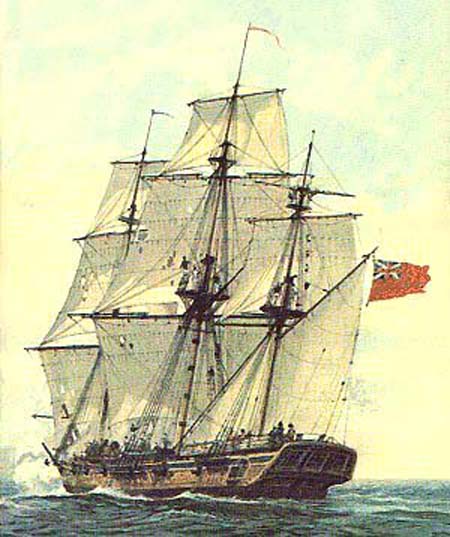
British Sloop O' War 1776


How They Fought

The war for American Independence at sea saw few large-scale battles between Continental and British ships. While the major battles in the later part of the eight-year conflict between the French and British were decisive for our victory, America's navy was small and limited. When Congress authorized a navy, the largest class built consisted of frigates, which were at the lower end of the rated ships. Therefore, most engagements involved sloops from the nascent fleet and American privateers. 

Most fights took the form of raids, one-on-one encounters, and, of course, the seizure of merchant vessels. Sloops were especially suited for all these tasks because they were fast, maneuverable, and carried just enough armament to get the job done. Besides, these small engagements held symbolic value in terms of propaganda, often influencing sentiments in America, Britain, and France. Now, let's take a look at the life of a sloop of war through the eyes of two of the war's most famous.


USS Enterprise


Neither from the Star Fleet nor the Pacific Fleet, the first Enterprise originally belonged to the British and cruised on Lake Champlain to supply their posts in Canada. After the capture of Fort Ticonderoga by the Americans on May 10, 1775, it became the object of desire in the mind of Benedict Arnold, who realized he would not have control of Lake Champlain until its capture. 

He learned it was stationed at a small British garrison at St. John’s on the Richelieu in Canada and set out from Skenesborough (Whitehall, New York) in the commandeered sloop Liberty for that place on May 14, 1775. He surprised and captured the British garrison on May 18, took possession of the 70-ton sloop, and sailed it south to Crown Point. Arnold named it Enterprise and outfitted it with twelve long 4-pound carriage guns and ten swivels. Around August 1, 1775, Captain James Smith was sent by the New York Provincial Congress to General Philip Schuyler and ordered to take command of “the sloop Enterprise."


USS Enterprise


USS Ranger 

Ranger, originally called Hampshire, was launched on May 10, 1777, by James Hackett, a master shipbuilder, at the shipyard of John Langdon on what is now Badger's Island in Kittery, Maine. Captain John Paul Jones was in command. Readers might recall that Kittery was mentioned in my last post. It set sail for France on November 1, 1777, carrying dispatches about General Burgoyne's surrender to the commissioners in Paris. During the voyage, Ranger captured two British prizes. Ranger arrived at Nantes, France, on December 2. 

On February 14, 1778, Ranger received an official salute to the new American flag, the "Stars and Stripes," from the French fleet at Quiberon Bay. On April 10, 1778, Ranger sailed from Brest toward the Irish Sea, and four days later, she captured a prize between the Scilly Isles and Cape Clear. On April 17, she took another prize and sent it back to France. Captain Jones led a daring raid on the British port of Whitehaven on April 23, spiking the guns of the fortress and burning the ships in the harbor. Sailing across the bay to St. Mary's Isle, Scotland, Jones planned to seize the Earl of Selkirk and hold him hostage to secure better treatment for American prisoners of war. 

However, the scheme failed. Several Royal Navy cruisers were hunting for Ranger, and Captain Jones sailed across the North Channel to Carrickfergus, Ireland, to lure out HMS Drake, a 14-gun ship, for a fight. Drake slowly emerged against the wind and tide, and after an hour of battle, the battered Drake surrendered, resulting in three Americans and five British killed in the fight. After making temporary repairs and putting a prize crew on Drake, Ranger continued along the west coast of Ireland, capturing a storeship, and arrived at Brest with her prizes on May 8.


USS Ranger


John Paul Jones relinquished command of Ranger to take control of the refurbished prize, Bonhomme Richard. He left his first officer, Lieutenant Simpson, in command. Ranger departed Brest on August 21 and arrived in Portsmouth, New Hampshire, on October 15, with three prizes captured in the Atlantic. The sloop set sail from Portsmouth on February 24, 1779, and joined the Continental Navy ships Queen of France and Warren in harassing British shipping in the North Atlantic. Seven prizes were seized in early April and safely brought into port for sale. 

On June 18, Ranger set out again with Providence and Queen of France, capturing two Jamaican ships in July and nine more vessels off the Grand Banks of Newfoundland. Of the 11 prizes, three were recaptured, but the remaining eight, along with their cargoes, were worth over a million dollars when sold in Boston. These attacks on British merchantmen by Ranger and other sloops of war greatly contributed to funding U.S. efforts and undermining British mercantile interests, ultimately pressuring Parliament to respond. However, Ranger's fate would be disgraceful.


Siege of Charleston


On November 23rd, Ranger was ordered to Commodore Whipple's squadron, arriving in Charleston on December 23rd to support the garrison under British siege. On January 24, 1780, Ranger and Providence captured three transports loaded with supplies during a brief cruise along the coast near Tybee, Georgia. The British assault force was also found in the area. Ranger and Providence returned to Charleston with this news. 

Soon after, the British launched their final push. Although the channel and harbor layout made naval operations and support difficult, Ranger positioned herself in the Cooper River and was captured when the city fell on May 12, 1780. USS Ranger was then taken into the British Royal Navy and became HMS Halifax. But she was decommissioned the following year. This was a bit of an anticlimax for the famed and brave sloop of war.


Sloop o War USS Providence