Followers

Showing posts with label naval history. Show all posts

Sunday, March 16, 2025

The Sailing Irishman

This special Saint Patrick's Day edition honors Commodore John Barry: the Irish boy who became the father of the U.S. Navy.


John Barry


1745—Ireland. In a small tenant farm along a windswept coast in County Wexford, a boy named John Barry is born into a family of poor Catholic farmers. Life under the English penal laws crushed Irish spirits into the ground. Like many Irish families, the threat of eviction was always present, and one day, the landlord forced them off their tiny piece of land. 

Homeless, the Barrys moved to the rugged seaside village of Rosslare. Luck of the Irish—hardly, but it did give young Barry a way out. He learned the ropes on his uncle’s fishing skiff, and sailing it through choppy waves was the boy’s first taste of the sea. Who could have guessed that someday he’d make the Royal Navy tremble at his name and build what would eventually become the world’s most powerful navy?

Cabin Boy to Captain

Barry’s no stranger to hardships. As a young boy, he barely had shoes, but he has grit. By his teens, he was on ships, starting as a cabin boy—fetching water, scrubbing decks, and avoiding the mate’s boot. The sea is a tough school, but Barry learns fast. With broad shoulders and a calm head that made him a natural leader, he quickly rose through the ranks. 

In the 1760s, he was in Philadelphia, a busy port on the Delaware River, becoming wealthy through trade. By age twenty-one, Barry was a merchant shipmaster, commanding vessels for major names like Reese Meredith. Standing over six feet tall, he was strong but still calm and steady even in fierce storms and rough seas. Soon, he was in high demand as a captain. “Big John” Barry was the skipper owners trusted to lead their ships.


Citizens of Philadelphia


He spends years hauling cargo across the Atlantic, dodging icebergs and setting speed records — such as the fastest day of sailing in the century aboard the prestigious Black Prince. By the 1770s, John Barry had reached the peak of his fortunes. However, storm clouds were gathering on the horizon — tension between the colonies and British authorities. Soon, Barry would exchange merchant manifests for cannonballs.


Merchant Captain at Sea

From Merchant Navy to the Continental Navy

When the First Continental Congress met in 1774, Barry was already friends with future Revolutionary War financier Robert Morris. When the Second Continental Congress decided to create a navy in 1775 using merchant vessels, Barry’s Black Prince was turned into the USS Alfred, which flew the Grand Union flag—America’s first naval ensign. Barry pushed for a naval command and was appointed captain of the USS Lexington, a 14-gun brig, that December.


Command of USS Lexington

He was the first army or navy officer to receive a Continental commission, signed by none other than John Hancock, President of the Continental Congress, on March 14, 1776. History is about to be made!

First Fight

Barry’s first action takes place on April 7, 1776, off the Virginia Capes. Barry demonstrates his resolve. The Lexington engages with the British tender Edward, a spirited ship serving HMS Liverpool. Broadsides are exchanged—cannonballs flying, wood splintering—for an hour and twenty minutes. As calm as ever, Barry shows his courage, giving orders, and when the smoke clears, Edward strikes her colors—the first British ship captured by a Continental vessel. Barry sails his prize into Philadelphia—the American navy’s first!


Fighting Captain

Warrior on Land and Sea

By late 1776, the Cause was at its lowest point. Washington’s shrinking army was retreating through New Jersey after New York. What could Barry do? His next ship, the frigate Effingham, was still in the shipyard. Eager to join the fight, he gathered sailors, marines, and heavy artillery, formed an ad hoc naval brigade, and marched to support Washington. 

At Trenton, his crew transported artillery through snow and ice, pounding the Hessian lines. His brigade also fought at Princeton. Washington personally thanked Barry before asking him to escort wounded prisoners to British General Cornwallis under a flag of truce. A true fighting Irishman on land or sea!


Commanding Guns at Trenton

Back on the water in 1777, Barry commanded the brig USS Delaware and began raiding British shipping in the river with the same name. For the seasoned naval leader, it was like shooting ducks in a barrel; he took over twenty prizes, including the armed schooner Kitty

In 1778, Barry took command of the frigate Raleigh, capturing three more prizes before she ran aground during a skirmish with British warships. Barry was forced to scuttle his ship but swiftly took command of another vessel, the USS Alliance, the fleet’s fastest ship. 

In 1780, he was given a secret mission: to take Colonel John Laurens to France. That mission—securing loans and supplies—helped secure Washington’s victory at Yorktown in October 1781. To top it off, Barry captured a few British prizes on the return trip—just because he could.
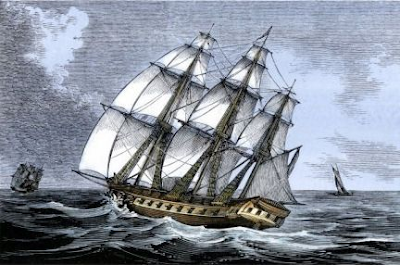

Secret Mission to France

The Final Fights

Barry’s most brutal fight took place on May 29, 1781. Standing tall on the quarterdeck of the Alliance, he faced the fight of his life. Two British sloops, HMS Atalanta and HMS Trepassey, attacked him. All hell broke loose as they closed in—broadsides tearing sails, grapeshot ripping through flesh. Barry was badly wounded when a piece of grapeshot went through his shoulder. He stayed at his station, rallying his crew and shouting commands, but the heavy blood loss eventually forced him below deck. In the end, both British warships surrendered—an act of double surrender. Even British captains now agree that he’s an American sea captain to respect.


Taking on a Brace of Warships

Fittingly, on March 10, 1783, Barry fought the last naval battle of the war off Cape Canaveral. His Alliance squared off against HMS Sybille and a squadron. Barry is in a tight spot as he is convoying the Duc de Lauzane, loaded with cash and supplies from the West Indies. Barry has the advantage over Sybille in firepower, but the rest of the squadron is closing in on him. He abandons the newly captured Sybille, choosing to save the convoy and get the Duc de Lauzane safely to port. As the war nears its end, Barry has made a name for himself as a fighting captain.


Final Fight

Father of the Navy

Our Celtic commodore quickly resumed merchant sailing, making a historic voyage to China in 1787—opening trade with the “reclusive empire.” However, in 1794, with the U.S. Navy forming under the Naval Act, Barry was called to serve his country once more—as its first commodore! President Washington himself awarded Barry Naval Commission Number One. Barry began overseeing the construction of the 44-gun frigate USS United States, his flagship.


USS United States

During the Quasi-War with France (1798–1801), Barry went back to work, seizing French merchant ships in the West Indies while training the next group of naval leaders—future icons like Stephen Decatur and Richard Dale.

The Final Watch

Despite worsening asthma, Barry continued to sail. But on March 6, 1803, the United States slides into port with Barry on the quarterdeck for the last time—his sea duty finished. He may have given up his ship, but not the Navy, remaining as its head until he died on September 13, 1803, at his Strawberry Hill home near Philadelphia. The first commodore was buried with full honors at St. Mary’s Churchyard. While happily married, Barry died childless. Yet his legacy lives on in the Navy he shaped and the men he mentored.


John Barry Gravesite

Legacy of a Legend

Some random shots about John Barry: author of an influential book for improving fleet communication, an early supporter of a standalone Navy Department (which was established in 1798). Barry was a man of faith—he started each day with a Bible reading. He was a brilliant leader of men—he cared for his crew, ensuring they were fed and in good shape. A wise disciplinarian—he quelled three mutinies with a firm yet fair approach, earning lasting loyalty from his men.


Barry's Advocacy Paid Off in 1798

Many tributes were paid: four destroyers were named USS Barry, statues of Barry stand in Wexford and D.C., and the Commodore Barry Bridge was named in his honor. Rhode Island celebrates September 13 as “Commodore John Barry Day.”

John Barry statue in Wexford, Ireland


Who's the Best?

Though not as famous as John Paul Jones, Barry distinguished himself in both war and peace. Starting as an Irish cabin boy and eventually becoming an American commodore, he fought on land and sea, built a navy from scratch, and set a standard for bravery. Historians often call John Barry the “Father of the American Navy,” a title many also credit to John Paul Jones. 

Jones's contributions after the Revolutionary War were inconsistent, especially since he took a commission in Czarina Catherine the Great's navy (see my blog, Yankee Doodle in the Crimea). However, unlike Jones, Barry's legacy includes long-term influence and establishing institutions. Jones was flamboyant, but Barry left a lasting mark.


John Paul Jones as Russian Admiral


Next time you hear “I have not yet begun to fight,” tip your hat to Jones—and raise a glass to the quiet giant who led the Revolution to victory and beyond. Fair winds to you, Commodore Barry. 
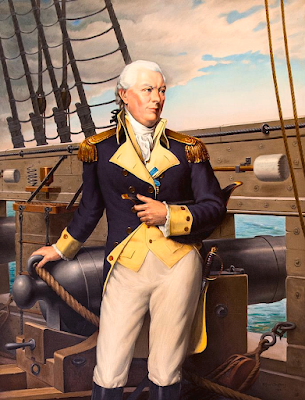

John Barry in His Office

Thursday, January 30, 2025

Island in the Sun

 Special Mission

Large puffs of white clouds drift lazily with the trade winds beneath the bright blue November sky over Oranje Bay. Isaiah Robinson, captain of the 14-gun brig Andrea Doria, brought his spyglass to his eye. Ahead, twin peaks with lush green slopes rose sharply from the sandy shore, where the Dutch trading port city of Oranjestad stood. He shifted his gaze to the large stone fort sitting atop the bluffs overlooking the anchorage, which was his destination.

“How will they receive us, sir?” asked a young midshipman standing beside him. The United States declared independence from Britain earlier that summer but had not yet received diplomatic recognition.

“We shall know soon enough, Mister Sewall,” replied Robinson.


Entering the Harbor at Sint Eustatius

The First Salute

The Andrea Doria sailed quickly and then lazily toward the harbor, crowded with trading ships from across the New World and Europe. Sint Eustatius, part of the Dutch Antilles, was a duty-free port that, since its occupation by the Dutch West Indies Trading Company in the early 17th century, served as a hub for maritime trade—both legal and illegal. Tobacco, rice, cotton, and rum passed through her, forming part of a global supply chain that connected two hemispheres. However, the port was sadly a transit point for the worst kind of trade—human chattel.

Robinson snapped his glass shut and nodded to the Gunner's Mate. “Fire the salute!”

Thirteen of the fourteen barrels flashed and belched smoke—one for each state. Andrea Doria had officially announced her arrival. Robinson wondered, What will be their reply?

From his perch at the fort, the island's governor, Johannes de Graaf, watched the salvo fired by the brig below. He turned to the battery commander and doffed his plumed hat. A salvo of eleven guns erupted, belching a cloud of gun smoke above the harbor.

Captain Robinson smiled in satisfaction. “The signal of a returned salute is two guns less than the saluted.”

“What does it mean, sir?” asked Sewall.

Robinson did not respond to the young officer but turned to the entire crew. “The United Netherlands recognizes us as a sovereign nation!”


The crew erupted into a long cheer as the Andrea Doria headed to safe harbor.


The First Salute - Andrea Doria

Island in the Sun

I have slightly adjusted my plan to dedicate the upcoming editions of the Yankee Doodle Spies blog to characters from the series’ next novel, The Reluctant Spy. Instead, we will focus on a place that plays a significant role in this adventure story. This unique location is an island in the West Indies. An island that was crucial during the American Revolution and features prominently in the fifth book of the Yankee Doodle Spies series, The Cavalier Spy. As those who have read it know—this island is Sint (Saint) Eustatius, sometimes called Statia.


Governor Johannes de Graaf

Revolutionary Role

Sint Eustatius’s role in the American fight for independence didn’t end with that “first salute.” In fact, Governor de Graaf greeted the crew, and Robinson gave him a copy of the Declaration of Independence along with a letter written in Hebrew, meant for the Jewish merchants in the Netherlands. Many Jewish settlers on Sint Eustatius helped make the island a trading and banking hub that linked the Old World with the New.


The Declaration of Independence


Lively and Prosperous

When Robinson and his crew went ashore, they discovered a bustling port town with hundreds of storehouses, shops, inns, taverns, and bordellos. The storehouses were packed with goods from the region’s islands—coffee, cocoa, rice, tobacco, and wood from North America, along with finished products from Europe. The bay was filled with ships from all over the world, waiting to unload or load cargo. The small island, a “duty-free” port, was as busy as Amsterdam, handling 3,000 ships a year.


Port of Amsterdam

The Jewish Community

The large Jewish population was the driving force behind the island’s prosperity. In the early 18th century, Sephardic Jews migrated to Sint Eustatius from the Netherlands, bringing entrepreneurial skills and talent, and establishing financial ties with their communities in Europe and elsewhere. The population eventually made up about one-tenth of the island's residents. These traders became wealthy enough to build the largest synagogue in the New World, Honen Dalim. Stone bricks were imported from Europe to construct the massive structure.


Many Jewish-owned Trading Houses 


Duty-Free Port

Though short on natural resources, the small island in the sun boasted a global network of traders and maritime interests. The Jewish settlers on St. Eustatius made up a significant part of those merchants who were also “illegal” sellers of war materials and supplies to the Americans. Add to that the banking interests in Amsterdam, and you had the ingredients for a system that some called the “Armory of the American Revolution.”


Prosperous Trading Hub

Robinson would meet with some of the local Jewish businessmen and purchase munitions. This marked the start of a covert (or not so covert) trade that exchanged American cash crops, such as tobacco, for war supplies. It was a vital pipeline during the early years of the fight for independence.

Smugglers Hub

But the troublesome island that defied the rules of maritime trade was in the crosshairs of the empire that enforced maritime regulations—at least wherever the navy patrolled. However, political and diplomatic politeness kept the British government from doing much to halt the secret trade that gave the American rebels their lifeline. As long as the Netherlands and France were not confirmed allies of America, the better approach was to send occasional squadrons to patrol the waters. But eliminating the source of smugglers and (to the British) illegal traders would have to wait.


Smugglers Avoided Tariffs - 
But Also Supplied the American Revolution


A Vital Threat

A few years into the war, London realized that the threat from the small island needed to be addressed. By 1780, the Admiralty believed it was time for action. France and Spain were at war, and after the revelations captured with American emissary Henry Laurens, the focus shifted to the West Indies, where the British believed their greater economic interests were. With the Southern strategy in motion, everything was set for a confrontation.


The Admiralty

Send Rodney

British Admiral George Rodney, a capable and well-respected naval veteran, was given the assignment. In late 1780, he sailed with a fleet of fifteen ships of the line, many support ships and transports, and about 3,000 men to finally deal with the “nest of vipers.” Arriving at the harbor entrance on February 3, 1781, the fleet looked impressive. With around 1,000 naval guns, Governor de Graaf could only watch in dismay, as he had just a dozen cannons and fifty men. He accepted Rodney’s offer of surrender.


Admiral George Rodney

Worse Than Thought

The British admiral was amazed by the abundance of supplies and munitions on the island and the number of vessels loaded with goods involved in American trade. Beaches were lined with warehouses overflowing with goods, mainly sugar and tobacco. Others were filled with naval stores—the timber, resin, tar, and hemp rope needed for ships. The scale of the island's contribution to the American war effort was further demonstrated by the number of munitions belonging to the Royal Navy that were seized—sold by British merchants on nearby St. Kitts!


Full Storehouses and Magazines


Months of Rapine

Rodney began confiscating anything of value. With substantial gambling debts, the more he could seize for Britain, the bigger his share of the loot. The admiral burned, dumped, or looted what he could find. The island was plundered like a medieval city. His contempt for the Jews was clear—he believed many successful merchants were mainly responsible for supporting the Americans. In an act similar to later Boer War tactics, Rodney had many of the island’s leading Jewish figures rounded up and sent to St. Kitts. While now destitute families watched in horror, he seized all of their possessions.


The British Take Sint Eustatius


Not Following Orders

Meanwhile, Rodney lost focus on his duties. He broke his orders to destroy the supplies intended for the American forces and to shadow a French fleet heading for North America under Rear Admiral Francois Joseph Paul de Grasse. As he lingered on Sint Eustatius to continue looting, the French arrived in American waters and set sail for the Chesapeake. Rodney sent part of his fleet to join Admiral Hood while, now sick, he sailed back to England. De Grasse and Hood clashed at the Battle of the Chesapeake, where the French forced the British to retreat. They then trapped British General Charles Cornwallis’s army at Yorktown, sealing Britain’s fate in North America.


Admiral de Grasse

After Rodney

The British occupation of Sint Eustatius was brief. Months later, a French fleet recaptured it, and it was returned to Dutch control in 1784. But the island, once vibrant, was a shell of its former self. Months of destruction and plundering by Hood bankrupted the locals, and the population of about 8,000 began to decline. With the war over and the former British colonies now free to trade freely, its importance decreased.


Statius Contemporary Map

During the Napoleonic Wars, the French and British fought over it (the Netherlands was made a client state and then absorbed by France). The Congress of Vienna returned Sint Eustatius to the Netherlands in 1816. But the “Golden Island” would never be the same as it was during its heyday of the late 18th century.


The Congress of Vienna

Statius Speculation

The story of the island in the sun has two “what ifs.”

The first is obvious. What if Rodney had not succumbed to his greed and instead followed his orders, rather than spending months looting and expropriating, but had shifted focus to the French threat after capturing the island? Would America’s fate, and that of the world, have turned out differently?

The second is more vague. But what if the Jewish population had been left untouched and not gone into a diaspora? Would their trade and finance expertise have made Eustatius an even more important regional hub for commerce, leading the entire West Indies to prosperity?

Visitors to the island today can barely imagine its brief yet crucial role in shaping history. But the island in the sun did have its part—and it's one we should always remember.


Monday, September 14, 2020

Tinkerer, Sailor, Soldier, Surgeon

A Connecticut Yankee


Many of our early patriots were accomplished men of letters—lawyers, judges, planters, and merchants—but relatively few were involved in science and technology. David Bushnell belongs to the latter group. Born in Saybrook, Connecticut, on August 30, 1742, he was the son of a farmer. As the eldest of five children, he grew up working on the family farm near Westbrook. After his father died in 1769, he sold his half interest in the farm to his brother Ezra and entered Yale College in 1771.


David Bushnell


Bombs to Boats


While at Yale, he became intrigued by the idea of underwater explosions. An inventive tinkerer by nature, Bushnell successfully combined a black powder charge with a clockwork timing device, creating the first naval mine. He used this knowledge not only in building the underwater mine but also later in making floating torpedoes that exploded on contact. 

He worked with the wealthy New Haven inventor and manufacturer Isaac Doolittle to develop the first mechanically triggered time bomb as well as the first screw propeller. As he worked on developing a practical delivery system for this unique weapon, the start of the American War for Independence gave a new sense of urgency to his efforts. 

By fall that year, he had designed and built the American Turtle (better known simply as Turtle), a primitive submarine. He named it Turtle because it looked like two turtle shells lashed together. It wasn't pretty, but it worked.


Turtle Design Sketch


Test and Evaluation


Gen Israel Putnam
This primitive submarine was operated by a single operator, who powered it with two hand-cranked screw propellers. A system of water pumps took in and expelled water to control the craft's climb or descent, which could reach a depth of about 15 feet. The pilot had a small conning tower with several windows. The tower contained a depth gauge and a phosphorus-lit compass. 

The Turtle’s punch was Bushnell’s original clock/mine combination connected to a metal drill engineered to bore through the copper sheathing coating the hulls of British warships. Once the mine was attached and released, the timing mechanism engaged, giving the Turtle one hour to escape before a 150-pound charge exploded, detonated by a flintlock trigger device. 

Bushnell arranged a successful demonstration, essentially a “demval” in today’s acquisition parlance. Present for the event on the Thames River was Connecticut General Israel Putnam, who urged the American government to continue funding for its “full operational capability.”


Turtle Replica


Run Silent, Run Deep - Sorta


History was made in the summer of 1776 when the Turtle attacked the British fleet anchored in New York Harbor under the command of Admiral Richard Howe. Unfortunately, Bushnell fell ill, and a sergeant named Ezra Lee volunteered to take his place. On the night of September 6, a pair of whaleboats towed the Turtle offshore, where it began its attack. Pumping feverishly, Lee slowly guided the Turtle toward the British fleet. 

Despite challenging tides, Lee managed to reach the primary target, Lord Howe’s flagship, the 64-gun ship of the line, HMS Eagle. The Turtle’s drill failed to penetrate the hull because it was blocked by an iron bar. With air running low, Lee abandoned the effort and released the mine, which floated free. The mine ultimately exploded in a massive blast that sent a plume of water into the night sky. 

The unexpected iron bar prevented what could have been a disastrous hit to a major target, potentially changing British naval tactics for the rest of the war. See my Yankee Doodle Spies post on "The Boat" for a more detailed discussion of this attack.


Bushnell's Turtle takes on HMS Eagle
and initiates submarine warfare


Torpedoes are Running


Bushnell remained undaunted. Confident in his progress, he kept improving the Turtle. He launched several small attacks on individual British ships, but inexperienced pilots and unfavorable tides prevented each attempt. The Turtle was lost the following October when a transport carrying it was sunk by British cannon fire on the North (Hudson) River. Undeterred by setbacks, Bushnell continued experimenting with naval mines and explosives. On August 13, 1777, he released another mine that floated toward the HMS Cerebus, anchored in Black Point Bay. This time, the tides were favorable, but the device got caught on a small schooner. It exploded, killing three British sailors.


 Turtle needed to be towed  into attack position by rowboats


Battle of the Kegs

A Bushnell mine exploding
unnerved the British

He tried again in January 1778, this time releasing 20 large kegs filled with explosives off Bordentown, New Jersey. The kegs were intended to float down the Delaware River and destroy the British fleet at Philadelphia. One mine exploded near a British rowboat, killing several sailors. 

The attack so rattled the British fleet that it spent the rest of the day shooting at the floating kegs and nearly anything else that floated. This event was satirized in the poem, “Battle of Kegs,” by Francis Hopkinson. Rebel propaganda portrayed this as an embarrassment for the hapless Royal Navy. However, Bushnell's career as an undersea weapons developer was over.


Captain David Bushnell's sappers and miners
fought during the siege at Yorktown

The Sapper


Bushnell returned to Saybrook in the spring of 1778. Local Loyalists had once detained him, but he managed to secure his release. Later that year, Bushnell left the world of maritime warfare and joined the Continental Army after General George Washington appointed him as commander of the first company of sappers and miners at West Point, NY. Captain Bushnell served competently for the rest of the conflict and led the sappers during the siege of Yorktown, the battle that effectively ended the war. After his discharge from the Continental Army, he briefly returned to Connecticut and later spent some time in France before coming back to the United States to settle in Warrenton, Georgia, where he practiced medicine. He died there in 1824.


David Bushnell Memorial in Georgia


Seminal Submariner


In the long run, David Bushnell’s efforts laid the groundwork for the later development of underwater mines, torpedoes, and, of course, the submarine. His fundamental use of water for ballast still applies today, as does the use of the propeller. Although his impact on the course of the American War for Independence was limited, he nonetheless shaped the future direction of naval warfare. No small feat for a Connecticut farm boy.


Today's submarines are descendants of Bushnell's
Turtle and still share its basic design, albeit on steroids


Saturday, February 23, 2019

The First Baronet

Who is Peter Parker?


This edition of the Yankee Doodle Spies will recount the exploits of one Peter Parker. No, not that Peter Parker. Our Peter Parker was not a web-crawling teen like his comic book namesake. But before he was a teen, he was skipping along the rigging with a speed and grace that would make even Spider-Man jealous. This is our first naval topic in a while and focuses on a little-known British sailor who rose through the ranks due to long service, some patronage, good timing, and courage. Sometimes, all it takes to rise to the top is simply being there.


Skipping up the rigging


Midshipman


Our Peter Parker was born in Ireland in 1721, the son of Vice-Admiral Christopher Parker. Like all legacy officers of the Royal Navy, he started his career early, serving as a cabin boy and midshipman. During this period, he served on several ships under Vice-Admiral Edward Vernon of the West Indies station at the beginning of the War of Jenkins' Ear.


Vice Adm Sir Edward Vernon


War of the Austrian Succession


The eight-year War of the Austrian Succession provided plenty of action for the Royal Navy and numerous opportunities for up-and-coming young officers like Peter. Parker received his lieutenant’s commission in the summer of 1743 aboard the HMS Russell, a second-rate, 80-gun ship of the line. He served on several warships at various stations, most notably in the Mediterranean, where he participated in the battle of Toulon on February 11, 1744, aboard the flagship of Rear-Admiral William Rowley, the 90-gun HMS Barfleur.

Admiral William Rowley


In May 1747, he was promoted to captain and commissioned a captured French privateer as the 24-gun frigate HMS Margate. Captain Parker commanded this vessel in the Channel, the North Sea, and the Mediterranean. When she was paid off in April 1749, he had a brief stint aboard the 66-gun HMS Lancaster before going on half-pay with the end of the war. It was common practice to place officers on half-pay during periods between active conflicts.


Young Lieutenant Parker served at Toulon

Seven Years of War


Captain Parker remained ashore on half-pay for several years while overseeing the construction of the 44-gun HMS Woolwich in Portsmouth. With the outbreak of the Seven Years’ War, he went to sea on the Woolwich and commanded it on a voyage to the Baltic Sea. However, he fell seriously ill during the trip after catching a fever that swept through the ship.

After he recovered, the navy sent him to the Leeward Islands in December 1756, where, in January 1759, he transferred to the 50-gun HMS Bristol. Parker commanded the Bristol during the unsuccessful campaign against Martinique and later in the campaign that captured Guadeloupe.


Taking Fort Louis at Guadeloupe was one
of many sea-land campaigns in Parker's career


In 1760, he returned to his home station in the Channel, where he took command of the 64-gun HMS Montague. Parker captured several prize ships while navigating the narrow but dangerous waters between Britain and the Continent. His success earned him command of the 70-gun HMS Buckingham and a squadron that dismantled French fortifications on the Isle d’Aix. The next year, he took part in the assault on a fort at Belle-Isle. This was typical 18th-century warfare, involving the capture of positions and negotiations to secure a better peace. But fierce action and naval skill made this possible. His last wartime command was the 74-gun HMS Terrible just before the 1763 Treaty of Paris.


HMS Terrible in action

Another Half-Pay Hiatus


The 1763 Treaty of Paris placed Parker and most of his fellow officers on half-pay. This half-pay status aimed to cut costs while keeping experienced officers available for future conflicts. In the 18th-century Royal Navy, there was always the next war. Parker stayed without a command for nearly ten years. But then things changed. Knighted in 1772, Sir Peter Parker was given command of the second-rate but heavily armed (90-gun) HMS Barfleur when he rejoined the service in 1773. By then, tensions were rising in the North American colonies. In 1775, Parker was assigned to command the fourth-rate 50-gun HMS Bristol, but more importantly, he was soon to command a squadron and promoted to commodore.


Ships returning to Plymouth

War of Rebellion


In February 1776, Captain Peter Parker was appointed commodore of a small squadron at Plymouth and tasked with transporting several Irish regiments under General Charles Cornwallis to America. The destination was the Cape Fear region of North Carolina. This was part of a complicated plan in which he would work with North Carolina’s infamous Royal Governor Josiah Martin and General Henry Clinton to rally Loyalist support in the unrest-filled colony.


Sir Peter Parker, 1st Baronet

Ill-Fated Southern Rendezvous


Bad weather and bad luck thwarted these efforts. A rough Atlantic voyage followed, and by the time Parker’s fleet reached its rendezvous with Clinton, the expected Loyalist uprising they depended on had been crushed. To their dismay, they learned of the decisive battle at Moores Creek Bridge on February 21, 1776. 

The resettled Scots Highlanders of the Carolina hill country had agreed to march to the coast in support of the crown. Ironically, many of them had been resettled after the disaster at Culloden decades earlier in Scotland. Now, they had taken up the claymore for the crown that defeated them in 1745. The Highlanders’ attack was easily scattered by the rebels from the coastal Tidewater—thus, there was no force to link up with.


Battle at Moores Creek Bridge


But no armada should ever go to waste, so Parker and Clinton shifted their focus south to Charleston, South Carolina. The town was seen as being poorly defended. Quickly capturing it would provide a good naval base in the South and a safe haven for Loyalists across the region. The idea of winning hearts and minds remained a central part of the British approach to the war.

Charleston


On June 1, 1776, Parker’s flotilla was off Charleston, but the lack of charts (see the Yankee Doodle Spies Blog Post on hydrography) forced the British to sound the waters while they waited for the tides to favor an attack. It was a good plan given the circumstances, but the delay allowed the American commander, Colonel William Moultrie, time to strengthen the defenses of Fort Sullivan on Sullivan’s Island.


Moultrie's gallant defense of Fort Sullivan
spared the South for a few years


On June 28, Parker finally managed to land British troops on Long Island, the island further up the coast to the northeast of Sullivan’s Island, and positioned ships where they could bombard the island. Despite a severe bombardment, the defenders held their ground, shielded by Fort Sullivan’s palmetto walls. The spongy bark of the palmetto logs absorbed cannon fire. The defenders had only a few guns, but Moultrie utilized these effectively. He concentrated their fire on Parker’s flagship, HMS Bristol. In a stroke of bad luck, the ship’s cable was severed. Out of control, the Bristol swung around, and the guns from the fort unleashed enfilade fire upon her.

Our commodore bravely stood his post on the quarterdeck in the finest tradition of the Royal Navy. But a heated cannonball, deadly red-hot shot, burned his pants off his rear end and caused serious injuries. Meanwhile, things worsened further. To avoid capture, the frigate HMS Actaeon ran onto shoals and ran aground. Under American fire, the resourceful British sailors set their ship ablaze to prevent it from being captured. The intense fighting continued for 10 hours. Finally, with casualties exceeding 250, Parker signaled the flotilla to break off, and they disengaged.


Shoals, palmetto logs, and well-aimed guns set
our commodore's pants afire


Parker’s failure at Charleston preserved the South for the cause, at least for a few years. The resulting boost in American morale rallied southern patriots and subdued southern Loyalists. In this type of war, morale would prove to be decisive.

True North


With their commodore recovering from his burns, Parker’s flotilla returned to New York. There, it joined the fleet under Admiral Richard Howe. Commodore Parker recovered enough to command the squadron that captured Long Island in August 1776. At that time, his ships supported the landing of British troops on Long Island, forcing the rebel army to retreat from New York City.


Parker's leadership was part of a brilliant sea-land
campaign that resulted in victory on
Long Island and New York


In December 1776, Parker was entrusted with command of a flotilla that carried an invasion force under Henry Clinton in another successful operation: capturing Newport, Rhode Island. This gave the British an extra base from which to threaten Massachusetts and Connecticut. More maritime success for the commodore that would not go unnoticed.


Sir Henry Clinton


Commodore Parker stayed at Rhode Island for nearly a year with two 50-gun warships and several frigates under his command. Although the assignment seemed like a remote posting, his career was about to take a turn toward higher rank: flag officer!

A Flag Officer


Comte de Grasse
  Parker was promoted to rear admiral on April 28, 1777. He was soon named commander of the Jamaica Station (not the subway stop). By that time, British strategy had shifted to capturing as much of the West Indies as possible. The rest of the war focused on supporting efforts there against the French and Spanish. He performed his duties well and was promoted again to rear admiral in March 1779.

His time in America ended in 1782, and Parker returned to England in August of that year. He had the distinct privilege of carrying the captured French admiral, Francois-Joseph-Paul, Comte de Grasse, and his staff as prisoners from the Battle of the Saintes. Despite the defeat at the Saintes, de Grasse gained honors for his victory at the Battle of the Chesapeake in 1781-a rare defeat of the Royal Navy that set the stage for American victory. One can only wonder about the sea stories they shared over wine during the voyage back! In London, de Grasse would set the stage for negotiations that led to the Treaty of Paris, which ended the American War for Independence.

High Command

Service in American waters brought Parker great distinction, despite Charleston. He was elevated to baronet in 1783 and appointed commander of Portsmouth Harbor, the home port of the Royal Navy. During this time, he met and mentored a young Lieutenant Horatio Nelson, the future victor of Trafalgar. Parker helped Nelson early in his career, and for that, the British should hold him in high regard. Parker was named admiral of the fleet in September 1799 after the death of Admiral Lord Howe. He was also appointed a general of marines. Sadly, one of Parker’s last official acts was serving as the chief mourner at Vice-Admiral Lord Nelson’s funeral on 9 January 1806.


Parker would mentor a young Horatio Nelson
and sadly preside at his funeral


An MP


While not unusual for military officers of that era, Parker served in Parliament as the MP for Seaford from 1784 to 6. In 1787, he became the MP for Malden, holding the position until 1790. Parker’s West Indian prize money enabled him to build an estate in Essex, although his parliamentary address was registered as Bassingbourn in Cambridgeshire. He supported the government but delivered only two speeches during his time in the House of Commons. 

As a Member of Parliament, Parker held pro-slavery views, stating that “the abolition of the Africa Trade would, in my opinion, cause a general despondency amongst the Negroes and gradually decrease their population and consequently the produce of our islands, and must in time destroy near half our commerce and take from Great Britain all the pretensions to the rank she now holds as the First Maritime power in the World.”


Parliament

Family Life


True to his class and position, Parker made a good match in his family life by marrying Margaret Nugent. They had two sons and two daughters, with one son, Christopher, rising to Vice Admiral.

Admiral Sir Peter Parker, 1st Baronet, was regarded as tough and opinionated, yet well-respected for his composure and coolness in action. After all, how many admirals continued to fight with their pants seared off? While he was considered cantankerous, he met his match with Margaret, who had a very strong personality. During his command period in Jamaica, she was almost his equal in managing the station. He died in London on December 21, 1811, and was buried at St. Margaret's, Westminster.


Peter Parker's resting place at
St. Margaret's Church

Legacy


Peter Parker's career, reminiscent of Forrest Gump, spanned decades, continents, battles, and interactions with prominent figures of the 18th-century Royal Navy — a path that was not unusual. After all, building an empire often requires men to place themselves in strange situations, sometimes for years at a time. Naval officers frequently came from a long line of naval leaders. 

As we see, Parker's lineage was notably distinguished. Besides being the son and father of an admiral, he was also the grandfather of one. Parker's use of patronage helped elevate his son Christopher (who served under him) to captain and then admiral at a young age. Christopher's son, Captain Peter, the renowned 2nd Baronet, also served under his grandfather and alongside Horatio Nelson. 

The second Peter Parker fought in America, just like his father and grandfather, during the War of 1812. In 1814, near Baltimore, he was shot in the pants during combat, similar to the first Sir Peter — though sadly, it proved to be fatal. He was buried at St. Margaret's.


Captain Peter Parker, 2nd Baronet