Followers

Showing posts with label John Barry. Show all posts

Sunday, March 16, 2025

The Sailing Irishman

This special Saint Patrick's Day edition honors Commodore John Barry: the Irish boy who became the father of the U.S. Navy.


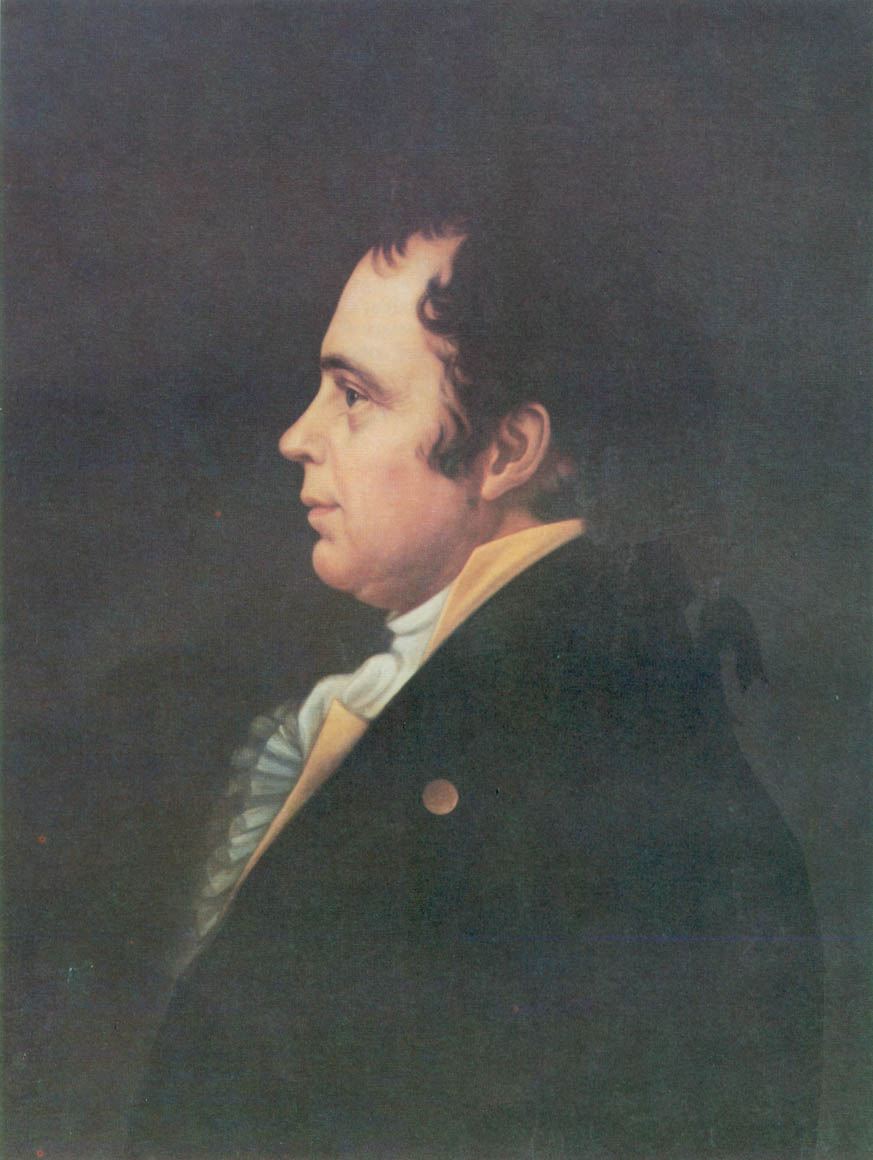
John Barry


1745—Ireland. In a small tenant farm along a windswept coast in County Wexford, a boy named John Barry is born into a family of poor Catholic farmers. Life under the English penal laws crushed Irish spirits into the ground. Like many Irish families, the threat of eviction was always present, and one day, the landlord forced them off their tiny piece of land. 

Homeless, the Barrys moved to the rugged seaside village of Rosslare. Luck of the Irish—hardly, but it did give young Barry a way out. He learned the ropes on his uncle’s fishing skiff, and sailing it through choppy waves was the boy’s first taste of the sea. Who could have guessed that someday he’d make the Royal Navy tremble at his name and build what would eventually become the world’s most powerful navy?

Cabin Boy to Captain

Barry’s no stranger to hardships. As a young boy, he barely had shoes, but he has grit. By his teens, he was on ships, starting as a cabin boy—fetching water, scrubbing decks, and avoiding the mate’s boot. The sea is a tough school, but Barry learns fast. With broad shoulders and a calm head that made him a natural leader, he quickly rose through the ranks. 

In the 1760s, he was in Philadelphia, a busy port on the Delaware River, becoming wealthy through trade. By age twenty-one, Barry was a merchant shipmaster, commanding vessels for major names like Reese Meredith. Standing over six feet tall, he was strong but still calm and steady even in fierce storms and rough seas. Soon, he was in high demand as a captain. “Big John” Barry was the skipper owners trusted to lead their ships.


Citizens of Philadelphia


He spends years hauling cargo across the Atlantic, dodging icebergs and setting speed records — such as the fastest day of sailing in the century aboard the prestigious Black Prince. By the 1770s, John Barry had reached the peak of his fortunes. However, storm clouds were gathering on the horizon — tension between the colonies and British authorities. Soon, Barry would exchange merchant manifests for cannonballs.


Merchant Captain at Sea

From Merchant Navy to the Continental Navy

When the First Continental Congress met in 1774, Barry was already friends with future Revolutionary War financier Robert Morris. When the Second Continental Congress decided to create a navy in 1775 using merchant vessels, Barry’s Black Prince was turned into the USS Alfred, which flew the Grand Union flag—America’s first naval ensign. Barry pushed for a naval command and was appointed captain of the USS Lexington, a 14-gun brig, that December.


Command of USS Lexington

He was the first army or navy officer to receive a Continental commission, signed by none other than John Hancock, President of the Continental Congress, on March 14, 1776. History is about to be made!

First Fight

Barry’s first action takes place on April 7, 1776, off the Virginia Capes. Barry demonstrates his resolve. The Lexington engages with the British tender Edward, a spirited ship serving HMS Liverpool. Broadsides are exchanged—cannonballs flying, wood splintering—for an hour and twenty minutes. As calm as ever, Barry shows his courage, giving orders, and when the smoke clears, Edward strikes her colors—the first British ship captured by a Continental vessel. Barry sails his prize into Philadelphia—the American navy’s first!


Fighting Captain

Warrior on Land and Sea

By late 1776, the Cause was at its lowest point. Washington’s shrinking army was retreating through New Jersey after New York. What could Barry do? His next ship, the frigate Effingham, was still in the shipyard. Eager to join the fight, he gathered sailors, marines, and heavy artillery, formed an ad hoc naval brigade, and marched to support Washington. 

At Trenton, his crew transported artillery through snow and ice, pounding the Hessian lines. His brigade also fought at Princeton. Washington personally thanked Barry before asking him to escort wounded prisoners to British General Cornwallis under a flag of truce. A true fighting Irishman on land or sea!


Commanding Guns at Trenton

Back on the water in 1777, Barry commanded the brig USS Delaware and began raiding British shipping in the river with the same name. For the seasoned naval leader, it was like shooting ducks in a barrel; he took over twenty prizes, including the armed schooner Kitty

In 1778, Barry took command of the frigate Raleigh, capturing three more prizes before she ran aground during a skirmish with British warships. Barry was forced to scuttle his ship but swiftly took command of another vessel, the USS Alliance, the fleet’s fastest ship. 

In 1780, he was given a secret mission: to take Colonel John Laurens to France. That mission—securing loans and supplies—helped secure Washington’s victory at Yorktown in October 1781. To top it off, Barry captured a few British prizes on the return trip—just because he could.
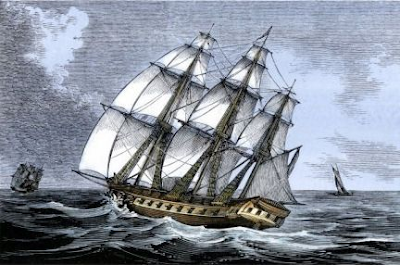

Secret Mission to France

The Final Fights

Barry’s most brutal fight took place on May 29, 1781. Standing tall on the quarterdeck of the Alliance, he faced the fight of his life. Two British sloops, HMS Atalanta and HMS Trepassey, attacked him. All hell broke loose as they closed in—broadsides tearing sails, grapeshot ripping through flesh. Barry was badly wounded when a piece of grapeshot went through his shoulder. He stayed at his station, rallying his crew and shouting commands, but the heavy blood loss eventually forced him below deck. In the end, both British warships surrendered—an act of double surrender. Even British captains now agree that he’s an American sea captain to respect.


Taking on a Brace of Warships

Fittingly, on March 10, 1783, Barry fought the last naval battle of the war off Cape Canaveral. His Alliance squared off against HMS Sybille and a squadron. Barry is in a tight spot as he is convoying the Duc de Lauzane, loaded with cash and supplies from the West Indies. Barry has the advantage over Sybille in firepower, but the rest of the squadron is closing in on him. He abandons the newly captured Sybille, choosing to save the convoy and get the Duc de Lauzane safely to port. As the war nears its end, Barry has made a name for himself as a fighting captain.


Final Fight

Father of the Navy

Our Celtic commodore quickly resumed merchant sailing, making a historic voyage to China in 1787—opening trade with the “reclusive empire.” However, in 1794, with the U.S. Navy forming under the Naval Act, Barry was called to serve his country once more—as its first commodore! President Washington himself awarded Barry Naval Commission Number One. Barry began overseeing the construction of the 44-gun frigate USS United States, his flagship.


USS United States

During the Quasi-War with France (1798–1801), Barry went back to work, seizing French merchant ships in the West Indies while training the next group of naval leaders—future icons like Stephen Decatur and Richard Dale.

The Final Watch

Despite worsening asthma, Barry continued to sail. But on March 6, 1803, the United States slides into port with Barry on the quarterdeck for the last time—his sea duty finished. He may have given up his ship, but not the Navy, remaining as its head until he died on September 13, 1803, at his Strawberry Hill home near Philadelphia. The first commodore was buried with full honors at St. Mary’s Churchyard. While happily married, Barry died childless. Yet his legacy lives on in the Navy he shaped and the men he mentored.


John Barry Gravesite

Legacy of a Legend

Some random shots about John Barry: author of an influential book for improving fleet communication, an early supporter of a standalone Navy Department (which was established in 1798). Barry was a man of faith—he started each day with a Bible reading. He was a brilliant leader of men—he cared for his crew, ensuring they were fed and in good shape. A wise disciplinarian—he quelled three mutinies with a firm yet fair approach, earning lasting loyalty from his men.


Barry's Advocacy Paid Off in 1798

Many tributes were paid: four destroyers were named USS Barry, statues of Barry stand in Wexford and D.C., and the Commodore Barry Bridge was named in his honor. Rhode Island celebrates September 13 as “Commodore John Barry Day.”

John Barry statue in Wexford, Ireland


Who's the Best?

Though not as famous as John Paul Jones, Barry distinguished himself in both war and peace. Starting as an Irish cabin boy and eventually becoming an American commodore, he fought on land and sea, built a navy from scratch, and set a standard for bravery. Historians often call John Barry the “Father of the American Navy,” a title many also credit to John Paul Jones. 

Jones's contributions after the Revolutionary War were inconsistent, especially since he took a commission in Czarina Catherine the Great's navy (see my blog, Yankee Doodle in the Crimea). However, unlike Jones, Barry's legacy includes long-term influence and establishing institutions. Jones was flamboyant, but Barry left a lasting mark.


John Paul Jones as Russian Admiral


Next time you hear “I have not yet begun to fight,” tip your hat to Jones—and raise a glass to the quiet giant who led the Revolution to victory and beyond. Fair winds to you, Commodore Barry. 
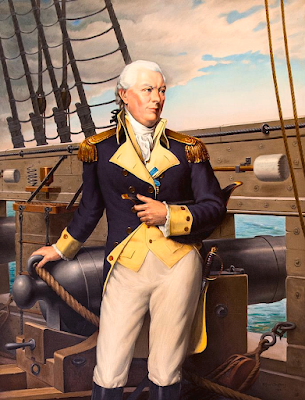

John Barry in His Office

Sunday, January 10, 2016

The Patriot Seaman

A Strategy of Sorts


The American Revolution was intensely complex. It started as a political movement and then turned into an armed uprising that developed into a war for independence, along with aspects of a civil war, a secret war, and ultimately a global conflict. But it was also an economic war. The British aimed to control and shut down American commerce, which was the colonies' vital lifeline. In some ways, British actions during the ten years leading up to Lexington and Concord were about gaining the most from the colonies without letting them become too wealthy, large, or influential. Some in Parliament and British leadership worried that someday the American colonies would surpass Britain in population, strength, and reputation. How right they were! Yet, instead of figuring out how to benefit from this, they tried to prevent it.


Down to the Sea in Ships


When war broke out, the British strategy involved surrounding the Americans with Indian and Canadian allies to the west and north. The east and south would be handled by the Royal Navy. So, a naval war became the less discussed but equally important, if not more so, than the land war. Great Britain had the largest and most powerful navy in the world, while the American colonies had none. America did have a growing and capable merchant marine, along with the raw materials to build ships. As a result, it began creating its own small navy and converting its merchant ships into privateers and naval vessels. This success was only possible thanks to the brave and determined men who sailed the ships and the resourceful, resolute men who captained them. This is one such captain's story.


A Navy Built from Merchantmen


Connecticut Navy


Seth Harding was born in Eastham, Massachusetts, although he moved to Norwich, Connecticut, when he was a young man. Harding went to sea early in his life and commanded several merchant ships during the French and Indian War. By 1771, he had moved to Liverpool, Nova Scotia. At the start of the American Revolution in 1775, he returned to Connecticut and offered his services to its nascent navy. Harding was commissioned as commander of the state brig, Defence. Harding captured many British ships while in command of this vessel and two others. He was first sent on patrol near Boston Harbor, where on June 12, 1775, he captured the British armed transport ship, George. Along with the ship, he took several hundred Scottish soldiers of the 71st Highland Regiment and their commander, Lieutenant Colonel Archibald Campbell.


Naval Actions Were Small


Most American actions, including Harding's, were small-scale but still played a vital role in the war. Here is a contemporary letter that mentions one of Harding's exploits:

FAIRFIELD, MAY 13, 1776.

More Tory business. Last Sunday Captain Harding, in the brig Defence, had the happiness of taking a number of Tories who were crossing over to Long Island, on some of their pious errands, I suppose; among whom was one McNeal, a wretch you have often seen up town. He generally wore a white hat and blue silk jacket; in exchange for which, I hope, they will give him a coat-of-mail, that is, one of lime and stone.

It is said there were a number of letters found on them, giving an account of their diabolical schemes, together with the names of several of their associates. In consequence of which, a number of gentlemen resolved to break up the den, and set off to Ridgefield; among whom was the bold asserter of his country's cause, Major Dimon, who, I have this moment heard, had like to have lost his life, in reposing too much confidence in one of the villains. It seems he was very active in taking one Lyons, who, after he had surrendered, invited him in, where he had a number of the brother murderers concealed, that fell on him and would have put an end to his life, had not some of his friends very providentially come to his assistance. The Major, I am told, is much wounded in the head, but still had resolution to go in quest of the others.

You shall hear further in my next.


During his service with Connecticut's navy, Harding actually commanded two brigs named Defence and   Oliver Cromwell. His success led to bigger and better things.


John Jay

Continental Navy


In September 1778, Harding accepted a Continental Navy commission and took command of a new 32-gun frigate, Confederacy. In 1779, he sailed along the East Coast with two other ships, Boston and Deane, capturing three prizes and performing convoy duties. His ship was undermanned, so he had to impress several French prisoners being exchanged by the British. During this cruise, the American flotilla captured a British privateer, Pole, and a schooner, Patsey, in addition to several merchant vessels. Overall, good work. In September of that year, Harding was instructed to take John Jay, the newly appointed American Minister to Spain, to Europe, but a tremendous Atlantic storm struck them, and the ship was dismasted 10 days out. Harding, through skillful seamanship, sailed his ship to Martinique for repairs, while his passengers continued on another vessel.


Continental Navy


"The Harding" goes to Work


Once repaired, Harding got back to work. Confederacy raided British merchant ships and protected convoys until April 18, 1781, when, at the Delaware Capes, she had to surrender to two British ships, the 44-gun Roebuck and 32-gun Orpheus. In early 1782, Harding was exchanged. He then commanded the privateer Diana, but was captured again near Jamaica. And once more, he was released. This was fairly common. Wanting more action, Harding volunteered to serve as First Lieutenant to famous American naval Captain John Barry on the Alliance. In October 1783, Harding was wounded during the final battle of the war, fighting off the coast of France against HMS Sybill. By then, Harding had gained a reputation, especially in France, where he was held in high regard. The King of France, Louis XVI, called him "the Harding."


John Barry


Back to the Merchant Navy


After the war, Harding returned to the merchant marine, sailing and trading in the Virgin Islands. He even became a Danish citizen to improve his business opportunities there. By 1786, Harding's war wounds had weakened him enough to retire, and he first settled in New York City. Clearly, New York drained his resources, and over time, he sank into poverty. In 1807, Congress granted him a pension. The fighting merchantman died in Schoharie, New York, in November 1814. Harding's talents and achievements reflect the young American navy and merchant marine, which played vital roles in securing independence, peace, and prosperity for the young nation.


The World War I vintage USS Harding, DD-91, is named after this fighting first-patriot...


Saturday, March 9, 2013

America Go Bragh!


With Saint Patrick's Day upon us, I decided to reflect on the role of the Irish in the American Revolution. Make no mistake, the war for independence and its political roots were grounded in Yankee tradition—drawing from English and Scottish political thought. But as everyone knows, when it comes time for action, a few Irishmen are often needed. For the record, a large number (if not the majority) of British troops were Irish. The Patriot side, however, had relatively fewer Irish due to the small Irish immigrant population in America at the time. This blog will highlight just a few, but it is dedicated to all Irish who fought on either side.


The Statesman


The most famous family of Patriot Irish was probably the Carroll family, with Charles Carroll of Carrollton being the most prominent. He was the only Catholic signatory of the Declaration of Independence. He specifically added "of Carrollton" to set himself apart from other Charles Carrolls (like his father) and to ensure the king's men knew who to hang if the rebellion failed. Educated by Jesuits in Maryland and France, he later studied law in England, where he was admitted to the bar. At the time of the rebellion, he was among the wealthiest men in the colonies. His writings and advocacy significantly influenced Maryland's path toward rebellion and independence. He also played a role in Maryland's own "Annapolis Tea Party" and the burning of the Peggy Stewart in October 1774. During the war, Carroll represented Maryland in the Continental Congress and served on Maryland's Committee of Safety before the declaration. A notable failure was his 1776 mission to Canada, where he, along with Benjamin Franklin, failed to persuade French Canada to join the rebellion.


Charles Carroll of Carrollton


The Prelate

Charles Carroll's cousin, Father John Carroll, accompanied Benjamin Franklin on the Canada mission. The obvious goal was to appeal to Canadian Catholics. As a young man, John Carroll went to France for seminary training and then to Belgium to teach philosophy and theology at Bruges and Liège. The suppression of the Jesuits by Papal Bull in 1773 drove him to Britain, and when relations between Britain and America worsened, he returned to Baltimore in 1774. Carroll's greatest contributions came after the American Revolution. In November 1789, he was appointed bishop of Baltimore with a diocese covering the entire United States. Carroll established America's first institutions for educating and ordaining priests, including the Sulpician Seminary in Baltimore. He supported Roman Catholic religious orders coming to America. Through George Washington, he secured federal funding for missionaries to the Indians. By 1811, he had established four new dioceses: Boston, New York, Philadelphia, and Bardstown (Kentucky), and was named America's first archbishop. During his years leading the American church, the number of Roman Catholics increased nearly tenfold, from about 25,000 to 200,000.

Father John Carroll

The Seaman


John Barry is another notable Irish patriot. Though often overshadowed by the more flamboyant sailor (and native Scotsman) John Paul Jones, Barry is generally regarded as the Father of the U.S. Navy. Unlike Carroll, who was born into wealth as a third-generation American landholder, Barry was a typical Irish hardscrabble transplant. Born the son of a poor farmer in County Wexford, young Barry enlisted as a cabin boy on his uncle's fishing schooner. He eventually rose to become a renowned master of mercantile vessels and settled in Philadelphia. When the war broke out, Barry worked tirelessly to equip the first Continental Navy vessels for combat. His reward was commanding the brig Lexington, which he led in one of America's first victories over a Royal Navy ship. Barry turned down a lucrative offer to "come over" for cash and a Royal Navy commission from the British. During the dark days of late 1776, when no ships were available, he served on land as a Marine officer and played a role in the battles at Trenton and Princeton. Back at sea the following year, he fought numerous engagements—often outnumbered—and generally proved more effective than he was outgunned. After the war, he returned to merchant shipping. Nevertheless, in 1794, Secretary of War Henry Knox recalled him to build the first U.S. Navy vessels and led the Navy through its perilous early years, which included a naval war with France and the Barbary pirates.


Father of the US Navy, Commodore Barry

The Sniper


The most famous marksman in a war famed for its plethora of marksmen was Tim Murphy of Morgan's Rifles. Murphy is said to have fired the shot that killed General Simon Fraser at Saratoga in 1777. Legend has it that Morgan gave the order. Climbing a tree, Murphy fired at 300 yards, and Fraser fell, dying.

Some view that as the defining moment of the battle, the battle that changed the course of the war and maybe the world.  Fraser was General Johnnie Burgoyne's best commander, arguably the best field general in the British Army.  His death heralded the destruction of the British forces and the end to Burgoyne's dreams of crushing the rebellion from the north.

Sniper Tim Murphy takes aim at Bemis Heights

The Foe

Although a distinct minority, the Irish fought in many Continental Army units as both enlisted and officers. Some of the "French" generals given commissions by Congress (the notorious Conway and hapless Fermoy come to mind) were of Irish heritage. And nine of Washington’s generals were born in Ireland—two major generals and seven brigadier generals. However, of these, only Brigadier General Edward Hand from County Offaly was at Yorktown. There was another Irish general there, but ironically, he was serving with the British forces. General Charles O’Hara, the illegitimate son of British General James O’Hara, second baron of Tyrawley, was born in Lisbon. O'Hara lost his son during the Yorktown campaign and had the dubious honor of representing Lord Cornwallis at the surrender. There were no all-Irish regiments in the British order of battle at Yorktown, but many Irish soldiers were among the rank-and-file. For instance, the roster of the 76th Foot, a Scottish regiment at Yorktown, listed 114 Irish soldiers. Throughout the 1780s, the Dublin government funded a British military reserve of 12,000 troops, with Cork serving as the main logistical base for the British forces in North America. The renowned Royal American Regiment, which fought in the French and Indian War, had been posted to Ireland, and when it returned to America to fight the rebellion, most of its rank-and-file were Irish.


Brigadier General Charles O'Hara
substituted for the "indisposed"
Major General Cornwallis

The Family


Several of Washington's aides, his 'military family," were Irish or of Irish descent: John Fitzgerald, Peregrine Fitzhugh, James McHenry, Stephen Moylan, and Joseph Reed. Moylan and Fitzgerald were born in Ireland. Most notable was McHenry, who later became Secretary of War and whose namesake fort in Baltimore Harbor became the site of the battle that inspired the "Star-Spangled Banner."


Former aide James McHenry later became
Secretary of War


There is no connection between aide John Fitzgerald and the hoary-haired "Senior Intelligence Advisor"  in The Yankee Doodle Spies series, the fictional Robert Fitzgerald. However, Robert Fitzgerald and Jeremiah Creed represent the Irish and all immigrants who were caught up in the great struggle for liberty.