Followers

Showing posts with label John Paul Jones. Show all posts

Sunday, March 16, 2025

The Sailing Irishman

This special Saint Patrick's Day edition honors Commodore John Barry: the Irish boy who became the father of the U.S. Navy.


John Barry


1745—Ireland. In a small tenant farm along a windswept coast in County Wexford, a boy named John Barry is born into a family of poor Catholic farmers. Life under the English penal laws crushed Irish spirits into the ground. Like many Irish families, the threat of eviction was always present, and one day, the landlord forced them off their tiny piece of land. 

Homeless, the Barrys moved to the rugged seaside village of Rosslare. Luck of the Irish—hardly, but it did give young Barry a way out. He learned the ropes on his uncle’s fishing skiff, and sailing it through choppy waves was the boy’s first taste of the sea. Who could have guessed that someday he’d make the Royal Navy tremble at his name and build what would eventually become the world’s most powerful navy?

Cabin Boy to Captain

Barry’s no stranger to hardships. As a young boy, he barely had shoes, but he has grit. By his teens, he was on ships, starting as a cabin boy—fetching water, scrubbing decks, and avoiding the mate’s boot. The sea is a tough school, but Barry learns fast. With broad shoulders and a calm head that made him a natural leader, he quickly rose through the ranks. 

In the 1760s, he was in Philadelphia, a busy port on the Delaware River, becoming wealthy through trade. By age twenty-one, Barry was a merchant shipmaster, commanding vessels for major names like Reese Meredith. Standing over six feet tall, he was strong but still calm and steady even in fierce storms and rough seas. Soon, he was in high demand as a captain. “Big John” Barry was the skipper owners trusted to lead their ships.


Citizens of Philadelphia


He spends years hauling cargo across the Atlantic, dodging icebergs and setting speed records — such as the fastest day of sailing in the century aboard the prestigious Black Prince. By the 1770s, John Barry had reached the peak of his fortunes. However, storm clouds were gathering on the horizon — tension between the colonies and British authorities. Soon, Barry would exchange merchant manifests for cannonballs.


Merchant Captain at Sea

From Merchant Navy to the Continental Navy

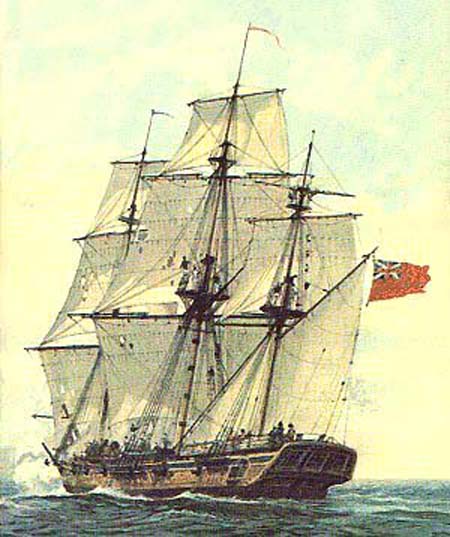
When the First Continental Congress met in 1774, Barry was already friends with future Revolutionary War financier Robert Morris. When the Second Continental Congress decided to create a navy in 1775 using merchant vessels, Barry’s Black Prince was turned into the USS Alfred, which flew the Grand Union flag—America’s first naval ensign. Barry pushed for a naval command and was appointed captain of the USS Lexington, a 14-gun brig, that December.


Command of USS Lexington

He was the first army or navy officer to receive a Continental commission, signed by none other than John Hancock, President of the Continental Congress, on March 14, 1776. History is about to be made!

First Fight

Barry’s first action takes place on April 7, 1776, off the Virginia Capes. Barry demonstrates his resolve. The Lexington engages with the British tender Edward, a spirited ship serving HMS Liverpool. Broadsides are exchanged—cannonballs flying, wood splintering—for an hour and twenty minutes. As calm as ever, Barry shows his courage, giving orders, and when the smoke clears, Edward strikes her colors—the first British ship captured by a Continental vessel. Barry sails his prize into Philadelphia—the American navy’s first!


Fighting Captain

Warrior on Land and Sea

By late 1776, the Cause was at its lowest point. Washington’s shrinking army was retreating through New Jersey after New York. What could Barry do? His next ship, the frigate Effingham, was still in the shipyard. Eager to join the fight, he gathered sailors, marines, and heavy artillery, formed an ad hoc naval brigade, and marched to support Washington. 

At Trenton, his crew transported artillery through snow and ice, pounding the Hessian lines. His brigade also fought at Princeton. Washington personally thanked Barry before asking him to escort wounded prisoners to British General Cornwallis under a flag of truce. A true fighting Irishman on land or sea!


Commanding Guns at Trenton

Back on the water in 1777, Barry commanded the brig USS Delaware and began raiding British shipping in the river with the same name. For the seasoned naval leader, it was like shooting ducks in a barrel; he took over twenty prizes, including the armed schooner Kitty. 

In 1778, Barry took command of the frigate Raleigh, capturing three more prizes before she ran aground during a skirmish with British warships. Barry was forced to scuttle his ship but swiftly took command of another vessel, the USS Alliance, the fleet’s fastest ship. 

In 1780, he was given a secret mission: to take Colonel John Laurens to France. That mission—securing loans and supplies—helped secure Washington’s victory at Yorktown in October 1781. To top it off, Barry captured a few British prizes on the return trip—just because he could.
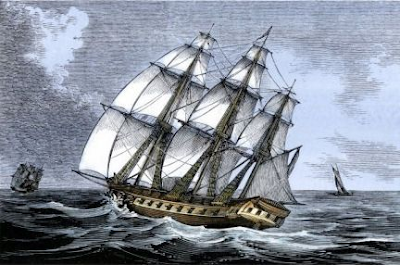

Secret Mission to France

The Final Fights

Barry’s most brutal fight took place on May 29, 1781. Standing tall on the quarterdeck of the Alliance, he faced the fight of his life. Two British sloops, HMS Atalanta and HMS Trepassey, attacked him. All hell broke loose as they closed in—broadsides tearing sails, grapeshot ripping through flesh. Barry was badly wounded when a piece of grapeshot went through his shoulder. He stayed at his station, rallying his crew and shouting commands, but the heavy blood loss eventually forced him below deck. In the end, both British warships surrendered—an act of double surrender. Even British captains now agree that he’s an American sea captain to respect.


Taking on a Brace of Warships

Fittingly, on March 10, 1783, Barry fought the last naval battle of the war off Cape Canaveral. His Alliance squared off against HMS Sybille and a squadron. Barry is in a tight spot as he is convoying the Duc de Lauzane, loaded with cash and supplies from the West Indies. Barry has the advantage over Sybille in firepower, but the rest of the squadron is closing in on him. He abandons the newly captured Sybille, choosing to save the convoy and get the Duc de Lauzane safely to port. As the war nears its end, Barry has made a name for himself as a fighting captain.


Final Fight

Father of the Navy

Our Celtic commodore quickly resumed merchant sailing, making a historic voyage to China in 1787—opening trade with the “reclusive empire.” However, in 1794, with the U.S. Navy forming under the Naval Act, Barry was called to serve his country once more—as its first commodore! President Washington himself awarded Barry Naval Commission Number One. Barry began overseeing the construction of the 44-gun frigate USS United States, his flagship.


USS United States

During the Quasi-War with France (1798–1801), Barry went back to work, seizing French merchant ships in the West Indies while training the next group of naval leaders—future icons like Stephen Decatur and Richard Dale.

The Final Watch

Despite worsening asthma, Barry continued to sail. But on March 6, 1803, the United States slides into port with Barry on the quarterdeck for the last time—his sea duty finished. He may have given up his ship, but not the Navy, remaining as its head until he died on September 13, 1803, at his Strawberry Hill home near Philadelphia. The first commodore was buried with full honors at St. Mary’s Churchyard. While happily married, Barry died childless. Yet his legacy lives on in the Navy he shaped and the men he mentored.


John Barry Gravesite

Legacy of a Legend

Some random shots about John Barry: author of an influential book for improving fleet communication, an early supporter of a standalone Navy Department (which was established in 1798). Barry was a man of faith—he started each day with a Bible reading. He was a brilliant leader of men—he cared for his crew, ensuring they were fed and in good shape. A wise disciplinarian—he quelled three mutinies with a firm yet fair approach, earning lasting loyalty from his men.


Barry's Advocacy Paid Off in 1798

Many tributes were paid: four destroyers were named USS Barry, statues of Barry stand in Wexford and D.C., and the Commodore Barry Bridge was named in his honor. Rhode Island celebrates September 13 as “Commodore John Barry Day.”

John Barry statue in Wexford, Ireland


Who's the Best?

Though not as famous as John Paul Jones, Barry distinguished himself in both war and peace. Starting as an Irish cabin boy and eventually becoming an American commodore, he fought on land and sea, built a navy from scratch, and set a standard for bravery. Historians often call John Barry the “Father of the American Navy,” a title many also credit to John Paul Jones. 

Jones's contributions after the Revolutionary War were inconsistent, especially since he took a commission in Czarina Catherine the Great's navy (see my blog, Yankee Doodle in the Crimea). However, unlike Jones, Barry's legacy includes long-term influence and establishing institutions. Jones was flamboyant, but Barry left a lasting mark.


John Paul Jones as Russian Admiral


Next time you hear “I have not yet begun to fight,” tip your hat to Jones—and raise a glass to the quiet giant who led the Revolution to victory and beyond. Fair winds to you, Commodore Barry. 
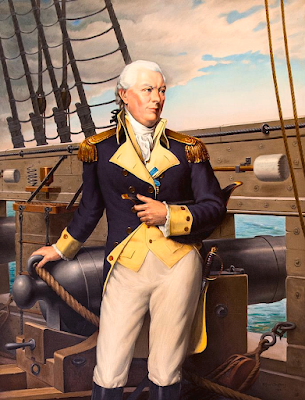

John Barry in His Office

Sunday, April 19, 2015

Sloop o' War

Hoist up the Sloop...


Apologies to the Beach Boys, but unfortunately, too many folks know the term "Sloop" from the great song "Sloop John B," which was actually first recorded by the Kingston Trio. However, "Sloop B." was originally a West Indies folk song, "The John B. Sails." Since the last Yankee Doodle Spies post had a naval theme, I thought I'd continue that theme, as April is the month when the great American naval legend John Paul Jones launched his renowned raids against Great Britain. And he set out in a sloop. I will save a detailed analysis of naval vessels for another time and will focus on the sloop. During the time of the Yankee Doodle Spies, "sloop" was more of a general term for a sailing ship of a certain size, rather than a specific type of vessel.


All kinds of Ships


The battleships of the Age of Sail were "rated ships" with square masts carrying more than 20 guns, and the most heavily armed carried over 100. There were six rates of these ships. The first and second rates were the largest battleships of the period, boasting ninety or more guns. 

However, most rated ships, or men-of-war, during the American Revolution were third rates, equipped with 64 to 84 guns. All of these ships were designed to fight in a line of battle, exchanging broadsides with the enemy line until one side surrendered. Lower rates of ships also existed, with the best known being frigates—the battlecruisers of their day—with around 28 to 40 guns. 

In the type of war fought by the upstart Americans, many non-rated ships proved to be the most practical to employ, especially at the beginning of the American War for Independence. While I won't detail all the types of cannon used, suffice it to say that the weapons were generally rated based on the weight of the iron ball shot fired. 

The larger weights ranged around 48 pounds, while middle weights included 32, 24, and 18-pounders. Smaller guns were 12 and 6-pounders. There were even smaller weights—around a pound—mainly swivel guns carried by most ships, which were not included in the ship's armament rankings. Yes, the larger-rated ships typically carried more of the larger caliber guns.


Ships of the Line were the
battleships of the age


Sloop O' War


The modern definition of a sloop is a one-masted sailboat with a fore-and-aft mainsail and a jib. However, during the time of the Yankee Doodle Spies, a sloop of war was described as a small, square-rigged sailing warship with two or three masts. Sloops were the next class below the rated ships. This loosely defined group of ships carried between 8 and 20 guns. They could be ship-rigged or brig-rigged, meaning they could have anywhere from one to three masts. 


There was no standard classification for sloops, making exact categorization difficult. A nautical dictionary from that period, Blanckey's Naval Expositor, shows how flexible the definition of a sloop of war could be: "Sloops are sailed and masted as men's fancies freed them, sometimes with one mast, with two and three, with Bermudoes, Shoulder of Mutton, Lugg, and Smack sails; they are in figure either square or round and stern'd."


British Sloop O' War 1776


How They Fought

The war for American Independence at sea saw few large-scale battles between Continental and British ships. While the major battles in the later part of the eight-year conflict between the French and British were decisive for our victory, America's navy was small and limited. When Congress authorized a navy, the largest class built consisted of frigates, which were at the lower end of the rated ships. Therefore, most engagements involved sloops from the nascent fleet and American privateers. 

Most fights took the form of raids, one-on-one encounters, and, of course, the seizure of merchant vessels. Sloops were especially suited for all these tasks because they were fast, maneuverable, and carried just enough armament to get the job done. Besides, these small engagements held symbolic value in terms of propaganda, often influencing sentiments in America, Britain, and France. Now, let's take a look at the life of a sloop of war through the eyes of two of the war's most famous.


USS Enterprise


Neither from the Star Fleet nor the Pacific Fleet, the first Enterprise originally belonged to the British and cruised on Lake Champlain to supply their posts in Canada. After the capture of Fort Ticonderoga by the Americans on May 10, 1775, it became the object of desire in the mind of Benedict Arnold, who realized he would not have control of Lake Champlain until its capture. 

He learned it was stationed at a small British garrison at St. John’s on the Richelieu in Canada and set out from Skenesborough (Whitehall, New York) in the commandeered sloop Liberty for that place on May 14, 1775. He surprised and captured the British garrison on May 18, took possession of the 70-ton sloop, and sailed it south to Crown Point. Arnold named it Enterprise and outfitted it with twelve long 4-pound carriage guns and ten swivels. Around August 1, 1775, Captain James Smith was sent by the New York Provincial Congress to General Philip Schuyler and ordered to take command of “the sloop Enterprise."


USS Enterprise


USS Ranger 

Ranger, originally called Hampshire, was launched on May 10, 1777, by James Hackett, a master shipbuilder, at the shipyard of John Langdon on what is now Badger's Island in Kittery, Maine. Captain John Paul Jones was in command. Readers might recall that Kittery was mentioned in my last post. It set sail for France on November 1, 1777, carrying dispatches about General Burgoyne's surrender to the commissioners in Paris. During the voyage, Ranger captured two British prizes. Ranger arrived at Nantes, France, on December 2. 

On February 14, 1778, Ranger received an official salute to the new American flag, the "Stars and Stripes," from the French fleet at Quiberon Bay. On April 10, 1778, Ranger sailed from Brest toward the Irish Sea, and four days later, she captured a prize between the Scilly Isles and Cape Clear. On April 17, she took another prize and sent it back to France. Captain Jones led a daring raid on the British port of Whitehaven on April 23, spiking the guns of the fortress and burning the ships in the harbor. Sailing across the bay to St. Mary's Isle, Scotland, Jones planned to seize the Earl of Selkirk and hold him hostage to secure better treatment for American prisoners of war. 

However, the scheme failed. Several Royal Navy cruisers were hunting for Ranger, and Captain Jones sailed across the North Channel to Carrickfergus, Ireland, to lure out HMS Drake, a 14-gun ship, for a fight. Drake slowly emerged against the wind and tide, and after an hour of battle, the battered Drake surrendered, resulting in three Americans and five British killed in the fight. After making temporary repairs and putting a prize crew on Drake, Ranger continued along the west coast of Ireland, capturing a storeship, and arrived at Brest with her prizes on May 8.


USS Ranger


John Paul Jones relinquished command of Ranger to take control of the refurbished prize, Bonhomme Richard. He left his first officer, Lieutenant Simpson, in command. Ranger departed Brest on August 21 and arrived in Portsmouth, New Hampshire, on October 15, with three prizes captured in the Atlantic. The sloop set sail from Portsmouth on February 24, 1779, and joined the Continental Navy ships Queen of France and Warren in harassing British shipping in the North Atlantic. Seven prizes were seized in early April and safely brought into port for sale. 

On June 18, Ranger set out again with Providence and Queen of France, capturing two Jamaican ships in July and nine more vessels off the Grand Banks of Newfoundland. Of the 11 prizes, three were recaptured, but the remaining eight, along with their cargoes, were worth over a million dollars when sold in Boston. These attacks on British merchantmen by Ranger and other sloops of war greatly contributed to funding U.S. efforts and undermining British mercantile interests, ultimately pressuring Parliament to respond. However, Ranger's fate would be disgraceful.


Siege of Charleston


On November 23rd, Ranger was ordered to Commodore Whipple's squadron, arriving in Charleston on December 23rd to support the garrison under British siege. On January 24, 1780, Ranger and Providence captured three transports loaded with supplies during a brief cruise along the coast near Tybee, Georgia. The British assault force was also found in the area. Ranger and Providence returned to Charleston with this news. 

Soon after, the British launched their final push. Although the channel and harbor layout made naval operations and support difficult, Ranger positioned herself in the Cooper River and was captured when the city fell on May 12, 1780. USS Ranger was then taken into the British Royal Navy and became HMS Halifax. But she was decommissioned the following year. This was a bit of an anticlimax for the famed and brave sloop of war.


Sloop o War USS Providence


Saturday, March 15, 2014

A Yankee Doodle in Crimea

To Russia with Love


Recent events in Crimea prompted me to blog about that land's connection to the Yankee Doodle Spies. That connection involves John Paul Jones, the renowned naval hero who arguably played a key role in helping Imperial Russia pursue its ambitions against the Turkish rulers of Crimea. Jones was born in Scotland as John Paul. He went to sea at an early age and eventually became a ship's master. However, his fierce temper led to criminal charges, and he eventually adopted the name Jones by adding it to his birth name. The controversial merchant mariner linked to America through his brother, who settled in Fredericksburg, Virginia. When the war with Britain broke out, he joined the new American navy and became one of its most celebrated heroes.

Admiral John Paul Jones


America's Fighting Sailor


Jones was a unique character—ruthless and fearless, willing to take on any challenge. He was known for many successful one-on-one ship fights, notably his epic battle with the Serapis, and daring raids on England, Scotland, and Ireland. He attempted to destroy a fleet of merchant vessels at Whitehaven by fire, but the plan was not carried out, and only one ship was burned. Still, his exploits sent a message heard around the world: the US Navy could and would fight anyone, anywhere! Jones was friends with Benjamin Franklin and became a rock star in some circles. However, he also made many enemies due to his temper. In the summer of 1782, he was considered for command of a first-rate named America, but Congress later gave the ship to France. Instead, he was assigned duties in Europe aimed at obtaining prize money. When that assignment ended, he was stuck in Paris without a portfolio.


Whitehaven Raid


The Czarina's Rebel


Catherine the Great
In 1787, a foreign sovereign summoned the renowned sailor who had fought against his former king. Imperial Russia was engaged in another campaign to gain access to the sea, fighting the Ottoman Empire. Jones was recommended to Czarina Catherine the Great through a series of friends. When his name was considered for a naval command, she remarked that he would "get to Constantinople." In the 18th century, it was common for officers to accept foreign commissions when pensioned or retired from their native forces. The Royal Navy had downsized after the Treaty of Paris, and many of its officers joined the service of the Czarina. Many British officers were upset when it became known that Jones would serve in the Russian Navy as Kontraadmiral (Rear Admiral) Pavel Ivanovich Jones. Nonetheless, he was sent to the Black Sea, where Catherine's Prime Minister (and lover), Prince Grigory Alexandrovich Potëmkin, commanded the armies and navies in the lower Ukraine and Crimea. Jones's record in the campaign was mixed, and he clashed with peers and superiors.

Siege of Ochakov


Jones was given command of a small flotilla with a first-rate ship as his flagship, the 24-gun vessel Vladimir. He participated in the naval campaign at Liman, an arm of the Black Sea where the Southern Bug and Dnieper rivers flow, against the Turks. Jones pushed Ottoman forces out of the area in the first naval battle of Liman. 

A second battle quickly ensued when the Turkish navy returned from the Black Sea, aiming to break through to Ochakov, a key fortress on the Dnieper that was besieged by Russian naval and land forces, the latter led by the renowned General Suvorov. 


General Suvorov


Jones went on a night reconnaissance, rowed by a strong-built Cossack sailor named Ivak. To Ivak's surprise, Jones infiltrated the Turkish fleet. In what must have been a tense experience, they made their way past floating pickets and several anchored ships. Using some Turkish Cossacks, they learned the enemy passwords and went further into the fleet. Eventually, they targeted a large vessel in the middle of the fleet, the Pasha's flagship, and marked it with chalk, saying, "To Be Burned, Paul Jones." 

The following day's battle had mixed outcomes. Tensions between Jones and the German adventurer commanding the galleys, Prince de Nassau-Siegen, began from the start. Nassau-Siegen despised Jones and did everything possible to hinder him. Despite the discord and disorder in the command structure, the Russians achieved an impressive victory; however, if Jones had more freedom of action, it could have been even greater.


From Russia Without Love


Potemkin's enmity brought an ignominious end
to John Paul Jones'  controversial Russian
adventure
Not long afterward, the jealous schemes of Potëmkin and his ally, Prince Charles of Nassau-Siegen, led to Jones being recalled to St. Petersburg under the false pretense of being assigned to a command in the North Sea. There, he was forced to remain idle as rival officers conspired against him and even maliciously attacked his personal reputation with accusations of sexual misconduct. 

In April 1789, Jones was arrested and accused of raping a 12-year-old girl named Katerina Goltzwart. But the Count de Segur, the French representative at the Russian court (and also Jones's last friend in the capital), conducted his own personal investigation into the matter and was able to convince Potëmkin that the girl had not been raped and that Jones had been accused by Prince de Nassau-Siegen for his own purposes. 


However, Jones did not emerge unscathed in reputation. He had admitted to prosecutors that he had "often frolicked" with the girl "for a small cash payment," only denying that he knew her age and emphatically stating he had not deprived her of her virginity. Still, most in Petersburg dropped him like a hot potato. 

The Czarina (herself as dissolute as they come) was outraged by the affair. On June 8, 1789, Jones was awarded the Order of St. Anne. This was a significantly lower honor than those given to Nassau-Siegen and other senior officers who participated in the Liman campaign. Jones left Russia shortly after, feeling embittered. 


And what about the Crimea? After a long winter siege, Ochakov fell to Potemkin's forces, ending the Turkish hold on the peninsula. The Treaty of Jassy in 1792 officially recognized Russia's seizure of the Crimean Khanate, with the Sultan formally ceding Odessa and Ochakov as well.