Followers

Showing posts with label naval warfare. Show all posts

Sunday, March 16, 2025

The Sailing Irishman

This special Saint Patrick's Day edition honors Commodore John Barry: the Irish boy who became the father of the U.S. Navy.


John Barry


1745—Ireland. In a small tenant farm along a windswept coast in County Wexford, a boy named John Barry is born into a family of poor Catholic farmers. Life under the English penal laws crushed Irish spirits into the ground. Like many Irish families, the threat of eviction was always present, and one day, the landlord forced them off their tiny piece of land. 

Homeless, the Barrys moved to the rugged seaside village of Rosslare. Luck of the Irish—hardly, but it did give young Barry a way out. He learned the ropes on his uncle’s fishing skiff, and sailing it through choppy waves was the boy’s first taste of the sea. Who could have guessed that someday he’d make the Royal Navy tremble at his name and build what would eventually become the world’s most powerful navy?

Cabin Boy to Captain

Barry’s no stranger to hardships. As a young boy, he barely had shoes, but he has grit. By his teens, he was on ships, starting as a cabin boy—fetching water, scrubbing decks, and avoiding the mate’s boot. The sea is a tough school, but Barry learns fast. With broad shoulders and a calm head that made him a natural leader, he quickly rose through the ranks. 

In the 1760s, he was in Philadelphia, a busy port on the Delaware River, becoming wealthy through trade. By age twenty-one, Barry was a merchant shipmaster, commanding vessels for major names like Reese Meredith. Standing over six feet tall, he was strong but still calm and steady even in fierce storms and rough seas. Soon, he was in high demand as a captain. “Big John” Barry was the skipper owners trusted to lead their ships.


Citizens of Philadelphia


He spends years hauling cargo across the Atlantic, dodging icebergs and setting speed records — such as the fastest day of sailing in the century aboard the prestigious Black Prince. By the 1770s, John Barry had reached the peak of his fortunes. However, storm clouds were gathering on the horizon — tension between the colonies and British authorities. Soon, Barry would exchange merchant manifests for cannonballs.


Merchant Captain at Sea

From Merchant Navy to the Continental Navy

When the First Continental Congress met in 1774, Barry was already friends with future Revolutionary War financier Robert Morris. When the Second Continental Congress decided to create a navy in 1775 using merchant vessels, Barry’s Black Prince was turned into the USS Alfred, which flew the Grand Union flag—America’s first naval ensign. Barry pushed for a naval command and was appointed captain of the USS Lexington, a 14-gun brig, that December.


Command of USS Lexington

He was the first army or navy officer to receive a Continental commission, signed by none other than John Hancock, President of the Continental Congress, on March 14, 1776. History is about to be made!

First Fight

Barry’s first action takes place on April 7, 1776, off the Virginia Capes. Barry demonstrates his resolve. The Lexington engages with the British tender Edward, a spirited ship serving HMS Liverpool. Broadsides are exchanged—cannonballs flying, wood splintering—for an hour and twenty minutes. As calm as ever, Barry shows his courage, giving orders, and when the smoke clears, Edward strikes her colors—the first British ship captured by a Continental vessel. Barry sails his prize into Philadelphia—the American navy’s first!


Fighting Captain

Warrior on Land and Sea

By late 1776, the Cause was at its lowest point. Washington’s shrinking army was retreating through New Jersey after New York. What could Barry do? His next ship, the frigate Effingham, was still in the shipyard. Eager to join the fight, he gathered sailors, marines, and heavy artillery, formed an ad hoc naval brigade, and marched to support Washington. 

At Trenton, his crew transported artillery through snow and ice, pounding the Hessian lines. His brigade also fought at Princeton. Washington personally thanked Barry before asking him to escort wounded prisoners to British General Cornwallis under a flag of truce. A true fighting Irishman on land or sea!


Commanding Guns at Trenton

Back on the water in 1777, Barry commanded the brig USS Delaware and began raiding British shipping in the river with the same name. For the seasoned naval leader, it was like shooting ducks in a barrel; he took over twenty prizes, including the armed schooner Kitty

In 1778, Barry took command of the frigate Raleigh, capturing three more prizes before she ran aground during a skirmish with British warships. Barry was forced to scuttle his ship but swiftly took command of another vessel, the USS Alliance, the fleet’s fastest ship. 

In 1780, he was given a secret mission: to take Colonel John Laurens to France. That mission—securing loans and supplies—helped secure Washington’s victory at Yorktown in October 1781. To top it off, Barry captured a few British prizes on the return trip—just because he could.
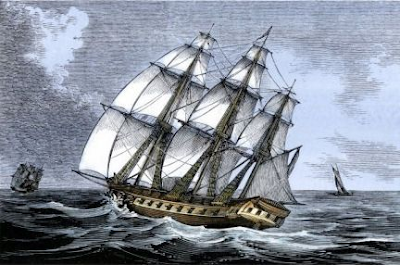

Secret Mission to France

The Final Fights

Barry’s most brutal fight took place on May 29, 1781. Standing tall on the quarterdeck of the Alliance, he faced the fight of his life. Two British sloops, HMS Atalanta and HMS Trepassey, attacked him. All hell broke loose as they closed in—broadsides tearing sails, grapeshot ripping through flesh. Barry was badly wounded when a piece of grapeshot went through his shoulder. He stayed at his station, rallying his crew and shouting commands, but the heavy blood loss eventually forced him below deck. In the end, both British warships surrendered—an act of double surrender. Even British captains now agree that he’s an American sea captain to respect.


Taking on a Brace of Warships

Fittingly, on March 10, 1783, Barry fought the last naval battle of the war off Cape Canaveral. His Alliance squared off against HMS Sybille and a squadron. Barry is in a tight spot as he is convoying the Duc de Lauzane, loaded with cash and supplies from the West Indies. Barry has the advantage over Sybille in firepower, but the rest of the squadron is closing in on him. He abandons the newly captured Sybille, choosing to save the convoy and get the Duc de Lauzane safely to port. As the war nears its end, Barry has made a name for himself as a fighting captain.


Final Fight

Father of the Navy

Our Celtic commodore quickly resumed merchant sailing, making a historic voyage to China in 1787—opening trade with the “reclusive empire.” However, in 1794, with the U.S. Navy forming under the Naval Act, Barry was called to serve his country once more—as its first commodore! President Washington himself awarded Barry Naval Commission Number One. Barry began overseeing the construction of the 44-gun frigate USS United States, his flagship.


USS United States

During the Quasi-War with France (1798–1801), Barry went back to work, seizing French merchant ships in the West Indies while training the next group of naval leaders—future icons like Stephen Decatur and Richard Dale.

The Final Watch

Despite worsening asthma, Barry continued to sail. But on March 6, 1803, the United States slides into port with Barry on the quarterdeck for the last time—his sea duty finished. He may have given up his ship, but not the Navy, remaining as its head until he died on September 13, 1803, at his Strawberry Hill home near Philadelphia. The first commodore was buried with full honors at St. Mary’s Churchyard. While happily married, Barry died childless. Yet his legacy lives on in the Navy he shaped and the men he mentored.


John Barry Gravesite

Legacy of a Legend

Some random shots about John Barry: author of an influential book for improving fleet communication, an early supporter of a standalone Navy Department (which was established in 1798). Barry was a man of faith—he started each day with a Bible reading. He was a brilliant leader of men—he cared for his crew, ensuring they were fed and in good shape. A wise disciplinarian—he quelled three mutinies with a firm yet fair approach, earning lasting loyalty from his men.


Barry's Advocacy Paid Off in 1798

Many tributes were paid: four destroyers were named USS Barry, statues of Barry stand in Wexford and D.C., and the Commodore Barry Bridge was named in his honor. Rhode Island celebrates September 13 as “Commodore John Barry Day.”

John Barry statue in Wexford, Ireland


Who's the Best?

Though not as famous as John Paul Jones, Barry distinguished himself in both war and peace. Starting as an Irish cabin boy and eventually becoming an American commodore, he fought on land and sea, built a navy from scratch, and set a standard for bravery. Historians often call John Barry the “Father of the American Navy,” a title many also credit to John Paul Jones. 

Jones's contributions after the Revolutionary War were inconsistent, especially since he took a commission in Czarina Catherine the Great's navy (see my blog, Yankee Doodle in the Crimea). However, unlike Jones, Barry's legacy includes long-term influence and establishing institutions. Jones was flamboyant, but Barry left a lasting mark.


John Paul Jones as Russian Admiral


Next time you hear “I have not yet begun to fight,” tip your hat to Jones—and raise a glass to the quiet giant who led the Revolution to victory and beyond. Fair winds to you, Commodore Barry. 
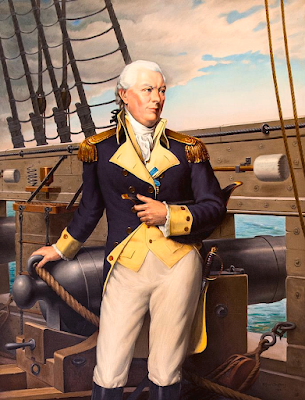

John Barry in His Office

Monday, September 14, 2020

Tinkerer, Sailor, Soldier, Surgeon

A Connecticut Yankee


Many of our early patriots were accomplished men of letters—lawyers, judges, planters, and merchants—but relatively few were involved in science and technology. David Bushnell belongs to the latter group. Born in Saybrook, Connecticut, on August 30, 1742, he was the son of a farmer. As the eldest of five children, he grew up working on the family farm near Westbrook. After his father died in 1769, he sold his half interest in the farm to his brother Ezra and entered Yale College in 1771.


David Bushnell


Bombs to Boats


While at Yale, he became intrigued by the idea of underwater explosions. An inventive tinkerer by nature, Bushnell successfully combined a black powder charge with a clockwork timing device, creating the first naval mine. He used this knowledge not only in building the underwater mine but also later in making floating torpedoes that exploded on contact. 

He worked with the wealthy New Haven inventor and manufacturer Isaac Doolittle to develop the first mechanically triggered time bomb as well as the first screw propeller. As he worked on developing a practical delivery system for this unique weapon, the start of the American War for Independence gave a new sense of urgency to his efforts. 

By fall that year, he had designed and built the American Turtle (better known simply as Turtle), a primitive submarine. He named it Turtle because it looked like two turtle shells lashed together. It wasn't pretty, but it worked.


Turtle Design Sketch


Test and Evaluation


Gen Israel Putnam
This primitive submarine was operated by a single operator, who powered it with two hand-cranked screw propellers. A system of water pumps took in and expelled water to control the craft's climb or descent, which could reach a depth of about 15 feet. The pilot had a small conning tower with several windows. The tower contained a depth gauge and a phosphorus-lit compass. 

The Turtle’s punch was Bushnell’s original clock/mine combination connected to a metal drill engineered to bore through the copper sheathing coating the hulls of British warships. Once the mine was attached and released, the timing mechanism engaged, giving the Turtle one hour to escape before a 150-pound charge exploded, detonated by a flintlock trigger device. 

Bushnell arranged a successful demonstration, essentially a “demval” in today’s acquisition parlance. Present for the event on the Thames River was Connecticut General Israel Putnam, who urged the American government to continue funding for its “full operational capability.”


Turtle Replica


Run Silent, Run Deep - Sorta


History was made in the summer of 1776 when the Turtle attacked the British fleet anchored in New York Harbor under the command of Admiral Richard Howe. Unfortunately, Bushnell fell ill, and a sergeant named Ezra Lee volunteered to take his place. On the night of September 6, a pair of whaleboats towed the Turtle offshore, where it began its attack. Pumping feverishly, Lee slowly guided the Turtle toward the British fleet. 

Despite challenging tides, Lee managed to reach the primary target, Lord Howe’s flagship, the 64-gun ship of the line, HMS Eagle. The Turtle’s drill failed to penetrate the hull because it was blocked by an iron bar. With air running low, Lee abandoned the effort and released the mine, which floated free. The mine ultimately exploded in a massive blast that sent a plume of water into the night sky. 

The unexpected iron bar prevented what could have been a disastrous hit to a major target, potentially changing British naval tactics for the rest of the war. See my Yankee Doodle Spies post on "The Boat" for a more detailed discussion of this attack.


Bushnell's Turtle takes on HMS Eagle
and initiates submarine warfare


Torpedoes are Running


Bushnell remained undaunted. Confident in his progress, he kept improving the Turtle. He launched several small attacks on individual British ships, but inexperienced pilots and unfavorable tides prevented each attempt. The Turtle was lost the following October when a transport carrying it was sunk by British cannon fire on the North (Hudson) River. Undeterred by setbacks, Bushnell continued experimenting with naval mines and explosives. On August 13, 1777, he released another mine that floated toward the HMS Cerebus, anchored in Black Point Bay. This time, the tides were favorable, but the device got caught on a small schooner. It exploded, killing three British sailors.


 Turtle needed to be towed  into attack position by rowboats


Battle of the Kegs

A Bushnell mine exploding
unnerved the British

He tried again in January 1778, this time releasing 20 large kegs filled with explosives off Bordentown, New Jersey. The kegs were intended to float down the Delaware River and destroy the British fleet at Philadelphia. One mine exploded near a British rowboat, killing several sailors. 

The attack so rattled the British fleet that it spent the rest of the day shooting at the floating kegs and nearly anything else that floated. This event was satirized in the poem, “Battle of Kegs,” by Francis Hopkinson. Rebel propaganda portrayed this as an embarrassment for the hapless Royal Navy. However, Bushnell's career as an undersea weapons developer was over.


Captain David Bushnell's sappers and miners
fought during the siege at Yorktown

The Sapper


Bushnell returned to Saybrook in the spring of 1778. Local Loyalists had once detained him, but he managed to secure his release. Later that year, Bushnell left the world of maritime warfare and joined the Continental Army after General George Washington appointed him as commander of the first company of sappers and miners at West Point, NY. Captain Bushnell served competently for the rest of the conflict and led the sappers during the siege of Yorktown, the battle that effectively ended the war. After his discharge from the Continental Army, he briefly returned to Connecticut and later spent some time in France before coming back to the United States to settle in Warrenton, Georgia, where he practiced medicine. He died there in 1824.


David Bushnell Memorial in Georgia


Seminal Submariner


In the long run, David Bushnell’s efforts laid the groundwork for the later development of underwater mines, torpedoes, and, of course, the submarine. His fundamental use of water for ballast still applies today, as does the use of the propeller. Although his impact on the course of the American War for Independence was limited, he nonetheless shaped the future direction of naval warfare. No small feat for a Connecticut farm boy.


Today's submarines are descendants of Bushnell's
Turtle and still share its basic design, albeit on steroids


Saturday, August 31, 2019

Marblehead Men

Sailors become Soldiers who become Sailors

One of the most overlooked units in the Continental Army also played a vital role in saving the American cause, paving the way for several iconic commemorative paintings. The people who live along the rocky New England coast are as tough and rugged as the landscape itself. 

At least, they were during the era of the Yankee Doodle Spies. Hard, gritty men and women were the first to take meaningful action against what they saw as the injustices of British rule. I suppose carving out a civilization from a weather-beaten wilderness requires folks of tough mettle and stubborn ways.


New England's coast bred tough people


Among the toughest and most resourceful of that group were the men who sailed the cold and stormy waters along the North Atlantic coast, fishing, trading, and smuggling in both fair and foul weather. It is only natural that a militia regiment drawn from such stock would prove to be one of the go-to units of the struggle.

Marblehead Militia


All counties and some towns in New England had militia units that established a long-standing tradition dating back to at least the late 17th century. These units had experience from several wars fought against native tribes, Canadian neighbors, and their French rulers.

At the start of the fight against Britain, the Marblehead militia was among these. Because it was formed along the rugged New England coast, it was naturally composed of men who spent their civilian lives at sea.

Marblehead Militia


As tensions peaked in April 1775, the regiment was lucky to get a commander who proved to be as tough and resourceful as the men he led – Colonel John Glover. Under Glover, the regiment marched to Cambridge, where they joined the New Englanders besieging the British at Boston.


During the siege, Congress formed the new Continental Army under General George Washington's command. The Marblehead Militia, known as “Glover’s Regiment,” joined the Continental Army in June. It was originally called the 23rd Massachusetts Regiment. Only the best militia units were combined into the Continental regiments, creating America's first “professional” army.

The Continental Line


With their new status, they also received a new name, and the Marblehead militia was quickly renamed the 14th Massachusetts Continental Line. As a continental regiment, they would now be required to march and fight wherever the army moved, and wherever George Washington led them. He soon took them south to face new dangers and seek new opportunities for glory.

Nevertheless, the regiment of about 750 sailors never completely abandoned their heritage. Unlike other continental regiments, which started wearing similar uniforms of dark blue tunics, white or buff breeches, and leggings topped with a cocked hat, the Marblehead sailors dressed more like traditional sailors. The Marbleheaders wore distinctive blue jackets, white pants, and white caps. However, it was the skill, not their appearance, that was the greatest trait of these hardy sailors.

Washington’s Navy


As the siege of Boston went on, Washington decided he needed a naval force to stop supplies from reaching the British garrison. He assigned the 14th Massachusetts Line to outfit and crew four schooners for this purpose. Glover even offered his own schooner, the Hannah. His port at Beverly became the base of “Washington’s Navy.” Operating with a limited budget, the small fleet of five schooners managed to disrupt British supply lines and bring in captured supplies to support the Americans. Sailors from Marblehead also built most of the defenses that kept the British from taking the base.


Washington's Navy consisted of
fast schooners manned by experienced sailors


The Miracle on Long Island


Long before it became a traffic nightmare, Long Island was the scenic and rural breadbasket of New York. In the summer of 1776, it became the focal point of the British plan to crush the American rebellion.

Driven from Boston earlier that year, Lord William Howe’s reinforced army of over twenty thousand sailed into New York Harbor and landed at Staten Island. Soon, he moved his troops across the water and quickly encircled George Washington’s forces along the heights of Brooklyn. Although there was fierce fighting, the British numbers and well-positioned guns made Washington’s hold on the island a dangerous liability. He faced a difficult choice: defend with little hope or attempt to escape.


British Landing at Long Island would soon threaten the
American Army and the cause


In some ways, the latter was the toughest decision. The British naval strength was even more powerful than their land forces. Crossing despite these two hurdles would almost certainly cause disaster. But when a sudden fog rolled into New York harbor on the night of August 29th, Washington seized a brief chance to act.


So under cover of darkness and a thick fog, he made a risky decision and ordered his army to move against the enemy. His advantage was the 14th Massachusetts’ sailor-soldiers. For hour after hour, Glover’s men rowed boat after boat, carrying soldiers, horses, and equipment they could manage without alerting the British, who waited just a few hundred yards away.


Glover worked his men through the night to save an army


Despite the darkness and fog, the Marblehead men moved smoothly and silently. A splash or the bumping of a boat against another could easily have alerted the Royal Navy, whose warships lay anchored nearby. By the next morning, they had evacuated around 9,000 men from the jaws of the British lion to the safety of Manhattan.


The miracle retreat from LI saved the army and the cause


A War of Maneuver


The regiment’s usefulness was evident during the “war of maneuver,” which caused Washington to hurriedly relocate positions to avoid being destroyed by the British. Glover’s men slowed down the British advance at Kips Bay, giving the rest of the army time to retreat to the safety of Harlem. As the campaign moved north to Westchester, the regiment again played a vital role—this time as soldier-sailors.


Glover's sailor-soldiers stymied the British at Pelham


On October 13th, about 4,000 British and Hessian troops advanced inland from Pelham Bay. However, along the stone walls crossing the farmland, 750 men from the 14th Massachusetts and John Glover’s forces stood ready. They kept the British at bay, trading space for time and allowing the Continental Army a chance to prepare for the next attack. Glover’s men, skilled in scouting and raiding, showed they were just as comfortable on land as they were on their schooners’ decks. They captured supplies and enemy prisoners, then helped operate the artillery during Washington and Howe’s clash at White Plains.

The Crossing that Shocked the World


By December of that year, a battered and severely diminished Continental Army reached its breaking point as it looked across the Delaware River. Just hours behind, the advanced guard of a British column led by Major General Charles Cornwallis was closing in quickly. The men from Marblehead collected anything that floated along the river for miles and quickly ferried the ragtag army to safety.


Gen Charles Cornwallis nearly bagged
Washington, but for the Marblehead Regt.


But their greatest challenge still lay ahead. With enlistments dwindling as a new year approached, Washington had a short window to do something with his army besides fleeing from the redcoats. General Howe gave him the chance. Believing the Americans beaten, he scattered his army into winter quarter garrisons, leaving only a few isolated brigades in West Jersey.


The Glover Regiment brought Washington to destiny


Washington turned to Glover’s men once again. In another secret nighttime operation, Washington enlisted the experienced sailors to operate a different kind of boat. Long and sleek, the Durham boats were powered by pushing long poles into the riverbed. 

On a night when snow mixed with rain, file after file of Continentals, poorly dressed and poorly fed but determined, silently boarded the boats under the watchful eyes of the sailors. Throughout the night, strong arms pushed staffs into the swirling water. Strong legs and backs moved the boats, filled with men and equipment, across the swift current toward the dark and dangerous Jersey side. Despite the ice flows, Glover’s sailors managed to ferry over 2,000 troops and 18 guns.


Sailors to soldiers as Glover's Marblehead Regiment
 joins the night march on Trenton


But their work was not finished. The sailors then became soldiers and marched the grueling nine miles to Trenton, fighting valiantly in the short battle that shocked the world and saved the cause. Their final act was to lead the army back across the river, as their enlistments had expired and the regiment was disbanded.


Down to the Sea in Ships


Glover stayed with the Continental Army, but his men went home. New England was never a major battlefield for the rest of the war, but it still played a crucial role—providing support and attacking the British at sea. Glover’s experienced soldiers now became sailors again, engaging in a different kind of war, less showy but just as damaging to the British.

Privateers devastated British merchant shipping and tied down
the Royal Navy


Some people resorted to smuggling, a crucial way to support the war effort. Others went even further and turned to privateering, attacking British merchant ships in a conflict that deprived the British of wealth and supplies while boosting America’s limited resources. The Marblehead men played a key role in capturing more than 3,000 vessels during the war.


Sunday, June 26, 2016

Rev War Hydrography

What the heck is Hydrography?


This past week, we celebrated "world hydrography day," so I thought I would reflect on this little-known science's importance to the American War for Independence. Let's begin with the definition of hydrography: the science that deals with measuring and describing the physical features of oceans, lakes, rivers, seas, and their surrounding coastal areas, especially concerning their use for navigation. Although the formal science of hydrography was not officially established until the late 18th century (by the French), evaluations of waterways had been vital to navigation safety for many centuries before, especially starting with the Age of Exploration. During the American Revolution, watermen with detailed knowledge of coastlines, rivers, and estuaries played a crucial role for both sides, but especially the British, who relied heavily on the Royal Navy for their strategic advantage.


1571 pre-Mercator nautical chart from Portuguese cartographer
Fernao Vaz Dourado


Knowledge of the waterways and shorelines around Boston, New York, Philadelphia, Wilmington, and Charleston was crucial for warships, merchant vessels, smugglers, and privateers. This was especially true for the rebels, whose use of small craft and longboats was often their only defense against the diverse British ships. Local ferrymen, fishermen, and pilots were vital, and both sides competed fiercely for their services and loyalty. Failing to understand the features above and below the water, as well as the local tides, often resulted in disasters, big and small. In ancient (and maybe not so ancient) times, mariners called on Neptune, the god of the sea, for help when their knowledge of tides and shoals let them down. Here are some stories of Neptune's influence on the fight for independence...


The First Affair


The grounding of a ship before the American Revolution is a clear example of hydrography's influence. The so-called Gaspee Affair occurred on June 9, 1772. The HMS Gaspee, a British customs ship, ran aground in Rhode Island, where a group of Sons of Liberty attacked and set fire to the vessel. The British government threatened to send the American perpetrators to England for trial, but no arrests followed. Still, their threat to try Americans in England caused upset protests in the colonies, which learned about the incident from the Committees of Correspondence. The creation of these Committees of Correspondence eventually led to the founding of the First Continental Congress and, ultimately, the Declaration of Independence.


Grounding and burning of the Gaspee - prelude to war


Gloucester


Neptune works both ways—he rarely takes sides. The Battle of Gloucester is a good example. It was a small fight early in the American Revolutionary War (August 8 or 9, 1775) at Gloucester, Massachusetts. Royal Navy Captain John Linzee, commanding the sloop-of-war HMS Falcon, saw two schooners coming back from the West Indies. After taking one schooner, Linzee chased the second (American) into Gloucester Harbor, where it ran aground. Linzee sent sailors to seize the prize. But, the townspeople called out their militia, who captured the British sailors sent to take the grounded ship. The militia also took back the ship. Local knowledge of the waters around Boston gave the New Englanders a big advantage against the strong land and naval forces during that crucial year.


Massachusetts coastline


Aside from this incident, Gloucester is known for being the home of the legendary Marblehead sailors, whose expertise and skill in navigating coastlines and riverways played a vital role in rescuing the Continental Army from defeat and facilitating Washington's Christmas night crossing of the Delaware River, which delivered a significant victory at Trenton.


Marblehead Sailors helped save the Revolution


HMS Somerset vs Neptune

The HMS Somerset began its service during the American Revolution by shelling Charlestown in 1775. The Somerset achieved great success operating in estuaries, bays, and rivers. It acted as the flagship headquarters at Bunker Hill (Breed's Hill).


Knowledge of waterways was critical for large ships of war


The Somerset was involved in another brief but significant incident during the war, the Battle of Chelsea Creek. On the night of May 27, 1775, the armed schooner HMS Diana ran aground in Chelsea Creek while trying to stop Americans from driving British livestock off Noddle's Island in Boston Harbor. The American rebels set fire to the ship. HMS Somerset's tender, Britannia, was able to rescue the crew of the Diana. Later, it participated in the fierce river fighting at Fort Mifflin near Philadelphia.


HMS Somerset


The battle for Fort Mifflin involved ships and boats navigating the treacherous waters of the lower Chesapeake River. It was a desperate, prolonged siege, featuring land and naval forces that used the elements and geography to their advantage. The Somerset participated in the later phase, bombarding the fort from far offshore. Meanwhile, other small vessels navigated dangerous waters in the turbulent ebb and flow of fierce combat that lasted for weeks. To prevent the British from using two nearby islands, the Americans breached the riverside dikes.


This action forced the British to build their batteries on top of the dikes and work in knee-deep water. An example of the challenges faced is when the British lost an 8-inch howitzer and a soldier drowned when the craft carrying the gun sank in the Schuylkill. While bombarding Fort Mifflin, the Augusta and Merlin ran aground. A high tide that evening was met with contrary winds that hindered the depth needed for the ships to be freed.


On October 23, 1777, the American forts focused their fire on the two stranded ships. HMS Isis maneuvered alongside the grounded sixty-four in an effort to rescue it. British accounts claimed that American gunnery caused only minor damage, though flaming wads from the ships' guns set the Augusta on fire. At midday, the Augusta exploded with a tremendous blast that shattered windows in Philadelphia. An eyewitness reported that 60 sailors, a lieutenant, and the ship's chaplain died while struggling in the water. The loud explosion was heard nearly 30 miles away in Trappe, Pennsylvania. After the Augusta's destruction, the crew of the Merlin set their ship on fire and abandoned it.


British bombard Fort Mifflin


But Neptune's favor for Somerset ended when she ran aground off Provincetown in 1778. Over 100 of her men were taken prisoner by angry locals who made them walk back to Boston, a distance of more than 125 miles! The wreck of the Somerset surfaced in those waters after a storm in 1886, and again in January 2008.


Knowledge of the tides and shoals was critical around New York


New York, New York

When the British drove the Continental Army out of New York City in 1776, their knowledge of the waterways and islands proved essential. Although they had no shortage of sympathizers familiar with the waters, the Americans did as well. The farther the British moved away from the "safe zone" of New York Island (Manhattan) and Long Island, the more risky the situation became. In 1776, to prevent an attempt at naval encirclement, the rough shoreline and waters of the Bronx forced General Howe to attempt landing further north near Pelham. This delay allowed the Americans to shift forces to defend the Continental Army and keep their lines of communication intact.


The British landed at Pelham when the  shoals near
Throg's Neck proved unmanageable


The coves along the north shore of Long Island allowed rebels to slip boats in and out without usually risking detection. This helped one of George Washington's most famous spy rings gather intelligence across the Long Island Sound to American-held Connecticut (where knowledge of the cost was just as important).

During the War of Independence, the great Sandy Hook was more than just the peninsula extending from the Jersey shore today. The "hook" stretched across the harbor's mouth as a huge sandbar, blocking ships of the line and frigates from passing in or out of Lower New York Bay except at high tide. This limited British options when they needed to send ships to sea quickly. Later in the war, a French fleet abandoned plans to attack New York for the same reason.


Vessels in New York Harbor had to wait for the tide to rise


The Carolinas  


In the Cape Fear area near Wilmington, North Carolina, superior knowledge of the coastal and inland waterways enabled the rebels to prevent reinforcements by sea, keeping the crucial state in American hands from February 1777 until a second wave of British troops arrived in 1780. This marked the start of a prolonged guerrilla-style war along the dangerous Cape Fear River. British warships patrolled while blockade runners attempted to smuggle valuable supplies. Both sides depended on local knowledge of the waterways to succeed.


In the savage guerrilla war along North Carolina's coast,
both sides needed knowledge of the waterways


William Moultrie 
In neighboring South Carolina, local knowledge of the waterways and swamps in the Lowcountry played a crucial role in the struggle. The partisans along the coastal rivers proved to be a constant thorn in the side of the British, who needed two attempts to capture the port of Charleston. In the first attempt in 1776, famed South Carolinian William Moultrie's clever defense, along with the geography of the islands and waters, withstood a large British force of warships and soldiers. A key to his success was the use of palmetto logs for the fort.


The palmetto is very porous (spongy), and every time the British fired a cannon, the cannonball would get stuck in the fort and wouldn’t explode. If it did explode, the fort's sand walls would fall apart and put out the fire. Confused because the fort wasn’t burning, the British moved closer. Bad idea. Three of His Majesty’s ships ran aground on a sandbar, now the site of Fort Sumter. There, they became easy targets for patriots. Francis Marion, who would later become famous as the “Swamp Fox,"


British naval map of Sullivan Island defenses