Followers

Showing posts with label John Adams. Show all posts

Monday, February 16, 2026

The Magnificent Seven

This special Presidents Day Yankee Doodle Spies post profiles The Magnificent Seven.  No, not the rogues in the iconic 1960 John Sturges film, or the high-flying tech stocks on Wall Street, but the presidents of the United States who played a role in the American Revolution and War for Independence. 


Foundary of Freedom

The flames of revolution ignited in 1775, and from the smoke of muskets and the ink of bold declarations emerged seven men whose youthful or mature efforts during the American Revolutionary War (1775–1783) would propel them to the presidency of the United States. George Washington, John Adams, Thomas Jefferson, James Madison, James Monroe, John Quincy Adams, and Andrew Jackson each answered the call in their own way—some with sword in hand on frozen battlefields, others with eloquent words in candlelit chambers or through daring diplomacy across the Atlantic. 


The Magnificent Seven


Their stories intertwine personal courage, intellectual fire, and unyielding commitment to liberty, forming the very foundation upon which the nation stood. No president after this remarkable group bore the direct imprint of those revolutionary years, making their collective legacy a vivid reminder of how sacrifice and vision gave birth to a republic.


The Essential Man


First among the magnificent, George Washington (1732–1799), the towering Virginian whose calm resolve anchored the revolution, stepped forward as commander-in-chief of the Continental Army in 1775. Nominated by John Adams, Washington drew on his French and Indian War experience to lead a ragtag force against the world's premier military power. Picture the icy Delaware River on Christmas night 1776: Washington, cloak whipping in the wind, guiding boats through sleet to surprise Hessian troops at Trenton, a daring gamble that revived flagging spirits. 


George Washington


He endured the soul-testing winter at Valley Forge, where hunger and disease ravaged his men, yet he emerged stronger, drilling the army into a disciplined force with the aid of Baron von Steuben. His masterstroke came at Yorktown in 1781, where French allies sealed a trap around Cornwallis, forcing surrender and turning the tide. Washington's greatest gift to the cause was restraint—he crushed whispers of monarchy in the Newburgh Conspiracy and resigned his commission in 1783, embodying republican virtue. This path culminated in his unanimous election as the first president (1789–1797), the "Father of His Country," whose leadership set the tone for a free nation.


Colossus of Independence


Brilliant lawyer and architect of a nation, John Adams (1735–1826), the fiery Massachusetts lawyer, wielded intellect as a weapon in the political arena. At the First Continental Congress in 1774, he advocated for unity against British tyranny, nominated Washington as commander, and championed a navy to challenge British sea power. In 1776, he helped form the Committee of Five, persuaded Thomas Jefferson to draft the Declaration of Independence, and then fought tirelessly for its adoption. 


John Adams


As a diplomat, Adams secured Dutch loans that kept the war machine funded and co-negotiated the 1783 Treaty of Paris, ending hostilities on favorable terms. His blunt honesty and tireless advocacy for independence helped shape a stable government, culminating in his election to the vice presidency and, later, to the second presidency (1797–1801).


Father of the Declaration 


The sage of Monticello, Thomas Jefferson (1743–1826), the eloquent Virginian, penned words that still echo: "We hold these truths to be self-evident." As a delegate to the Continental Congress in 1776, he drafted the Declaration, crystallizing the revolution's ideals of liberty and equality. 


Thomas Jefferson


Back in Virginia, he reformed laws—abolishing primogeniture and championing religious freedom—while serving as governor (1779–1781), rallying defenses against British raids and narrowly escaping capture at Monticello. His pen and principles sustained the revolutionary spirit, foreshadowing his transformative third presidency (1801–1809), which included the Louisiana Purchase, which doubled the young nation's size.


The Little Giant


With a mind as large as his stature was small, James Madison (1751–1836), the quiet intellectual often called the "Father of the Constitution," honed his skills in wartime politics. In the Virginia legislature from 1776, he supported religious liberty and raised troops. 


James Madison


By 1780, in Congress, he grappled with the weaknesses of the Articles of Confederation, advocating fiscal reforms and a stronger union to support the war effort. His behind-the-scenes diplomacy and governance insights bridged the revolutionary chaos to postwar stability, influencing his fourth presidency (1809–1817) during the War of 1812.


Hero of Trenton


James Monroe (1758–1831) embodied youthful valor. At 17, he left college to join the Third Virginia Regiment, crossing the Delaware with Washington and charging Hessian cannons at Trenton—earning a severe wound that nearly killed him. He fought at Brandywine, Germantown, and Monmouth, later serving as a militia scout. Those trials forged his republican zeal, as evidenced by his fifth presidency (1817–1825) and the Monroe Doctrine, which warned Europe to stay out of the Americas.


James Monroe


The Prodigy


Learning at the knee of one of the era’s giants, John Quincy Adams (1767–1848), the precocious son of John Adams, tasted diplomacy at a young age. At 11, he sailed to France with his father; by 14, he served as secretary to the American envoy in Russia, aiding efforts to secure recognition. Though the mission faltered, the experience immersed him in global intrigue, shaping the diplomat who became the sixth president (1825–1829).


Young John Quincy Adams


Heroic Youth of the Waxhaws


Later known as “Old Hickory,” Andrew Jackson (1767–1845), the orphaned boy of the Carolina frontier, faced the war's harshest realities. At 13, he served as a militia courier through the guerrilla chaos, witnessing battles such as the Battle of Hobkirk's Hill. Captured by British troops, he refused to shine an officer's boots and was slashed across the face and hand—scars he carried forever. Imprisoned, he lost his brothers and mother to disease and hardship. That raw defiance fueled his later triumphs and his populist seventh presidency (1829–1837).


Andrew Jackson


In the crucible of revolution, these seven presidents were indeed magnificent—through command, conviction, courage, and cunning, they wove the threads of independence into enduring governance. Their lives remind us that America's story began not only in quiet halls but also in the roar of battle, the scratch of a quill, and the bold dreams of those who dared to build a new world. 


Happy Presidents' Day!


Sunday, August 13, 2017

The Patriot Playwright

An American First


On April 16, 1787, "the first American play" premiered at the John Street Theater in New York City. Titled The Contrast, it was written by 29-year-old Royall Tyler. It is considered the first American play ever performed publicly by a company of professional actors. An American play, in the sense that it was written by an American, with an American theme, for American audiences.


John Street Theater - Birthplace of American Theater would close in 1798


A Playwright Patriot


Royall Tyler was born in Boston on July 18, 1758. He came from a wealthy and prominent Massachusetts family. Tyler went to Latin School in Boston for his early education. He then attended Harvard to study law. During this time, he joined the Continental Army, where he received a commission and eventually became a major. Tyler was admitted to the bar in 1780 and joined John Adams's law firm. Tyler fell in love with the future president's daughter, but the engagement was broken off, reportedly because Adams disapproved of Tyler's "high-spirited temperament." John's attitude probably kept many potential suitors away.


General Benjamin Lincoln


Back to the Bar. Back to the Army and on to the Theater


The end of the war and the birth of the republic in 1783 didn't take long to be followed by America's first crisis. In 1786, Shay's Rebellion erupted in New England. Many veterans rightly felt that the new republic didn't pay enough attention to their economic struggles and that their years of service were largely disregarded. A former Massachusetts soldier and struggling farmer, Daniel Shays, led a group of disgruntled veterans seeking justice for their grievances. 

The response was swift, as a panicked government assembled forces to put down the rebels. In 1787, Tyler once again answered his country's call. He left his law practice to accept an appointment as aide-de-camp to General Benjamin Lincoln, tasked with suppressing Daniel Shays and his rebel soldiers. After Shays left Massachusetts (the heart of the rebellion) for New York, Tyler was sent to New York City to negotiate his capture and return to Massachusetts. And while there, like many others over the years, Tyler did something he had never done before—he went to see a play!


Shays Rebellion would set events leading to
the birth of the American stage

That's Entertainment


The theater was slow to become popular in America as a form of entertainment. There are records of Shakespeare performances in Williamsburg in the early 1700s, and generally, the Southern colonies — which were more receptive to all British customs — were quicker to embrace the theater. In the North, it was considered a sinful form of entertainment. Massachusetts actually passed a law in 1750 that banned theater performances, and by 1760, similar laws were in place in Pennsylvania, Rhode Island, and New Hampshire, although performances sometimes slipped through with special permission from authorities.


Reprint with comment by  modern historian Cynthia Kierner
 illustrates the enduring value of The Contrast as a vehicle
for understanding mores of post-Revolutionary America.


A Playwright is Born


In any case, Royall Tyler had never been to the theater before. On March 12, 1787, he attended a performance of Richard Sheridan's School for Scandal (1777). He was so inspired that in just three weeks, he wrote his own play, The Contrast. Barely a month later, The Contrast became the first play by an American writer to be professionally produced. 

The Contrast was a comedy of manners, poking fun at Americans with European pretensions, and the main character, Jonathan, was the first "Yankee" stock character. This backwoodsman spoke in a distinctive American voice and mannerisms. Mixing such a character with sophisticates is a technique writers use to this day—the traditional "fish out of water." 

Tyler did not pioneer this, but he did master it. And the results were compelling to late 18th-century audiences. The Contrast was a success. It was performed four times that month in New York, which was very unusual. Then it moved on to Baltimore and Philadelphia, where George Washington went to see it. The first citizen's approval added to the buzz both for the play and the stage in general.


Man of Letters


Tyler became one of the most accomplished men of letters in early America. While he kept practicing law, he wrote six other plays. Only four of these plays still exist today; three are biblical plays, and the fourth is another social satire, The Island of Barrataria. He also produced several verse and prose works, including a lively adventure novel, The Algerine Captive (1797). 

The story is based on the memoir of a young man who experiences a series of misadventures that ultimately lead to his enslavement by Barbary pirates. Aside from its American themes, the book ends with a serious plea for Americans to unite. It went through more than one printing and is only the second American work to be printed in Britain.


Royall Tyler: jurist and author in late life


Author & Attorney


Tyler's literary works were published anonymously. After all, the arts were still considered beneath the mainstream, and he was a serious jurist with a reputation to uphold. His works generated little income. He clearly created them out of love. Many modern authors, including this one, can relate to that situation! As a member of the legal profession, he aimed to correct the flaws and follies he satirized in his writing. He died in Brattleboro, Vermont.


The Seed of Modern Theater Long Forgotten


The success of The Contrast elevated contemporary drama and theatrical productions, making them highly popular among all classes. In a short time, they shifted from mild disdain to great respect and sometimes intense popularity. In that sense, the "arts" owe him a great deal. Certainly, the modern stage does. Yet I am sure few in the field know of Royall Tyler, the patriot and playwright who gave birth to their art form. I think a new rebellion is needed. A Royall rebellion, in fact. Maybe the "Tony" should be renamed the "Tyler?"


So should Tony become Tyler?


Saturday, May 13, 2017

Yankee Doodle Spies Mothers Day

I just thought I'd take a moment to salute all the mothers of the American Revolution. Motherhood was an unrelenting, painful, tedious, demanding, unforgiving, and too often underappreciated vocation during the time of the Yankee Doodle Spies. Sadly, not unlike today in many cases. I use this blog, in great part, to hail the so-called second tier of first patriots. The untold and little-mentioned men and women who played important roles in the struggle that birthed the first modern republic. Okay, I do post on the top tier from time to time, but that is to fill out the story. This one is for the moms...


Mary


I posted a previous blog about the greatest (sorta) mother of the American Revolution: Mary Ball Washington. This steely widow gave birth to the age's "indispensable man," George Washington. She was kind of a Beeyoche, but her stubborn, strong-willed nature clearly passed to George. The result: a leader who, although flawed, managed to adapt to adversity, rally diverse peoples, and keep a nation (and himself) together for eight long years until the millennium's most unlikely victory came to be. Despite their often strained relationship, Washington doted on his mother. We can be thankful to the woman who raised a son to become the leader of a new nation and the idol of most of his age.

Mary Ball Washington's fire and
stubbornness passed on to her noted son


Martha


I truly think the Lord above was having fun with these two mothers who influenced, molded, and simply made George Washington the man he was. Martha Custis was a wealthy widow when she married George. She was also his senior and already a mother. George adopted her children as his own and doted on the family he married into. Martha was short and, in middle age, tended to stoutness. But although Washington was admired by the most glamorous women in the hemisphere, Martha was his lodestone. Her strength in maintaining his farm and family enabled him to ride off from Mount Vernon and return eight long years later. But he could not remain apart from Martha that long. Almost every winter, he requested that she leave their farm and join him in winter quarters, where she became the surrogate mother of his officers and men.


Martha as a young woman


Abigail


Abigail Smith is best known as Abigail Adams. David McCullough's book about John Adams and the resulting TV series have made her the most renowned of "First Mothers." Adams admired and encouraged Abigail's outspokenness and intelligence. She supported him by running the family farm, raising their children, listening to him, and trying to help him with his problems. Despite her own bouts with illness, she gave birth to five children. One daughter, Susanna, born in 1768, lived for only a year. Beyond being the bedrock of the founding father who would become America's second (and first controversial) president, Abigail was also the mother of the nation's sixth president - their son John Quincy Adams.


Abigail's letters bolstered her husband
while informing him of family doings


Caty


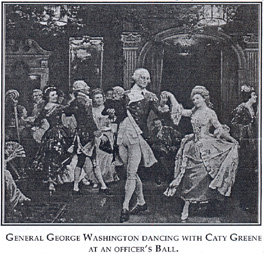
Nathaniel Greene is considered the second greatest (and for some, the greatest) commander in the American army. Catharine Littlefield married Nathaniel Greene in 1774 at the age of nineteen. When her husband marched off to war a year later, she was abruptly thrust into the role of head of household. Eager to be with her husband, she joined Gen. Greene at his military headquarters whenever possible. Over the course of the war (and shortly after), Catharine had five children. Conflicted between caring for her children and longing to be with her husband, Caty (as she was also called) settled on a compromise. To maintain a normal family life when conditions allowed, she brought her young children with her to camp. At other times, she left them in the care of family or friends. It was during these separations that Caty felt the war's effects most keenly on her family. She was a staple at winter quarters, and her presence had a positive effect not only on her husband but also on the other officers and the commander in chief himself - they were often dance partners.


Happy Mothers Day! 

Saturday, February 2, 2013

Promotions and Pride

I served over 20 years in the US Army and had 8 years of ROTC experience before that. Not what you might think—I took junior ROTC at Xavier High School, the Jesuit Military Academy in New York. However, throughout all those years, there was one event that always brought me a sense of accomplishment, mixed with a bit of dread—the promotion!

In the military, a person's success is measured in three ways when not actually in combat: surviving, ensuring your unit members survive, or advancing on the enemy with fire and movement to achieve or hold your objective. In other words, winning battles and wars. However, throughout a war or a career, awards and medals for accomplishments, gallantry, and similar achievements are sometimes complemented by promotions. The Army does not provide cash bonuses like the civilian sector; therefore, promotions (which include longevity steps) are the only tangible form of compensation... the gift that keeps on giving. And they definitely boost the ego.

                                                                                
                                                         Medals are symbols of achievement


While many who serve their country may publicly dismiss the need for such recognition, most of these sentiments are simply nonsense. Nearly everyone appreciates acknowledgment, and in the military, promotions are the main form of recognition, besides gallantry awards. During the era of the Yankee Doodle Spies, the promotion of officers was highly important.

And just like their British counterparts, the American officer corps was highly political. Congress controlled promotions and commands at the highest levels. Officers actively lobbied congressional representatives to advance their careers. The American agents in France, Silas Deane and Benjamin Franklin, even sought rank and command for foreign officers and civilians. John Adams, disgusted by this military politicking, wrote that he “wearied to Death with the Wrangles between military officers, high and low. They Quarrell like Cats and Dogs. They worry one another like Mastiffs Scrambling for Rank and Pay like Apes for Nuts.”


Silas Dean


Military pride almost cost us our independence. More importantly, a denied promotion or command often played a key role during the war. Note the less-than-honorable service of General Charles Lee, Washington's second-in-command, who avoided excelling whenever it threatened Washington's authority. The scheming of General Horatio Gates, victor at Saratoga, became the focus of an anti-Washington group aimed at replacing Washington with him. Furthermore, pride, as harmful to the nation's fight for independence, is most famously shown by the treason of General Benedict Arnold, whose grievances (and they were many) included the unfair denial of a well-deserved promotion to Major General. Each of these men turned against Washington and, therefore, against the cause, because of excessive pride.

                                               
                                                                              Horatio Gates

We often forget that the men who served as our First Patriots were human beings with families and obligations. Promotion meant prestige and honor, which were highly valued traits in the 18th century. These promotions also brought higher pay, and most officers, along with all enlisted men, were not wealthy landowners but rather teachers, shopkeepers, small farmers, and so on. Therefore, the possibility of a promotion and the potential for increased earnings were important considerations. They all (correctly) believed that a higher rank during the war would lead to greater prestige, which could be helpful after the war. Again, they weren't much different from people today. In an ideal world, patriotism would be its own reward. But, in reality, patriotism should be rewarded fairly.

                                                                             
                                                                         Charles Lee

Unfortunately, a promotion in the Continental Army did not always come with a pay raise. In fact, payments for officers and enlisted personnel were irregular. Congress had to request funds from the states to pay the Army, and the states often delayed or refused whenever they could. Without going into detail here, this nearly undermined the new republic before it even began, and only swift action by George Washington himself prevented a disaster. It also shaped Washington's political views toward a strong central government, one capable of funding national defense and serving the common good. Interestingly, the politics of promotion played an important role in both the war's progress and the country's formation.


                                                                Continental Army Officers


Saturday, September 15, 2012

The Legacy Today - Military Intelligence Corps


"There is nothing more necessary than good intelligence to frustrate a designing enemy, & nothing requires greater pains to obtain."
--George Washington


The Yankee Doodle Spies series serves in part as a tribute to the United States’ first army—the Continental Army—and its initial intelligence agency. In a sense, it also honors today’s Army and contemporary Army intelligence.


Unlike today’s Army, the Continental Army lacked a holistic intelligence structure. Instead, various militia units and Continental forces scattered across the states recruited their own local spy networks and attempted to detect British and Loyalist spy networks with varying degrees of success. In 1775, Congress created a Committee of Secret Correspondence to oversee all intelligence activities – essentially America’s first intelligence entity (I hesitate to say agency). Benjamin Franklin was a member. A year later, Congress established a Committee on Spies. John Adams was a member of that one. Additionally, New York’s “Committee to Detect Conspiracies” oversaw counterespionage operations in and around New York City, famously uncovering a plot to assassinate George Washington. John Jay was the committee’s original Chairman.

                                                                                                                                                                                
John Jay


Regarding military intelligence, Washington directed much of the intelligence activity centered on the main Continental Army. He was both the consumer and the producer of intelligence. His action arm was initially under the direction of Thomas Knowlton and later Benjamin Tallmadge. Both play cameo roles in the Yankee Doodle Spies series. As commander in chief, he personally spent a considerable amount of time fretting over and developing sources of information, including spies, informants, prisoners, intercepted correspondence, and even what we today call “open source.”


Benjamin Tallmadge


But after the war, there was no comprehensive intelligence organization for most of the Army’s history. Instead, the function fluctuated. The Army eventually adopted the modern staff system with intelligence centralized around an appointed G2 and intelligence officers assigned from other Army branches. In wartime, tasks were completed effectively, but intelligence must be involved in both peace and war.


Fortunately, 50 years ago this year, the Army finally resolved the issue by establishing Military Intelligence as a branch, professionalizing its intelligence officer corps for the first time. Twenty-five years ago, the Army took it a step further by forming the Military Intelligence Corps, integrating its enlisted cadre into a professional body to enhance the quality of intelligence provided to the United States Army.


The benefits of creating the MI Branch and Corps were numerous, but foremost among them was a trained and dedicated cadre of men and women advocating for the service branch that George Washington valued so highly.