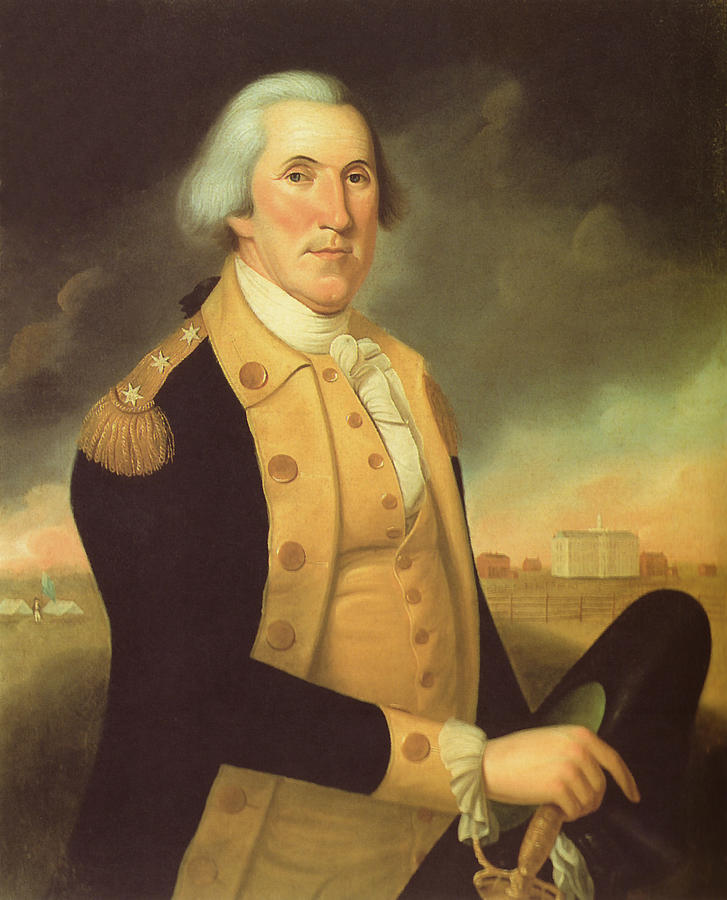
This week heralds our federal income tax deadline - a time that fills most Americans with dread. And no wonder. Our nation was founded by men who resisted unjust taxes. The American Revolution was precipitated, in part, by a series of laws passed between 1763 and 1775 that regulated trade and taxes. These laws caused tensions between colonists and British officials. British unwillingness to respond to American demands for change allowed colonists to argue that they were part of an increasingly corrupt and autocratic empire in which their traditional liberties were threatened. This position eventually served as the basis for the colonial Declaration of Independence.
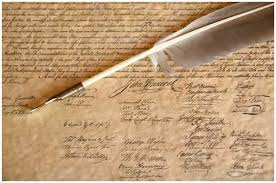 |
The Declaration of Independence was the result
of years of political turmoil and outright rebellion |
After 1763, the British government emerged from the Seven Years' War (known in America as the French and Indian War) burdened by heavy debts. This led British Prime Minister George Grenville to reduce duties on sugar and molasses while enforcing the law more strictly. The colonial governments of New York and Massachusetts sent formal letters of protest to Parliament.
To ensure that the colonies did not try to pay for goods and their taxes in local currency, the British Parliament passed the 1764 Currency Act, which forbade the colonies from issuing paper currency. This made it even more difficult for colonists to pay their debts and taxes.
Following the Currency Act, Grenville proposed a Stamp Tax. This law would require colonists to purchase a government-issued stamp for legal documents and other paper goods. In effect, it was an indirect tax on many things colonists needed to conduct day-to-day business. Grenville submitted the bill to Parliament for debate, and only one member objected to Parliament's right to tax the colonies.
In response, the Virginia House of Burgesses passed resolutions denying the British Parliament's authority to tax the colonies. In Boston, tensions escalated. Colonists rioted and destroyed the house of the stamp distributor. News of these protests inspired similar actions in other colonies, and thus the Stamp Act served as a common cause that united the 13 colonies in opposition to the British Parliament. In October of 1765, delegates from 9 colonies met to issue petitions to the British government denying Parliament's authority to tax the colonies. An American boycott of British goods, coupled with a recession, also led British merchants to lobby for the act's repeal on pragmatic economic grounds. Under pressure from American colonists and British merchants, the British government decided it was easier to repeal the Stamp Act than to enforce it.
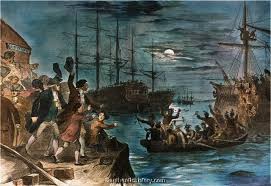 |
| The Boston Tea Party |
The repeal of the Stamp Act temporarily quieted colonial protest, but resistance to new taxes imposed in 1767 under the Townshend Acts soon returned. Tensions escalated as disgruntled colonists organized. In 1773, colonists staged more vocal, widespread protests after the British Parliament granted the East India Company a monopoly on the tax-free transport of tea. The tax-free status of the British East India Company meant that colonial tea traders could not compete. Enraged colonists responded by encouraging a general boycott of British goods. On December 16, 1773, American colonists disguised as Indians boarded East India Company ships in Boston Harbor and threw crates of tea overboard. This famous protest became known as the Boston Tea Party.
When news of the Tea Party reached England, British officials moved to enforce discipline and order in the colonies. The British government ordered the closure of the port of Boston until the East India Company was compensated for the destroyed tea. Parliament also passed several pieces of legislation in 1774, which Americans termed the Intolerable Acts. British control was further solidified by the appointment of General Thomas Gage as the military governor of Massachusetts. He attempted to place Massachusetts under direct British control.
By 1774, most colonists agreed that a meeting to discuss an appropriate collective response to British actions was a good idea. Colonial legislatures sent representatives to Philadelphia, and the First Continental Congress convened in September 1774. The Continental Congress adopted the Articles of Association on October 20. These Articles listed colonial grievances and called for a locally enforced boycott across all the colonies, effective December 1. The delegates also drafted a petition to King George III outlining their grievances, although by then they doubted the crisis would be resolved peacefully.
King George III
Recognizing that further coercive measures would only enrage the colonists and might lead to war, British military governor Gage wrote to London, recommending the suspension of the Intolerable Acts. Gage hoped to appease many colonists and thereby split colonial moderates from radicals. If London was not amenable to his recommendations, Gage stated that he would need significant reinforcements to crush the growing rebellion.
 |
| General Thomas Gage |
As a reward for his suggestions, Gage was ordered to be removed from his post. The British government felt that further punitive measures were necessary, so Parliament passed additional trade restrictions on New England. London declared the colonies in rebellion, but to split the resistance, it also offered to stop taxing those colonies that supported the British government.
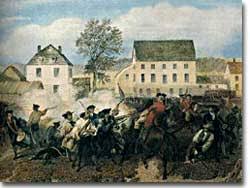 |
Lexington
|
By this time, the most astute leaders on both sides viewed armed conflict as inevitable. Gage's attempts to secure his position in Boston only brought him into conflict with local militias and a hostile populace, and it was only a matter of time before open war broke out in 1775. The opportunity for peaceful negotiation had ended, and the war for American Independence began on April 19, 1775, when British troops and American colonists clashed at Lexington and Concord.
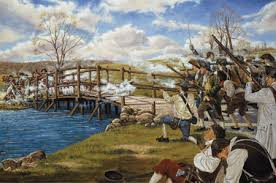 |
| Concord |
Later this week (after our taxes are paid), we will celebrate the anniversary of the battles at Lexington and Concord...the shot heard round the world...