Followers

Showing posts with label military awards. Show all posts

Sunday, January 26, 2014

The Birthday Present

Celebrating Washington's Birthday


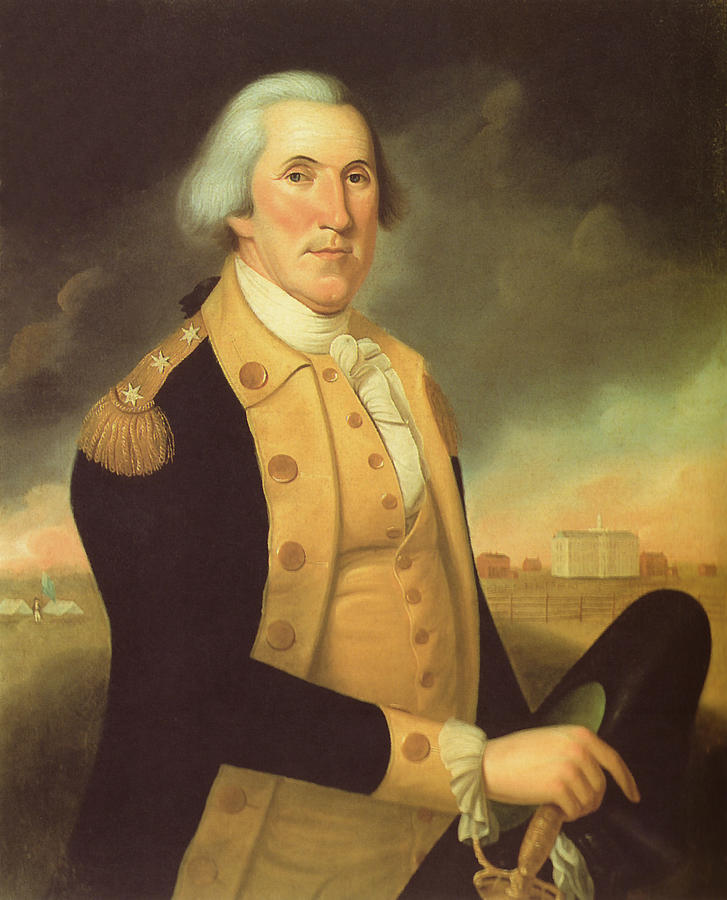
Birthday Boy and Commander-in-Chief


King George III

Believe it or not, there was a time when George Washington's birthday was not a celebrated federal holiday. Wait a minute, that time would be... now! In this blogger's humble opinion, His Excellency is more than worthy of a day for him alone and not shared with 40-something other chief executives. He was the first.  And the first is always (OK, usually) special. But Washington was more than special. He was the essential man of his age. With the exception perhaps of King George III and his inner circle, that was the considered opinion of most of the world (America and Europe). Later, even George III had some lauding comments on Washington eschewing absolute power and kingship. In 1879, the US Congress honored our first president by closing government offices in Washington, DC, on  February 22nd. Curiously, this had nothing to do with the budget. It was the first holiday honoring a particular American citizen, and it was celebrated on his actual birthday, not the Monday of. Back then, the holidays were about commemorating something meaningful, not just another 3 day weekend. In 1885, Congress expanded the holiday to include all federal offices and activities.


A Special Birthday Present


In 1931, the Chief of Staff of the Army, Douglas MacArthur, submitted a recommendation to Congress intended to present the first commander-in-chief with a very special 200th birthday present: the awarding of a "new" medal to recognize soldiers injured in combat. On February 22, 1932, Washington's 200th birthday, the U.S. War Department announced the creation of the "Order of the Purple Heart." 

General Order No.3 announced the establishment of the award, which would have a likeness of Washington:

"...By order of the President of the United States, the Purple Heart, established by General George Washington at Newburgh, August 7, 1782, during the War of the Revolution, is hereby revived out of respect to his memory and military achievements."

By order of the Secretary of War:

Douglas MacArthur

General, Chief of Staff


But why was this so special after all? 


 The First Award


Biographers and students of George Washington know that he is the author of many firsts, both in the military and later in the presidential and political arena. The sobriquet, First in War, First in Peace, First in the hearts... was literally true. This was the logical result of Washington's place and time in our nation's founding and the leadership he showed through eight years of war, the establishment of the US Constitution, and eight years of the world's first presidency. The list of things established by him in the military, civil and governmental spheres is impressive. One of these firsts is the nation's first military award. The award, originally called the Badge of
Washington's Headquarters, Newburgh, NY
Military Merit was established by Washington when he served as the commander-in-chief of the Continental Army as the long war for independence was coming to a close. That order, issued from his headquarters at Newburgh, New York, stated it would be a decoration consisting of a purple, heart-shaped piece of silk, edged with a narrow binding of silver, with the word Merit stitched across the face in silver. The badge was to be presented to soldiers for "any singularly meritorious action" and permitted its wearer to pass guards and sentinels without challenge! I like that last perk. Does cutting the line at TSA count?


On August 7, 1782, this general order established the Badge of Military Merit:

"... The General ever desirous to cherish virtuous ambition in his soldiers, as well as to foster and encourage every species of military merit directs whenever any singularly meritorious action is performed, the author of it shall be permitted to wear on his facings, over his left breast, the figure of a heart in purple cloth or silk edged with narrow lace or binding."

Original Badge of Merit Replica


The honoree's name and regiment were also to be inscribed in a "Book of Merit." As it turns out, only three Revolutionary War soldiers are known to have received the Badge of Military Merit: Sergeant Elijah Churchill, 2nd Continental Dragoons; Sergeant William Brown, 5th and Sergeant Daniel Bissel, 2nd Connecticut Continental Line Infantry. Possible Yankee Doodle Spies connection: 2nd Continental Dragoons included Lieutenant Colonel Benjamin Tallmadge's unit - Washington's spies. Unknown if Sergeant Churchill was a member of that element, but it is likely.


The Legacy


It did not take long for the Purple Heart to evolve in scope and purpose. On May 28, 1932, 138 World War I veterans were conferred their Purple Hearts at Temple Hill in New Windsor, NY. Temple Hill was the site of the New Windsor Cantonment, which was the final encampment of the Continental Army in the winter of 1782-1783. At first, the Purple Heart was exclusively awarded to Army and Army Air Corps personnel. Still, in 1942, President Franklin Roosevelt allowed the Navy to award the Purple Heart to Sailors, Marines, and Coast Guard personnel. Later that year, the Purple Heart was made available for posthumous award to any member of the military killed on or after December 7, 1941. The original Purple Heart was awarded for meritorious service. But with the creation of the Legion of Merit in 1942, the award of the Purple Heart for meritorious service was discontinued and is now awarded to any member of the Armed Forces who has been wounded or killed in designated combat activities.

Today's Purple Heart


Saturday, February 2, 2013

Promotions and Pride

I served over 20 years in the US Army and had 8 years of ROTC experience before that. Not what you might think—I took junior ROTC at Xavier High School, the Jesuit Military Academy in New York. However, throughout all those years, there was one event that always brought me a sense of accomplishment, mixed with a bit of dread—the promotion!

In the military, a person's success is measured in three ways when not actually in combat: surviving, ensuring your unit members survive, or advancing on the enemy with fire and movement to achieve or hold your objective. In other words, winning battles and wars. However, throughout a war or a career, awards and medals for accomplishments, gallantry, and similar achievements are sometimes complemented by promotions. The Army does not provide cash bonuses like the civilian sector; therefore, promotions (which include longevity steps) are the only tangible form of compensation... the gift that keeps on giving. And they definitely boost the ego.

                                                                                
                                                         Medals are symbols of achievement


While many who serve their country may publicly dismiss the need for such recognition, most of these sentiments are simply nonsense. Nearly everyone appreciates acknowledgment, and in the military, promotions are the main form of recognition, besides gallantry awards. During the era of the Yankee Doodle Spies, the promotion of officers was highly important.

And just like their British counterparts, the American officer corps was highly political. Congress controlled promotions and commands at the highest levels. Officers actively lobbied congressional representatives to advance their careers. The American agents in France, Silas Deane and Benjamin Franklin, even sought rank and command for foreign officers and civilians. John Adams, disgusted by this military politicking, wrote that he “wearied to Death with the Wrangles between military officers, high and low. They Quarrell like Cats and Dogs. They worry one another like Mastiffs Scrambling for Rank and Pay like Apes for Nuts.”


Silas Dean


Military pride almost cost us our independence. More importantly, a denied promotion or command often played a key role during the war. Note the less-than-honorable service of General Charles Lee, Washington's second-in-command, who avoided excelling whenever it threatened Washington's authority. The scheming of General Horatio Gates, victor at Saratoga, became the focus of an anti-Washington group aimed at replacing Washington with him. Furthermore, pride, as harmful to the nation's fight for independence, is most famously shown by the treason of General Benedict Arnold, whose grievances (and they were many) included the unfair denial of a well-deserved promotion to Major General. Each of these men turned against Washington and, therefore, against the cause, because of excessive pride.

                                               
                                                                              Horatio Gates

We often forget that the men who served as our First Patriots were human beings with families and obligations. Promotion meant prestige and honor, which were highly valued traits in the 18th century. These promotions also brought higher pay, and most officers, along with all enlisted men, were not wealthy landowners but rather teachers, shopkeepers, small farmers, and so on. Therefore, the possibility of a promotion and the potential for increased earnings were important considerations. They all (correctly) believed that a higher rank during the war would lead to greater prestige, which could be helpful after the war. Again, they weren't much different from people today. In an ideal world, patriotism would be its own reward. But, in reality, patriotism should be rewarded fairly.

                                                                             
                                                                         Charles Lee

Unfortunately, a promotion in the Continental Army did not always come with a pay raise. In fact, payments for officers and enlisted personnel were irregular. Congress had to request funds from the states to pay the Army, and the states often delayed or refused whenever they could. Without going into detail here, this nearly undermined the new republic before it even began, and only swift action by George Washington himself prevented a disaster. It also shaped Washington's political views toward a strong central government, one capable of funding national defense and serving the common good. Interestingly, the politics of promotion played an important role in both the war's progress and the country's formation.


                                                                Continental Army Officers