Followers

Showing posts with label Veterans. Show all posts

Saturday, February 29, 2020

Captain Molly

Female First Patriot


The American War for Independence would not have succeeded without the dedicated efforts of many women, from all walks of life. Besides the obvious morale support women provided the cause, they maintained the farms or ran the shops when the men-folk were with the army or the militia. They raised money and engaged in the day to day commerce that kept the economy going and helped feed the revolution. They organized efforts to sew and knit, providing badly needed garments, blankets, and the like for an army poorly served by traditional logistics. Many also followed the gun, joining husbands or sweethearts with the forces as camp-followers. This female first patriot’s service began that way. But it did not end that way. Her name was Mary Chocrane Corbin, and she was indeed, a female bad-ass.


Captain Molly - an original bad-ass


Frontier Orphan


Margaret Chochrane (later changed to Chocran) was born near today’s Chambersburg, Pennsylvania in Franklin County, Pennsylvania, on 12 November 1751, of Scotch-Irish settlers. Pennsylvania was a battlefront during the French and Indian War, however, and in 1756 and Indian attack changed her life for the worse. In a savage raid so common then, her father was killed and her mother carried off never to be seen again. Margaret escaped but now an orphan, she was raised by an uncle. This was not uncommon in those days. One can only think her hardscrabble youth steeled her for the challenges that lay in store for her.


Margaret's mother was carried off in an Indian raid

Newlywed... New Recruit


In 1772, at the relatively old age of twenty-one, she married John Corbin, a Virginian who came to Pennsylvania during the war and lingered on. In the run-up to the War for Independence, John Corbin enlisted in Captain Thomas Proctor’s company of the 1st Continental Artillery. Corbin was a matross, a gunner’s assistant in an artillery crew. As a matross, it was John Corbin’s duty to assist the gunner in loading, firing, and sponging the guns.


John Corbin served as a matross, assistant gunner


Follow the Army


Like many women of her day, Margaret joined the army with her husband and served his unit as a camp follower. Camp followers were an essential component of 18th-century armies, providing essential services such as cooking, washing clothes and blankets, fetching firewood and water. In combat, they often attended the wounded or carried water for the troops. Without the service of these dedicated women, soldiers of the Revolutionary War would have suffered even more than they did. Especially the Americans, whose logistics often lacked.


Camp Followers were critical to the armies

Active Service


Margaret was with the Continental Army in this capacity in New York in 1776. By November of that year, General Washington’s army had been driven from Brooklyn, had abandoned most of Manhattan, and had withdrawn to the Jerseys in the face of overwhelming British land and naval power. In Manhattan, the Continental Army was clinging to a small piece of rock at the northern tip of the island. Fort Washington stood high above the North (Hudson) River and the Harlem River, making it a critical piece of land.  On November 16, General William Howe ordered a three-pronged bombardment and assault on Washington’s namesake bastion.


Fort Washington


Captain Molly


The fort’s defenders put up a desperate fight at first, stymieing the efforts of British and Hessian regulars. But soon the endless pounding of guns and determined assaults took its toll on the outnumbered defenders.  John was assisting a gunner until the gunner was killed. At this point he took charge of the gun and Margaret stepped in to assist him. Before long, the intense British fire took him down - John Corbin was killed in combat. Undeterred, his wife now stepped in for him. 
Margaret was often reported to have a feisty nature. On this day it would serve the forlorn cause at the fort.  With no time to grieve her fallen husband, Margaret sprang into action and began serving one of the guns in his place, personally loading and firing round after round at the attackers. But the British soon trained their guns on the belching American cannon. Before long, Margaret herself was struck by a blast of grapeshot from the HMS Pearl firing from the river below the fort. A swarm of lead balls tore into her shoulder, mangled her chest, and lacerated her jaw. Several soldiers carried her to the rear where she received what little treatment they could give. 


Captain Molly working a cannon at Fort Washington


Wounded in the Line of Duty


The fort soon surrendered, and thousands of soldiers were marched off to eventual death on prison hulks. But Margaret’s wounds were so severe she was paroled by the fort’s new commandant, Hessian General von Knyphausen. Margaret and the other wounded were ferried across the river to Fort Lee. Bleeding from multiple wounds, and an arm hanging by a thread, Margaret suffered a wagon jolting and bumping along poor roads all the way to Philadelphia. She survived the journey and the wounds, although they would plague her for the rest of her life. In addition, she permanently lost the use of her left arm.


Corbin suffered horrific wounds in
the service of her country


Corps of Invalids


In time, Corbin’s condition was made known to the Pennsylvania Executive Council, which granted her a small sum of money and referred her to the Continental Congress. The Board of War, impressed by her reputation as “Captain Molly,” then voted her a soldier’s half-pay for life on July 29, 1779. Afterward, Corbin was allowed to join the Corps of Invalids at West Point, New York. Congress created the corps to garrison posts, using soldiers no longer fit for full active service.


Corbin was assigned to the Corps of Invalids
for the remainder of the war


Honorable Discharge & Second Marriage


She was also allotted one free suit of clothing per year or the equivalent in money. In 1782, Congress allowed her to receive a daily ration of rum due to veteran soldiers.  As the war drew to a close, she was formally discharged from the military in April 1783. While serving at West Point Margret married again. Her new husband was also invalid, and the couple lived several years in grinding poverty. When he died, "Captain Molly" lived hand and mouth, often relying on the charity of locals.


The Corps of Invalids garrisoned West Point


Legacy


Our female first patriot died just shy of her 50th birthday at Highland Falls, New York on January 16, 1800, and was buried in an unmarked grave.


The DAR helped move Margaret Corbin's remains to its
final resting place


There she lay until in the early 20th century, Corbin’s remains were subsequently rediscovered and, through the intervention of the daughters of the American Revolution (DAR), she was interred at the US Military Academy in 1926 with full military honors. Her grave was marked by a bronze memorial. Corbin was the first woman of the Revolutionary War to receive a disability pension for military service. Ir is fitting that she was laid to rest with some of the great military heroes of America's wars.


Margaret Corbin finally laid to rest at West Point's cemetery?


However, the tale of America's first female veteran took on a strange twist in 2016. Her grave was accidentally dug up and it was decided to conduct a post exhumation forensic analysis. Unfortunately, the results determined the remains were of a very large male. When notified, the DAR remained undaunted and have resolutely pledged to continue the search for Margaret Corbin's actual remains. But you do not have to travel to West Point to visit a Captain Molly memorial. A plaque was erected on the site of Fort Washington in upper Manhattan, in today's Fort Tryon Park. Visitors to the Big Apple can visit it and visit the site of her gallant action in the service of her nation.


In an interesting side-note: Mary Corbin’s association with the artillery often causes her to be confused with another gunner, Mary Ludwig Hays, or Molly Pitcher, a common name for camp followers at the time. The other Molly may be the subject of a future Yankee Doodle Spies profile.

Saturday, November 11, 2017

First Patriots... First Veterans


Issues regarding veterans and their fair treatment pre-date the founding of our nation. The colonists fought a series of wars against the natives and the French in the run-up to the break with Britain. The English colonies in North America provided pensions for disabled veterans. The first law in the colonies on pensions, enacted in 1636 by Plymouth, provided money to those disabled in the colony’s defense against Indians. Other colonies eventually followed Plymouth’s example.


Revolutionary War


But the American Revolution brought treatment of veterans to the forefront of the earliest politics in America. In 1776 the Continental Congress tried to encourage enlistments and reduce
desertions by passing the nation’s first pension law. It granted half pay for life in cases of loss of limb or other serious disability. But because the Continental Congress did not have the authority or the money to make pension payments, the actual payments were left to the individual states. This obligation was carried out in varying degrees by different states. At most, only 3,000 Revolutionary War veterans ever drew any pension. Later, grants of public land were made to those who served to the end of the war.


Continental Army Soldiers


A Veterans Rebellion?


But again the money was not appropriated and many veterans or their families sold off what pension rights they had for pennies on the dollar. The political fall out of all this was tremendous. The boiling point came with Shays' Rebellion in 1786 when western Massachusetts farmers, mostly veterans of the War for Independence, could not get credit for their farming despite the government reneging on their wartime and veterans' compensation. Shays himself, was a captain who served at Lexington & Concord, was a wounded veteran.


Shays' Rebellion: A Veterans' rebellion?


A New Government


Ironically, Shays' rebellion showed the need (among other things) for a stronger central government, which led to the Continental Congress and the US Constitution adopted and ratified in 1789, with the ratification of the U.S. Constitution. The first United States Congress assumed the burden of paying veterans benefits. The first federal pension legislation was passed in 1789. It continued the pension law passed by the Continental Congress. The Secretary of War administered pensions in the early years of the republic. Yet fair payment and treatment for veterans continued to impact America's political landscape. Those who answered the colors had to fight to maintain their rights even as they sacrificed for others to retain theirs.


Constitutional Convention


A Second "War for Independence"


The War of 1812 brought the plight of Revolutionary War pensioners back into the public eye. Veterans of that conflict were provided a reasonable pension, including widows and orphans. As the economy began to thrive Congress looked to new ways to support veterans, especially the remaining Revolutionary War veterans.  A new principle for veterans benefits, providing pensions based on need, was introduced in the 1818 Service Pension Law. The law provided that every person who had served in the War for Independence and needed assistance would receive a fixed pension for life. The rate was $20 a month for officers and $8 a month for enlisted men. Before this legislation, pensions were granted only to disabled veterans.  The result of the new law was an immediate increase in pensioners. From 1816 to 1820, the number of pensioners increased from 2,200 to 17,730, and the cost of pensions rose from $120,000 to $1.4 million.


The War of 1812 brought more veterans to consider


Congress Takes Action


When Congress authorized the establishment of the Bureau of Pensions in 1833, it was
the first administrative unit dedicated solely to the assistance of veterans. Under the 1832 Act that established the Bureau,   Revolutionary War pensions, which until then were given only to regular Army veterans—the Continentals—or disabled veterans, were authorized for all who had served at least six months in any of the military forces during the war. For the most part, this meant those who had served in the various state militias, though it also included naval personnel, state line troops, and certain contract civilians such as teamsters. The depositions taken to substantiate the required service are a remarkable record in themselves, providing eyewitness accounts of the Revolution drawn from them reveals. The depositions, however, are more than a collection of personal accounts of service—as fascinating as these can be. They are rich with data concerning Revolutionary War veterans and their families and a unique record of the life and time of this generation.


Certification that one John Bacon
 was eligible to receive a pension
for Revolutionary War service.


 Veterans enrich our History


It is no small final irony also that our knowledge of the American Revolution is filled out by the accounts of the wartime experiences of the Revolutionary War soldiers. Because records of that war were sparse and fragmented, it was incumbent on veterans or their families to justify pension applications. These accounts, although often spotty or sometimes spurious, provided a unique insight into the conflict as seen by those who fought it. In a sense, the veterans helped portray the war they fought to posterity. And for that, as well as their service, we should thank them.


Honor All Those Who Served - especially our First Patriots


Honor Our Veterans


Sunday, May 21, 2017

Rev War Talk: Veterans & Leaders


Dick Winter's Memorial at Veteran's Plaza in Ephrata. Pennsylvania


The Lecture


As part of their ongoing Veteran's Lecture Series, the Winters Leadership Memorial Committee invited me to speak on the American Revolution, the Yankee Doodle Spies, and related topics. The committee sponsors one such talk each month, typically the last Tuesday. The talk will encompass an overview of the eight-year struggle for independence plus a series of cameos on various aspects of the war such as intelligence, maritime, geography, etc. It will take place in the library at Ephrata, Pennsylvania. The Lecture Series itself began back in 2014 as a way to continue the effort we started with the construction of Ephrata’s Veterans Plaza & installation of the Winters Leadership Memorial. The driving purpose behind building the Veterans Plaza was to honor all veterans from all wars. One of the plaques in the plaza says it best, “They are not dead who live in the hearts they leave behind.”


The Man


The Winters Leadership Memorial is named after Major Dick Winters, legendary WWII commander of Easy Company of the 101st Airborne (Screaming Eagles) commemorated in the book and television mini-series: Band of Brothers. Winters grew up in and around Ephrata, in central Pennsylvania, where he eventually returned.

Winters was immortalized in the book and HBO series, "Band of Brothers"

The Memorials


In June of 2012,  a statue was installed at Utah Beach in Normandy.  It was created in Richard D. Winters' likeness, designed to honor all leaders, especially those of the Junior Officer’s.  Winters felt that the leadership and decision making of these young and inexperienced men was critical to the success of the D-Day invasion and other critical WWII battles. The artist who created the Winters Statue also offered the community of Ephrata the opportunity to erect a reproduction of the Normandy statue.  A committee was formed,  and the group set out to raise the funds required to acquire the statue, build the Veterans’ Plaza it would rest in, and maintain the site. In May 2015  the statue was dedicated at the plaza.


Actor Damian Lewis, who portrayed Dick Winters in the HBO series,
speaks with 101st vet during the commemoration of the Winters Memorial
  in Normandy, France


America's Veterans Issues & the Revolutionary War


So what does all of this have to do with the Rev War? Well, everything as it turns out. Issues regarding veterans commenced even as the American War for Independence was in its waning years. Soldiers released from services often failed to receive compensation promised by the states and Congress, little as that was. There were several "affairs" sometimes even mutinies over lack of compensation, food and clothing.


Newburgh Conspiracy


One of the most famous was the Newburgh Conspiracy, a rebellion of Continental Army officers in March 1783 that was nipped in the bud by George Washington himself. Washington personally confronted the conspirators, who planned to march on Congress and overthrow the fledgling confederation government. In 1780, Congress had passed a resolution providing half-pay for retired soldiers. But as late as  1783 the states (who had the power of the purse) had yet to comply with Congress’s request for money. The British Army was still quite ensconced in North America - the last troops would not leave until very late in the year. So the action of these conspirators could have resulted in stamping out the new nation before it could be established.


Continental Army at New Windsor Cantonment


How did it happen? As the conspirators gathered at an assembly hall/chapel  (the Temple Building) at Newburgh's  New Windsor Cantonment, to the surprise of all, Washington suddenly appeared before the assembly. The group had an inflammatory ultimatum penned by Major Armstrong, a former aide to cashiered General Horatio Gates (no friend of Washington). Washington denounced Armstrong and the ultimatum in very strong (for the 18th Century) terms.


The Temple Building - chapel where the officers gathered and Washington
confronted the conspiracy

The commander in chief remarked of the ultimatum, "...something so shocking in it, that humanity revolts at the idea." Taking the pulse of the audience he went on, "My God! What can this writer have in view, by recommending such measures! Can he be a friend to the army? Can he be a friend to this country? Rather is he not an insidious foe?" He also asked that they, "Give one more distinguished proof of unexampled patriotism and patient virtue." He asked for their, "full confidence in the purity of the intentions of Congress."


Washington's Headquarters at Newburgh


In closing, Washington attempted to read a letter he recently received from Joseph Jones, a Congressman from Virginia. The letter was to assure the commander in chief of (some in) Congress's assurance that the needs of the soldiers would receive a full measure of support. But Washington’s vision had recently begun to fail. He struggled with the opening paragraph. Frustrated Washington retrieved a pair of glasses from his pocket.  Then, the usually formal and stiff Washington made a rare casual remark. "Gentleman, you must pardon me, for I have not only grown gray but almost blind in service to my country."

This spontaneous act of demonstrating his humanity, from a man almost all held as next to God, had the immediate effect of taking the air out of the sails of mutiny and rebellion. Many officers began to weep. Possibly the greatest threat to the American Revolution and the new nation had evaporated due to the heartfelt and humble words of Washington. Sadly, veterans have had to fight for their rights from that day forward. Sometimes things did not end as peacefully and quickly as that March day in the Hudson Valley.


Washington did as much in saving The Cause with
his talk as in all the battles he fought


Sunday, January 26, 2014

The Birthday Present

Celebrating Washington's Birthday


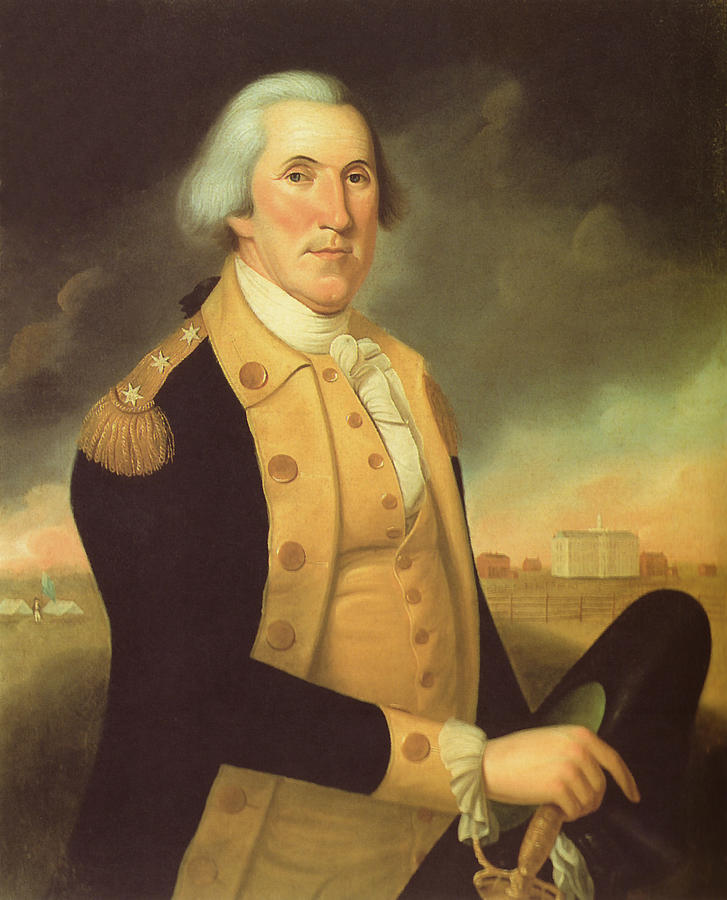
Birthday Boy and Commander-in-Chief


King George III

Believe it or not, there was a time when George Washington's birthday was not a celebrated federal holiday. Wait a minute, that time would be... now! In this blogger's humble opinion, His Excellency is more than worthy of a day for him alone and not shared with 40-something other chief executives. He was the first.  And the first is always (OK, usually) special. But Washington was more than special. He was the essential man of his age. With the exception perhaps of King George III and his inner circle, that was the considered opinion of most of the world (America and Europe). Later, even George III had some lauding comments on Washington eschewing absolute power and kingship. In 1879, the US Congress honored our first president by closing government offices in Washington, DC, on  February 22nd. Curiously, this had nothing to do with the budget. It was the first holiday honoring a particular American citizen, and it was celebrated on his actual birthday, not the Monday of. Back then, the holidays were about commemorating something meaningful, not just another 3 day weekend. In 1885, Congress expanded the holiday to include all federal offices and activities.


A Special Birthday Present


In 1931, the Chief of Staff of the Army, Douglas MacArthur, submitted a recommendation to Congress intended to present the first commander-in-chief with a very special 200th birthday present: the awarding of a "new" medal to recognize soldiers injured in combat. On February 22, 1932, Washington's 200th birthday, the U.S. War Department announced the creation of the "Order of the Purple Heart." 

General Order No.3 announced the establishment of the award, which would have a likeness of Washington:

"...By order of the President of the United States, the Purple Heart, established by General George Washington at Newburgh, August 7, 1782, during the War of the Revolution, is hereby revived out of respect to his memory and military achievements."

By order of the Secretary of War:

Douglas MacArthur

General, Chief of Staff


But why was this so special after all? 


 The First Award


Biographers and students of George Washington know that he is the author of many firsts, both in the military and later in the presidential and political arena. The sobriquet, First in War, First in Peace, First in the hearts... was literally true. This was the logical result of Washington's place and time in our nation's founding and the leadership he showed through eight years of war, the establishment of the US Constitution, and eight years of the world's first presidency. The list of things established by him in the military, civil and governmental spheres is impressive. One of these firsts is the nation's first military award. The award, originally called the Badge of
Washington's Headquarters, Newburgh, NY
Military Merit was established by Washington when he served as the commander-in-chief of the Continental Army as the long war for independence was coming to a close. That order, issued from his headquarters at Newburgh, New York, stated it would be a decoration consisting of a purple, heart-shaped piece of silk, edged with a narrow binding of silver, with the word Merit stitched across the face in silver. The badge was to be presented to soldiers for "any singularly meritorious action" and permitted its wearer to pass guards and sentinels without challenge! I like that last perk. Does cutting the line at TSA count?


On August 7, 1782, this general order established the Badge of Military Merit:

"... The General ever desirous to cherish virtuous ambition in his soldiers, as well as to foster and encourage every species of military merit directs whenever any singularly meritorious action is performed, the author of it shall be permitted to wear on his facings, over his left breast, the figure of a heart in purple cloth or silk edged with narrow lace or binding."

Original Badge of Merit Replica


The honoree's name and regiment were also to be inscribed in a "Book of Merit." As it turns out, only three Revolutionary War soldiers are known to have received the Badge of Military Merit: Sergeant Elijah Churchill, 2nd Continental Dragoons; Sergeant William Brown, 5th and Sergeant Daniel Bissel, 2nd Connecticut Continental Line Infantry. Possible Yankee Doodle Spies connection: 2nd Continental Dragoons included Lieutenant Colonel Benjamin Tallmadge's unit - Washington's spies. Unknown if Sergeant Churchill was a member of that element, but it is likely.


The Legacy


It did not take long for the Purple Heart to evolve in scope and purpose. On May 28, 1932, 138 World War I veterans were conferred their Purple Hearts at Temple Hill in New Windsor, NY. Temple Hill was the site of the New Windsor Cantonment, which was the final encampment of the Continental Army in the winter of 1782-1783. At first, the Purple Heart was exclusively awarded to Army and Army Air Corps personnel. Still, in 1942, President Franklin Roosevelt allowed the Navy to award the Purple Heart to Sailors, Marines, and Coast Guard personnel. Later that year, the Purple Heart was made available for posthumous award to any member of the military killed on or after December 7, 1941. The original Purple Heart was awarded for meritorious service. But with the creation of the Legion of Merit in 1942, the award of the Purple Heart for meritorious service was discontinued and is now awarded to any member of the Armed Forces who has been wounded or killed in designated combat activities.

Today's Purple Heart