Followers

Showing posts with label Maryland 400. Show all posts

Monday, May 30, 2016

Mister Smith fights for Washington

Coincidence?


Lord Stirling

While writing The Patriot Spy, I researched and continued to explore various people, places, and events involved in the campaigns around New York in 1776. One key event in the campaign—and in the book—was the daring attack of the "Maryland 400." The number of Marylanders was about 250, with remnants of Haslet's Delaware Regiment joining in to make up the difference. 

This was a desperate hope attack led by New Jersey General "Lord" Stirling against a large force of redcoats commanded by General Lord Cornwallis. While Stirling claimed the title of lord (or, in his case, laird, as he claimed Scottish peerage), Cornwallis held real authority. 

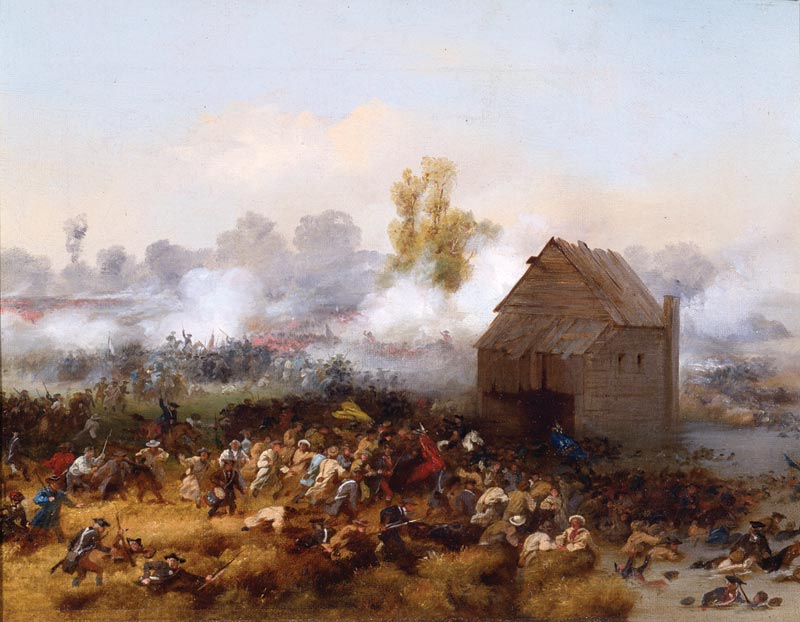
Cornwallis had the advantage of good ground and about 2,000 of the best troops in the army, along with two guns, to face the small American force, which was now hopelessly cut off. Stirling led attacks that showcased some of the bravest moments of the entire eight-year war. Intense musket fire was exchanged, and the Americans from Maryland and Delaware made several attempts to reach the British line, but in the end, the force was decimated. All were killed, wounded, or captured, except for the Maryland commander, Major Mordecai Gist, and a handful of others, including the resolute Captain Samuel Smith.


Major Mordecai Gist


In The Patriot Spy, a young officer named Lieutenant Jeremiah Creed, a mysterious Irish immigrant, performs a daring withdrawal and escapes across Gowanus Creek. That act of heroism is observed from the American defenses by General George Washington, who then decides to recruit the talented Creed for an intelligence war against the British. The rest you will have to discover in the novel.


In my research, I, of course, read about the event and the escape of several, including Gist. However, with literary license, I included the fictional Creed, commander of the Maryland Light Infantry company. What I did not know at the time was that a very real commander of the light infantry had indeed escaped with a few of his men.


Haslet's Delaware Line on Long Island


Fact Meets Fiction


The high point of the Battle of Long Island
So, who was this real-life person I unintentionally channeled in my novel? His name was Captain Samuel Smith. Oddly, although he was born in Pennsylvania, he also had Irish roots, as his family came from County Tyrone. 

Smith's family moved to Baltimore when he was young, and he eventually worked in his father's successful merchant business. Young Smith sailed to Europe, where he traveled widely. The fictional Creed also visited various parts of Europe and other locations before settling in Maryland. 

Smith returned to America after the battles at Lexington and Concord in 1775. By early 1776, he was appointed commander of the 6th company in First Maryland, Colonel Smallwood's Regiment. 

As noted in The Patriot Spy, Smallwood was absent from the action on Long Island while serving (with Colonel John Haslet) on court-martial duty in Manhattan. Ironically, it was an espionage trial!


Mordecai Gist, urging the Maryland 400 to glory on Long Island


As an 18th-century company commander, Smith would lead his troops in the attack and be at the rear during the withdrawal. He likely faced enemy fire many times because, make no mistake about it, this was a battle of hellish proportions: massed volleys, withering skirmish fire, smoke everywhere, the crack of muskets, and the boom of cannon, overpowering the screams and cries of the dead and dying. 

The evacuation by Smith and his men was no small feat. To do this, they had to withstand enemy musket and cannon fire, avoid the close pursuit of bayonet-wielding regulars, navigate rough terrain, and finally cross swampland and the Gowanus Creek itself. 

During the battle, Washington watched the action from a redoubt on nearby Cobble Hill (the intersection of today's Court Street and Atlantic Avenue). Upset by the destruction of the best troops, he is reported to have said, "Good God, what brave fellows I must this day lose!"


Captain Samuel Smith leads his men on Long Island


I should note that the action there was the largest and bloodiest of the war—and the first pitched battle fought by the United States as a nation, happening just weeks after the Declaration of Independence. Smith's military career kept gaining momentum after the action on Long Island. He fought prominently at White Plains and Brandywine. In 1777, he was promoted to Lieutenant Colonel and tasked with defending Fort Mifflin, located on an island in the Delaware River.

Mifflin was one of two key forts protecting Philadelphia from Admiral Lord Richard Howe's British fleet. The fort was mainly made of mud walls and had a garrison of just 400 men. Still, Smith repelled a determined attack by a squadron of British ships in October. A ship of the line and a sloop-of-war both ran aground under intense fire from Mifflin's defenders. 

However, the British returned in force in November, this time with frigates, floating batteries, and land-based artillery. They battered Mifflin from all sides with a brutal bombardment, often at close range. The defenders fought bravely but paid a heavy price. They kept firing until all their guns were silenced by the more powerful British shot.

Toward the end, Smith was seriously wounded and had to be evacuated. Soon after, the remaining defenders also left the fort. But not before they had done an admirable job against great odds. Smith received a commendation from Congress for his actions and was awarded a commemorative sword. He recovered and went on to fight at the Battle of Monmouth in 1778. After the battle, he resigned his commission and returned to Baltimore, where he became a privateer, sending ships out to harass and seize the British merchant fleet.


Sketch of British naval assault on Fort Mifflin in 1777


A Man of Peace... and then again of War...


 Following the war, Smith resumed his mercantile pursuits and became one of Maryland's wealthiest men. In 1791, he was appointed commander of the state militia to help suppress the Whiskey Rebellion in western Pennsylvania. His popularity earned him a seat in the House of Representatives in 1792, where he served four terms. 

Smith supported Thomas Jefferson in the 1800 election and served as Acting Secretary of the Navy until 1803. Afterwards, he became a U.S. Senator. When tensions with Britain escalated, Smith opposed going to war. Yet, he donned his uniform again in 1814 when a combined fleet attacked Baltimore.

As a major general and militia leader once more, Smith organized the city’s defenses against a combined land and sea attack. The results are legendary: the naval victory at Fort McHenry (which inspired "The Star-Spangled Banner") and the lesser-known defense at North Point of the British landing force under another Irishman, British General Robert Ross. 

The British land forces at North Point were routed—a rare feat of arms that was overshadowed by the more famous defeat at New Orleans. In many ways, Samuel Smith saved the nation. If the British had captured America's most strategic port and split the states geographically, the outcome could have been disastrous.


Major General Smith  at Baltimore in 1814


Final Years


Smith served multiple terms in the Senate before becoming the mayor of Baltimore in 1836. During his career, he helped establish the Bank of Maryland and was among the founders of the Washington Monument and the Battle Monument in Baltimore.


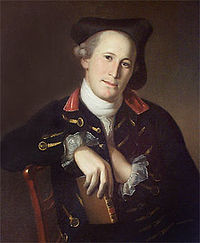
Samuel Smith as Senator


The brave captain of the Maryland 400 passed away in his city on April 22nd, 1839. His funeral was a tribute to one of Maryland and Baltimore's greatest, as well as one of America's earliest patriots.

One of his biographers reminds us that these last rites were:

"...a tribute to the political achievements of the man who represented his State in the national legislature through the administration of seven presidents. As the procession reached Baltimore Street and turned east along the waterfront, the ships in the Patapsco lowered their colors to half-mast for the merchant whose ships had known the ports of the world from Europe to China. And as the throng of citizens watched the hearse with its military escort ascend Hampstead Hill, the guns of Fort McHenry boomed a final salute..."

Samuel Smith's life was noteworthy and well-lived by any measure. The former Captain of the Maryland 400 became one of the most popular and accomplished men of his time, although sadly, he enjoys little fame today. First Patriot Samuel Smith is buried at the Old Western Burying Ground, at the intersection of Fayette and Greene Streets, Baltimore, Maryland.


Samuel Smith Burial Site


Saturday, February 20, 2016

The Maryland Line

Who Were These Guys?


Few Americans (sadly) know much about the eight-year American War for Independence. Likewise, few of the war's units have resonated with the public, other than perhaps the Minutemen, Dan Morgan's Rifle Corps, and maybe "Swamp Fox" Francis Marion's partisans. However, at the time, contemporary writers and some members of the public were aware of the exploits of the Continental Line units. These specially formed regiments, drawn from the states by order of Congress, were the closest thing to regulars Washington had to face the highly professional British and Hessians. I intentionally placed my protagonists in the Yankee Doodle Spies series within one of the most renowned units of the American War for Independence - the Maryland Line. With George Washington's birthday upon us, it is fitting to present the story of one of his favorite units of the war.


The Formation of a Fighting Machine


The 1st Maryland Regiment (Smallwood's Regiment) originated with the authorization of a Maryland Battalion of the Maryland State Troops on the 14th of January 1776. It was organized that spring at Baltimore, Maryland (three companies) and Annapolis, Maryland (six companies) under the command of Colonel William Smallwood. The regiment was established with eight line companies (fight shoulder to shoulder) and one light infantry company (fight like Indians) from the northern and western counties of the colony of Maryland.  On 6 July 1776, the Maryland Battalion was assigned to the main Continental Army. On 12 August 1776, it was assigned to Stirling's Brigade and five days later (17 August 1776) adopted into the main Continental Army. The regiment was well-equipped and was one of the few American units to have bayonets, a key factor in its later performance. The regiment was also well trained and disciplined. Arguably the best outfit in the Continental Army at the time.


William Smallwood


Laurels on Long Island


The Maryland Regiment had joined the Continental Army barely two weeks before the Battle of Long Island. When the British under Cornwallis surprised the Americans by circling around their rear, Stirling ordered all forces, other than the Marylanders, who were outside the fortified position on Brooklyn Heights, to retreat there, leaving behind himself and four companies of the 1st Maryland and Haslett's Delaware Regiment.  Stirling led these men against Cornwallis' 2,000 British soldiers who were massed around the Old Stone House, a thick-walled field-stone and brick.


Long Island


The Marylanders charged the British forces six times to give their comrades time to make their way to safety with the rest of Washington's army in the Heights. Twice, they managed to drive the British from the house, but as more British reinforcements arrived and the Marylanders' casualties mounted, they finally had to give up the assault and try to get to safety themselves. “Good God, what brave fellows I must this day lose,” Washington remarked to Israel Putnam as he witnessed the Marylanders repeatedly charge Cortelyou House, effectively holding back the British advance. Later, Washington described their efforts as an "hour more precious to American liberty than any other."

Only Major Mordecai Gist and nine others managed to reach the American lines. Note and spoiler alert - this is a critical scene in The Patriot Spy, where Lieutenant Jeremiah Creed leads some of his men and Gist to safety. Washington witnessing this fighting withdrawal gets Creed assigned to special intelligence missions.


Mordecai Gist


Back to the story: Of the others, 256 lay dead in front of the Old Stone House, and more than 100 were wounded/and or captured. The dead patriots were buried in a mass grave consisting of six trenches in a farm field. The result of the brief battle was a hard blow for the Americans. More than a thousand men were killed, captured, or missing. Generals Stirling and Sullivan were  British prisoners of war. The battalion had lost more than 250 of their number. Most of the Marylanders' casualties occurred in the retreat and desperate covering action at the Cortelyou House. Ultimately, of the original Maryland 400 muster, 96 returned, with only 35 fit for duty. As few troops would stand and fight in the face of England’s battle-tested professional army, the fact that the Maryland Line functioned and operated as a disciplined unit was not lost on Washington.


Apres Brooklyn


After reorganization and reconstitution, the Maryland regiment won more laurels in the desperate actions that followed against numerically superior British forces at White Plains (October 28, 1776), where they faced Colonel Johann Von Rall's Hessians. From 10 December 1776 to January 1777, the regiment was assigned to General Hugh Mercer's Brigade.


Trenton


During the critical winter "that tried men's souls," the regiment, though much reduced in size, was at the forefront of the fighting at Trenton (December 26, 1776) and Princeton (January 3, 1777). The following year, the re-designated 1st Maryland helped defend Pennsylvania and fought at Brandywine (September 11, 1777) and Germantown (October 4, 1777).


Germantown


The battle-worn survivors of this regiment ostensibly reorganized in December 1777, continuing their enlistments “for three years or during the war.” But by the close of 1777, few remained from the original line Washington witnessed at Long Island. Bled weak by fighting in the vanguard of the war, they received reinforcements from the Maryland companies of the Flying Camp. They earned recognition for their sacrifices by a nickname bestowed by General Washington himself, "The Old Line."


Moving South


Cowpens
In 1780, the Maryland Line (the first two battalions) reorganized as the first and second Maryland and became the backbone of the Southern Department. They provided a solid cadre of "regulars" around which various militia units could rally. At the disastrous Battle of Camden, SC  (August 16, 1780), the second Maryland served on the army's flank under General De Kalb while the first Maryland formed the army's reserve under General Horatio Gates  When General Nathanael Greene was sent south to relieve the disgraced Gates, the Maryland Line served with distinction in several battles. At the end of the decisive victory at the Battle of Cowpens (17 January 1781), the Maryland Line (the 2nd Maryland) held the center of General Daniel Morgan's command. The Maryland Line also served at Guilford Court House, NC (15 March 1781), where Greene tried to stop Lord Cornwallis's invasion of that state. Although a technical loss, the Americans put up a fight and inflicted unacceptable losses on the British, making it a Pyrrhic victory.


Guilford Court House


A Faded Legacy of Honor


After the war, many members of the Maryland Line continued to maintain relationships formed during the long struggle for independence. In the last days of the war, the Society of the Cincinnati formed chapters in each of the thirteen original states. William Smallwood called for the first assembly of the Maryland Society of the Cincinnati on 20 November 1783 and Smallwood and Mordecai Gist became the first officers of the Maryland chapter of the society, which consisted entirely of officers of the Maryland Line. One of the express purposes of the society was to foster fraternal camaraderie and honor their collective military history. Effectively meeting for reunions as long as there were survivors, the first members of the Cincinnati likely cultivated and propagated the story of the old line. As the revolutionary generation dwindled, perhaps the first “greatest generation” in American history, so faded the memory of gallant service and sacrifice. Unfortunately, this would become the case for the follow-on patriots of the 19th, 20th, and 21st centuries.


Washington was the first National President of
The Society of the Cincinnati


Saturday, April 12, 2014

A Blog about a Blog?

Finding the First Maryland 400


The heading recalls the famous Seinfeld episode where they were trying to sell a TV series to NBC. The concept was a show about nothing! Of course, it was anything but that.  I was going to take a pass on doing a blog this week as it is, after all, Easter week. But I received a post from a blog I follow and I decided to review the Blog as it directly connects to The Patriot Spy, book one in the Yankee Doodle Spies series. So this week we have a blog about a blog!

The Blog


Several months ago, a Facebook friend sent me a link to a Blog established by the State of Maryland Archives.  The Archives commissioned a research project on Maryland's First Continental Line regiment called "Finding the Maryland 400."  As the Blog's home page explains:

The attack of the Maryland 400 
"During the Revolutionary War, men from all over Maryland joined the Continental Army to fight the British. In August of 1776, a group of these men under Col. Smallwood were sent to New York to help defend the city from an attack; the ensuing conflict is remembered as the Battle of Brooklyn (or Battle of Long Island). The battle was a resounding defeat for the Americans under the command of Gen. George Washington, and they were forced to retreat and give up the island. The story of the Maryland 400 goes that during  these
events, 400 of Maryland’s soldiers were sent to cover the retreat from the field and bravely threw themselves at a much stronger and better positioned British force repeatedly. Though they succeeded in buying enough time for the retreat, they suffered heavy losses, perhaps over half of their number. Who exactly these men were has remained unknown, with little to commemorate their actions in the battle."

So in the summer of 2013, the Maryland State Archives and the Maryland Military Department, Office of the Adjutant General, the Maryland Military Historical Society, and other partner groups hired some interns to research the identities of the First Patriots who served in the Maryland 400 at the Battle of Long Island. Their goal was to create an accurate list of the Maryland soldiers who participated in the battle and write biographies about some of the men. The chronicles the research progress as well as new discoveries.


The Design


The blog is well designed and appealing.  The key sections are:

William Smallwood
Updates - These are articles about individuals or events the research has uncovered or that otherwise relate to the Maryland 400. The latest discusses Larkin Dorsey, a sixteen-year-old from Anne Arundel County who enlisted in the Ninth Company of the First Maryland Regiment. Readers of The Patriot Spy might recall my fictional Lieutenant Jeremiah Creed originally commanded the Light Company but later led men from several companies, perhaps even the Ninth. Larkin's  father asked Lieutenant Colonel Francis Ware to keep an eye on Larkin Dorsey."  Apparently, such fostering was common in a time when people were linked by bonds of family and place. As the post explains... "Ware was second in command of the Regiment. Ware, who did not have children of his own, agreed to take on the responsibility for young Larkin. It should be noted that both Smallwood and Ware missed the seminal action on Long Island due to other duties and arrived at the end of the engagement. Major Mordecai Gist led the attacks.

Biographies - This is a list of members of the 400 with links to their biographies. Among them are Smallwood, Mordecai Gist (who has a role in The Patriot Spy), and Ware (mentioned above).  The biographies are listed by the company, a nice touch.

Mordecai Gist
Roster - Although not fully complete, this section provides a very comprehensive roster of those identified as members of the unit. The gaps in understanding who served and fought are explained, as is the paper and field strength of the unit when it fought. There is a search capability included.

Interactive Map - This is my favorite part of the blog. Everyone has to be somewhere and the researchers do a really nice job geospatially portraying the movement of the members of the 400 based on pension records, unit rolls, correspondence, etc. As more data is uncovered and added, this will prove a fun and easy research tool. One can note quickly, for example, that several members migrated to the reaches of Tennessee, Kentucky, Ohio, and Pennsylvania after the war, indicative of the new nation's trend west that ended (ironically) when the Brooklyn Dodgers moved to Los Angeles. The original Brooklyn Dodgers clubhouse was a building at the center of the battle in which the gallant 400 fought.


The Maryland Monument in Prospect Park


The Rating


Those who want to see for themselves (and let us know via this blog) can go to directly to the Blog, which is on Word Press (can I mention another blog platform?):  http://msamaryland400.wordpress.com/about/
You do not have to be from Maryland or even a Revolutionary War, or even a history buff to appreciate and enjoy "Finding the Maryland 400" Blog. Although still a work in progress, based on what the researchers have put together so far, and the quality of the display, I give "Finding the Maryland 400" a full Five Fifes