Followers

Showing posts with label Anthony Wayne. Show all posts

Wednesday, December 27, 2017

The Mad Man

Who was that Mad Man?


As a boy learning about the American Revolution, I found it quite amusing that a general would be called "Mad" Anthony Wayne. I wondered who that madman was and what he was so mad about. Any study of the American War for Independence should include this colorful Pennsylvanian, who captured the imagination of his contemporaries and endures through the ages.

Scion of a Scots-Irish Military Family


Anthony Wayne was born on January 1, 1745, to Isaac Wayne and Elizabeth Iddings Wayne in Easttown Township, Chester County, Pennsylvania. Isaac Wayne was born in Ireland, the son of Captain Anthony Wayne, a military officer who immigrated to America with his Dutch wife, Hannah. Their son Isaac became a tanner, establishing one of Pennsylvania's top businesses, and eventually took over the family estate, Waynesboro, from the aging captain. 

Young Anthony Wayne was well-educated, attending the Philadelphia Academy and the College of Philadelphia. Like George Washington, Wayne also worked as a surveyor, especially in Nova Scotia. He returned to Pennsylvania in 1766, where he continued surveying and worked at Isaac's tannery. He also married Mary Penrose, who bore him two children, Margretta and Isaac. 

As tensions with Great Britain increased, young Anthony became involved in the American cause. Like many emerging leaders of means, he turned to public service. Wayne served in the Pennsylvania legislature in 1774, and the next year, he raised a militia regiment in Chester County. In January 1776, he received a commission as colonel of the 4th Pennsylvania Continental Line. Things were about to get interesting for Anthony and the war.


Wayne's Home in Waynesboro


A Mad Campaigner in a Mad Campaign


As colonel of the 4th Pennsylvania, Wayne headed north to join General John Sullivan's division in the reckless and doomed invasion of Canada. In his first action, Wayne fought bravely but unsuccessfully against larger forces at the Battle of Trois-Rivieres in June 1776. 

The campaign soon fell apart, but Wayne proved himself through his leadership in guiding the army's retreat into New York. He then took command of Fort Ticonderoga, a crucial defense point on New York's northern frontier. Congress, pleased with his efforts, promoted him to Brigadier General in February 1777. Not long after, he was called south to join General George Washington and the main Continental Army, where he was given command of a brigade of Pennsylvanians.


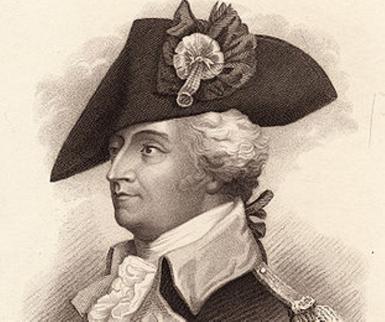
Anthony Wayne

A Colorful Character


Wayne was a vibrant and irreverent leader who seemed to set the stage for later military figures like George Custer and George Patton. He used profanity effectively, often amusing his troops. Like Patton, he understood that soldiers should look sharp and that military pride comes from a good appearance. Similar to Custer and Patton, he was always well-dressed and kept a neat appearance. His bravado added to his legend, making him a favorite subject not just among troops but also among fellow officers. And like Custer and Patton, Wayne proved himself with inspiring performances in battle.


Holding the line at Brandywine


Although Washington was defeated, he managed to extricate his army and keep it as a threat to the slowly advancing British forces. When the Americans abandoned Philadelphia, Washington sent Wayne to shadow the British army and threaten their lines of communication. 

Unfortunately, the British received intelligence that revealed Wayne's position. Wayne's encampment near the Paoli Tavern was overrun in a stealthy night attack by Major General Charles Grey on the evening of September 20th. Grey earned the nickname "No Flint" because he ordered his men to remove their flints to avoid accidental discharges that could spoil his surprise: cold steel for the rebels. Later, claims emerged that the British took no prisoners and granted no quarter, leading to the engagement being known as the "Paoli Massacre." 

The massacre tarnished Wayne's reputation somewhat. Undaunted, he led his men across the fog-shrouded fields near Germantown, Pennsylvania, on October 4, 1777. With typical audacity, Wayne's command advanced ahead of other Continental brigades and pressed on the retreating British with the bayonet. However, Wayne and his old commander, General John Sullivan (also known to be headstrong and impetuous), advanced too quickly. Both were cut off about two miles ahead of the other Continental regiments. 

When the British regained their composure, their defenses stiffened. When Washington finally ordered a retreat, he once more called on Wayne to provide the rear guard. Not long after, the Continental Army went into winter quarters at Valley Forge.


Despite  the Paoli Massacre, 
Wayne was held in high regard


The harsh winter at Valley Forge had a silver lining. A new American army was born, trained, and drilled to fight in European style by German General Von Steuben. This new army would get its chance to prove itself the following summer, and Wayne would be in the mix once again. The British relieved Lord Howe of his command and replaced him with Sir Henry Clinton, who decided to abandon Philadelphia and concentrate forces once more around New York City. 

In June 1778, Clinton ordered half of his forces to sail north. However, a sizable column marched across New Jersey toward their new base of operations. Wayne was called upon to lead the advance guard at Monmouth Court House, New Jersey. Once again thrust into a controversial engagement, Wayne's forces were abandoned by Major General Charles Lee. His men were soon pinned down by superior British forces, a rearguard that struck back at the pursuing Americans. Demonstrating determination and resourcefulness under fire, Wayne held his ground until reinforcements sent by Washington arrived. Wayne reorganized his troops and continued fighting.


American attack at Monmouth


Light Anthony


By the spring of 1779, Washington's Army focused on the main British garrison in New York. The British tried to lure Washington into a decisive battle. Awaiting anticipated French support, Washington played a game of cat and mouse. 

In May 1779, Sir Henry Clinton, the British Commander in Chief, launched the first phase of a complex plan to destroy Washington's army. Using their superior naval forces, the British moved up the North (Hudson) River and took the strategic position at Stony Point, about 10 miles south of West Point and 35 miles north of New York City. 

This move aimed to draw Washington out of the Hudson Highlands. Clinton then sent an expedition to Connecticut, leaving a reinforced regiment with fifteen guns to defend the earthworks around Stony Point. Washington observed the British defenses and decided to take them by force. 

To accomplish this, the Corps of Light Infantry was formed on June 12, 1779. There was no doubt who would command the unit or the mission: Anthony Wayne. The Corps of Light Infantry was an elite unit assembled for campaigns from 1777 to 1781. Its members came from the light infantry companies of each regiment in Washington's army. 

In 1779, the Corps consisted of a brigade of four regiments, each with two battalions of four companies. At midnight on July 16, the attack began in three columns, with Wayne personally leading one. In a tactic successfully used against him at Paoli, Wayne had his men advance with unloaded muskets, ready to storm the defenses with bayonets. Wayne's column came under musket fire, and he was wounded. Nevertheless, Wayne's men pressed on and quickly overran the British defenses. They captured over 500 prisoners and suffered only 100 casualties. 

This victory boosted the morale of the American Army and the cause, which had suffered setbacks. For his heroism and tactical success, Congress awarded Wayne a rare medal in recognition of the victory.


Stony Point was Wayne's most celebrated exploit


Why so Mad?


I always thought Wayne was nicknamed "Mad" because of his heroics in battle, especially for his actions at Stony Point. However, ironically, he didn't earn his nickname for his reckless fighting style; instead, it came from an incident in Morristown, New Jersey, during winter quarters in 1781. 

The story goes that New Jersey law officers detained an eccentric soldier known as “the Commodore” or “Jimmy the Drover” for a minor civil infraction. The soldier asked Wayne for help, but Wayne threatened to have the troublemaker whipped instead. “Jimmy the Drover” supposedly responded, “Anthony is mad! Farewell to you; clear the coast for the Commodore, ‘Mad Anthony’s’ friend.” Wayne’s Pennsylvanians really enjoyed the story and decided that “Mad Anthony” was a fitting nickname for their leader. You have to admit, it’s not a bad nickname.

 Winning the War


In the spring of 1781, Wayne led his Pennsylvanians into Virginia and served under Lafayette to help stop the British. On July 6, 1781, he fought alongside Lafayette at the Battle of Green Spring. His aggressive charge surprised the larger British forces, probably saving the Americans from defeat. Wayne then joined Washington to help defeat Cornwallis at Yorktown. 

However, the war did not end there. In 1782, Wayne was sent to Georgia to help drive out British forces. He broke the longstanding British alliance with the Indian tribes in Georgia. As British power declined, he managed to negotiate treaties with the two strongest tribes, the Creek and the Cherokee. As a final honor, Congress promoted him to major general on October 10, 1783. 

After the hostilities ended, Wayne went back to Pennsylvania. The well-known war hero served in the Pennsylvania Assembly and was a delegate to the Constitutional Convention. But after the war, his life was focused on peace and quiet, as it was for many of his peers.

Commander of the US Army


Wayne, as Commander of the
Legion of the United States
In 1792, it was time for Anthony Wayne to answer the bugle call once again. 

President George Washington appointed Wayne as commander-in-chief of the modest U.S. Army, known as the Legion of the United States. The Legion had suffered several defeats at the hands of the intertribal Indian Confederation formed to resist white encroachments into the Ohio Territory— the Midwest. 

The Indian Confederacy decisively defeated U.S. forces in 1790 and 1791 under the leadership of Shawnee chieftain Blue Jacket and Miami chief Little Turtle. The Indians had been supported and supplied by the British, who refused to evacuate British fortifications in the region as stipulated in the Treaty of Paris.


Wayne's victory at Fallen Timbers was the new
Army's first post in the RevWar


Upon his arrival, Mad Anthony energized the beleaguered Legion with his own passionate leadership. At the Battle of Fallen Timbers, Wayne decisively ended Indian resistance when his experienced force of 1,000 men routed the 2,000 warriors assembled for a final showdown near Fort Miami on the Maumee River. 

This victory allowed Wayne to negotiate the Treaty of Greenville in August 1795. Under its terms, the Indians ceded most of Ohio and large parts of Indiana, Illinois, and Michigan. This outcome was not guaranteed for many reasons (British schemes aimed to keep the 13 states along the Atlantic coast). Wayne's victory secured thousands of square miles of disputed land for the United States and led to signed peace treaties with the Indian tribes. Mad Anthony Wayne successfully completed the mission for which President George Washington had called him back to active duty.


Treaty of Fort Greenville secured peace in the
 Northwest Territory and American expansion


Untimely Death


Having finished his work in the northwest, Wayne started the long journey home. He sailed from what is now Detroit on a sloop. After five days, he reached the site of the old French outpost at Fort Presqu'Isle, now known as Erie, Pennsylvania. Though the weather was nice, his thoughts grew darker, and he wrote several letters about his final wishes. 

At Presque Isle, Wayne had a serious gout attack. Anyone who's experienced gout knows that’s enough reason to be upset. This was clearly a severe case with complications. Urgent calls for doctors were sent to Pittsburgh and the Army hospitals. Wayne's health kept getting worse as he developed intense stomach pains. The doctors from the east arrived, but on the same day, December 15, 1796, "Mad" Anthony Wayne died. He was buried in a simple coffin, with his initials and date of death carved into the wood using round-headed brass tacks, at the foot of the blockhouse flagstaff on garrison hill.


Rebuilt blockhouse on Presque Isle

A Strangely Eerie Homecoming

In 1808, Wayne's son Isaac returned to Presque Isle to take his father's remains back home. 


Unfortunately, he lacked enough space for all the remains in his small, sulky wagon. The doctor helping him boiled the late hero's corpse, then returned the flesh and clothing to the coffin and reburied it. He then packed the bones for transport to the east. "Mad" Anthony Wayne's bones were buried in the family plot at St. David's Episcopal Church cemetery in Radnor, Pennsylvania. The strange end to the great warrior's earthly remains gave rise to legends of hauntings. One could say that while Anthony Wayne may have become enraged for little reason in life, he certainly had a reason for anger in death.


Wayne's 2d Gravesite Radnor, Penna.


Sunday, July 17, 2016

The "Little Gibraltar"


Command of the Hudson


After a summer of inaction following the Battle of Monmouth in June 1778, the British commander in chief in North America, Sir Henry Clinton, received orders the following winter “to bring Mr. Washington to a general and decisive action.” To that end, in May 1779, Clinton assembled about 6,000 men at Kingsbridge (the Bronx) in preparation for a quick strike on West Point, considered the "key to the continent." The series of fortifications at West Point controlled the Hudson River and prevented the British from cutting off New England from the rest of the colonies. Twelve miles south was Stony Point, a fortified peninsula jutting half a mile into the river and rising 150 feet above it. Directly across the river from Stony Point lay Verplanck's Point, with a garrison stationed at Fort Lafayette.


British General Sir Henry Clinton


British Strike North


On 30 May Clinton's forces sailed north on 70 ships commanded by Commodore George Collier. The 40-man American garrison at Stony Point, seeing the much larger force approaching, burned the blockhouse and abandoned the defenses without firing a shot. On the east bank of the Hudson, the other American garrison was less fortunate. Seventy North Carolina Continental troops were trapped and forced to surrender. Sir Henry ordered both forts' defenses to be heavily reinforced. At Stony Point, this was done by felling trees and constructing an earthen fort along with two barriers called abatis. Additionally, two British ships provided extra protection. The defenses at Verplanck’s Point, across the river, were fortified with troops ready to reinforce Stony Point if needed. British control of the water greatly favored them. Clinton garrisoned both forts with a total of 1,000 men, while the rest were sent on raids into Connecticut.


The British believed their defenses were secure, referring to the new fort as “Little Gibraltar.” To defend "Little Gibraltar," they had a garrison of about six hundred men, including the 17th Regiment of Foot, the Grenadier Company of the 71st Regiment, a company of the Royal Americans, and a small detachment of the Royal Artillery, all under the command of Lieutenant Colonel Henry Johnson of the 17th Regiment. 

Stony Point was a natural fortress, and with these reliable troops continually strengthening their position, Clinton had no concerns for the post’s safety. He later wrote, "entertain the smallest apprehension that any attack the enemy could make against that place…could possibly be attended with mischief before I should be able to afford them assistance." 

The British aimed not only to control the Hudson to divide the rebellious colonies but also to draw out George Washington's Continental Army, which was positioned between Philadelphia and New York around Middlebrook, New Jersey. A move on West Point was intended to accomplish this. Clinton's strategy favored the initiative, interior lines, and the advantage of quick reinforcement and water movement.


General Anthony Wayne


Washington Reacts


Now, with the British move, Washington hurried north to meet the new threat. When Washington arrived in the area, he was concerned that losing Stony Point posed a serious threat to the Hudson River and the routes to West Point. When intelligence reports indicated that the defenses were not yet finished, he quickly decided to attack. He had just the man for the job: Brigadier General Anthony Wayne. 

Wayne was a tough, bold leader of men—crafty and fearless. He once said he was "ready to take hell." Wayne conducted a "leader's" reconnaissance of the position and then a second with Washington accompanying him. Both agreed that a siege or a direct storming of the fort would be impractical; instead, he should seize the fort quickly with a surprise attack, a coup de main. 

Wayne commanded the Light Division, an elite group selected from regiments of Continental infantry. He organized his assault force into three columns totaling 1,350 men. They set out on July 15, 1779. For eight hours, they navigated narrow mountain trails, detaining civilians along the way to avoid detection. When the soldiers reached Sprintsteel’s farm, two miles from Stony Point, they were told about their mission for the first time. 

Three columns would lead the Continental forces: one of 300 men would march through the Hudson River from the north; a second, led by Wayne, would cross Haverstraw Bay from the south. Each of these two columns would consist of three parts: the first would be a group of twenty men known as "the forlorn hope," tasked with entering enemy lines first, overcoming sentries, and cutting through the abatis; the second, an advance party, would seize the fort's works; and the third, the main body, would move around the unfinished back of the fort and approach from the river.


Famed Night Attack


Light Division meets British regulars
with cold steel
The forlorn hope moved out around midnight on July 15-16. It was a moonless night, and they reached the British defenses without being detected. Wayne, learning from his humiliating defeat at Paoli, had the men in his columns remove their flints and advance with fixed bayonets. One of the columns, a diversion under Major Hardee Murfee, attacked the British center and drew away several companies of Lieutenant Colonel Henry Johnson's 17th Regiment. 

Murfee's men did have flints and powder, as their mission was to attract the defenders' attention. With the diversion underway, Wayne's column and the second column under Colonel Richard Butler scaled the heights and overran the defenses. Despite their surprise, the roughly 600 British defenders fought back as professionals and resisted fiercely. The fighting was hand-to-hand and brutal. After 30 minutes, the fort fell. 

The British lost 63 killed, 70 wounded, and the remaining 543 captured, along with twelve guns. The American attackers lost 15 dead and 83 wounded. Wayne sustained a head wound early in the attack but continued to lead his forces. 

Earlier, the fiery Wayne had offered a bounty to the first man to enter the enemy works. The winner of the award was an officer named François Louis Teissedre de Fleury, who had come to America from France and had served bravely in previous battles, rising to the rank of captain of engineers. The "Little Gibraltar" on the Hudson had fallen to Yankee stealth, daring, and courage - with some Gallic help.


Wounded early, Wayne continues leading the attack


The Value?


The symbolic significance of Stony Point led the Continental Congress to award three medals out of the ten struck during the War for Independence - gold for Wayne and silver for de Fleury and Major John Stewart, who commanded the advance party of the left column. The British responded to the bold attack by reinforcing the fort at Verplanck's Point and sinking an American ship that was transporting some of the twelve captured guns from Stony Point to West Point. 

Once Verplanck's Point was secured, the strategic importance of Stony Point was diminished in Washington's view. He also recognized that Wayne's assault showed the position was not as easily defensible as previously thought. As a result, he ordered the fortifications to be reduced and Wayne's men to withdraw on the 18th. The British reoccupied the point on the 19th. Although the operation lacked significant strategic value, it greatly boosted morale by demonstrating the improving fighting skills of the American Army. 

In addition to the Congressional medals, the battle was noted beyond American shores. Edmund Burke's Annual Register (a British publication that summarizes politics, history, and literature annually) for 1779 stated that the action "would have done honor to most veteran soldiers." The French Ambassador in Philadelphia remarked, "I am convinced this action will elevate the ideas of Europe about the military qualities of Americans..."


General Anthony Wayne during the Assault


Stony Point apres War


In 1826, Stony Point became the site of a lighthouse built to guide ships through the narrow passage of Haverstraw Bay at the southern end of the Hudson Highlands. During its 99 years of operation, only one vessel ran aground, with no reported fatalities – a testament to the vigilance of the lightkeepers. A new light tower was constructed in 1926 at the water’s edge (not accessible to the public) and continues to serve as an aid to navigation under the care of the United States Coast Guard. 

The 1826 Lighthouse is now a historic site, symbolizing the significance of the Hudson River maritime community to New York's development. Today, the grounds of Stony Point feature a mix of woods and well-maintained lawns, offering commanding panoramic views of the Hudson River, looking north to the Hudson Highlands and south to Haverstraw Bay. 

There is a site museum displaying some of the captured guns and other artifacts from the site’s past military engagements and soldiers' camp life. The artifacts, including an authentically reconstructed mortar bed for a captured 8” mortar and a stand of period bayonets, are arranged around a diorama depicting Stony Point as it appeared on the night of the attack.


Stony Point Light House


Sunday, January 24, 2016

Quinton Bridge

A Second Forage War


Mad Anthony Wayne


The winter of 1777-1778 was especially tough for the Americans, but both sides often sent out significant forces to forage for their own troops and to disrupt the other's foraging efforts. On February 19th, 1778, with the Continental Army desperately needing supplies, Brigadier General "Mad" Anthony Wayne led a force across the Delaware River south of Philadelphia on a foraging mission through southern New Jersey. General Howe responded by sending about 4,000 men to disrupt Wayne. However, Wayne moved quickly north, collecting provisions, forcing residents to move supplies he couldn't take, and occasionally skirmishing with the British pursuing him. Howe sent another force in March under Lieutenant Colonel Charles Mawhood to forage and try to force Wayne into a fight.


Lord Howe


Simcoe


British Move into the Jerseys


On March 17th, Mawhood led a force of 1,200 British regulars and Loyalist companies of the New Jersey Volunteers, along with John Graves Simcoe's Queen's Rangers, across the Delaware River into Salem County, New Jersey. Scouts alerted Wayne to the British movement. He had finished his work and was preparing to return to the Continental Army encampment at Valley Forge.


19th Century Map of Salem Co.


Americans Defend


Alloway Creek in Salem County served as a natural line of defense. The local militia, who were very active in NJ, quickly established strong defensive positions at the two crossings nearest the Delaware River—Quinton's Bridge and Hancock's Bridge—after learning of the British movement, to prevent crossing attempts. Mawhood led his force to Salem, where they were met by local Loyalists who informed them that Colonel Benjamin Holmes, along with 300 militia, was at Quinton's Bridge, only three miles (4.8 km) to the southeast. Holmes had positioned his forces on the north side of the bridge and had taken up the bridge's planking to block easy passage.


The Militia had good positions along  the creek

Ruse de Guerre


Before dawn on March 18th, Mawhood moved several detachments of men into position on the side of the creek opposite the American forces. Captain William Smith was the senior officer with 300 local militiamen under his command defending the area around Quinton Bridge. Mawhood realized the rebels held strong defensive positions behind the creek, so he devised a plan to draw out the patriots. Under cover of darkness, the British concealed small detachments of the 17th and Simcoe's Rangers in and around Weatherby's Tavern on the Salem side of the creek, just northeast of the road. On the morning of the 18th, Mawhood baited his trap by ordering an element of the 17th Foot to stage a retreat toward Salem.


Simcoe's Queen's Rangers


Punked Patriots


The rebels fell for the trap. Captain Smith left one-third of his troops to defend the defenses while he led about 200 men across the creek in what turned into a chaotic chase. Without proper flank security, the militiamen headed up the road past the tavern. When they had gone roughly two hundred yards beyond the bridge, the British and Loyalists opened fire from all directions. Surrounded by a hail of musket balls from the front, sides, and back, they panicked and ran toward the creek for safety. However, they left around 40 of their comrades dead in the crossfire. Additionally, some of the fleeing patriots drowned trying to cross the creek. One patriot, Andrew Bacon, risked the


Smith's Militia Retreating (Rare color photo!)

Frustrated British


By that time, help arrived in the form of Colonel Elijah Hand's militia and two cannons. They reinforced the south side of the creek. Frustrated, Mawhood pulled back his forces and moved on to another objective—Hancock's Bridge—before ultimately returning to Philadelphia. The engagement at Quinton's Bridge was small but typical of the war. There was no clear winner or loser. The significant loss of lives was balanced by the quick reinforcement of the creek and Mawhood's decision to seek his luck elsewhere.

Saturday, September 20, 2014

Middelbrook

Background


Nestled at the start of the Watchung Mountains in New Jersey is the colonial town of Middlebrook. During the time of the Yankee Doodle Spies, Middlebrook was a small village northwest of Bound Brook. Although the village of Middlebrook no longer exists, it has been absorbed into the town of Bound Brook. During the American Revolution, this small farming community sat along the route of two armies engaged in more than just a fight for a continent – it was a struggle for ideas. For the Continentals, it was a fight for a new nation and a new concept of government. For the British Army, it was a fight to preserve the old order and the rights of a King.


Good ground


Gen Washington at Princeton
General George Washington had marched past Middlebrook after the Battle of Princeton on his way to Morristown in January 1777. Its advantage as a strategic position did not go unnoticed by the former surveyor. Late in the spring of 1777, Washington moved his small army of about 7,000 from their winter encampment at Morristown to Middlebrook Heights. 

Why? The ground was good, enabling the Americans to observe the British troops at New Brunswick and Perth Amboy. He moved Anthony Wayne's Brigade onto the forward slopes to defend the approaches to the pass. The Americans fortified the already defensible terrain. From these positions, Washington could keep watch on the British garrisons in New York and New Brunswick. But even better, it gave him a position to flank the British if they attempted to cross New Jersey to Philadelphia.


Battleground


However, the British also recognized the strategic advantages of the positions around Middlebrook for the rebels. So on the night of June 13th, 1777, General Lord Cornwallis moved out of New Brunswick, hoping to lure Washington out of his Middlebrook defenses into the open flat land for battle. With Hessians leading his columns, Cornwallis launched a four-pronged attack on the village. Washington responded, but not in the way the British had hoped. 

The commander-in-chief sent the militia, reinforced with some Continentals, to harass the enemy columns. However, most of the Continental Army stayed in their secure positions. By the end of June, a frustrated Cornwallis and his British forces retreated to Staten Island. The British maintained ground near New Brunswick, the Amboys, and at Paulhus Hook (Jersey City), but much of the rest of Jersey was a no man's land where Loyalist and Patriot factions, militias, and criminal elements from both sides fought. Middlebrook was at a critical point in this no man's land.


Lord Cornwallis

Observation point


The attack on Middlebrook, along with other forays and feints, caused General Howe to change his strategy. The British commander-in-chief launched a naval operation toward the Chesapeake to capture the rebel capital at Philadelphia from the south. Most of the British regiments left their fortress in New York for a combined sea-land campaign aimed at driving the rebels from their capital, but they left British General Burgoyne's army to struggle in the wilderness of upstate New York. 

Thus, the small engagement at Middlebrook played a crucial role in a chain of events that helped alter the course of the war. Recognizing the need for a new plan for the 1778 summer campaign, the British abandoned Philadelphia and again focused on New York. Washington struck from the rear, and the largest pitched battle of the American Revolution took place at Monmouth. When the British column retreated to its secure zone around New York and nearby areas, Washington once more used the Middlebrook region as a base to observe and threaten the British.


Winter Encampment


In November 1778, George Washington once again moved the army back to the Middlebrook area. It provided a natural defensive position and allowed him to monitor the British foothold in New Jersey. Washington established his headquarters at the Wallace House in what is now Somerville. 

The main army, made up of brigades from Virginia, Maryland, and Pennsylvania, along with the Delaware regiment, the artillery corps, and support units, camped along the base of the Watchung Mountains. There, they benefited from some shelter from the weather, abundant trees for construction and firewood, and support from a mostly patriotic local population and an active militia. Fortunately, the winter was relatively mild. The Continental Army stayed at the second Middlebrook encampment until late June 1779. That winter at Middlebrook would later be known for a symbolic event.


First Flag


There is an interesting footnote to the story of Middlebrook. On June 14, 1777, Congress adopted the Flag Resolution, establishing the famous Betsy Ross flag as the national flag of the United States. An official flag was brought from Philadelphia to be flown at the Middlebrook encampment before the soldiers took the field for the summer campaign season. 

In an act of great symbolism for the young and struggling nation, the first thirteen-star American flag was flown at an American army base. One wonders what the beleaguered but determined soldiers would think if they could see into a future where their descendants would champion the very ideas they fought for in campaigns across the globe. Or a future in which the flag they flew over Middlebrook would be flown as a symbol of liberty at hundreds of army bases across the yet unexplored continent and later on scores of foreign shores.


Flag at Middlebrook Encampment