Followers

Showing posts with label New Jersey. Show all posts

Sunday, June 28, 2020

Scotch Willie


The Winter Spy, the next book in the "Yankee Doodle Spies series," introduces some new characters, both real and fictional. This post highlights one of those historical figures, an acerbic, two-fisted Scots-Irishman who seemed to tick off everyone but was often called upon when there was fighting to be done and battles to win.


Our subject is William Maxwell, who hailed from County Tyrone, Ireland. Born in 1733, young Maxwell emigrated to the colonies with his parents in 1747, settling in what was then Sussex County, New Jersey. Little is known of his early life until he followed the drum and enlisted in the provincial forces when the French and Indian War erupted in 1754. 


Maxwell played a key role in the 
 Winter Spy


The 21-year-old Maxwell was with Braddock's forces during the disastrous defeat at the Monongahela River in western Pennsylvania. But the brave Maxwell survived the massacre and continued service to King and Country, first as an ensign in Col. John Johnson's New Jersey Regiment and later as a lieutenant in the Jersey Blues.  


Maxwell was under arms during the 1758 campaign and the British defeat by General Montcalm at the Battle of Carillon (Fort Ticonderoga). But two disasters did not lead to three. Third time's a charm - he participated in the decisive British victory on the Plains of Abraham and the fall of Quebec in 1759. 


French Victory at Fort Carillon


The drum and musket seemed to become our fiery Irishman. The end of the war saw him remain in the service of the crown. He was posted to the western frontier (Britain now had a larger empire to guard). Over time, he rose to the position of commissary officer at Fort Michilimackinac. This highlights Maxwell's administrative talent, as he was responsible for purchasing and delivering the army's supplies.


When tensions between the colonies and the crown increased, Maxwell firmly supported the rebellion. He resigned his commission and moved east. Wanting to join the cause, he returned to his now adopted colony of New Jersey and actively participated in its political scene. Maxwell was appointed to the provincial Congress and eventually became Chairman of the Committee of Safety. This position utilized his military experience, as Committees of Safety were responsible for arming and preparing the colonies for potential war.


Shot Heard 'round the World:
Lexington turned insurgency into rebellion


 The shot heard 'round the world in April 1775 resonated loudly in the Jerseys, and the call to arms was answered. Maxwell abandoned his political role for a military one, this time to defend his adopted country. In November of that year, he was appointed colonel of the 2nd New Jersey Continental Line infantry. His field service would come quickly and intensely.  


Continental Line Infantry


A late 1775 campaign to win Canada for the American cause was faltering. So, in the spring of 1776, he joined General John Sullivan’s expedition to bolster American forces in Canada. He fought under General William Thompson in the battle at Trois Rivieres on June 6, 1776. Although he endured another defeat, he was now a highly experienced field commander, and there was more fighting to prevent the shattered army from falling apart during its retreat back to New York. 


General John Sullivan


Like many military men of the war, Maxwell was quick to feel slighted, especially regarding his achievements. When Colonel Arthur St. Clair was promoted to brigadier general ahead of him, he bitterly wrote to Congress. He was also outspoken against the commander of the Northern Department, General Philip Schuyler, and his plan to abandon the French fort at Crown Point, New York, to the advancing forces of General Guy Carleton. Crown Point is just north of Ticonderoga on Lake Champlain. Perhaps he felt some resentment at witnessing another defeat on the lake.


Fort Ticonderoga


But Maxwell received good news when, on 23 October 1776, he was also appointed brigadier general. The promotion brought him back to the Jerseys, this time serving under General George Washington at the very end of the New Jersey campaign. His knowledge of the Jerseys kept him in active service, screening against British inroads after the successful one-two punch Washington dealt at Trenton and Princeton. 


The American attack on Trenton


The Continental Army settled into winter quarters at Morristown, New Jersey. During the winter of 1777, he led a mix of continental and militia units in a series of forage fights. He demonstrated the ability to orchestrate quick strikes, utilize intelligence and terrain, and secure victories. The British suffered heavy casualties during a period when they were supposed to rest and recover. 


Maxwell struck at British forays for food throughout the Winter


Maxwell was proving to be a brave combat officer, but there were some murmurs about his personality and habits. His taciturn demeanor and thick Ulster accent earned him the nickname, “ScotchWillie.” 


Brigadier General William Maxwell


In the spring, Maxwell received a high command and took control of the Light Infantry Brigade. This elite unit included carefully selected men from every regiment in the army. The brigade was intended to fill the gap created when Colonel Daniel Morgan's riflemen were sent to northern New York.


Maxwell's Light Infantry Brigade was an elite corps


Not for the last time, Maxwell was thrust into the spotlight. Charged with guarding the British advance, he skillfully led his men at Cooch's Bridge, Delaware, on September 3, 1777. This was the first skirmish in General William Howe's crucial campaign to capture the rebel capital, Philadelphia. Maxwell's troops fought bravely until outflanked by Hessian enemies and forced to retreat by stronger forces. This battle was reportedly fought under the new “Stars and Stripes” flag recently adopted by Congress. 


 Cooch's Bridge


Maxwell performed well at Brandywine and Germantown that fall, although he was accused of excessive drinking. A court of inquiry proved inconclusive, so he returned to Valley Forge that winter, leading a newly recruited New Jersey brigade. The following summer, Maxwell’s troops were heavily engaged at Monmouth in August 1778, and he later testified against General Charles Lee at his court-martial for abandoning his post.


At Monmouth, Washington rallied the Army when
General Charles Lee mishandled the advance guard


In the summer of 1779, Maxwell again joined General Sullivan, this time for his controversial punitive expedition into the heart of Iroquois territory in central New York. Sullivan specifically requested his services. His brigade played a key role at the Battle of Newtown. Maxwell did not disappoint, and in August, when Sullivan fell ill, he temporarily took command of the entire army. 


Battle of Newtown, Sullivan's Iriquois Campaign


That fall, Maxwell returned to the Jerseys with his brigade. In June 1780, he proved crucial in organizing troops and militia. With his forces now deployed to defend the Continental Army base at Morristown, they played a key role in resisting the advance of British and Hessian units at Connecticut Farms and later Springfield. 

At Connecticut Farms, on June 7, his men successfully delayed the advance of General von Knyphausen's six thousand British and Hessian troops. Maxwell was able to harass and slow the enemy's advance while inflicting roughly an equal number of casualties. Frustrated, von Knyphausen ultimately withdrew. 


Maxwell delayed the British-Hessian
forces at Connecticut Farms


A few weeks later, von Knyphausen launched another attack, his column clashing with Maxwell’s brigade and once again covering the army’s advance. Maxwell continued to fight a delaying action, giving the American commander, General Nathanael Greene, time to set up his defenses around Springfield. When Maxwell took command of one of the reserve wings, Greene managed to repel von Knyphausen, who then retreated back to Staten Island. These were among the last actions in the north, as the British shifted their focus to a southern strategy.


Around this time, Maxwell was troubled by various issues. He was worried about the shrinking size of his brigade due to failed enlistments and a wave of mutinies in the Army. Tensions with subordinate officers also weighed heavily on him. Additionally, he had become dissatisfied with the lack of recognition. He urged General Washington to send his resignation to Congress, possibly incorrectly believing he could secure a promotion. However, the plan backfired when it was accepted, and command of the New Jersey troops passed to Colonel Elias Dayton, who had supporters both in and out of the army.


Elias Dayton succeeded Maxwell
as Brigadier General


In a petition to Washington, Maxwell tried but failed to secure reinstatement. Politics had caught up with Scotch Willie. Dayton now held his former general officer position, and Congress was not willing to demote him. With his military career over, Maxwell turned back to politics. In 1783, he served a term in the New Jersey state legislature but otherwise failed to make a mark and returned to his farm at the end of the term. The hard-drinking Maxwell died at Lansdowne, New Jersey, on November 4, 1796.


ScotchWillie's Grave

  
Scotch Willie falls into an interesting group of Revolutionary War commanders: not brilliant, flawed, but competent, brave, and resolute. Sullivan himself and Lord Stirling fall into the same category. Yes, they are overshadowed by the likes of Nathanael Greene, Henry Knox, Anthony Wayne, and the Marquis de Lafayette. But they served in key posts, in key campaigns, and brought enough leadership and success to keep the cause alive during some of its toughest moments. 


Sunday, January 27, 2019

The Militia General


The Militia General: Philemon Dickinson


The role of the militia during the fight for independence was uneven. For various reasons, militias were often unreliable and poorly equipped. But mostly, they lacked strong leadership. However, Philemon Dickinson stood out as a leader any Continental soldier would be proud to follow. Like the militia, Dickinson embodies understated service and quiet achievement. Unlike many militia units, Dickinson was consistently dependable. Like the militias he led, Dickinson always kept one eye on the home front.


Philemon Dickinson


The Making of a Citizen


Philemon Dickinson was born at Crosiadore in Talbot County, Maryland, on April 5, 1739. As the son of a local judge, he was also the younger brother of fellow patriot and signer John Dickinson. After graduating from the College of Pennsylvania (now the University of Pennsylvania) in 1759, the younger Dickinson briefly worked as a clerk at his brother John’s law office. However, he soon left the profession and began managing their father’s estates. In 1767, he married Mary Cadwalader, a member of one of the area's most prominent families. The couple moved to a farm just outside Trenton, New Jersey. 


Dickinson attended the College of Pennsylvania


A Call to Arms


With a family involved in revolutionary politics, it was natural that Philemon would eventually take part alongside his older brother John. In 1775, he was offered a colonelcy in the Hunterdon County militia, and he quickly accepted. By October of the next year, he had been promoted to brigadier general and also served in the state’s provincial congress. During the Continental Army’s retreat across the Jerseys in 1776, Dickinson proved to be a valuable asset to the beleaguered George Washington. His performance under fire at Trenton in December 1776 was especially noteworthy. There, the tough militia general ordered his own house to be shelled during the heat of battle after learning it was an enemy command post.


The American attack on Trenton


Kicking Off the Forage War


On January 20, 1777, Dickinson led a combined force of 350 Jersey militiamen and 50 Pennsylvania riflemen in a daring attack against a British foraging party of about 500 Regulars and Hessians. Dickinson divided his force into two groups. His brave men waded through the icy waist-deep Millstone River and ambushed the enemy during a running gun battle that forced them back to their base at New Brunswick. Dickinson’s men seized thirty-six supply wagons and over 100 horses. This was perhaps Dickinson’s most notable single battle where he was in overall command. 

The bold assault sent shockwaves through the British command because, although they claimed it was a successful rearguard action, it proved that the militia was not going home for the winter. Instead, these citizen soldiers (along with some Continental troops) opted to stay and fight an enemy eager for “winter quarters.” The skirmish set the tone for a series of militia attacks, ambushes, and raids against the British foraging efforts in the Jerseys—known as the forage war. In June, Dickinson was promoted to Major General and appointed commander-in-chief of the New Jersey militia. 


Jersey Militia and Pennsylvania Riflemen
waded the icy Millstone River

Militia General


In May 1778, he proved his skill as the New Jersey militia commander when his men repelled an attack on Trenton by British forces under Major John Maitland. The battle foreshadowed the British “retrograde” from the occupied American capital. His courage was tested again shortly after. Washington sent him and his militia to disrupt and block the British column when Sir Henry Clinton ordered a retreat from Philadelphia. 

Most of the British Army had to march across New Jersey to reach safety in the highlands and the transports back to New York. Dickinson’s 800 men stayed ahead of the advancing column, cutting down trees and destroying bridges to slow its progress so Washington could attack from behind at the Battle of Monmouth on June 28.


The Jersey militia slowed the retrograde of the British Army
leading to the American attack at Monmouth 


Crushing the Cabal

John Cadwalader

A dedicated supporter of General Washington during one of the key political and military disputes of the war, the so-called Conway Cabal, Dickinson served as a second to his wife’s cousin, Pennsylvania General John Cadwalader. Cadwalader dueled with Franco-Irish General John Conway over the latter’s insulting remarks about George Washington. 

In 18th-century dueling protocol, the Code Duello, the second played a crucial role in organizing, supporting, and sometimes participating in the duel. Clearly, Dickinson proved to be a loyal family member as well as a fierce supporter of his commander in chief. Cadwalader, for his part, won the duel—firing a pistol round into Conway’s mouth. The unlucky Conway survived and, in a twist, declared loyalty to Washington before resigning from the Continental Army.


John Conway's opposition to Washington
led to a dual


War’s Last Gasp in the Jerseys


The course of the war would soon turn south, but New Jersey’s proximity to New York made it a battleground for covert warfare and small-scale hit-and-run attacks. On June 23, 1780, the last battle in the North was fought at Springfield, New Jersey, where Dickinson played a key role in repelling the renowned Hessian general Wilhelm von Knyphausen.


The Battle of Springfield

Soldier to Citizen


Remarkably, but not surprisingly, Dickinson also played a political role during his war years. As the action shifted to the Southern theater, he moved toward a less active form of public service. He ran for governor of New Jersey three times but was unsuccessful each time. However, in 1782, he became a member of the Continental Congress from 1782 to 1783. 

Two years later, he served as vice president of the New Jersey state council. He was part of the commission to select a site for the national capital in 1784. When factions emerged, the dedicated Washington supporter aligned with the Federalists. In 1790, he was chosen to serve as a U.S. Senator from New Jersey, a position he held until 1793. Mary had died in 1791, but as was typical for the era, Dickinson remarried.


Dickinson retired to his estate
near Trenton


Always the model citizen-soldier, Philemon Dickinson eventually retired to his New Jersey estate, “the Hermitage," near Trenton in 1794. He died there on February 4, 1803, and was buried in the Friends Meeting House Burying Ground in Trenton.

Sunday, January 24, 2016

Quinton Bridge

A Second Forage War


Mad Anthony Wayne


The winter of 1777-1778 was especially tough for the Americans, but both sides often sent out significant forces to forage for their own troops and to disrupt the other's foraging efforts. On February 19th, 1778, with the Continental Army desperately needing supplies, Brigadier General "Mad" Anthony Wayne led a force across the Delaware River south of Philadelphia on a foraging mission through southern New Jersey. General Howe responded by sending about 4,000 men to disrupt Wayne. However, Wayne moved quickly north, collecting provisions, forcing residents to move supplies he couldn't take, and occasionally skirmishing with the British pursuing him. Howe sent another force in March under Lieutenant Colonel Charles Mawhood to forage and try to force Wayne into a fight.


Lord Howe


Simcoe


British Move into the Jerseys


On March 17th, Mawhood led a force of 1,200 British regulars and Loyalist companies of the New Jersey Volunteers, along with John Graves Simcoe's Queen's Rangers, across the Delaware River into Salem County, New Jersey. Scouts alerted Wayne to the British movement. He had finished his work and was preparing to return to the Continental Army encampment at Valley Forge.


19th Century Map of Salem Co.


Americans Defend


Alloway Creek in Salem County served as a natural line of defense. The local militia, who were very active in NJ, quickly established strong defensive positions at the two crossings nearest the Delaware River—Quinton's Bridge and Hancock's Bridge—after learning of the British movement, to prevent crossing attempts. Mawhood led his force to Salem, where they were met by local Loyalists who informed them that Colonel Benjamin Holmes, along with 300 militia, was at Quinton's Bridge, only three miles (4.8 km) to the southeast. Holmes had positioned his forces on the north side of the bridge and had taken up the bridge's planking to block easy passage.


The Militia had good positions along  the creek

Ruse de Guerre


Before dawn on March 18th, Mawhood moved several detachments of men into position on the side of the creek opposite the American forces. Captain William Smith was the senior officer with 300 local militiamen under his command defending the area around Quinton Bridge. Mawhood realized the rebels held strong defensive positions behind the creek, so he devised a plan to draw out the patriots. Under cover of darkness, the British concealed small detachments of the 17th and Simcoe's Rangers in and around Weatherby's Tavern on the Salem side of the creek, just northeast of the road. On the morning of the 18th, Mawhood baited his trap by ordering an element of the 17th Foot to stage a retreat toward Salem.


Simcoe's Queen's Rangers


Punked Patriots


The rebels fell for the trap. Captain Smith left one-third of his troops to defend the defenses while he led about 200 men across the creek in what turned into a chaotic chase. Without proper flank security, the militiamen headed up the road past the tavern. When they had gone roughly two hundred yards beyond the bridge, the British and Loyalists opened fire from all directions. Surrounded by a hail of musket balls from the front, sides, and back, they panicked and ran toward the creek for safety. However, they left around 40 of their comrades dead in the crossfire. Additionally, some of the fleeing patriots drowned trying to cross the creek. One patriot, Andrew Bacon, risked the


Smith's Militia Retreating (Rare color photo!)

Frustrated British


By that time, help arrived in the form of Colonel Elijah Hand's militia and two cannons. They reinforced the south side of the creek. Frustrated, Mawhood pulled back his forces and moved on to another objective—Hancock's Bridge—before ultimately returning to Philadelphia. The engagement at Quinton's Bridge was small but typical of the war. There was no clear winner or loser. The significant loss of lives was balanced by the quick reinforcement of the creek and Mawhood's decision to seek his luck elsewhere.

Sunday, November 29, 2015

The Surgeon Counterinsurgent

The cause of the American Revolution was a conflict between two motives: one for independence from Britain and its monarchy, and the other for continued allegiance to that same monarchy as part of the larger British "empire" that grew in the 18th century. The Loyalists often get a bad reputation. They were not evil, misguided, or any more treacherous than the patriots overall. They were simply traditional folks who saw greater benefits in remaining under the crown than in rejecting it. In the long lead-up to the War for Independence, many tried to steer the politics of their respective colonies toward resolving their grievances.


Political agitation caused some to  remain ambivalent


But by the outbreak of actual hostilities, Loyalists were forced to go underground (keep their sympathies secret) or assert royal prerogative through action. New Jersey was the most divided of all the states in this regard. Many influential Loyalists had participated in the various committees, associations, and even Congress to guide the disaffected toward a political solution. But once the challenge was made, they began to slip away quietly or suddenly to action.


Loyalists organized for the day the British would arrive


One such "First Loyalist" was a little-known doctor from Teaneck, New Jersey, in divided Bergen County, named Abraham Van Buskirk. Van Buskirk was a notable figure in the region. The Van Buskirk family was an old Dutch family that had lived there for many years. His father, Lawrence Van Buskirk, operated a successful stagecoach service. By the time of the war, the elder Van Buskirk had passed the enterprise, called The Flying Machine, to his son Andrew, who managed the stage to the Hoboken Ferry. He also ran a tavern in New Bridge.

Doctor Abraham occasionally helped out, usually making the run to Paulus Hook. Van Buskirk and his family were well established in the area. His travels on the stage and familiarity with the region would later prove useful. Abraham Van Buskirk and many other prominent New Jersey Dutch failed in their political efforts to keep the colony aligned with the crown. Additionally, they secretly took other measures as the cloud of war gathered over the troubled Royal Colony.

Despite his Tory leanings, Van Buskirk became an officer in the county militia. However, many local patriots were skeptical and saw him as a Loyalist. He had been associated with the patriot cause early on, having been elected as a moderate to the county committee and provincial congress. Van Buskirk managed to dodge accusations so skillfully that he appeared more like a patriot. But he was a man of principles; he broke ranks with the patriots over the issue of outright independence for the thirteen colonies, refusing to swear the oath of abjuration, renouncing his loyalty to the Crown, and resigning from the provincial congress. Yet, in his practical Dutch way, Van Buskirk and his fellow secret Loyalists would only openly declare if the British showed up in loco. Fortunately for them, and unfortunately for the patriots, they did not have to wait long.


Cornwallis's Invasion of the Jerseys


During late summer and into the fall of 1776, the people of Jersey waited anxiously as the British, under Lord William Howe, systematically drove Washington and his Continental Army from Staten Island, Long Island, and the Island of New York (Manhattan). After an inconclusive battle at White Plains (in Westchester), Washington moved most of his forces across the North (Hudson) River to the "safety" of the Jerseys.

In November, British General Lord Cornwallis led a force of 5,000 men up the palisades overlooking the Hudson River and forced the Continental Army into a hasty retreat toward Pennsylvania. Now was Van Buskirk's moment! On November 22, the British crossed the Hackensack River and captured the city. Swarms of Hessians dazzled or terrified residents, depending on their allegiance. The Volunteer Loyalists gathered in town. He and his men could openly declare and organize their unit, the 4th Battalion, New Jersey Volunteers. Van Buskirk, the citizen, soon proved himself as a capable military leader, guiding his unit with a steady hand and determined efficiency.

Loyalist Infantry

The War for Independence was fought fiercely at the local level, especially between Loyalists and rebels. Some of the most intense fighting took place in the Hackensack Valley. To support British efforts to control Jersey, Van Buskirk began sending his men on raids across Bergen County and later patrolling key areas like Bergen Neck and Staten Island. Van Buskirk's patrols captured prisoners for questioning or exchange. They foraged from the local people’s resources, just like the patriots did. They engaged in numerous skirmishes with the hated rebel militia and sometimes with Continental troops. Van Buskirk quickly became a terror to Hackensack Valley patriots and any Continental units passing through the area.

After Washington's surprise victory at Trenton, many British units left New Jersey, but a few stayed near Paulhus Hook and Bergen. From there, Van Buskirk's companies launched more raids into the so-called "neutral ground" of the valley. They played a part in the "Winter War" (or Forage War), helping to safeguard farmers trying to supply goods to the British forces concentrated in New York. Throughout 1777, Van Buskirk effectively waged unconventional warfare from his base at Bergen Point, sending operatives as far as the New York border to capture patriots for interrogation and retaliation.


In September 1777, the British commander in New York, General Clinton, launched a three-pronged, 2,000-man assault into New Jersey. Van Buskirk's men participated eagerly, landing at Elizabeth Town and moving quickly north, where they performed well during an engagement at Passaic. In August of that year, American General John Sullivan started an attack on British and Loyalist forces on Staten Island. Abraham Van Buskirk's battalion was part of Brigadier General Cortland Skinner's Loyalist Brigade.


Patrick Ferguson

In May 1779, Van Buskirk supported a British raid on Closter with the aim of reaching Paramus. Captain Patrick Ferguson, who would later gain fame for King's Mountain, played a key role in the operation. Later that year, Van Buskirk foiled local patriots in another way by escaping Light Horse Harry Lee's raid on Paulhus Hook, where he was among the intended targets. Van Buskirk's intelligence network was now well-established in that part of New Jersey, and it made a real difference.


The winter of 1779-80 was exceptionally cold. Van Buskirk's 4th New Jersey was based on Staten Island. Conditions would soon warm up. On January 14, American General Lord Stirling attempted a raid against Van Buskirk but was ultimately unsuccessful. Undeterred, Van Buskirk launched a counter-attack on January 25, capturing 50 prisoners despite the severe cold affecting both sides. In April of that year, Van Buskirk played a leading role in the Battle of Hooperstown.


In September 1781, Van Buskirk led his battalion during the turncoat Benedict Arnold's infamous burning of New London and the siege at Fort Griswold, where the surrendering fort commander, Colonel Ledyard, was infamously stabbed and many of his men were bayoneted to death. The last action of the war in the North somewhat symbolizes the true nature of the desperate struggle for America.

Benedict Arnold: British general


The action in Connecticut in 1781 was one of the last major engagements in the North. Following the lengthy negotiations after Yorktown in October 1781, the war returned to a state of "low intensity." One can imagine Van Buskirk played his part skillfully until the end. After the war, Van Buskirk's fate was no different from that of many other Loyalists whose dreams were shattered and whose homes were destroyed or seized by vengeful rebels. Someone as dedicated to the crown as Van Buskirk had few options. As a result, the surgeon, businessman, politician, and soldier joined many other Loyalists who emigrated to Nova Scotia. There, he settled in Shelburne, where he died in 1791.


Sunday, May 31, 2015

The Liberty Pole

Liberty Pole as Symbol


For many colonists, the patriot cause in fighting for independence from Great Britain represented liberty. Patriots believed that representation in government, economic freedom, and personal liberties defined true freedom. However, this view was not shared by everyone. The fight for American liberty involved an ideological struggle between neighbors and brothers, and in some regions, just as many people loyal to the King as there were patriots. Many doubted which side was right or wrong. These individuals were undecided at first. 

Unfortunately, just as today, some people were indifferent, and many shifted their loyalties from patriot to Loyalist depending on who controlled the area. Not everyone believed the best way to achieve individual freedom was to establish a new government. Many colonists thought that, as Englishmen, the King would protect their rights, and anything else was considered treason. To some, the Liberty Pole symbolized freedom; to others, it represented treason. Stark differences.

Liberty Tree: Boston
But the Liberty Pole actually started as a Liberty Tree. The original Liberty Tree was a large elm tree in the South End of Boston. Angry Boston citizens first used it around 1765 as a rallying point during the Stamp Act crisis, when the British Parliament was threatening a tax on paper goods like legal documents and newspapers. 

The Sons of Liberty, an organization founded in Boston by Samuel Adams to protest British taxes, saw their membership grow quickly across the colonies. As the movement spread from Boston, the Sons of Liberty continued the practice of gathering under a large tree, which was present in many village greens, and these came to be called Liberty Trees. 

Their goal was to shape public opinion and coordinate patriotic actions against Britain. In towns without a sufficiently large tree, patriots sometimes erected tall poles to symbolize a Liberty Tree. These became known as Liberty Poles. Most Liberty Poles were set up in town squares, the centers of civic life, often as tall as 100 feet. These squares served not only as gathering places but also as symbols of resistance to British rule.


Erecting a Liberty Pole G, Goshen, New York


In New York City, where some of the earliest battles of the Revolutionary War eventually took place, there was an ongoing fight over the Liberty Pole. In May 1766, when news spread that the Stamp Act had been repealed, the Sons of Liberty celebrated by erecting a Liberty Pole. It became a rallying point for large meetings and a symbol of the American struggle. In June, two regiments of British soldiers arrived in New York City and were housed in the upper barracks. These troops cut down the liberty pole on August 10th. A second and third pole were erected and also taken down. A fourth pole was raised and encased in iron to prevent it from being cut down again.


First Liberty Pole in New York City

Liberty Pole as Place


And that place would be New Jersey, in a time long ago: before the Sopranos, Bridgegate, or even the Turnpike. In present-day Englewood, New Jersey, there stands a pole erected in 1964. It is believed to be at or near the site of an earlier pole erected almost 200 years earlier to celebrate the repeal of the Stamp Act. This event was more than symbolic, as it served as a catalyst for further action in the defense of liberty in the Hackensack Valley, a hub of political agitation and warfare. The "English Neighborhood" (which included today's City of Englewood) in New Jersey was part of the larger Patriot and Loyalist conflict in the state. Even the name, "English Neighborhood," reveals the division among the people in the valley. The Dutch settlers named it to highlight its position as the settlement closest to the foreign English in Manhattan, then called the Island of New York.

Even before the fighting started, neighbors disagreed on issues of religion and government. The spot in the "English Neighborhood," known to all the colonists (including George Washington) as Liberty Pole, would become a key symbol of liberty. But on November 20th, 1776, the Liberty Pole witnessed a time of great despair. The valley was a strategic crossroads connecting New York City, Long Island, the west, the Hudson Highlands, and the south. 

Along with the waters of the Hackensack, the Kings Highway ran north-south before turning west. At this junction stood a tavern that became the focus of much social, economic, and political activity. In 1776, the inn’s owner, a passionate patriot, followed the example of the Liberty Boys in New York by erecting a Liberty Pole topped with a gold Liberty Cap to celebrate the repeal of the Stamp Act. Known as the Liberty Pole Tavern, the inn was a center of activity, and the surrounding area was also called Liberty Pole.


Watching the Hudson from Fort Lee


Although no major battles occurred here, events crucial to the American cause took place in Englewood. On the night of November 20, 1776, British General Lord Cornwallis crossed the Hudson River with nine thousand men to what is now Alpine, aiming to capture the rebel forces at Fort Lee, commanded by Nathaniel Greene. General Washington, aware of the plan, led his army from Fort Lee down the King's Highway to the Liberty Pole Tavern, then veered onto what is now Teaneck Road toward New Bridge, where he managed to cross the Hackensack River. 

By summer 1776, the fight for independence with real armies pushed closer to the English Neighborhood. The British drove George Washington's army from Long Island and lower New York across the North (Hudson) River. For a time, Washington made his headquarters in Hackensack, trying to organize a defense against a British attack up the Hudson River. He ordered the arming of forts on both sides of the river, Fort Washington and Fort Lee. On November 16, 1776, the British captured Fort Washington in upper Manhattan, leaving Fort Lee unsupported and allowing the Royal Navy free movement up and down the river. The fall of Fort Lee as a defensive outpost was imminent. 

Washington realized he would be vulnerable to a British attack and faced the decision to move his declining force of 2,000 men across the Hackensack—by ferry or via the one bridge located in River Edge at New Bridge. During this crisis, Washington was criticized, and his army’s morale was low. Recognizing Washington's predicament, British Commander Lord Howe permitted Lord Charles Cornwallis to launch an amphibious attack on New Jersey, just miles north of Fort Lee. 

They moved on the night of November 19, 1776. The next day, Washington learned of the British invasion and quickly rode to Liberty Pole. There, he planned to meet General Greene, the commander of Fort Lee, and his men, who were evacuating the fort. The British were about 2 miles away in Tenafly. Most of the soldiers marched together (down what is now Grand Avenue in Leonia) until reaching Liberty Pole and Washington. Amid the chaos of the retreat, some soldiers were ordered to secure the


Cornwallis moves across the North River (Hudson)  to the Jerseys


As the exhausted American army withdrew from the Jerseys, the area around Liberty Pole entered a different kind of warfare—one that symbolized the fight for independence even more than the pitched battles described in most accounts. It became a war of political intrigue, espionage, sabotage, and small skirmishes. Raids were carried out. Loyalties were questioned, as many of the Dutch were at best ambivalent about the struggle. Spies operated and were caught. Chaos and disorder spread throughout the area around Liberty Pole. 

The conflict simmered continuously, flaring up into brief, fierce bursts of action whenever the armies returned. Liberty Pole became the site of a notable skirmish later in the war. In 1779, a tired but resilient band of troops under the famed General "Light-Horse Harry" Lee courageously defended against Tory attacks as a Patriot force returned from a successful raid on the Paulhus Hook, what is now Jersey City. The raid on the Hook was only partly successful, but Lee's boldness and his successful retreat across the Hackensack River earned praise from General Washington and gratitude from Congress.


Light Horse Harry Lee's rear guard fought
bravely at Liberty Pole


In 1780, Washington’s Army was in the Hudson Highlands, and the forward lines around Tappan drew the attention of spies from both sides, Tory bands, militias, Continentals foraging, and various bandits. A British pardon lured American deserters from the Highlands, giving British intelligence a wealth of information. In one recorded act of reprisal, a raiding party of American militia marched down the valley to Liberty Pole and captured several deserters. These examples illustrate the type of fighting that took place around the pole and throughout the valley during the long fight for America's independence.


Sunday, January 11, 2015

Somerset Court House

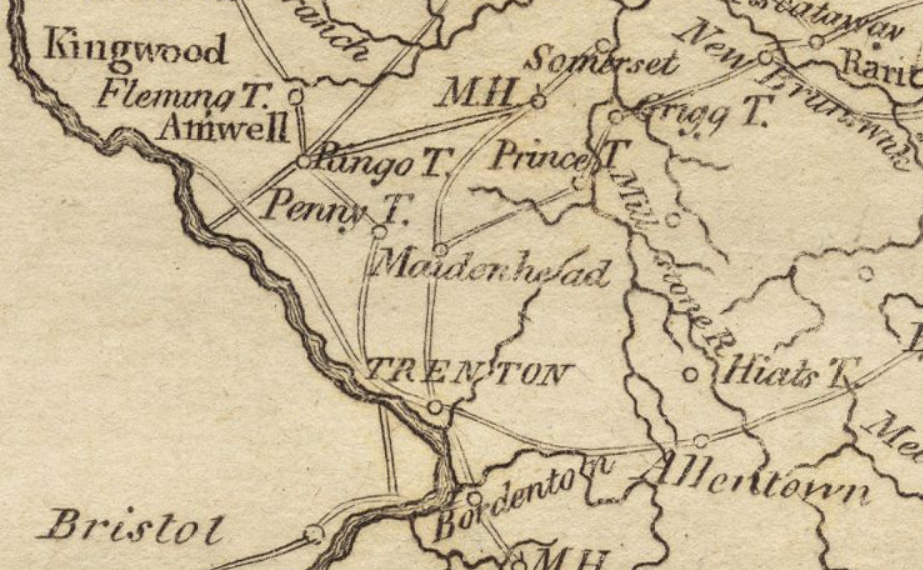
The area around Somerset Court House in central New Jersey saw an extraordinary amount of Revolutionary War military activity. Reason: it was on the main approach between north Jersey and Princeton, and between Princeton and New Brunswick, a British stronghold in Jersey. Not unexpectedly, the militia around Somerset Court House, now Millstone, New Jersey, saw action on several occasions. Somerset lay in that "middle area" between the British and American outposts, which had some quite vicious but little-celebrated fighting. Besides being in a strategic crossroads, the area around Somerset Court House was full of thriving farms with an abundance of crops and animals. During the winter in particular the ground was often frequented by British foraging parties from nearby New Brunswick.


Background


After General Washington took Trenton for the second time and fought past the British under General Cornwallis at  Princeton on January 3, 1777, he faced being caught between Cornwallis and the main the British Army around New Brunswick. But Washington's troops were exhausted after weeks of marching and fighting in extreme weather with inadequate food and clothing. So His Excellency decided to send his beleaguered regiments up the Millstone River valley toward Morristown, which could provide suitable and secure winter quarters. Morristown was protected by the Watchung Mountains, which could be strongly fortified at the passes to stop a British attack.


New Jersey was a battleground


 After the rebels fought at Princeton, Washington moved north to Somerset Court House. The advanced guard, part of the Delaware Line, came upon the village of Stone Brook (seat of Somerset Court House)  15 miles up the valley from Princeton, arriving around at twilight. However, the British had already evacuated supplies desperately needed by the Patriots. And the Americans were simply to exhausted to pursue. But within a few weeks, the winter war for forage between both sides would be in full swing and the area around Somerset was one of the prime battlegrounds of that campaign.


The Forage War Begins


At the urging of General William Maxwell, New Jersey Militia General Philemon Dickinson, and others, Washington ordered his Continental regiments and the local  New Jersey militia to engage  British outposts, patrols, couriers, and most especially forage parties Washington wanted to contain, harass and tire the British and Loyalists so they couldn't (or wouldn't) leave the main bases at New Brunswick and Amboy without sending considerable forces of say 1500 to 2000 men. The militia responded to this call with enthusiasm. Thus began a series of actions in the middle of what was normally the quiet time in 18th-century warfare. But warfare in North America, especially the war for independence took a different turn.


Militia General Philemon Dickinson


Battle of Millstone or Van Nest's Mill


On January 20th, 1777, British Lieutenant Colonel Abercromby, with 500 men and several cannon, went on a foraging party towards Hillsborough. American militia patrols spotted them and sent word back to  General Dickinson that "the enemy were out plundering." Dickinson had around 400 men in hand plus a company of 40 or so Pennsylvania Continental Riflemen under the command of Captain Durkee from the Wyoming Valley. The British were posted at a bridge over the Millstone River, near Abraham Van Nest's mill, about two miles from Somerset Court House. The Millstone ran into the nearby Raritan River. Abercromby had placed three field pieces on a hill, about 50 yards from the bridge to prevent any rebel forces from crossing there. The rivers were covered with a crust of ice and the water beneath, about waist high by most accounts, and of course ice cold.


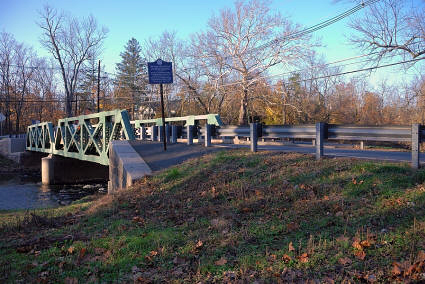
Millstone River Today

The Action


Seeing the bridge crossing protected,  Dickinson ordered his men downriver (towards the Raritan), where they broke through the ice and waded into the cold waters that reached well above their knees. Dickinson divided his forces, sending one force to meet the front of the British wagon train, while a second moved to flank them. One wing of the American attack successfully surprised the British wagon train in the lane near Van Nest's Mill, cutting it off before it reached the main road and the bridge toward New Brunswick. Well-placed fire struck horses from the first wagon, halting the train,  Panicked, the wagon drivers scattered. This caused the British to beat a hasty retreat to the bridge, leaving their booty behind. But when the pursuing militiamen reached the bridge, the Hessian rearguard fired grapeshot from its artillery to cover the retreat. After an exchange of fire across the river, the British withdrew. As was the case with most such actions, the actual combat was brief. The British taking the brunt of causalities and lost around a dozen prisoners and twice that in killed and wounded. The British admitted that the rebel surprise attack "occasion'd such disorder Amongst the Waggon Drivers that 42 Waggons were left behind." They also lost 104 horses, 115 head of cattle, and about 60 or 70 sheep. Valuable livestock denied the enemy in winter quarters and most needed by the always deprived rebels.


Militias defeat Regulars: How Could this Happen?


This was no major battle or great victory. Yet it proved significant. Stalwart and determined, these once disparaged New Jersey militiamen had gained confidence and were less in awe of redcoats and Hessians due to American successes Princeton and Trenton. Even before Trenton, exaggerated reports of enemy depredations across the Jerseys began to stir the fires of revenge and retribution in many (but not all).  This was not the only instance when anger fired up the militia into ferocity against enemy regulars and Loyalists. In fact, it would become a growing theme throughout the remainder of the war. So in many ways, the action at this place called Somerset Court House was a harbinger of greater things to come.