Followers

Showing posts with label Great Britain. Show all posts

Saturday, October 27, 2012

The Patriot Project


What?  No Patriot Spy? Not this week.  Seriously, I decided to use this blog to give a shout out to the Loudoun County Virginia's Patriot Project. Loudoun County is a pivotal county in the 2012 presidential election.  Many pundits say that as Loudoun County goes, so goes Virginia.  And as Virginia goes, so goes the presidential election.

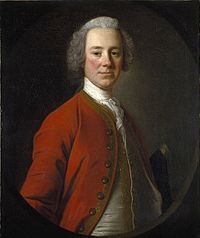
John Campbell, 4th Earl of Loudoun
But more importantly, during the American War for Independence, Loudoun County provided over 1,700 Continentals for George Washington's army.  That's the most provided by any county in the Old Dominion. Originally part of Lord Fairfax's large landholding in northern Virginia, Loudoun County became a separate jurisdiction in 1757 when the Virginia House of Burgesses divided Fairfax County.  The western portion they named after John Campbell, the Fourth Earl of Loudoun. Loudoun served with no distinction as commander in chief of all British and colonial forces in the French and Indian War. During his tenure, the French and Indians reached their apogee of success. British efforts stalled and the Indian tribes terrorized the frontier from present-day Pittsburgh south to the Carolinas.  Lord Loudoun held colonials in disregard - even in contempt.  But to cap it off, Lord Loudoun ignored Washington's request for a "regular" British Army commission.

Col. George Washington in the
French and Indian War
This seemingly small act was catastrophic for the British Empire and the monumental for the history of the world.  Why?  Because this affront to Washington marked the beginning of his questioning whether the American colonies would ever receive fair treatment from the motherland.  You can argue that his long journey from staunch Royalist to a leading advocate for an independent America began with that act. The bombastic and ineffectual Loudoun was eventually recalled an replaced by commanders who were more professional and more successful.  Britain wrested New France from the French.

In colonial times, Loudoun County was the gateway to the west.  It received many settlers from eastern Virginia, Pennsylvania, and Maryland.  Among them came Germans, Irish, and Scots-Irish.  English settlers also moved west from the coastal areas to establish tobacco farms, but in the main, it was a county of yeoman farmers, not rich plantations. And it was certainly that yeoman farmer tradition and culture that made Loudoun a key contributor to the war effort. The county’s population then was 18,000. The farmer depicted represents one of 2,000 Loudoun men to enlist in the militia, more than any other Virginia county.


Saturday, September 29, 2012

The First Patriot Spy?

Nathan Hale


Earlier this week marked the 236th anniversary of Nathan Hale's death. Hale is a minor yet significant figure in the first two books of the Yankee Doodle Spies Series.

On September 22, 1776, Nathan Hale, the first American (not rebel) spy, was hanged by the British. Born in 1755 on a farm near Coventry, Connecticut, Hale attended Yale and, after graduating in 1773, became a schoolteacher. Caught up in the patriotism sweeping the colonies after the battles of Lexington and Concord, he joined the Continental Army forming around Boston in 1775. Initially ambivalent, Hale decided to join the Cause after receiving a letter from his close friend, Benjamin Tallmadge, urging him to serve. Ironically, or perhaps causally, Tallmadge later became the head of Washington's intelligence unit (and a recurring character in Yankee Doodle Spies).

Hale rose to the rank of Captain in a Connecticut Regiment but later joined Lieutenant Colonel Thomas Knowlton's (also a peripheral figure in the series) elite Ranger battalion. Hale was, by all accounts, an extremely handsome man—tall for his era—and very well-spoken. Liked by everyone, his commander, Knowlton, held him in special regard. After the Continental Army retreated from its disastrous defense of Long Island, Lieutenant General George Washington needed to assess the strength, activities, and morale of the British occupiers. Washington was especially concerned about the timing and location of the inevitable British assault on the Island of New York (now called Manhattan). He asked Knowlton to provide an agent for this very high-risk mission. In a society obsessed with "honor," espionage was considered even dirtier than it is today. Because of that, none of the officers in Knowlton's unit volunteered. But Hale, who had yet to see combat and was bored with the administrative duties he had so far, offered his services.
Spying under spurious cover?

In a mission both daring and futile, he was clandestinely transported onto Long Island from Connecticut by longboat, disguised as an itinerant schoolmaster. In a lesson in tradecraft, the idea of a young schoolmaster traveling through a war zone seems desperate, if not downright absurd. However, Hale was indeed a schoolmaster, and it’s always easier to depict something similar to your own experience or background. The exact details of his capture are a matter of much debate. In his book, *Washington's Spies*, author Alexander Rose states that the renowned Loyalist Ranger Robert Roberts captured him. Roberts was a hero during the French and Indian War but switched allegiances and sold his services to the British during the American Revolution. According to Rose, Roberts and his men identified Hale on Long Island and lured him into a trap. Other accounts tell a different story. Regardless, the cover was blown.
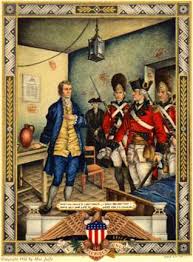
A Spy Uncovered


What we do know for sure is that Hale was captured on September 21 and immediately brought in for questioning by the British commander, General William Howe. By then, the British Army had already invaded New York. Howe had just moved into the Beekman Mansion, near the current corner of 51st Street and 1st Avenue in Manhattan. Intelligence found on Hale, which was not in code or invisible ink, meant he was completely compromised.

The next morning, a Sunday, the former spy was marched north about a mile along the post road to the Park of Artillery, located next to a pub called the Dove Tavern, roughly 5 1/2 miles from the city limits. There, he was hanged. Hale's supposed quote before execution is somewhat debated, and several different accounts exist from various sources, all of which seem plausible. Traditionally, hanging was reserved for thieves and murderers, not soldiers, especially not officers. It’s likely Hale intended his last words to both dispel the dishonor of being labeled a spy and to serve as a model of patriotic sacrifice.
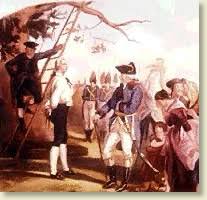
I have but one duty...

To me, the most credible statement reportedly made by Nathan Hale before his execution comes from the diary of a British officer named Lt. Robert MacKensie, who was serving in New York at the time. The entry is especially believable because it was written on the very day of Hale's execution.

"...He behaved with great composure and resolution, saying he thought it the duty of every good Officer, to obey any orders given him by his Commander-in-Chief; and desired the Spectators to be at all times prepared to meet death in whatever shape it might appear."
Saturday, August 18, 2012

Who's the Greatest?


Marshal Maurice de Saxe
The greatest military enemy of Great Britain, that is.  Some might think renowned tyrants like Hitler, Napoleon, or Louis XIV.  As a naval power one might say the Phillip II of Spain’s launching of the mighty Spanish Armada makes him the island nation’s greatest adversary. But of course, all these men failed against Britannia. Throughout its past, Britain also faced many great generals on the battlefield such as France’s Marshal Maurice de Saxe, Nazi Germany’s Field Marshal Erwin Rommel and the great Boer Commando leader Jan Smuts. But a recent poll of British historians named America's own George Washington as Britain's greatest military enemy!
Field Marshal Rommel

The British Army Museum recently ran an internet poll in which over 8,000 folks responded.  The  museum’s judges then reduced the contenders to five top leaders:  America’s Continental Army commander George Washington; IRA Chief of Staff Michael Collins; France’s Napoleon Bonaparte; Field Marshal Rommel; and Turkey’s great Kemal Ataturk (who stymied the Empire at Gallipoli). Because the selectees had to have led troops in the field against a 
Michael Collins
British Army, purely national leaders like Hitler or the Sun King were eliminated from inclusion. The results are significant for two reasons:  Washington successfully led the Continental Army through eight years of conventional and asymmetric warfare against the best Britain could throw at him.  He struggled with all kinds of issues in supply; quality officers and men; command and control; political infighting and several disastrous losses early on.  Yet his strategy, determination, and leadership caused Britain to come to terms and he wrested the heart of an entire continent away from them.  And he went on to be the “significant man” in the founding era of the world’s most successful and enduring Republic.

Throughout the conflict, Washington was minimized and demeaned by his opponents. The British steadfastly refused to refer to him as general, instead referring to him as “Mr. Washington”.   During the surrender at Yorktown, General Cornwallis sent his deputy to turn over his sword.  That general, in turn, tried to surrender to the French commander, Comte de Rochambeau.  Rochambeau chivalrously directed him to General George Washington.  So as we follow the adventures of the Yankee Doodle Spies, we have the consolation of knowing they were led by the best of the best.  And now, the British finally admit it!  

British Surrender at Yorktown