Followers

Showing posts with label Morristown. Show all posts

Monday, September 28, 2020

The Winter War


“I shall constantly bear in Mind, that as the Sword was the last Resort for the preservation of our Liberties, so it ought to be the first thing laid aside, when those Liberties are firmly established.”

Letter from General George Washington to the Executive Committee of the Continental Congress, January 1, 1777


                                                Washington's pen was as mighty as his sword


January 1777

The Jerseys are aflame in a deep winter-war!

Backs against a frozen river and facing a column of crack redcoats intent on their destruction, George Washington’s army has a serious gut-check. They must outfight or outwit the British to preserve the faltering struggle for independence. With the help of the winter spy, General Washington intends to do both…

Back cover of The Winter Spy, June 2020


The Genesis

This is a book I never expected to write. But as I finished book two in the Yankee Doodle Spies series, my research and curiosity guided me to a straightforward question: what did Washington do AFTER crossing the Delaware? It turns out, quite a bit. I became so interested that I created a follow-up story to capture the feel and action of this important yet little-understood chapter in the American War for Independence.


                                       What did Washington do after he crossed the Delaware?


Winter Quarters

In the 18th century, armies typically fought from late April or early May through November. During the off-season, some soldiers and officers were sent home on furlough, but most simply tried to survive the winter while the armies were restocked and equipped for the next season of marching and fighting. The British had the advantage of quartering many of their forces in towns and cities, using stores, shops, stables, public buildings, and private homes.


                                         Gen Steuben drilling American troops at Valley Forge


For Americans, winter quarters were often a harsh experience of cold, disease, and starvation. For the British, it was a time of relative comfort between grueling military duties. Naturally, both sides had to keep guards and sentries posted. Some patrols were dispatched. During the 1778 Valley Forge encampment, winter quarters became a training ground with the arrival of General Steuben as Inspector-General and Drillmaster.


Winter Action


My readings for my second novel, The Cavalier Spy, opened my eyes to the actions General George Washington took after the Battle of Trenton: two major battles (2nd Trenton, Princeton), along with many skirmishes, marches, and hardships before his increasingly small army reached its final destination at Morristown, New Jersey. 

That decision was highly tactical. His actions compelled the British to withdraw most of their outposts in the Jerseys, leaving them in control of the area around Brunswick, Paulhus Hook (Jersey City), and their main strongholds in Staten Island, Long Island, and Manhattan. With the British in winter quarters, most armies would have hunkered down, recovered, and rearmed. The choice was tactical because Washington could monitor enemy movements with his forces safely behind the Watchung Hills, ready to move in any direction the British advanced in the spring. That was the original plan.


                                        Princeton was one of two actions fought in as many days


But as the British sent out foraging parties into New Jersey to buy or requisition foodstuffs, the Jersey militia responded. Small groups were ambushed, leading to larger foraging parties and bigger ambushes. The numbers grew until Washington authorized some of his Continental regiments, including those led by Generals Philemon Dickinson, William Alexander (Lord Stirling – an American who claimed a Scots peerage), and Ulster-born William “Scotch Willie” Maxwell. By the end of this winter of discontent, the British had lost roughly as many men killed or wounded during “winter quarters” as they did in the previous three pitched battles. Losses that British commander-in-chief, General William Howe, could not afford.


                                                     Gen William Alexander - Lord Stirling


The Plot

No spoiler alerts here – read the book! But needless to say, Lieutenant Jeremiah Creed and his White Knights are thrown into action once again, operating both within and outside the Continental Army. They clash again with the ruthless British dragoon, Major Sandy Drummond, who continues to use his intelligence network to break the rebellion. Along the way, a variety of soldiers and citizens clash, make friends, make enemies, fall in love, and struggle to stay sane during a time that tests men’s souls. Woven into the plot are two themes: the bonding of men in conflict and the war’s impact on families. And, there is always the weather—winds that can cut a man in two, frigid temperatures, and ice-covered roads and rivers play a significant role in a story that, after all, was named for them.


The Book


All three books in the Yankee Doodle Spies series are published by Lanyard Press.

The Winter Spy is available on Amazon in Paperback or Kindle.

https://www.amazon.com/Winter-Spy-Yankee-Doodle-Spies/dp/B08JVNPPKG/ref=tmm_pap_swatch_0?_encoding=UTF8&qid=&sr=


Sunday, September 6, 2015

The Life Guard


With Labor Day weekend upon us, I am officially concluding the Yankee Doodle Spies summer vacation. But in the spirit of those sun-drenched beach protectors, I’ve decided to blog about the lifeguards. This post isn’t about Baywatch, so you can put away your sunscreen and towels. And don't bother searching for a happy snap of Pamela Anderson and her crew. Even before America had recreational beaches, it had lifeguards, or in this case, The Life Guard. This is about George Washington's Life Guard, to be precise. Readers of The Patriot Spy and its just-released sequel, The Cavalier Spy, have probably noticed that wherever George Washington was, a Life Guard was likely nearby.


Despite fighting a war for independence and liberty, the founders' generation still believed in titles. And just like today, those titles often came with perks. Lieutenant General George Washington was more than just the commander in chief of the Continental Army. He was also the unifying force of the eight-year struggle we call the American Revolution. This wasn’t so much planned as a natural result of his leadership qualities, integrity, and stature. He brought together different classes and sections. He was a symbol. And as a symbol of his acknowledged position as the highest executive in the land, he received the title: "His Excellency." It’s a tribute to Washington’s unique presence and importance that this honorific didn’t disappear when he resigned from military service, at least officially.


The British were well aware of Washington's significance to the cause they aimed to crush. And the Americans knew that the British were aware. Throughout the war, the fear that the enemy might assassinate or capture the "essential man" lingered. But it wasn't long into Washington's command at Cambridge, Massachusetts, that the need for military bodyguards was recognized. On March 11th, 1776, Washington issued the following orders,


The General wishes to select a specific number of men to serve as his guard for himself and his baggage. The Colonel or Commanding Officer of each of the established regiments, except for the artillery and riflemen, will provide four men, from which the required number will be chosen. His Excellency relies on the Colonels to recommend good men based on their sobriety, honesty, and good conduct. He prefers them to be between five feet eight inches and five feet ten inches tall, well-built, and, above all, he emphasizes the importance of cleanliness in a soldier. Consequently, he requests careful selection of men who are clean and tidy. These men are to assemble at headquarters precisely at 12 o'clock noon tomorrow, when the final selection will be made. The General does not require them to be in uniform or armed, nor does he want anyone sent to him who is not fully willing or eager to be part of this Guard. They should be trained men."


Ever conscious of the need to avoid sectional preference, Washington chose a A New England man to lead the special unit: Captain Caleb Gibbs of the 14th Massachusetts Continental Regiment commanded the Guard, but George Lewis, a nephew of Washington, was named the Lieutenant. The explicit mission of the new group was "to protect General Washington, the army's cash, and official papers." Gibbs began reorganizing the unit. He created the motto, "Conquer or Die." The unit had several names. The official name was "His Excellency's Guard" or the "General's Guard." Many enlistees called it "The Life Guards," "The Washington Life Guards," or "Washington's Body Guard." Washington himself usually referred to them as "My Guards." In dispatches and correspondence, Gibbs called himself "Commandant C-in-C, Guards." The force was specially uniformed and outfitted, making it the best-dressed and equipped among all the Continentals. The uniform consisted of a blue coat with white facings, white waistcoat and breeches, black half-gaiters, and a cocked hat with a blue and white feather. The Guard's size varied during the war but generally settled around 180 men, about the strength of three regular infantry companies. It temporarily grew to 250 men during the winter of 1779–80, when the Continental Army was encamped at Morristown, New Jersey, near the British Army.


Life Guard and Traitor
It did not take long for the elite new unit to prove its worth—and its danger. By May 1776, the British evacuated Boston, and, anticipating an attack on New York, Washington began moving the Continental Army south. On May 24th, 1776, an element of the C-in-C Guards set up camp near Richmond Hill on Manhattan Island. Spies recognized the elite unit and understood what it meant. Anticipating Washington's arrival, a group of New York Tories had secretly plotted earlier that month. Their goal was to assassinate George Washington. Luckily for the Americans, the plot was uncovered. The New York Provincial Congress ordered several Tories, including the city's Mayor, David Matthews, arrested. Meanwhile, Washington sent Gibbs and a hand-picked team to arrest another forty conspirators. Disturbingly, some of these were Continental Army soldiers, including members of Washington's Life Guards: Sergeant Thomas Hickey, Drummer William Green, Fifer James Johnson, and Privates John Barnes and Michael Lynch. Hickey, who had previously been jailed for passing a counterfeit note, was entangled in this conspiracy. As often happens, foolishness and ego led to his downfall—he revealed the plot to another inmate, who used the information to improve his own situation. (I believe this is where plot lines for shows like Law and Order or NYPD come from.) Hickey faced a court-martial alone among the conspirators and was found guilty of mutiny and sedition. He was executed in New York before a crowd of 20,000 spectators on June 28, 1776.


Escorting His Excellency


After that fiasco, the Guard went on to serve with distinction for the rest of the war. The Guard's strength at that time was about 50 men. They accompanied Washington to White Plains and took part in the battle there on October 28th, occupying their position on Chatterton Hill. The next day, the entire Army retreated to New Jersey. When their enlistment terms expired, Washington discharged twenty of the Guard on the condition that they would reenlist in the cavalry unit being raised by Lieutenant Lewis, who had been detached from the Guard for that purpose. A small group fought alongside Washington at Trenton during the darkest hours of the revolution. Others were assigned to different regiments to bolster their numbers and morale.


The Life Guard (in helmets) also honored
distinguished visitors to HQ: here Lafayette


During the spring of 1777, as the army emerged from its first winter encampment at Morristown, NJ, Washington ordered Gibbs to procure new uniforms for the unit. Blue jackets and buff facings with leather helmets adorned with medium blue cloth binding and a white plume tipped in blue on the left side of the helmet. However, Gibbs, possibly due to limited supplies, outfitted them with red vests instead of buff. The Life Guards proved their worth the following winter. At Valley Forge, Von Steuben used members of the Guard as his demonstration company for the new American Drill. Von Steuben personally trained them and then sent them to other Continental Army regiments until the entire force was drilled in the new tactics. This transformed the often hapless Continental units into a force capable of facing the British regulars. It also established the Commander-in-Chief's Life Guards as the Continental Army's truly elite unit, not just a group of dandies in the general’s circle.


It is often overlooked that a key mission of the Life Guard was to protect the commander-in-chief's immediate supplies and equipment. Tents, office equipment, and especially correspondence needed safeguarding during the numerous marches made by Washington.
The Life Guards marched with Washington throughout the war. They were at his side during the campaigns in New York, New Jersey, and into Virginia. In 1779, Caleb Gibbs, now a major, was replaced by another New Englander, Connecticut-born William Colfax. Washington promoted the young officer to Captain. Colfax was present at the Surrender of Lord Cornwallis at Yorktown and was allowed by Washington to occupy a prominent position on horseback near him. As the long struggle drew to a close, Washington's Life Guard, now reduced to about fifty men, was furloughed from duty in June 1783 at army headquarters in Newburgh, New York. With the British about to evacuate New York City, the Life Guard was ordered disbanded on November 15th, 1783.


The Life Guard Flag


Sunday, January 11, 2015

Somerset Court House

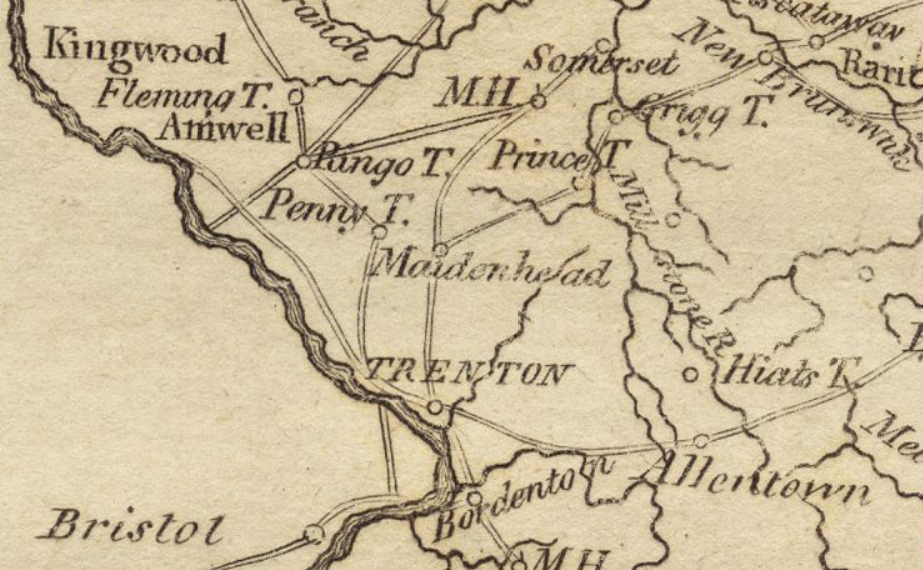
The area around Somerset Court House in central New Jersey saw an extraordinary amount of Revolutionary War military activity. Reason: it was on the main approach between north Jersey and Princeton, and between Princeton and New Brunswick, a British stronghold in Jersey. Not unexpectedly, the militia around Somerset Court House, now Millstone, New Jersey, saw action on several occasions. Somerset lay in that "middle area" between the British and American outposts, which had some quite vicious but little-celebrated fighting. Besides being in a strategic crossroads, the area around Somerset Court House was full of thriving farms with an abundance of crops and animals. During the winter in particular the ground was often frequented by British foraging parties from nearby New Brunswick.


Background


After General Washington took Trenton for the second time and fought past the British under General Cornwallis at  Princeton on January 3, 1777, he faced being caught between Cornwallis and the main the British Army around New Brunswick. But Washington's troops were exhausted after weeks of marching and fighting in extreme weather with inadequate food and clothing. So His Excellency decided to send his beleaguered regiments up the Millstone River valley toward Morristown, which could provide suitable and secure winter quarters. Morristown was protected by the Watchung Mountains, which could be strongly fortified at the passes to stop a British attack.


New Jersey was a battleground


 After the rebels fought at Princeton, Washington moved north to Somerset Court House. The advanced guard, part of the Delaware Line, came upon the village of Stone Brook (seat of Somerset Court House)  15 miles up the valley from Princeton, arriving around at twilight. However, the British had already evacuated supplies desperately needed by the Patriots. And the Americans were simply to exhausted to pursue. But within a few weeks, the winter war for forage between both sides would be in full swing and the area around Somerset was one of the prime battlegrounds of that campaign.


The Forage War Begins


At the urging of General William Maxwell, New Jersey Militia General Philemon Dickinson, and others, Washington ordered his Continental regiments and the local  New Jersey militia to engage  British outposts, patrols, couriers, and most especially forage parties Washington wanted to contain, harass and tire the British and Loyalists so they couldn't (or wouldn't) leave the main bases at New Brunswick and Amboy without sending considerable forces of say 1500 to 2000 men. The militia responded to this call with enthusiasm. Thus began a series of actions in the middle of what was normally the quiet time in 18th-century warfare. But warfare in North America, especially the war for independence took a different turn.


Militia General Philemon Dickinson


Battle of Millstone or Van Nest's Mill


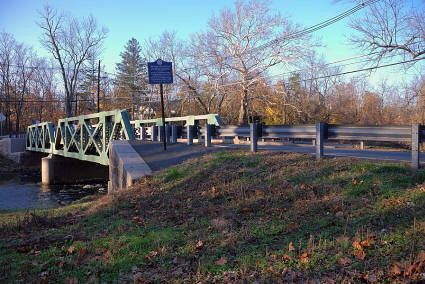
On January 20th, 1777, British Lieutenant Colonel Abercromby, with 500 men and several cannon, went on a foraging party towards Hillsborough. American militia patrols spotted them and sent word back to  General Dickinson that "the enemy were out plundering." Dickinson had around 400 men in hand plus a company of 40 or so Pennsylvania Continental Riflemen under the command of Captain Durkee from the Wyoming Valley. The British were posted at a bridge over the Millstone River, near Abraham Van Nest's mill, about two miles from Somerset Court House. The Millstone ran into the nearby Raritan River. Abercromby had placed three field pieces on a hill, about 50 yards from the bridge to prevent any rebel forces from crossing there. The rivers were covered with a crust of ice and the water beneath, about waist high by most accounts, and of course ice cold.


Millstone River Today

The Action


Seeing the bridge crossing protected,  Dickinson ordered his men downriver (towards the Raritan), where they broke through the ice and waded into the cold waters that reached well above their knees. Dickinson divided his forces, sending one force to meet the front of the British wagon train, while a second moved to flank them. One wing of the American attack successfully surprised the British wagon train in the lane near Van Nest's Mill, cutting it off before it reached the main road and the bridge toward New Brunswick. Well-placed fire struck horses from the first wagon, halting the train,  Panicked, the wagon drivers scattered. This caused the British to beat a hasty retreat to the bridge, leaving their booty behind. But when the pursuing militiamen reached the bridge, the Hessian rearguard fired grapeshot from its artillery to cover the retreat. After an exchange of fire across the river, the British withdrew. As was the case with most such actions, the actual combat was brief. The British taking the brunt of causalities and lost around a dozen prisoners and twice that in killed and wounded. The British admitted that the rebel surprise attack "occasion'd such disorder Amongst the Waggon Drivers that 42 Waggons were left behind." They also lost 104 horses, 115 head of cattle, and about 60 or 70 sheep. Valuable livestock denied the enemy in winter quarters and most needed by the always deprived rebels.


Militias defeat Regulars: How Could this Happen?


This was no major battle or great victory. Yet it proved significant. Stalwart and determined, these once disparaged New Jersey militiamen had gained confidence and were less in awe of redcoats and Hessians due to American successes Princeton and Trenton. Even before Trenton, exaggerated reports of enemy depredations across the Jerseys began to stir the fires of revenge and retribution in many (but not all).  This was not the only instance when anger fired up the militia into ferocity against enemy regulars and Loyalists. In fact, it would become a growing theme throughout the remainder of the war. So in many ways, the action at this place called Somerset Court House was a harbinger of greater things to come.